Best Push-Up Bars · Rings & Bars
The best push-up bars, ranked by what happens to your wrist
Nobody buys push-up bars for the extra inches. People buy them because the floor hurts their wrists, or because a flat-hand push-up stops at chest-to-floor. Those are two different fixes and they want different hardware. Four pairs ranked on the handle, the base and the rating.
Rope & Rep is reader-supported. Product links go through our affiliate resolver and we may earn a commission from qualifying purchases at no cost to you. Prices are the brand's and change — every button opens the live price on the brand's own store rather than showing a stale number.
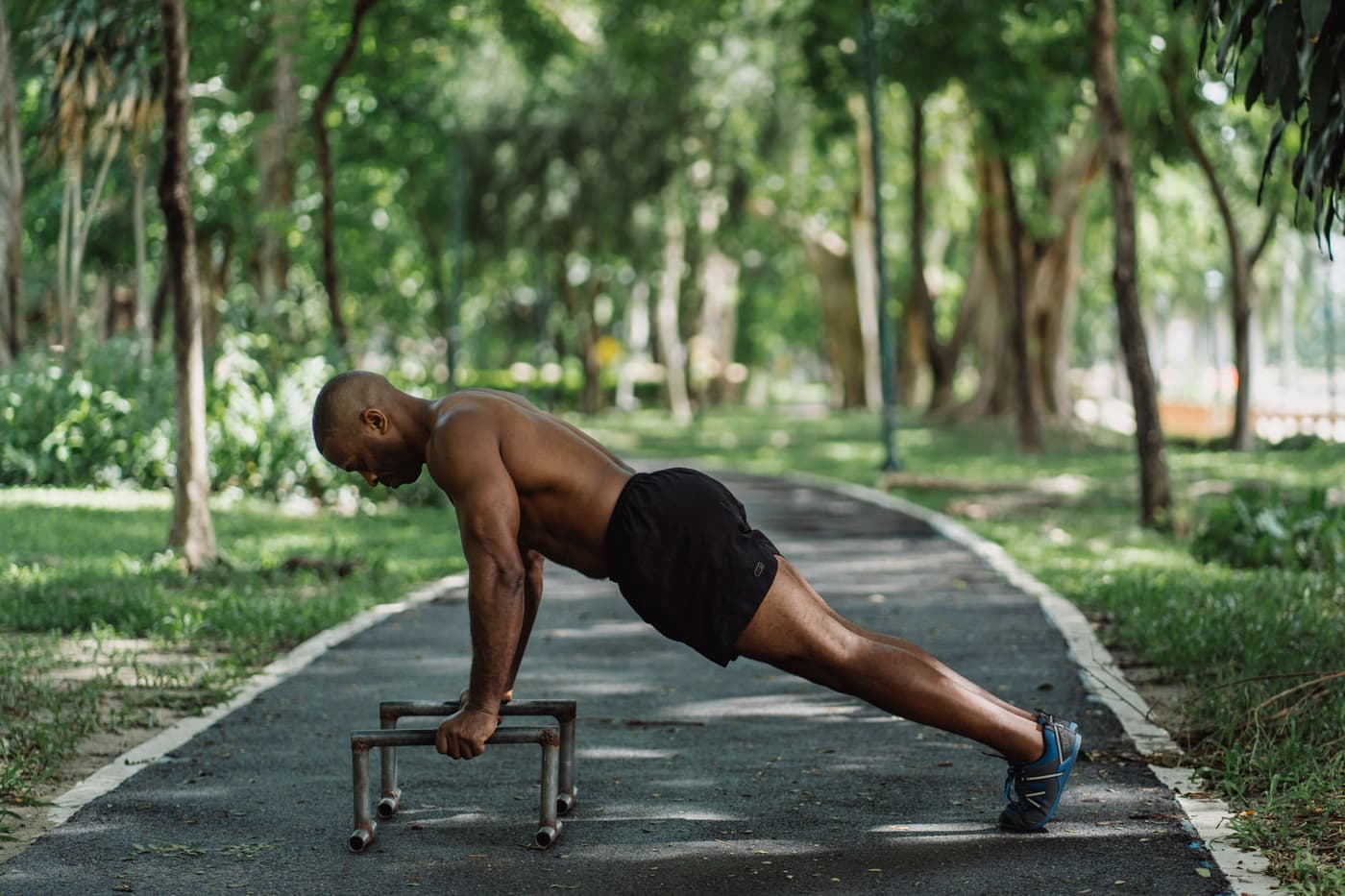
A man doing push-ups on low parallel bars in a park. Licensed stock photograph of the category — not the specific product.
Quick picks
| # | Product | Best for | Score | Price |
|---|---|---|---|---|
| 1 | AIROGYM Wooden Parallettes (pair) Solid-wood bars on a narrow-top, wide-bottom triangle frame: 11.8 × 5.5 × 3.9 in. each, a 1.57 in. round handle, non-slip bases and a stated 440 lb (200 kg) support — the cheap wooden pair that does not wobble. | A first wooden pair for push-ups, L-sits and handstand practice | 9.3 | Sold through third-party marketplaces only — this brand has no store of its own, so there is no link here and we earn nothing on it. AIROGYM Wooden Parallettes |
| 2 | PULLUP & DIP Parallettes (beech wood) Ergonomic beech-wood handles on heavy-duty steel feet, about 4.9 in. tall, 4.2 lb for the pair, rated 200 kg and shipped fully assembled — wood and steel where the budget pairs use plastic and foam. | L-sits, deficit push-ups and handstand work where a wooden handle is worth paying for | 9.5 | |
| 3 |  Lebert Fitness EQualizer (pair) Two independent 28 in. steel bars on a 21 in. base, 7.5 lb each, 400 lb capacity, that nest together for storage — the dip bars that fit under a bed and set up in five seconds. A hip resistance band is in the box. | Dips, rows and push-ups in an apartment where nothing can stay on the floor | 9.2 | |
| 4 | SELEWARE Push Up Bars / Parallettes (pair) The cheapest pair worth using: 8 × 5 × 4 in. stands with soft-rubber ergonomic grips and oversized non-slip base mats, 2.2 lb for the two — push-ups, L-sits and elbow levers without a wrist complaint. | Taking the bend out of your wrists on push-ups for the price of a takeaway | 9.5 | Sold through third-party marketplaces only — this brand has no store of its own, so there is no link here and we earn nothing on it. SELEWARE Push Up Bars / Parallettes |
Scores are our editorial judgment from each maker's published specs and mounting instructions, weighted for a renter or small-space trainer.
What a push-up bar actually changes
Three things, and it is worth knowing which one you are buying.
1. Wrist angle. Palms flat on the floor puts the wrist in near-maximum extension while carrying most of your bodyweight. Gripping a handle lets the wrist sit neutral, in line with the forearm, so the load runs through the bones rather than through the joint at the end of its range. For a lot of people this is the entire purchase and nothing else on this page matters.
2. Depth. On the floor, a push-up ends when your chest touches. On a four-inch handle it ends when your chest passes your hands, which adds range at the bottom - the hardest and most useful part of the movement. That is a genuine progression and it is free once you own the bars.
3. Hand position. Two independent stands can be set narrow for triceps, wide for chest, or turned out for a shoulder that does not like a square grip. A one-piece push-up board has that decision made for you.
What they do not change: they are not a strength shortcut, and they do not make a push-up harder by being tall. Hands above feet is an incline, which is easier. If you want push-ups to get harder, elevate your feet instead and keep the hands low - which is exactly why the tallest pick on this page is ranked third rather than first.
The criteria, in the order they matter
1. The handle: shape, diameter, material. Under a press the hand wants to wrap something round at roughly 40 mm - the gymnastics bar diameter - because a full wrap lets the wrist stack and spreads the load across the whole palm. Bare steel tube is cold and slick, thin foam compresses and goes shiny, soft rubber is kind on the palm but gives up over time, and wood is the only material here that stays the same for years. A shaped handle is a real upgrade if you want one fixed, ergonomic hand angle; a round dowel is better if you want to turn your hands out, which most pressers eventually do.
2. Base geometry under a forward load. This is the criterion that separates stands that are pleasant from stands that scare you, and it is why we weight it second rather than last. A push-up pushes down and forward. A stand with a narrow bottom lifts at the back edge; a stand that is wide at the bottom and narrow at the top cannot. Add a non-slip pad or an oversized mat and you also stop the pair walking apart on a hard floor - the classic budget-stand failure.
3. A published load rating. Pressing puts roughly two-thirds of your bodyweight through two small contact patches, and more than that at the bottom of an explosive rep. Two of the four picks publish a rating (both 440 lb / 200 kg) and two do not. We will not invent a number for the ones that do not, and we rank them below the ones that do.
4. Height, in the narrow band that is useful. Three to five inches: enough that your chest and knuckles clear the floor, not so much that the push-up turns into an incline. Anything in that band scores the same here. A 28 in. bar is a different tool and we say so where it appears.
5. Weight, storage and the floor. Last, and the reason this is good gear for a rented room: a pair of these is two to eight pounds and lives in a drawer. Non-slip feet that grip without marking a hardwood floor are worth a point, and so is the fact that none of it needs drilling, which is the whole premise of our apartment gym setup.
How the four compare
| Pair | Height | Handle | Base | Published load |
|---|---|---|---|---|
| AIROGYM wooden parallettes | 3.9 in. | 1.57 in. (40 mm) round solid wood | Narrow top, wide bottom triangle; non-slip | 440 lb (200 kg) |
| PULLUP & DIP beech parallettes | About 4.9 in. | Shaped ergonomic beech, non-slip | Heavy steel feet with anti-slip pads | 200 kg (about 440 lb) |
| Lebert EQualizer (pair) | 28 in. | Steel bar, 28 in. long | 21 in. base per bar, two independent bars | 400 lb |
| SELEWARE push-up bars | 4 in. | Soft rubber, ergonomic circumference | Oversized non-slip base mats | Not published |
Who should not buy push-up bars
If your wrists are fine and you are already doing sets of twenty flat-handed push-ups, bars are a small upgrade and your money is better spent on something that adds a movement rather than depth to one you have. The honest order of purchases for a bodyweight gym is a bar to hang from, then something to press on, then something to load with - our bodyweight gear list sets that out, and a pull-up bar beats push-up bars for most people as a first purchase because it unlocks a movement pattern you cannot otherwise train at all.
If the problem is that push-ups are too easy, bars help a little and your feet help a lot. Elevate the feet, slow the eccentric, or add a vest. If the problem is that push-ups are too hard, bars make it worse by adding range - do them with hands on a bench first.
And if the wrist pain is sharp, localized and new rather than the familiar ache of extension under load, bars are not the answer to that and neither are we. That is worth a clinician, not a purchase.
The picks in detail
Every pick, reviewed
Key specs
- Size
- 11.8 × 5.5 × 3.9 in. per bar
- Handles
- 1.57 in. (40 mm) solid wood
- Rated load
- 440 lb (200 kg)
Scores · editorial, out of 10
- Height & stability
- 9
- Grip & material
- 10
- Footprint & storage
- 10
- Rated load
- 8
- Value
- 10
Pick 1 · Parallettes
AIROGYM Wooden Parallettes (pair)
AIROGYM
Solid-wood bars on a narrow-top, wide-bottom triangle frame: 11.8 × 5.5 × 3.9 in. each, a 1.57 in. round handle, non-slip bases and a stated 440 lb (200 kg) support — the cheap wooden pair that does not wobble.
Best for
A first wooden pair for push-ups, L-sits and handstand practice
First, and it is the cheapest wooden pair on the page, which deserves an explanation rather than a shrug. For a press, the handle you want is a round dowel at about 40 mm — the gymnastics bar diameter — and that is exactly what these are: 1.57 in. of solid wood. A round handle lets you wrap the whole hand, lets the wrist stack in line with the forearm, and lets you turn your hands out fifteen degrees when your shoulders ask for it. A shaped handle, however nicely shaped, decides that angle for you.
The geometry is the other reason it leads. Each bar is 11.8 × 5.5 × 3.9 in. on a narrow-top, wide-bottom triangle frame with non-slip bases — which is precisely the shape that resists the forward tipping force a push-up generates, rather than the straight-sided shape that does not. The 3.9 in. of clearance sits in the useful band: knuckles and chest clear the floor and the movement is still a push-up rather than an incline. AIROGYM publishes 440 lb (200 kg) of support, so you are not guessing.
Honest costs. The listing title claims 550 lb while the detail says 440 lb — assume 440 lb, and treat the bigger number as marketing. No weight is published for the pair, which is an odd gap. It is bare wood, so it needs to stay dry and get wiped down, and bare wood is less comfortable than rubber on a sweaty palm. There is no outbound link on this pick: AIROGYM has no storefront of its own that we can send you to, and we will not invent a destination. And at 3.9 in. these are low by design — no dips, and L-sits are tighter than on a taller pair.
Why we picked it
- 40 mm solid wood is the gymnastics handle diameter, at a third of the premium price
- Narrow-top, wide-bottom triangle geometry plus non-slip bases — it will not tip under a push-up
- 3.9 in. of clearance is enough that knuckles stay off the floor
Good to know
The listing's own title claims 550 lb while the detail says 440 lb (200 kg) — assume 440 lb
Sold through third-party marketplaces only — this brand has no store of its own, so there is no link here and we earn nothing on it.
AIROGYM Wooden ParallettesSpecs from AIROGYM — Wooden Parallettes listing (dimensions, handle diameter, support rating, base).
Key specs
- Height
- About 4.9 in.
- Handles
- Ergonomic beech wood, non-slip
- Rated load
- 200 kg (about 440 lb)
Scores · editorial, out of 10
- Height & stability
- 10
- Grip & material
- 10
- Footprint & storage
- 9
- Rated load
- 10
- Value
- 9
Pick 2 · Parallettes
PULLUP & DIP Parallettes (beech wood)
PULLUP & DIP
Ergonomic beech-wood handles on heavy-duty steel feet, about 4.9 in. tall, 4.2 lb for the pair, rated 200 kg and shipped fully assembled — wood and steel where the budget pairs use plastic and foam.
Best for
L-sits, deficit push-ups and handstand work where a wooden handle is worth paying for
Second, and the pair to buy if you want one hand position and want it to be the right one. Shaped beech handles on heavy steel feet, about 4.9 in. tall, 4.2 lb for the pair, rated 200 kg and shipped fully assembled. The ergonomic beech is a genuine upgrade over a plain dowel in one specific way: it puts the wrist in a neutral position without you having to think about it, which matters most on the long holds that are not push-ups at all.
It is also the best-built thing on the page by a clear margin. Heavy steel feet with anti-slip pads mean no wobble and no marks on a hardwood floor, the extra inch of height is the most clearance of the three low pairs, and at 4.2 lb it packs into a backpack. If you are going to own one pair of handles for the next ten years, this is the one that will still be fine in ten years.
Honest costs, and they are the reason it is second on a page about pressing rather than first. It costs roughly twice the budget wooden pairs, and the thing you are paying for — a shaped handle — is worth more for L-sits and handstands than for push-ups, where a round handle you can rotate is arguably better. At about 4.9 in. it is still far too low for dips. And wood needs wiping down and keeping dry. On the parallettes roundup this pair is first, for exactly the reasons it is second here.
Why we picked it
- Shaped beech handles put the wrist in a neutral position — the reason to buy wood over tube steel
- Heavy steel feet with anti-slip pads: no wobble, and no marks on a floor
- Ships assembled, with a free exercise eBook, and packs into a backpack at 4.2 lb
Good to know
Roughly twice the price of the budget wooden pairs
Specs from PULLUP & DIP — Parallettes listing (handle material, steel feet, height, max load, weight, assembly).
Key specs
- Size
- 28 in. tall, 21 in. base (XL also sold)
- Weight
- 7.5 lb per bar, 15 lb the pair
- Rated load
- 400 lb
Scores · editorial, out of 10
- Stability & rated load
- 9
- Footprint & storage
- 10
- Height / width adjustment
- 8
- Grip
- 9
- Value
- 9
Pick 3 · Dip bars
Lebert Fitness EQualizer (pair)
Lebert Fitness
Two independent 28 in. steel bars on a 21 in. base, 7.5 lb each, 400 lb capacity, that nest together for storage — the dip bars that fit under a bed and set up in five seconds. A hip resistance band is in the box.
Best for
Dips, rows and push-ups in an apartment where nothing can stay on the floor
Third, and the pick that leaves the category rather than competing inside it. Two independent 28 in. steel bars on a 21 in. base, 7.5 lb each, rated 400 lb, that nest together and go under a bed. They are sold as dip bars and that is what they mostly are — but for a presser they do one thing nothing else here can: because the two bars are entirely separate, you set the width. Narrow for triceps, wide for chest, turned out for a shoulder that does not like a square grip, different every set if you want.
The height changes what you can train, in both directions. Hands at 28 in. makes a push-up easier, so these are the wrong tool for a straight-set push-up — but feet on the bars and hands on the floor makes it much harder, which no low pair can do. And they add the two movements low handles cannot: dips, and bodyweight rows under the bar, which is the cheapest pulling exercise in existence if you have no bar to hang from.
Honest costs. For the specific job of taking the bend out of your wrist on a normal push-up, a 28 in. bar is not the answer and a 4 in. handle is. The two independent bars can walk apart on a slick floor during dips — use a mat. There is no height adjustment within a size, so you pick the size by your height. And 15 lb for the pair is heavier than every other pick here. Parallettes vs dip bars is the full version of that decision.
Why we picked it
- Two separate bars — set them at any width, or use one for rows and step-ups
- Nest together and weigh 15 lb for the pair; store under a bed or in a closet
- A hip resistance band and the exercise video library come with it
Good to know
Independent bars can walk apart on a slick floor during dips — use a mat
Specs from Lebert Fitness — EQualizer with Resistance Band listing (bar height, base, per-bar weight, capacity, inclusions).
Key specs
- Size
- 8 × 5 × 4 in. per bar, 2 bars
- Handles
- Soft rubber, ergonomic circumference
- Base
- Oversized non-slip mats
Scores · editorial, out of 10
- Height & stability
- 10
- Grip & material
- 9
- Footprint & storage
- 10
- Rated load
- 10
- Value
- 10
Pick 4 · Parallettes
SELEWARE Push Up Bars / Parallettes (pair)
SELEWARE
The cheapest pair worth using: 8 × 5 × 4 in. stands with soft-rubber ergonomic grips and oversized non-slip base mats, 2.2 lb for the two — push-ups, L-sits and elbow levers without a wrist complaint.
Best for
Taking the bend out of your wrists on push-ups for the price of a takeaway
Fourth, and the budget pick: the cheapest pair on the page that we would actually let someone press on. 8 × 5 × 4 in. stands with soft-rubber ergonomic grips and oversized non-slip base mats, 2.2 lb for the two. The rubber is genuinely easier on the palm than bare steel tube at this money, the base mats grip the floor and protect it, and the whole purchase lives in a drawer or in hand luggage.
For the reader whose only question is "my wrists hurt on push-ups", this solves it for the price of a takeaway, and the oversized mats mean it solves it without the pair skating across a laminate floor — which is the usual failure of cheap stands and the reason most of them are not on this page at all.
Honest costs, and they are why it is last rather than second. No published load rating, which on a page that ranks two pairs at 440 lb is a real gap rather than a quibble. At 4 in. it is the lowest here, so L-sits are tight and dips are out entirely. The rubber grips will eventually compress and go shiny, where wood does not. And there is no outbound link on this pick either — SELEWARE has no storefront of its own, so you will have to find it at a retailer yourself.
Why we picked it
- Soft rubber grips are easier on the palm than bare steel tube at this price
- Large base mats grip the floor and protect it — the usual failure of budget stands
- 2.2 lb for the pair: they live in a drawer and travel in hand luggage
Good to know
4 in. tall — the lowest here, so L-sits are tight and dips are out
Sold through third-party marketplaces only — this brand has no store of its own, so there is no link here and we earn nothing on it.
SELEWARE Push Up Bars / ParallettesSpecs from SELEWARE — Push Up Bars Parallettes listing (bar size, grip material, base mats, pair weight).
Buying guide
Decide in one question
Is this about your wrist, or about your hand position? If it is the wrist, buy the handle that feels best under a wrapped hand and stop reading — a 40 mm round wooden dowel for most people, soft rubber if you want cushioning and do not mind replacing it eventually. If it is hand position, buy two independent stands rather than a board, because the point is being able to change the width.
What height do you actually want?
Three to five inches. That is enough for your chest to pass your hands and your knuckles to clear the floor, which is the full benefit. Below about three inches you are not adding meaningful range. Above about six you are drifting toward an incline press, which is easier, not harder. If you also want L-sits, go to the taller end of the band — a hair under five inches is the most useful compromise, and that is the handstand page's argument too.
Wood, rubber, foam or steel
Wood is the best material here and the reason is boring: it does not change. A 40 mm dowel feels the same after five years, takes chalk, and does not get slick when your hands are damp — it just needs to stay dry and get wiped down. Soft rubber is the most comfortable on day one and the only one that cushions, but it compresses and polishes over time. Thin foam over steel is the worst of the group: it bottoms out under a press and then you are holding tube. Bare steel is durable, cold and slick, and fine if you use chalk.
The spec two of these four do not publish
A rated load. AIROGYM publishes 440 lb and PULLUP & DIP publishes 200 kg; SELEWARE publishes nothing, and the Lebert figure of 400 lb is for a dip bar being used as a dip bar. We have not tested any of it and we will not quote a number nobody printed, so the ranking treats a published rating as a point in a pair's favor rather than pretending the unrated pairs are equivalent. Our methodology explains how we score where makers publish this little. One practical note that does not need a spec sheet: these stands are loaded one at a time as you shift weight through a rep, so each bar carries more than half of you.
Where push-up bars sit in a bodyweight gym
They are a cheap third purchase, not a first one. A bar to hang from does the most for you, because pulling cannot be trained any other way — the pull-up bar roundup covers the mounting routes for a place you do not own. Something to press from is next, which is this page. Something to load with is third, and for a renter that is usually a band set or one kettlebell, because neither makes noise through a floor. If you own all three you have most of a gym in a closet. Once the handles are down there, the parallettes workout is where to start, and the beginner progression is the longer plan.
How this list was built
Every pick is already in our registry, with dimensions, handle materials, base geometry and load ratings read from the maker's own product page or live listing — cited at the foot of this page, each with the date it was read. Destinations were re-probed across the whole registry on 18 November 2026; several maker sites could not be re-fetched on 19 November because our outbound requests were rate-limited, so the 18 November check is the most recent confirmation for those. Two of the four picks — AIROGYM and SELEWARE — are marketplace brands with no storefront of their own, so they carry no outbound buy link at all rather than a guessed one. We have not tested any of this equipment and no figure on this page is a measurement of ours.
The ranking is not our registry's weighted overall, and it is deliberately not the same order as the parallettes roundup. That page ranks the category on handle quality, height and stability for the gymnastics work — L-sits, tuck planches, handstand practice — and the shaped beech handle wins it. This page ranks on what happens to a pressing wrist: handle shape and diameter first, then base geometry under a forward load, then a published rating. That criterion puts the cheapest wooden pair first, because a round 40 mm dowel is the better pressing handle and the premium pair's advantage is in exercises this page is not about. It also brings in a product the parallettes page cannot rank at all — a pair of 28 in. dip bars — because being able to set your own hand width is a pressing feature no low stand offers. The handstand cut ranks the same three low pairs on a third criterion again, and parallettes vs dip bars decides between the two heights rather than inside one. All four pages cross-link.
FAQ
Questions readers ask
Are push-up bars actually worth it?
If push-ups bother your wrists, yes, and it is one of the cheapest fixes in home training — a handle lets the wrist stack in line with the forearm instead of sitting in deep extension under load. If your wrists are fine and you want push-ups to be harder, bars are a minor upgrade and elevating your feet is a bigger one. If you own nothing yet, a pull-up bar does more for you than push-up bars do.
Do push-up bars make push-ups harder?
Only through added range at the bottom — your chest can pass your hands instead of stopping at the floor, which is real but modest. What they do not do is make a push-up harder by being tall: raising your hands is an incline press, which is easier. Three to five inches of handle is the band where you get the extra depth without turning the movement into an incline.
What is the difference between push-up bars and parallettes?
Mostly the audience and the height. Push-up bars are low stands sold for pressing. Parallettes are the same idea sold to a gymnastics audience — usually a little taller with a longer handle, because they also have to carry an L-sit, a tuck planche and a handstand. Plenty of products are sold under both names, and one of our picks literally carries both words on the box. If you want the gymnastics work, buy the taller handle; the parallettes roundup ranks for that.
What height should push-up bars be?
Three to five inches. That clears your knuckles and lets your chest drop past your hands, which is the whole mechanical benefit. Taller makes the push-up easier rather than harder, and much taller turns the handles into dip bars — useful, but a different exercise.
Are wooden push-up bars better than foam-handled ones?
For durability and grip, yes. Wood at around 40 mm is the gymnastics handle diameter: the hand wraps it, the wrist stacks, it takes chalk and it feels identical after years of use. Thin foam over a steel tube bottoms out under a press, so you end up gripping the tube anyway. Soft rubber is the one genuine alternative — more comfortable at first, but it compresses and goes shiny over time. The trade with wood is that it has to stay dry and get wiped down.
Do push-up bars help with wrist pain?
For the common complaint — an ache from holding the wrist in deep extension while carrying most of your bodyweight — a handle usually helps straight away, because your wrist sits neutral instead. It is the most frequent reason people buy them. If the pain is sharp, localized or new rather than that familiar loaded ache, a purchase is not the right response to it; get it looked at.
Can you do dips on push-up bars?
Not on low ones. At four or five inches your feet cannot clear the floor at the bottom of a dip, and all three low pairs here say so in their own listings. You need something around 24 to 30 in. — a pair of dip bars or a station. The Lebert EQualizer at 28 in. is the pick on this page that does both, which is exactly why it is here, and the dip bar roundup covers the taller options properly.
How much weight can push-up bars hold?
Where it is published, 440 lb (200 kg) — AIROGYM and PULLUP & DIP both state that, and the Lebert dip bars are rated 400 lb. SELEWARE publishes nothing, and we will not guess a figure for it. Worth knowing: the two stands are loaded unevenly as you shift through a rep, so each one carries more than half your bodyweight, and that is before you add a vest.
Our recommendation
What we'd buy
Best Push-Up Bars
AIROGYM Wooden Parallettes (pair)
A first wooden pair for push-ups, L-sits and handstand practice
Sold through third-party marketplaces only — this brand has no store of its own, so there is no link here and we earn nothing on it.
AIROGYM Wooden ParallettesAlso worth buying
PULLUP & DIP Parallettes (beech wood)
L-sits, deficit push-ups and handstand work where a wooden handle is worth paying for
Brands: want your product tested? For Brands.
Related
Keep reading
- Best parallettes
The same catalog ranked for L-sits and handstands, which reaches a different order.
- Parallettes vs dip bars
Four inches or twenty-eight - the height decision, settled on what each unlocks.
- Parallettes workout for beginners
What to do once the handles are on the floor.
- Best dip bars
If dips are the real goal, start here instead - low handles cannot do them.
- Best resistance bands
The other quiet, no-drill purchase for a rented room, ranked on what it attaches to.
Sources
- —AIROGYM - Wooden Parallettes listing (11.8 x 5.5 x 3.9 in. per bar; 1.57 in. / 40 mm solid wood round handle; narrow-top, wide-bottom frame with non-slip bases; 440 lb / 200 kg stated support, with the listing title's 550 lb claim contradicted by the detail; no pair weight published). Read 12 October 2026; destination re-probed 18 November 2026. AIROGYM publishes no storefront of its own, so this product carries no outbound buy link.
- —PULLUP & DIP - Parallettes product page (ergonomic beech-wood handles on heavy-duty steel feet; about 4.9 in. tall; 4.2 lb the pair; rated 200 kg; ships fully assembled). Read 12 October 2026; destination re-probed 18 November 2026. · pullup-dip.com
- —Lebert Fitness - EQualizer with Resistance Band product page (28 in. bar height, 21 in. base, two independent bars, 7.5 lb per bar / 15 lb the pair, 400 lb rated load, XL size also sold, hip resistance band included). Read 12 October 2026; destination re-probed 18 November 2026. · lebertfitness.com
- —SELEWARE - Push Up Bars / Parallettes listing (8 x 5 x 4 in. per bar, pair; soft-rubber ergonomic grips; oversized non-slip base mats; 2.2 lb the pair; no load rating published). Read 12 October 2026. SELEWARE publishes no storefront of its own, so this product carries no outbound buy link.
- —Yes4All - Dip Stand 500 lb listing (10 width levels 18.5-25 in., 8 height levels to 38 in., 500 lb rating, built-in foam push-up handles). Referenced in prose only as the adjustable-width alternative; not ranked on this page.
- —AIROGYM — Wooden Parallettes listing (dimensions, handle diameter, support rating, base)
- —PULLUP & DIP — Parallettes listing (handle material, steel feet, height, max load, weight, assembly)
- —Lebert Fitness — EQualizer with Resistance Band listing (bar height, base, per-bar weight, capacity, inclusions)
- —SELEWARE — Push Up Bars Parallettes listing (bar size, grip material, base mats, pair weight)