Comparison · Rings & Bars
Parallettes vs dip bars: the decision is how far off the floor you need to be
They look like the same product at two heights, and they are not. A few inches of clearance buys you wrist-friendly push-ups and L-sits; two feet of clearance buys you dips. Which is a different purchase, for a different reason.
Rope & Rep is reader-supported. Product links go through our affiliate resolver and we may earn a commission from qualifying purchases at no cost to you. Prices are the retailer's and change — every button opens the live price on Amazon rather than showing a stale number.
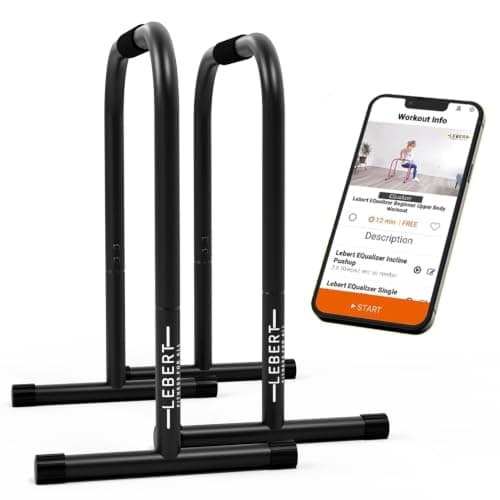
Lebert Fitness EQualizer (pair). Licensed stock photograph of the category — not the specific product.
What each one actually is
Parallettes are a pair of short bars, typically four to eight inches off the floor, with a handle you grip and a base that spreads the load. The height exists for one purpose: to get your wrist into a neutral position and to give your body somewhere to go below your hands. That is it. They are not a scaled down dip bar, they are a floor tool.
Dip bars - also sold as dip stands or dip stations - are a pair of parallel bars at roughly hip to waist height, usually 28 to 36 inches, stable enough to hold your whole bodyweight suspended between them. The height exists for a different single purpose: so your feet can leave the floor and your arms can travel through a full range without your knees hitting anything.
The confusion is understandable because the shape is identical and marketplace listings use both words interchangeably. But the two heights do not overlap in what they unlock, and nothing about owning one gets you closer to the other.
The one question that decides it
Do your feet need to leave the floor?
If yes - dips, straight-bar-style support holds, knee raises hanging between bars, full-range bodyweight pressing - you need dip bars, and there is no height of parallette that will do. A dip requires enough clearance for your torso to descend past your hands and for your legs to hang or tuck without touching down, which in practice is 24 inches absolute minimum and comfortably 28 to 32.
If no - push-ups, deficit push-ups, L-sits with your legs out in front, tuck planches, elbow levers, handstand work, pike presses - then four to five inches is genuinely all you need, and more height makes several of those worse rather than better. An L-sit on dip bars is a harder balance problem for no extra benefit; a tuck planche on a tall bar is a scarier exercise with the same difficulty.
Side by side
| Parallettes | Dip bars | |
|---|---|---|
| Typical height | 4-8 in. | 28-36 in. |
| Unlocks | Neutral-wrist push-ups, deficit push-ups, L-sits, tuck planche, elbow lever, handstand work | Dips, weighted dips, knee raises, inverted rows (on low stands), full-range pressing |
| Does NOT do | Dips, anything requiring your feet off the floor | Floor-level L-sits and planche work at a useful height |
| Pair weight | 2-5 lb typical | 15 lb (nesting pair) to 30 lb+ (station) |
| Storage | A drawer or a shelf | Under a bed if they nest; a corner if they do not |
| Price | The cheapest useful strength purchase on this site | Two to four times a pair of parallettes |
| Loads with a vest or belt | Rarely worth it - the limiting factor is leverage, not load | Yes - this is the main reason to buy the stable kind |
| Wrist position | The entire point - neutral grip takes the extension out | Neutral, but incidental |
Where parallettes win outright
Wrists. A push-up puts your wrist in about 90 degrees of extension under load, and for a large number of people that is the thing that stops them doing push-ups, not their chest. A parallette handle is a neutral grip - the same wrist angle as holding a suitcase - and it removes the problem entirely. This is the most common reason to buy a pair and the most reliably satisfying.
Depth. Five inches of clearance means your chest can travel five inches below your hands, which turns a push-up from a movement that ends at the floor into one with a real stretch at the bottom. It is a genuine difficulty increase for free.
The whole floor-skill family. L-sits, tuck planches, elbow levers, pike push-ups, handstand entries. Every one of these is easier to learn a few inches up because your feet and hips have room to pass under your shoulders - and every one of them is a skill a pull-up bar cannot teach you. Our parallettes workout for beginners runs the progression, and the handstand-specific page covers what changes when balance rather than strength is the goal.
Price and storage. A usable pair weighs two to five pounds and costs about what a takeaway does. Nothing else on this site offers that ratio of capability to footprint, which is why it is the thing we most often tell apartment readers to buy first.
Where dip bars win outright
Dips, and that is enough on its own. The dip is the best bodyweight pressing movement there is and the only one that loads the triceps and lower chest through a full range without a bench. If you own a pull-up bar and nothing else, dips are the biggest single gap in your training, and dip bars are the cheapest way to close it.
Loading. A dip is one of the two bodyweight movements that take added weight well - a vest or a belt turns it into a genuine strength lift. That is the reason to care whether a dip station is stable rather than merely tall, and it is why vest versus dip belt is a question this site has a page for.
Everything else your feet need to be off the floor for. Hanging or tucked knee raises between the bars, support holds, negatives on the way to a first dip. And on the low nesting kind of dip bar, inverted rows - which is a horizontal pull most home setups do badly.
They can carry other things. A pair of 28 in. bars is also a plyo step, a push-up handle at height, an elevated-feet anchor and a place to hang a band. The dip bar roundup ranks them on stability and storage, and the tall-user version exists because bar height is the constraint that bites hardest above about 6 ft 2 in.
The small-space argument, which is not the obvious one
You would expect parallettes to win on footprint, and in storage they obviously do - a drawer against a corner. But the comparison is more interesting than that, because the nesting kind of dip bar is genuinely apartment-viable: two independent 28 in. bars that stack together and go under a bed, set up in five seconds, and take a 400 lb rating while they are out. That is a dip station that costs you no permanent floor at all.
What does cost you floor is the stable, adjustable, bolted-together kind - the station with a bottom connection bar and four height settings. That one is a piece of furniture, and it is the one to buy if you intend to do weighted dips, because the thing you are paying for is that it does not shift when 220 lb of you plus a vest arrives at the bottom of a rep.
So the real small-space decision is three-way rather than two-way: parallettes in a drawer, nesting dip bars under a bed, or a fixed station in a corner. Our apartment gym setup guide places all three against the rest of a kit that fits a lease.
Before you buy either: do you have rings or a bar?
This changes the answer completely, and it is the question most comparisons skip.
If you own gymnastic rings, you already have dips - better dips than any dip bar gives you, because the rings rotate and the instability recruits more. You also have support holds and a route to muscle-ups. What rings do not give you is a rigid, stationary surface a few inches off the floor, which means parallettes are the complement and a dip station would be a duplicate. Buy parallettes. The rings roundup is the page if you have neither yet, and rings vs a pull-up bar covers that order of operations.
If you own a pull-up bar and nothing else, dips are your gap. Buy dip bars - or hang rings from the bar, which costs less and does more.
If you own nothing, neither of these is the first purchase. A bar or a pair of rings gives you vertical pulling, which nothing on this page does at all, and several dip stations include a pull-up bar in the frame - at which point you are shopping for a power tower rather than for dip bars.
Buying both, which is what most people end up doing
They are not really competitors, and the honest end state for a serious home setup is one of each: a pair of parallettes for floor skills and wrist-friendly pressing, and either dip bars or rings for dips. The total is under a hundred dollars for the budget version of both, which is less than one kettlebell.
If you are buying in sequence, the order that gets you the most soonest is: a bar or rings (vertical pulling, and rings cover dips), then parallettes (floor skills and push-up depth, for very little money), then a stable dip station only if you decide you want to load dips heavily. Most people never need the third.
How we compared them
Heights, weights, capacities and adjustment ranges for the four models ranked here come from each maker's published page, named on each product card, and every ASIN was confirmed live with a title-verified lookup. The judgments about what each height makes possible are editorial - drawn from what the movements mechanically require, not from testing - and the methodology page sets out exactly what our scores are and are not. Nothing on this page was hands-on tested.
Picks
The picks for each side
Two dip bars and two parallettes from our registry - the apartment pair and the weighted-dip station on one side, the wooden pair and the cheap pair on the other.
Key specs
- Size
- 28 in. tall, 21 in. base (XL also sold)
- Weight
- 7.5 lb per bar, 15 lb the pair
- Rated load
- 400 lb
Scores · editorial, out of 10
- Stability & rated load
- 8
- Footprint & storage
- 10
- Height / width adjustment
- 6
- Grip
- 8
- Value
- 8
Pick 1 · Dip bars
Lebert Fitness EQualizer (pair)
Lebert Fitness
Two independent 28 in. steel bars on a 21 in. base, 7.5 lb each, 400 lb capacity, that nest together for storage — the dip bars that fit under a bed and set up in five seconds. A hip resistance band is in the box.
Best for
Dips, rows and push-ups in an apartment where nothing can stay on the floor
Pros
- Two separate bars — set them at any width, or use one for rows and step-ups
- Nest together and weigh 15 lb for the pair; store under a bed or in a closet
- A hip resistance band and the exercise video library come with it
Cons
- Independent bars can walk apart on a slick floor during dips — use a mat
- No height adjustment within a size; pick the size by your height
Key specs
- Adjustment
- 4 height and 4 width settings
- Base
- Bottom safety connection bar, non-slip foot sleeves
- Rated load
- 400 lb
Scores · editorial, out of 10
- Stability & rated load
- 10
- Footprint & storage
- 6
- Height / width adjustment
- 9
- Grip
- 8
- Value
- 8
Pick 2 · Dip bars
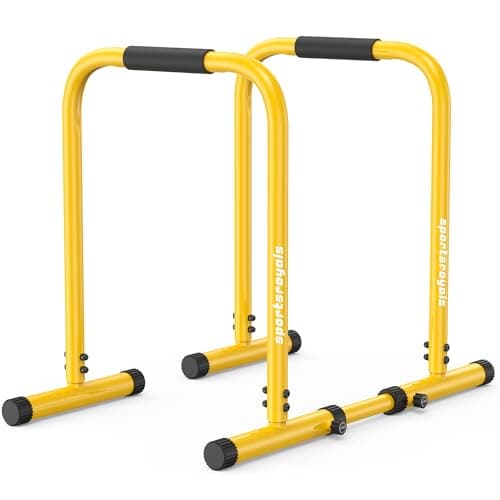
Sportsroyals DP3 Adjustable Dip Bar Station (400 lb)
Sportsroyals
A dip station with four height and four width settings, 2 mm thickened steel tube, a bottom safety connection bar and a 400 lb rating — the stable choice for weighted dips in a garage corner, and it stacks to store.
Best for
Heavy or weighted dips where the bars must not move
Pros
- A bottom connection bar stops the two uprights splaying apart under load
- Four heights and four widths, so the grip width is yours rather than the maker's
- 400 lb rating leaves room for a vest or dip belt
Cons
- Stacks for storage but does not fold flat
- Heavier to move than a pair of EQualizers
Specs from Sportsroyals — DP3 Adjustable Dip Bar listing (height and width adjustment, steel gauge, capacity, base).
Key specs
- Height
- About 4.9 in.
- Handles
- Ergonomic beech wood, non-slip
- Rated load
- 200 kg (about 440 lb)
Scores · editorial, out of 10
- Height & stability
- 9
- Grip & material
- 10
- Footprint & storage
- 8
- Rated load
- 10
- Value
- 7
Pick 3 · Parallettes
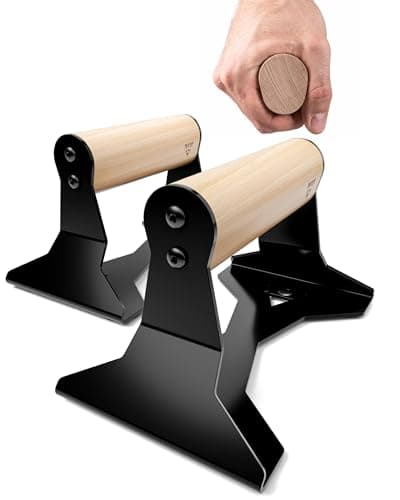
PULLUP & DIP Parallettes (beech wood)
PULLUP & DIP
Ergonomic beech-wood handles on heavy-duty steel feet, about 4.9 in. tall, 4.2 lb for the pair, rated 200 kg and shipped fully assembled — wood and steel where the budget pairs use plastic and foam.
Best for
L-sits, deficit push-ups and handstand work where a wooden handle is worth paying for
Pros
- Shaped beech handles put the wrist in a neutral position — the reason to buy wood over tube steel
- Heavy steel feet with anti-slip pads: no wobble, and no marks on a floor
- Ships assembled, with a free exercise eBook, and packs into a backpack at 4.2 lb
Cons
- Roughly twice the price of the budget wooden pairs
- About 4.9 in. tall: fine for L-sits and push-ups, too low for real dips
- Wood needs wiping down and keeping dry
Specs from PULLUP & DIP — Parallettes listing (handle material, steel feet, height, max load, weight, assembly).
Key specs
- Size
- 8 × 5 × 4 in. per bar, 2 bars
- Handles
- Soft rubber, ergonomic circumference
- Base
- Oversized non-slip mats
Scores · editorial, out of 10
- Height & stability
- 9
- Grip & material
- 7
- Footprint & storage
- 9
- Rated load
- 10
- Value
- 10
Pick 4 · Parallettes
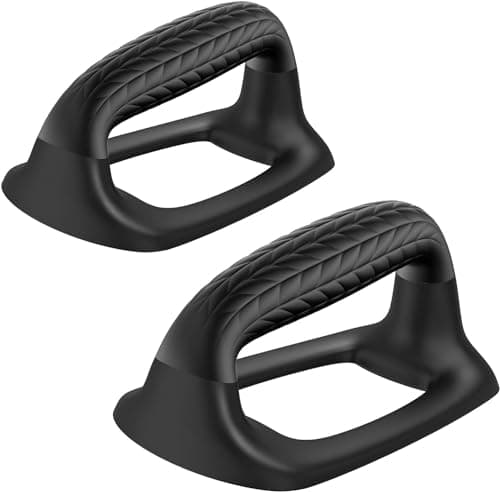
SELEWARE Push Up Bars / Parallettes (pair)
SELEWARE
The cheapest pair worth using: 8 × 5 × 4 in. stands with soft-rubber ergonomic grips and oversized non-slip base mats, 2.2 lb for the two — push-ups, L-sits and elbow levers without a wrist complaint.
Best for
Taking the bend out of your wrists on push-ups for the price of a takeaway
Pros
- Soft rubber grips are easier on the palm than bare steel tube at this price
- Large base mats grip the floor and protect it — the usual failure of budget stands
- 2.2 lb for the pair: they live in a drawer and travel in hand luggage
Cons
- 4 in. tall — the lowest here, so L-sits are tight and dips are out
- No published load rating
- Rubber grips will eventually compress and go shiny
Specs from SELEWARE — Push Up Bars Parallettes listing (bar size, grip material, base mats, pair weight).
FAQ
Questions readers ask
Can you do dips on parallettes?
Not meaningfully. A parallette is four to eight inches off the floor, and a dip needs your torso to descend past your hands with your legs clear - which takes 24 inches at an absolute minimum and comfortably 28 to 32. On parallettes you get about two inches of travel before you are sitting down. If dips are why you are shopping, buy dip bars or hang rings; the dip bar roundup covers the first and the rings roundup the second.
Should I buy parallettes or dip bars first?
If you already have a pull-up bar or rings, parallettes - rings already give you dips, and what you are missing is a stable surface a few inches off the floor for L-sits, planche work and neutral-wrist push-ups. If you have neither, dip bars do more, because dips are the biggest gap in a bar-only setup. If you have nothing at all, buy a bar or rings before either of these: nothing on this page trains vertical pulling.
What height should parallettes be?
Four to eight inches covers everything parallettes are for, and taller is not better. Low pairs around four to five inches are more stable and better for push-ups and handstand work; around eight inches gives you more room to pass your legs through for L-sits and tuck planches, at the cost of a slightly tippier base. If you are choosing one, go low - the extra clearance matters for fewer exercises than people expect. The parallettes roundup ranks them on exactly that trade.
Are parallettes good for wrist pain on push-ups?
This is the single most reliable reason to buy them. A floor push-up loads your wrist in roughly 90 degrees of extension; a parallette handle is a neutral grip, the same angle as holding a suitcase, which removes the extension entirely. For a lot of people that is the difference between doing push-ups and not. It is not medical advice - if the pain is sharp or persistent, get it looked at - but as an equipment fix it works better than almost anything else on this site for the money.
Can you do L-sits on dip bars?
Yes, and it is harder for no extra benefit. At 28 inches up you are managing a balance problem as well as the hold, and the fear of the height changes how you move. The L-sit was designed to be learned low, where your heels can brush the floor as a reference and a failed rep costs nothing. Dip bars can do it; a pair of parallettes does it better and costs a quarter as much.
Do dip bars need to be bolted down or weighted?
Not for bodyweight dips - a decent nesting pair with a wide base and a published rating is stable enough, which is why they work in apartments. It starts to matter when you add weight: a vest or a belt plus bodyweight is where a light frame begins to shift at the bottom of a rep, and that is the reason to pay for an adjustable station with a bottom connection bar and non-slip feet. Vest vs dip belt covers how to add the weight.
Parallettes or push-up handles - is there a difference?
Push-up handles are short, usually rotate, and are built for push-ups only. Parallettes are longer bars on a wider base, which is what lets you put your hands anywhere along them, hold a static position, and support your full weight for an L-sit or a planche without the handle tipping. If push-ups are genuinely all you want, handles are cheaper. If you want the skill work, the extra bar length and base width is the whole point.
Which is better in an apartment?
Parallettes for pure storage - a pair goes in a drawer. But the nesting kind of dip bar is more apartment-viable than people assume: two independent bars that stack together, slide under a bed, set up in seconds, and still take a 400 lb rating. What does not suit a small flat is the bolted adjustable station, which is a piece of furniture. Our apartment gym setup guide places all three.
Related
Keep reading
- Best parallettes
The parallette side, ranked on height and base stability.
- Best dip bars
The dip bar side, ranked on stability and storage.
- Gymnastic rings vs pull-up bar
The purchase that should come before either of these.
- Parallettes workout for beginners
What those four inches actually unlock, as a progression.
- Best parallettes for handstands
When balance rather than strength is the goal.
Sources
- —Lebert Fitness — EQualizer with Resistance Band listing (28 in. tall, 21 in. base, 7.5 lb per bar, 400 lb capacity, bars nest for storage, hip resistance band included) · amazon.com
- —Sportsroyals — DP3 Adjustable Dip Bar listing (four height and four width settings, 2 mm thickened steel tube, bottom safety connection bar, non-slip foot sleeves, 400 lb rating) · amazon.com
- —PULLUP & DIP — Parallettes listing (ergonomic beech-wood handles on heavy-duty steel feet, about 4.9 in. tall, 4.2 lb the pair, rated 200 kg / about 440 lb, shipped assembled) · amazon.com
- —SELEWARE — Push Up Bars / Parallettes listing (8 x 5 x 4 in. per bar, two bars, soft-rubber ergonomic grips, oversized non-slip base mats, 2.2 lb the pair) · amazon.com