Guide · Rings & Bars
A parallettes workout for beginners, in the order the skills actually build
Two small bars, six inches off the floor, and a surprisingly long list of things they unlock. Start with holding yourself still - the support hold is the whole foundation - and the L-sit arrives in about eight weeks.
Rope & Rep is reader-supported. Product links go through our affiliate resolver and we may earn a commission from qualifying purchases at no cost to you. Prices are the retailer's and change — every button opens the live price on Amazon rather than showing a stale number.
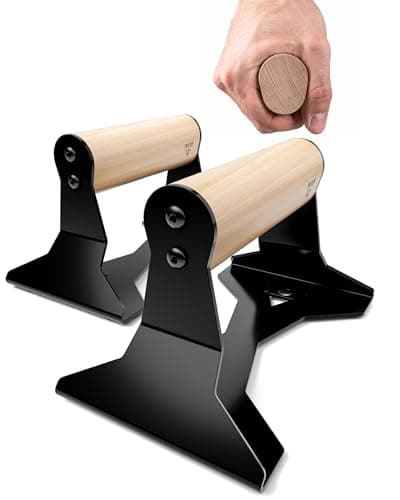
PULLUP & DIP Parallettes (beech wood). Licensed stock photograph of the category — not the specific product.
A beginner parallettes session · 6 steps
1
Set the bars and warm the wrists up
Place the bars shoulder-width apart on a non-slip surface. Spend two minutes on wrist circles, palm-down and palm-up floor rocks, and a few slow push-ups on the bars. Wrists are the tissue that limits this work; never skip this.
2
Support hold
Grip both bars, arms locked straight, shoulders pushed down away from your ears, body hanging between them with toes on the floor or lifted. Hold 10 to 20 seconds. Three to five sets. This is the foundation of everything else.
3
Deficit push-ups
Hands on the bars, body in one line, lower until your chest drops below the bars. Six to ten reps, three sets. The extra range is the point; stop the set when your hips start to sag.
4
Tuck hold, then the tuck L-sit
From the support hold, lift both knees towards your chest and hold. Five to fifteen seconds, three to five sets. Once that is easy, extend one leg at a time, then both into an L.
5
Parallette dips and leg raises
Dips: bars behind you, feet forward on the floor, lower until your upper arms are parallel to the ground - eight to twelve reps. Leg raises: from the support hold, raise straight legs as high as control allows - six to ten reps.
6
Finish with a stretch and shake out
Wrist flexor and extensor stretches, 30 seconds each side, then shoulders. Two minutes. This is what makes tomorrow's session possible.
What parallettes are actually good at
Parallettes are two short bars, usually four to six inches tall, that you put your hands on. That sounds too simple to matter and it changes three things. Your wrists go from bent back at ninety degrees to straight, which is why people with cranky wrists can do push-ups on parallettes and not on the floor. Your chest can drop below your hands, which adds range to every pressing movement. And your body can hang between the bars with your arms locked, which is the entry point to the whole family of straight-arm strength holds - the L-sit, the tuck planche, the handstand.
What they are not is a dip station. The bars are too low and too close together for proper dips with your feet off the ground - you can do bent-leg dips with your feet forward on the floor, which is useful, but if dips are the goal you want dip bars or rings instead. The parallettes roundup covers the height question in full.
The six exercises, in learning order
| # | Exercise | What it builds | Sets x prescription | When to move on |
|---|---|---|---|---|
| 1 | Support hold | Straight-arm scapular strength, the base position | 3-5 x 10-20 sec | 30 seconds with shoulders down and no shaking |
| 2 | Deficit push-ups | Chest and shoulders through full range, wrist comfort | 3 x 6-10 | 12 clean reps with the chest below the bars |
| 3 | Tuck hold | The transition from support to L-sit | 3-5 x 5-15 sec | 15 seconds with the knees held high |
| 4 | Parallette dips (feet forward) | Triceps, chest, shoulder stability | 3 x 8-12 | 12 reps with upper arms reaching parallel |
| 5 | Hanging leg raises from support | Hip flexors and lower abs for the L-sit | 3 x 6-10 | 10 reps with straight legs to hip height |
| 6 | Tuck L-sit to one-leg L-sit | The L-sit itself | 4-6 x 5-15 sec | 10 seconds with both legs straight - that is the L-sit |
Work that list top-down and do not skip the first one. The support hold looks like resting and it is the single most productive thing on the page - it teaches your shoulders to depress and your trunk to stay rigid under a straight-arm load, which is a position almost nobody has and almost everything in this discipline needs. People who jump straight to L-sit attempts spend three months failing at something a fortnight of support holds would have unlocked.
The 20-minute session
Minutes 0-3 - wrists and shoulders. Wrist circles and floor rocks, shoulder circles, then two sets of five slow push-ups on the bars.
Minutes 3-9 - the holds. Support hold for 10 to 20 seconds, rest 45 seconds, four to five times. Once the support hold is comfortable, swap two of those sets for tuck holds.
Minutes 9-15 - the pressing. Deficit push-ups, three sets of six to ten, with a set of eight to twelve parallette dips between each one. This is the volume block and it is where the soreness comes from.
Minutes 15-18 - the L-sit progression. Leg raises from the support hold, or tuck L-sits, four to six short sets. Keep these fresh-ish; they are a skill, not a finisher.
Minutes 18-20 - stretch. Wrist flexors, wrist extensors, shoulders. Non-negotiable.
Two or three times a week with a day between. Parallette work pairs very well with pulling - the bars press and the bar pulls - and the bodyweight training for beginners page shows how to put both into one week.
Three faults that stall nearly everyone
Shrugged shoulders in the support hold. If your ears disappear between your shoulders, you are hanging on your joints rather than holding yourself up. Push the floor away, drive the shoulders down, and the hold gets harder and more useful at the same time.
Chasing the L-sit before the tuck is solid. Straight legs multiply the leverage. A fifteen second tuck hold comes before a five second one-leg L, which comes before a full L-sit, and that order is not negotiable - attempting it out of order produces a bent-arm, shrugged, shaking position that trains nothing.
Rounding at the hips in deficit push-ups. The extra range tempts people to let the hips drop and the lower back arch. One rigid line from heel to head, and if it breaks, the set is over - the deficit is only valuable if your body holds its shape through it.
Where this goes next
The L-sit is the first real milestone and most people reach a ten-second hold in six to twelve weeks of consistent work from a standing start. After that, three roads open. Tuck planche leans, which is the same straight-arm family taken forwards. Handstand work on the bars, which is easier on the wrists than on the floor and is why gymnasts use parallettes for it. And rings, where everything you just learned has to be done on an unstable handle - the rings for beginners guide picks up from here.
If you want the pulling side of calisthenics running in parallel - which you should, because a press-only programme builds a round-shouldered body - the pull-up progression and muscle-up progression pages are the matching ladders, and calisthenics equipment for home covers what else is worth owning.
Picks
Parallettes this session is written for
The beech-handled pair rated to 440 lb, a wooden first pair at the same rating, and the cheap rubber-handled version if all you want is straight wrists on push-ups.
Key specs
- Height
- About 4.9 in.
- Handles
- Ergonomic beech wood, non-slip
- Rated load
- 200 kg (about 440 lb)
Scores · editorial, out of 10
- Height & stability
- 9
- Grip & material
- 10
- Footprint & storage
- 8
- Rated load
- 10
- Value
- 7
Pick 1 · Parallettes
PULLUP & DIP Parallettes (beech wood)
PULLUP & DIP
Ergonomic beech-wood handles on heavy-duty steel feet, about 4.9 in. tall, 4.2 lb for the pair, rated 200 kg and shipped fully assembled — wood and steel where the budget pairs use plastic and foam.
Best for
L-sits, deficit push-ups and handstand work where a wooden handle is worth paying for
Pros
- Shaped beech handles put the wrist in a neutral position — the reason to buy wood over tube steel
- Heavy steel feet with anti-slip pads: no wobble, and no marks on a floor
- Ships assembled, with a free exercise eBook, and packs into a backpack at 4.2 lb
Cons
- Roughly twice the price of the budget wooden pairs
- About 4.9 in. tall: fine for L-sits and push-ups, too low for real dips
- Wood needs wiping down and keeping dry
Specs from PULLUP & DIP — Parallettes listing (handle material, steel feet, height, max load, weight, assembly).
Key specs
- Size
- 11.8 × 5.5 × 3.9 in. per bar
- Handles
- 1.57 in. (40 mm) solid wood
- Rated load
- 440 lb (200 kg)
Scores · editorial, out of 10
- Height & stability
- 8
- Grip & material
- 9
- Footprint & storage
- 9
- Rated load
- 6
- Value
- 9
Pick 2 · Parallettes
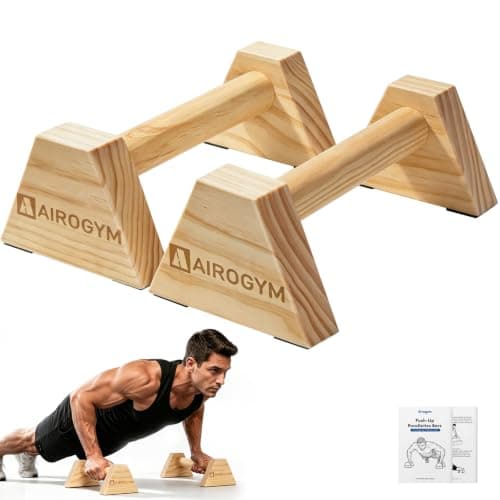
AIROGYM Wooden Parallettes (pair)
AIROGYM
Solid-wood bars on a narrow-top, wide-bottom triangle frame: 11.8 × 5.5 × 3.9 in. each, a 1.57 in. round handle, non-slip bases and a stated 440 lb (200 kg) support — the cheap wooden pair that does not wobble.
Best for
A first wooden pair for push-ups, L-sits and handstand practice
Pros
- 40 mm solid wood is the gymnastics handle diameter, at a third of the premium price
- Narrow-top, wide-bottom triangle geometry plus non-slip bases — it will not tip under a push-up
- 3.9 in. of clearance is enough that knuckles stay off the floor
Cons
- The listing's own title claims 550 lb while the detail says 440 lb (200 kg) — assume 440 lb
- No weight published for the pair
- Bare wood: it needs to stay dry and get wiped down
Specs from AIROGYM — Wooden Parallettes listing (dimensions, handle diameter, support rating, base).
Key specs
- Size
- 8 × 5 × 4 in. per bar, 2 bars
- Handles
- Soft rubber, ergonomic circumference
- Base
- Oversized non-slip mats
Scores · editorial, out of 10
- Height & stability
- 9
- Grip & material
- 7
- Footprint & storage
- 9
- Rated load
- 10
- Value
- 10
Pick 3 · Parallettes
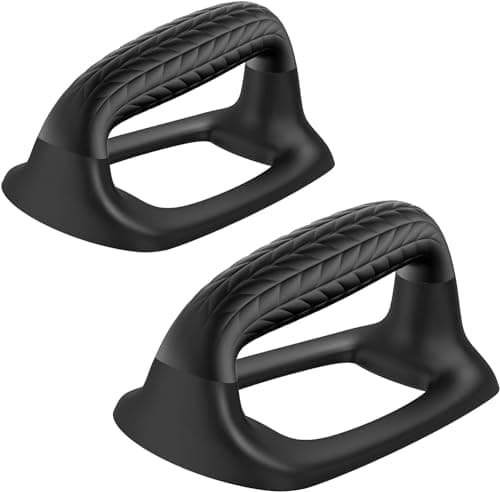
SELEWARE Push Up Bars / Parallettes (pair)
SELEWARE
The cheapest pair worth using: 8 × 5 × 4 in. stands with soft-rubber ergonomic grips and oversized non-slip base mats, 2.2 lb for the two — push-ups, L-sits and elbow levers without a wrist complaint.
Best for
Taking the bend out of your wrists on push-ups for the price of a takeaway
Pros
- Soft rubber grips are easier on the palm than bare steel tube at this price
- Large base mats grip the floor and protect it — the usual failure of budget stands
- 2.2 lb for the pair: they live in a drawer and travel in hand luggage
Cons
- 4 in. tall — the lowest here, so L-sits are tight and dips are out
- No published load rating
- Rubber grips will eventually compress and go shiny
Specs from SELEWARE — Push Up Bars Parallettes listing (bar size, grip material, base mats, pair weight).
FAQ
Questions readers ask
What exercises can you do on parallettes?
Support holds, deficit push-ups, tuck holds, L-sits, leg raises, bent-leg dips with the feet forward, tuck planche leans and handstand work. The common thread is a straight wrist and a chest that can drop below the hands. What they do not do well is full dips with the feet off the floor - the bars are too low and too narrow for that.
How long does it take to learn an L-sit on parallettes?
Six to twelve weeks of consistent work for a ten-second hold, starting from a solid support hold. The route is support hold, then tuck hold, then one leg extended, then both. Trying to go straight to the full L-sit is the single most common reason people spend months not getting one.
Are parallettes good for beginners?
Very. They make push-ups kinder on the wrists, add useful range, and give you the straight-arm support position that underpins every calisthenics skill - all for less than the price of a kettlebell and in a space the size of a laptop bag. The one caution is wrist preparation: two minutes before every session.
What height parallettes should a beginner buy?
Low, around four to six inches. Low bars are harder for L-sits because your feet have nowhere to go, but they are safer, more stable, more useful for push-ups and handstands, and they store anywhere. Taller parallettes exist mainly to make the tuck L-sit learnable earlier, and you can get the same effect by using a tuck position on low bars.
How often should I train on parallettes?
Two or three times a week with a day between. The limiting tissue is the wrist and the shoulder rather than the muscle, and both respond better to frequent short sessions than to long hard ones. Twenty minutes is a complete session.
Why do my wrists hurt when I use parallettes?
Almost always insufficient warm-up or too much volume too soon - straight-arm holds load the wrist at the end of its range under full bodyweight. Spend two minutes on wrist circles and floor rocks before every session, stretch flexors and extensors after, and stop holds when the wrist aches rather than when the muscle fails. Wider wooden handles distribute the load better than thin rubber ones.
Related
Keep reading
- Best parallettes
Which pair to buy, and why handle material matters for wrists.
- Gymnastic rings for beginners
Where the support hold goes next, on an unstable handle.
- Bodyweight training for beginners
Putting press and pull work into the same week.
- Best dip bars
What to buy if full dips, rather than holds, are the goal.
Sources
- —PULLUP & DIP — Parallettes listing (beech wood ergonomic handles, about 4.9 in. tall, rated 200 kg / 440 lb) · amazon.com
- —AIROGYM — Wooden Parallettes listing (11.8 x 5.5 x 3.9 in. per bar, 1.57 in. / 40 mm solid wood handles, rated 440 lb) · amazon.com
- —SELEWARE — Push Up Bars / Parallettes listing (8 x 5 x 4 in. per bar, soft rubber handles, oversized non-slip base mats) · amazon.com