Best for Handstands · Rings & Bars
The best parallettes for handstands are low, wooden and wider at the bottom
Handstand parallettes are not about height. They are about a handle your fingers can grip and a base that does not tip when your weight goes past your knuckles - which rules out most of what is sold.
Rope & Rep is reader-supported. Product links go through our affiliate resolver and we may earn a commission from qualifying purchases at no cost to you. Prices are the retailer's and change — every button opens the live price on Amazon rather than showing a stale number.
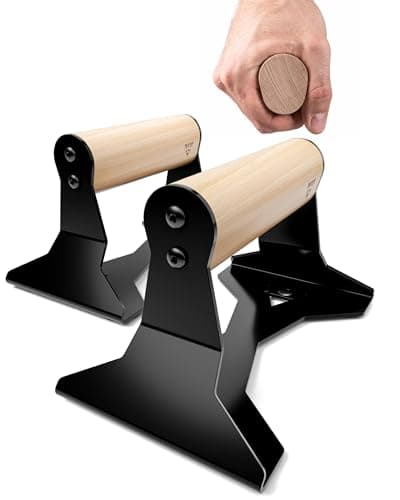
PULLUP & DIP Parallettes (beech wood). Licensed stock photograph of the category — not the specific product.
Quick picks
| # | Product | Best for | Score | Price |
|---|---|---|---|---|
| 1 | PULLUP & DIP Parallettes (beech wood) Ergonomic beech-wood handles on heavy-duty steel feet, about 4.9 in. tall, 4.2 lb for the pair, rated 200 kg and shipped fully assembled — wood and steel where the budget pairs use plastic and foam. | L-sits, deficit push-ups and handstand work where a wooden handle is worth paying for | 9.0 | |
| 2 | 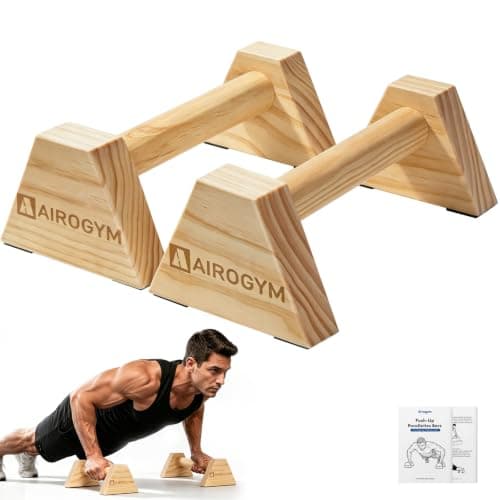 AIROGYM Wooden Parallettes (pair) Solid-wood bars on a narrow-top, wide-bottom triangle frame: 11.8 × 5.5 × 3.9 in. each, a 1.57 in. round handle, non-slip bases and a stated 440 lb (200 kg) support — the cheap wooden pair that does not wobble. | A first wooden pair for push-ups, L-sits and handstand practice | 8.3 | |
| 3 | 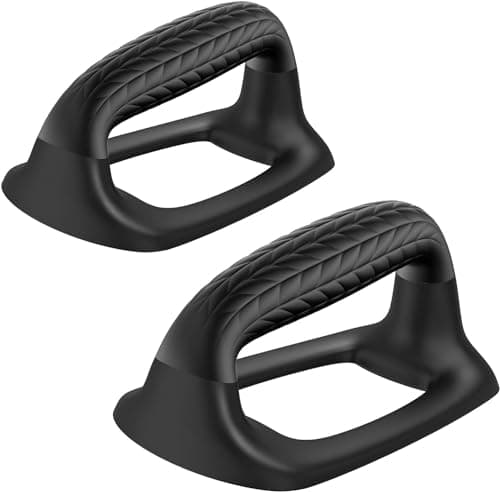 SELEWARE Push Up Bars / Parallettes (pair) The cheapest pair worth using: 8 × 5 × 4 in. stands with soft-rubber ergonomic grips and oversized non-slip base mats, 2.2 lb for the two — push-ups, L-sits and elbow levers without a wrist complaint. | Taking the bend out of your wrists on push-ups for the price of a takeaway | 8.8 |
Scores are our editorial judgment from each maker's published specs and mounting instructions, weighted for a renter or small-space trainer.
Why handstands on parallettes at all
A handstand on the floor loads the wrist in full extension — the hand flat, the forearm vertical, the joint at the end of its range for the whole hold. For a lot of people that is the thing that ends handstand practice before the balance does.
Parallettes change the wrist angle to neutral, the same position your hand sits in holding a suitcase. That removes the extension problem entirely, which means more practice time and less wrist complaint afterwards. It also lets the fingers wrap a bar, which is the part that actually matters for balance: on the floor you correct a forward lean by pressing with the fingertips, and that is a weaker, cruder correction than gripping a handle and pulling.
The trade is that the handstand gets harder, not easier. A bar is a smaller base of support than a flat hand, so the balance is less forgiving. Most people find parallettes make the wrists comfortable and the balance tighter — which is exactly what you want for practice, and exactly why people who train handstands seriously own a pair.
Height: why low wins
Search for handstand parallettes and the images show tall bars, a foot or more off the ground. Those exist for two specific purposes: press-to-handstand work where you need room for the legs to pass under, and L-sits for people who cannot yet hold their legs clear of the floor on low bars.
For the handstand itself, height does nothing useful and adds two problems. Taller bars are less stable, because the lever between your hands and the floor is longer and any tipping force is multiplied. And a fall from a taller handstand is a fall from further up, onto equipment.
Four to five inches is the normal range and it is the range all three pairs here sit in. If you specifically want tall bars for presses, that is a different product than anything on this page, and the wobble is the thing to check before buying.
The three criteria
Handle diameter and material. Forty percent. Around 40 mm of wood is the gymnastics standard and the reason is grip: it is thick enough to pull against and absorbent enough not to go slick. This is the single biggest differentiator between the pairs below.
Base geometry and stability. Thirty-five percent. Narrow at the top, wide at the bottom, with a non-slip contact patch. A pair that shifts a quarter of an inch mid-hold will end the hold.
Published load rating and build. Twenty-five percent. A handstand puts your entire bodyweight through two small contact points with a dynamic load on top, so a stated rating is worth having — and two of these three publish one that contradicts something else on the same listing, which we note where it happens.
The three, side by side
| Pair | Height | Handle | Rated load | Pair weight |
|---|---|---|---|---|
| PULLUP & DIP beech parallettes | About 4.9 in. | Ergonomic beech wood, shaped | 200 kg (about 440 lb) | 4.2 lb |
| AIROGYM wooden parallettes | 3.9 in. clearance, 11.8 x 5.5 in. base | 1.57 in. (40 mm) solid wood | 440 lb per the listing detail | Not published |
| SELEWARE push-up bars | 4 in., 8 x 5 in. base | Soft rubber, ergonomic | Not published | 2.2 lb |
What to look for in the base
This is the part reviews skip and it decides more holds than the handle does. In a handstand your centre of mass moves constantly over a base the width of your hands, and every correction sends force forward, backward or sideways through the frame.
A pair with a base the same width as the handle tips when that force goes sideways. A pair with a base wider than the handle — a triangle, narrow at the top and spread at the bottom — converts the same force into pressure on the floor. All three pairs here use some version of that geometry; the AIROGYM states it explicitly, and it is the clearest-cut example.
The second half is the contact patch. Large non-slip pads or mats under the frame do two jobs: they stop the bars walking on a hard floor, and they stop the bars marking it. On a wooden or laminate floor, a pair without pads is a pair that will leave you two neat scratches.
How to actually use them
The progression is boring and it works. Start with a wall-supported handstand, chest to the wall rather than back to it, with the parallettes about a hand's width from the skirting board. Hold for 20 to 30 seconds, five sets, every other day. The goal in the first month is wrist and shoulder tolerance, not balance.
Then move to short free holds with the wall behind you as a safety net, and work on the finger correction: the hand should be actively gripping and releasing against the bar, not passively resting on it. That correction is what parallettes make possible and the floor does not.
The strength work that makes handstands easier happens off the bars: overhead pressing, hollow holds and straight-arm shoulder work. Our parallettes workout for beginners lays out a session that includes all of it, and the muscle-up progression covers the other place that straight-arm strength pays off.
Where parallettes stop
They are 4 to 5 in. tall, so dips are out — there is no room to drop below the bars. If you want dips as well, that is a dip bar, which is a different purchase and a taller one. L-sits work on parallettes but are tight at this height if you have long legs, and a deficit push-up is about as deep as the clearance allows.
The other thing they do not do is replace rings. Rings add instability in every direction and open up a different family of movements; parallettes are fixed and the whole point is that they do not move. Most people who train bodyweight seriously end up with both, and the rings roundup covers that side.
The picks in detail
Every pick, reviewed
Key specs
- Height
- About 4.9 in.
- Handles
- Ergonomic beech wood, non-slip
- Rated load
- 200 kg (about 440 lb)
Scores · editorial, out of 10
- Height & stability
- 9
- Grip & material
- 10
- Footprint & storage
- 8
- Rated load
- 10
- Value
- 7
Pick 1 · Parallettes
PULLUP & DIP Parallettes (beech wood)
PULLUP & DIP
Ergonomic beech-wood handles on heavy-duty steel feet, about 4.9 in. tall, 4.2 lb for the pair, rated 200 kg and shipped fully assembled — wood and steel where the budget pairs use plastic and foam.
Best for
L-sits, deficit push-ups and handstand work where a wooden handle is worth paying for
The best handstand pair here, and the handle is why. Shaped beech-wood grips on heavy steel feet put the wrist in a neutral position and give the fingers a shaped, absorbent surface to pull against, which is the correction mechanism a handstand actually runs on. At about 4.9 in. it is the tallest of the three, which buys a little extra clearance for L-sits without getting into wobbly territory.
The feet are the other half. Heavy steel with anti-slip pads means the bars do not walk on a hard floor and do not mark it, and the pair weighs 4.2 lb so it travels. A stated 200 kg rating is the clearest figure on the page. Three honest marks against it: it costs roughly twice the budget wooden pairs, 4.9 in. is still far too low for dips, and bare wood needs wiping down and keeping dry.
Pros
- Shaped beech handles put the wrist in a neutral position — the reason to buy wood over tube steel
- Heavy steel feet with anti-slip pads: no wobble, and no marks on a floor
- Ships assembled, with a free exercise eBook, and packs into a backpack at 4.2 lb
Cons
- Roughly twice the price of the budget wooden pairs
- About 4.9 in. tall: fine for L-sits and push-ups, too low for real dips
- Wood needs wiping down and keeping dry
Specs from PULLUP & DIP — Parallettes listing (handle material, steel feet, height, max load, weight, assembly).
Key specs
- Size
- 11.8 × 5.5 × 3.9 in. per bar
- Handles
- 1.57 in. (40 mm) solid wood
- Rated load
- 440 lb (200 kg)
Scores · editorial, out of 10
- Height & stability
- 8
- Grip & material
- 9
- Footprint & storage
- 9
- Rated load
- 6
- Value
- 9
Pick 2 · Parallettes
AIROGYM Wooden Parallettes (pair)
AIROGYM
Solid-wood bars on a narrow-top, wide-bottom triangle frame: 11.8 × 5.5 × 3.9 in. each, a 1.57 in. round handle, non-slip bases and a stated 440 lb (200 kg) support — the cheap wooden pair that does not wobble.
Best for
A first wooden pair for push-ups, L-sits and handstand practice
The value pick, and genuinely close to the winner on the specification that matters. A 1.57 in. (40 mm) solid wood handle is the gymnastics diameter — the same thickness a competition parallette uses — at about a third of the premium price. The frame is the textbook geometry too: narrow at the top, wide at the bottom, with non-slip bases, which is exactly what stops a pair tipping sideways mid-correction.
Second for two reasons, both honest. The listing contradicts itself on capacity — the title claims 550 lb and the detail says 440 lb (200 kg), so we score the lower figure — and no pair weight is published at all. The 3.9 in. clearance is also the point at which L-sits get tight for taller users. If the handle is what you care about and the price difference matters, this is the pair to buy.
Pros
- 40 mm solid wood is the gymnastics handle diameter, at a third of the premium price
- Narrow-top, wide-bottom triangle geometry plus non-slip bases — it will not tip under a push-up
- 3.9 in. of clearance is enough that knuckles stay off the floor
Cons
- The listing's own title claims 550 lb while the detail says 440 lb (200 kg) — assume 440 lb
- No weight published for the pair
- Bare wood: it needs to stay dry and get wiped down
Specs from AIROGYM — Wooden Parallettes listing (dimensions, handle diameter, support rating, base).
Key specs
- Size
- 8 × 5 × 4 in. per bar, 2 bars
- Handles
- Soft rubber, ergonomic circumference
- Base
- Oversized non-slip mats
Scores · editorial, out of 10
- Height & stability
- 9
- Grip & material
- 7
- Footprint & storage
- 9
- Rated load
- 10
- Value
- 10
Pick 3 · Parallettes
SELEWARE Push Up Bars / Parallettes (pair)
SELEWARE
The cheapest pair worth using: 8 × 5 × 4 in. stands with soft-rubber ergonomic grips and oversized non-slip base mats, 2.2 lb for the two — push-ups, L-sits and elbow levers without a wrist complaint.
Best for
Taking the bend out of your wrists on push-ups for the price of a takeaway
The cheap pair that is still worth using, and the right buy for someone whose first goal is simply to stop their wrists hurting during push-ups. Soft rubber ergonomic grips are considerably kinder on the palm than bare steel tube at this price, and the oversized non-slip base mats are a real feature — they grip a hard floor and protect it, which is the usual failure of budget push-up stands.
Third for handstands specifically. At 4 in. it is the lowest here, so L-sits are tight and dips are out. Rubber grips go shiny and compress over time, which is the opposite of what you want for a handstand grip, and no load rating is published at all. At 2.2 lb for the pair they live in a drawer and fit hand luggage, which is a genuine argument for them as a travel pair.
Pros
- Soft rubber grips are easier on the palm than bare steel tube at this price
- Large base mats grip the floor and protect it — the usual failure of budget stands
- 2.2 lb for the pair: they live in a drawer and travel in hand luggage
Cons
- 4 in. tall — the lowest here, so L-sits are tight and dips are out
- No published load rating
- Rubber grips will eventually compress and go shiny
Specs from SELEWARE — Push Up Bars Parallettes listing (bar size, grip material, base mats, pair weight).
Buying guide
What to buy, in one paragraph
Buy the PULLUP & DIP pair if handstands are a real goal and you want the shaped wooden handle and the steel feet to go with it. Buy the AIROGYM if you want the same 40 mm wooden handle for a third of the money and can live with a listing that contradicts itself on capacity. Buy the SELEWARE if the immediate problem is wrist pain on push-ups and handstands are a someday thing.
How this list was built
Three pairs confirmed as live, purchasable listings were scored against the parallettes rubric, re-weighted for handstand work: handle diameter and base geometry carry far more here than portability or price do. Heights, handle diameters, materials, base dimensions and load ratings all come from the page named under each product; where a listing contradicts itself we score the lower figure and say so. Nothing here was tested. The methodology page sets out how the scoring works.
What wears out
On the wooden pairs, the finish on the handle where your hands go, which is cosmetic and takes years. On the rubber pair, the grips — they compress and go shiny, and that is the thing that eventually makes them unsuitable for handstands. On all three, the non-slip pads under the base, which are the cheapest part and the one actually doing safety work.
FAQ
Questions readers ask
Are parallettes good for handstands?
Yes, and for one specific reason: they put the wrist in a neutral position instead of full extension, which is what ends handstand practice for a lot of people. They also let the fingers grip a bar, which is a stronger way to correct a forward lean than pressing with fingertips on the floor. The balance gets harder, not easier — a bar is a smaller base than a flat hand.
How tall should handstand parallettes be?
Four to five inches. That is enough to put the wrist in a neutral grip and keep the base stable. Taller parallettes exist for press-to-handstand work and for L-sits with long legs, but for balance practice the extra height adds wobble and makes a fall further.
Wood or steel parallettes for handstands?
Wood, at around 40 mm. It takes chalk and sweat and stays grippy, and a thicker bar gives the fingers something to pull against. Bare steel tube goes slick as soon as your hands are damp, which in a handstand is immediately. Rubber grips sit between the two and go shiny over time.
Can you do dips on parallettes?
No. Parallettes sit 4 to 5 in. off the floor and there is nowhere for your body to go below the bars. If you want dips you want a dip bar or dip station, which is a separate and much taller purchase.
Do parallettes tip over during handstands?
Not if the base is wider than the top. The geometry to look for is a narrow handle on a spread triangular frame with non-slip pads underneath, which converts sideways correction force into pressure on the floor instead of a tipping moment. A pair whose base is the same width as the handle is the pair that tips.
Related
Keep reading
- Best parallettes
The general ranked list, scored across push-ups, L-sits and travel too.
- Parallettes workout for beginners
The session to run once the bars arrive, handstand progression included.
- Best dip bars
What to buy instead if dips are on the list - parallettes cannot do them.
- Best gymnastic rings
The unstable counterpart most bodyweight setups end up owning as well.
Sources
- —PULLUP & DIP — Parallettes listing (beech wood handles, heavy steel feet with anti-slip pads, about 4.9 in. height, 200 kg max load, 4.2 lb pair weight, ships assembled) · amazon.com
- —AIROGYM — Wooden Parallettes listing (11.8 x 5.5 x 3.9 in. per bar, 1.57 in. solid wood handle, 440 lb / 200 kg support in the detail, non-slip bases) · amazon.com
- —SELEWARE — Push Up Bars Parallettes listing (8 x 5 x 4 in. per bar, soft rubber ergonomic grips, oversized non-slip base mats, 2.2 lb pair) · amazon.com