Guide · Training
Muscle-up progression: the three parts, trained separately, then joined
A muscle-up is a very high pull, a transition, and a dip. Nobody fails all three — find which one is yours, train it on its own, and the whole movement arrives in one session that feels like an accident.
Rope & Rep is reader-supported. Product links go through our affiliate resolver and we may earn a commission from qualifying purchases at no cost to you. Prices are the retailer's and change — every button opens the live price on Amazon rather than showing a stale number.
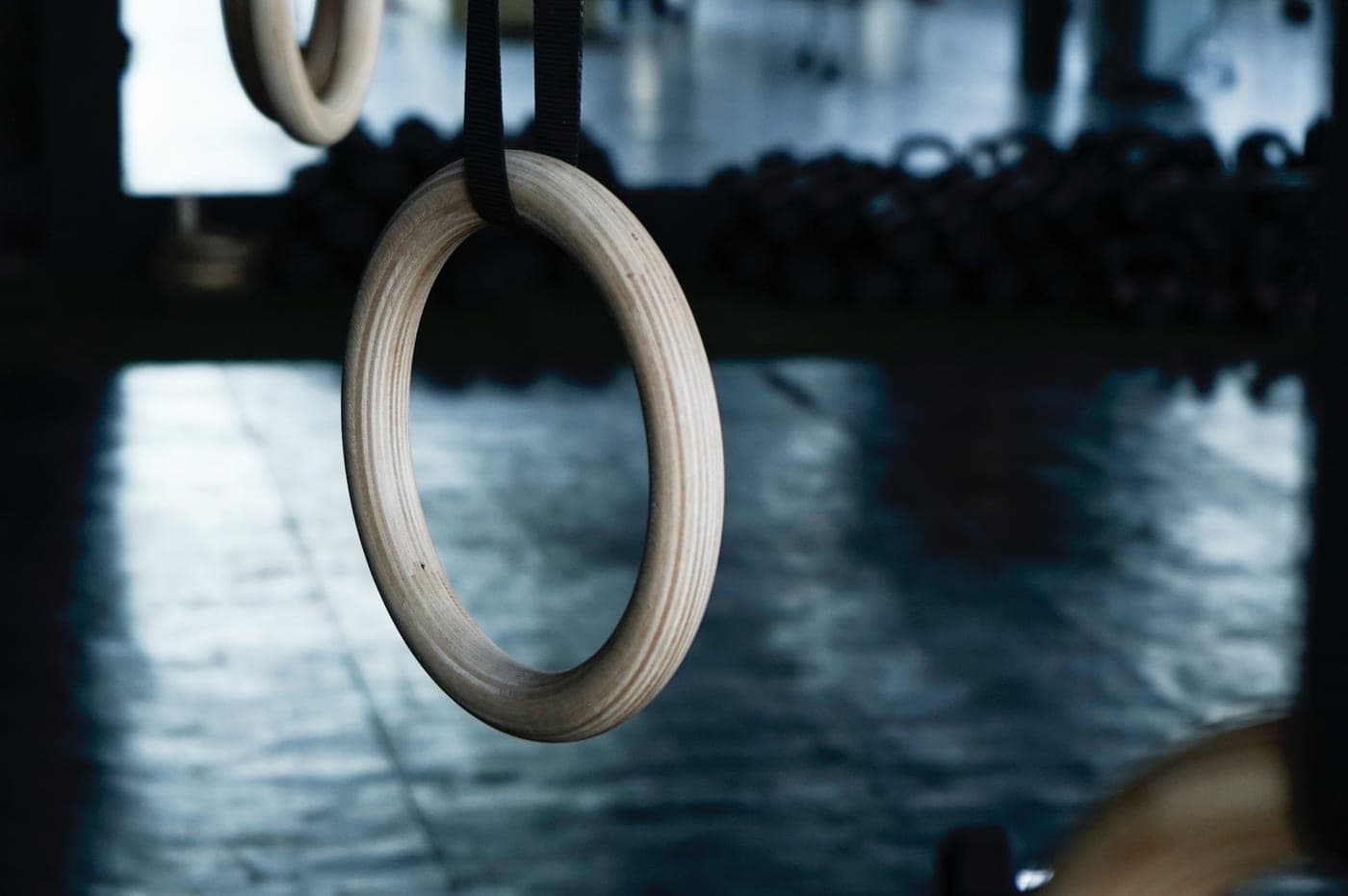
Wooden gymnastic rings hanging on straps in a home gym. Licensed stock photograph of the category — not the specific product.
The prerequisites, honestly
You can technically muscle-up with fewer, but people who start here have a far better time of it:
| Prerequisite | Target | Why it matters |
|---|---|---|
| Strict pull-ups | 8–10 | The pull has to reach chest height, which costs roughly double a chin-height rep |
| Chest-to-bar pull-up | 1–3 | This is the actual height requirement, tested directly |
| Strict dips | 8–10 | You come out of the transition into a dip at your weakest angle |
| Ring support hold | 20 sec. | Rings only — the top position is unstable until you have held it |
| False-grip hang | 20 sec. | Rings only — wrists and forearms limit this long before the back does |
If the pull-up numbers are not there yet, the pull-up progression is the prerequisite work and there is no way around it. If dips are the gap, ring dips or a dip station build them fastest — see the dip bars worth owning.
Part 1 — the high pull
A chin-height pull-up is not enough; you need to pull your chest or lower sternum to the bar or rings, because the transition happens from wherever your pull ends. Train it directly: chest-to-bar pull-ups for sets of three, and explosive pull-ups where you try to pull as high as possible and let go for a fraction of a second at the top. Do these fresh, early in the session, in low reps. They are a power exercise and they are useless when tired.
Part 2 — the transition
The transition is where every first attempt dies, and it is the part that needs no strength to practice — just the position, over and over.
Low-ring transitions
Set rings at about chest height, stand or sit under them with feet on the floor, take a false grip, and pull yourself through the transition using your legs as much as you need. The point is the path: elbows travel back and then rotate around, chest comes over the rings, wrists roll over the top. Fifty reps a session is not too many. This one drill is why rings are the easier starting point — the height is adjustable, so the difficulty is adjustable.
Banded transitions
With a band looped over the bar or rings and a foot in it, the whole movement becomes possible early, which lets you rehearse the timing at full height. Use it as a drill, not as the goal — a banded muscle-up teaches the rhythm, not the strength.
The false grip (rings only)
The heel of your hand sits on top of the ring with the wrist bent over it, so that at the top of the pull your hand is already above the ring and does not have to be re-gripped mid-air. It is uncomfortable for the first few weeks and that is normal — the load is on the wrist and forearm in a position they have never been in. Build it with false-grip hangs and false-grip ring rows before you try to pull hard from it.
Part 3 — the dip out of the bottom
You arrive in the dip already at the bottom, chest low, shoulders in a deep position, with none of the momentum left. Train deep dips with a slow bottom position and a pause: three sets of five with a two-second hold at the bottom. On rings, add support holds and ring dips — the stability demand is the actual difficulty.
A week that trains all three
| Day | Skill | Strength |
|---|---|---|
| Monday | Low-ring transitions 5 × 10; false-grip hangs 3 × 20 sec. | Weighted pull-ups 5 × 5 |
| Wednesday | — | Dips 4 × 8 with pause; rows 4 × 10 |
| Friday | Explosive/chest-to-bar pulls 6 × 2; banded muscle-ups 4 × 3 | Ring support holds 3 × 30 sec. |
Bar or rings first?
Rings, for most people training at home. The transition can be drilled at any height, the false grip does the work of getting your hands above the rings, and the shoulders move on a free path. The bar version needs more pull height and a faster, more aggressive transition — it is generally the harder skill, and it is far less forgiving of a shoulder that does not want to rotate. If you only have a bar, train the bar version but expect the timeline to be longer.
Hanging rings at home is its own small project — strap length, ceiling height, what you are allowed to drill. How to hang gymnastic rings at home covers all three, and wood vs plastic matters more than usual here: a false grip on a sweaty plastic ring slides.
Picks
What this progression runs on
Rings you can set at any height for transition work, a bar solid enough for explosive pulls, and a band for assisted transitions before you own the position.
Key specs
- Rings
- Birch wood, 28 mm
- Straps
- 2 × 14.76 ft, 1.5 in., numbered scale
- Rated load
- 1500 lb
Scores · editorial, out of 10
- Strap length & numbering
- 10
- Material & grip
- 9
- Rated load
- 10
- Setup where a renter can hang them
- 8
- Value
- 9
Pick 1 · Gymnastic rings
PACEARTH Wooden Gymnastic Rings (1500 lb)
PACEARTH
Birch rings on 14.76 ft, 1.5 in. cam-buckle straps printed with a scale, rated 1500 lb — the wood ring set that makes leveling both rings under a ceiling a ten-second job.
Best for
A first pair of wood rings hung from a doorway bar, a beam or a tree
Pros
- Numbered straps — set both rings to the same mark and they're level, every time
- 1.5 in. straps are wider than most, so they dig into wrists less on dips
- Serrated cam buckles; birch grips well with or without chalk
Cons
- Wood must stay dry — not for a rainy balcony or an outdoor tree year-round
- 14.76 ft is long for an 8 ft ceiling; you'll coil the excess
Specs from PACEARTH — Wooden Gymnastics Rings listing (ring size, strap length/width, capacity).

Key specs
- Mounting
- Wall studs; 14 or 26 in. projection
- Bar
- 50 in. wide, 46 in. usable, 1.25 in.
- Rated load
- 700 lb (properly installed)
Scores · editorial, out of 10
- Fit & clearance (door, ceiling, depth)
- 7
- Reversibility (no drill, no marks, takedown)
- 3
- Rated load & build
- 10
- Grip options
- 10
- Value
- 8
Pick 2 · Pull-up bars
REP Fitness Wall-Mounted Multi-Grip Pull-Up Bar
REP Fitness
The wall bar with the most grips: 46 in. of usable 1.25 in. bar with neutral, close, wide and angled handles, mountable at 14 or 26 in. from the wall, rated 700 lb into studs.
Best for
A garage or basement wall where you can hit two studs and want every grip
Pros
- Traditional, neutral, close, wide and angled grips on one bar
- Two projection options — 26 in. lets you swing for kipping or muscle-ups, 14 in. saves space
- 700 lb rating with a 2 in. back bar; nonslip powder coat
Cons
- Needs lag bolts into two studs — not a rental-friendly install unless the landlord agrees
- At 50 in. wide it takes real wall space; check the stud spacing matches before ordering
Specs from REP Fitness — Wall-Mounted Multi-Grip Pull-Up Bar (dimensions, projection, rating).
Key specs
- Length
- 41 in. loop
- Assistance
- 10–35 / 30–60 / 40–80 lb
- Bands
- 3 (5-band set also sold)
Scores · editorial, out of 10
- Assistance range
- 8
- Material & safety
- 8
- Sizing clarity
- 8
- Bar compatibility
- 10
- Value
- 9
Pick 3 · Assistance bands
WOD Nation Pull Up Assistance Band Set (red, black, purple)
WOD Nation
A three-band starter set — red 10–35 lb, black 30–60 lb, purple 40–80 lb — that covers the whole path from your first assisted rep to a nearly unassisted one.
Best for
A first set that spans beginner to almost-there without buying five bands
Pros
- Three bands cover the useful range for most adults under about 220 lb
- 100% natural latex; 41 in. standard length
- Cheaper than a five-band bundle you'll only half use
Cons
- No heavy green/blue band — a 250 lb beginner may need more assistance than purple gives
- Colors don't match other brands' scales; note the pounds, not the color
Specs from WOD Nation — Pull Up Assistance Band Set listing (resistance per band).
FAQ
Questions readers ask
How many pull-ups should you be able to do before trying a muscle-up?
Eight to ten strict pull-ups and at least one chest-to-bar rep, plus eight to ten strict dips. The chest-to-bar rep is the real test — it measures the pull height a muscle-up needs.
How long does it take to learn a muscle-up?
For someone who already has the pull-up and dip prerequisites, typically two to six months of consistent transition work. Starting from fewer than five pull-ups, plan in years, not months.
Is a ring muscle-up easier than a bar muscle-up?
For most people learning at home, yes. Rings let you drill the transition at any height and the false grip solves getting your hands over the top. The trade is that rings demand more stability.
Do you need a false grip for a muscle-up?
On rings, effectively yes — without it your hands have to re-grip in mid-air. On a bar there is no false grip; the hands roll over the bar during the transition instead.
Can you do muscle-ups on a doorway pull-up bar?
No. The transition throws your weight forward over the bar, which is exactly the direction a leverage doorway bar is not designed to resist. Use bolted rings, a joist mount or a rig.
Related
Keep reading
- Pull-up progression
The prerequisite strength, staged.
- Best gymnastic rings
Rings that take a false grip without slipping.
- How to hang gymnastic rings at home
Height, straps and what you can drill.
- Best dip bars
Building the dip half of the movement.
- Mounting to ceiling joists
The anchor explosive work needs.
Sources