Comparison · Conditioning
Weighted vest vs ankle weights: one loads your whole body, the other loads a lever
A vest puts weight over your center of mass, so everything you already do gets harder. Ankle weights hang weight at the end of a swinging limb, which is excellent for two or three exercises and a bad idea for walking. That is the comparison.
Rope & Rep is reader-supported. Product links go through our affiliate resolver and we may earn a commission from qualifying purchases at no cost to you. Prices are the retailer's and change — every button opens the live price on Amazon rather than showing a stale number.

A person training outdoors, running up a stairway on a residential street. Licensed stock photograph of the category — not the specific product.
What each one actually is
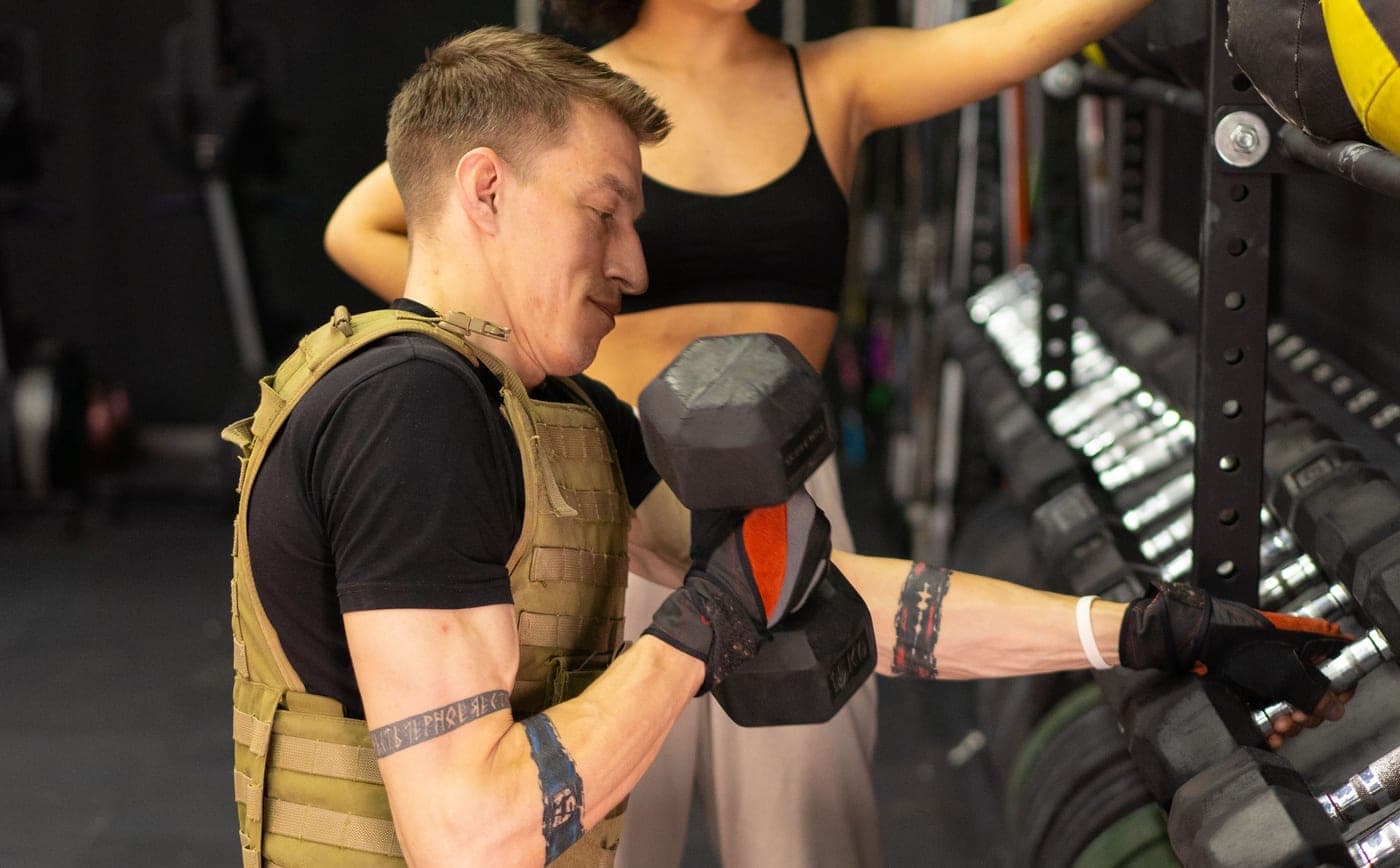
A weighted vest is a garment that holds weight against your chest and upper back. Because the load sits close to your center of mass, your body carries it the way it carries you — through your spine, hips, knees and ankles in that order. Nothing about your movement pattern has to change. That is the entire reason a vest works: you keep doing what you were doing, and it costs more.
Ankle weights are cuffs strapped above the ankle joint. The load sits at the far end of the longest lever in your body. GoFit's plain canvas pair holds five removable steel-shot packets per ankle behind a zipper — 0.5 lb packets on the 5 lb pair, 1 lb packets on the 10 lb pair. The Padded Pro version uses ten removable weight bars per ankle instead, which is the finest adjustment of any ankle weight we could verify in stock on 29 September 2026.
Because of that leverage, 2 lb on an ankle is not a small amount of resistance to the muscles that move the leg. It is also not a small amount of extra torque through the knee and hip when the leg is swinging.
Side by side
| Weighted vest | Ankle weights | |
|---|---|---|
| Where the load sits | Over your center of mass, on the torso | At the end of the leg, below the knee |
| Useful range | 5-40 lb depending on use | 1-5 lb per ankle; more is a warning sign |
| What it makes harder | Everything you already do | Leg raises, kickbacks, curls, abduction |
| Walking and running | Yes — the main use case | No — it alters your gait |
| Pull-ups and dips | Yes | Technically yes; the swing makes it worse |
| Rehab and physio use | Rarely prescribed | Commonly prescribed, at low loads |
| Joint load | Spread down the chain as body weight | Concentrated as torque at knee and hip |
| Entry cost | A cheap 20 lb vest is one purchase | Cheapest load-bearing gear on this site |
| Storage | Folds into a drawer | Fits in a drawer with room to spare |
The leverage argument, which is the real one
Hold a 2 lb weight against your chest and you barely register it. Hold the same 2 lb at arm's length and your shoulder objects within a minute. Nothing about the weight changed; the moment arm did. Your leg is a longer lever than your arm, and an ankle cuff sits at the very end of it.
That is exactly what you want for a standing hip abduction or a lying hamstring curl. The muscle has to produce force against a long lever, which is the whole stimulus, and it does it at a load small enough that nothing else is stressed. It is why ankle weights are a physio staple and why 1 to 5 lb per ankle is a genuinely useful range rather than a beginner range.
It is also exactly what you do not want while walking. Walking is a pendulum: your leg swings forward, decelerates, and lands. Add mass at the end of the pendulum and you change the timing of all three, so your hip flexors work harder to swing it and your knee works harder to stop it. You will get a harder walk. You will also get a different walk, and the joints doing the extra work were not the ones you were trying to train.
What each one is genuinely better at
The vest wins: loaded walking, hills and stairs, weighted pull-ups and dips, push-ups, step-ups, squats, carries, and anything where you want the same movement to cost more. Our walking roundup and pull-up roundup rank the vests for each of those, and the case for a vest over a rucking pack is on the ruck comparison.
Ankle weights win: hanging and lying leg raises, glute kickbacks, standing hip abduction and clamshells, prone hamstring curls, fire hydrants, and every seated or lying knee-extension variant. Also rehabilitation work, where a clinician has asked for a specific small load on a specific movement — which is a different reason to own them than conditioning.
Cost, which barely matters here
Ankle weights are the cheapest load-bearing purchase on this site: GoFit's plain canvas pair is $21.99 for the 5 lb version and $27.50 for the 10 lb, and the Padded Pro is $27.50 and $43.99 respectively, all read from gofit.net on 29 September 2026. A cheap adjustable vest is several times that, and a sized plate vest is an order of magnitude more.
But the price gap should not decide this, because the two things do not substitute for each other. Buying ankle weights because a vest is expensive is like buying a screwdriver because a saw is expensive.
If you only want one
Buy the vest. Not because it is better, but because it covers more: it loads the training most people on this site are actually doing — walking, pull-ups, push-ups, step-ups — and it does so without changing how any of them look. The CAP Barbell 20 lb is the cheapest honest entry, and the men's and women's pages sort out which one fits.
Then buy ankle weights later, when a specific exercise asks for them. They cost less than a takeout dinner and they store in a sock drawer, so there is no reason to agonize over the decision.
How much weight, per side
Vest: start at about 5% of body weight, work toward 10% for walking and bodyweight circuits. Weighted pull-ups tolerate more because they are short efforts.
Ankle weights: 1 to 3 lb per ankle for most isolation work, 5 lb as a ceiling. If you find yourself wanting 10 lb on each ankle, the exercise has outgrown ankle weights and wants a cable or a band instead. That is the honest ceiling and it is why both GoFit pairs top out at 5 lb per side.
How we compared them
Weight ranges, increment sizes, materials, closures, prices and stock came from each maker's own product page — hyperwear.com, capbarbell.com and gofit.net — read on 29 September 2026. The two sides were scored on separate rubrics, the weighted vest rubric and a new ankle weight rubric weighting strap security 30%, weight range and increment 25%, comfort against skin 25% and value 20%, because a single scale would have flattered one of them. Nothing here was tested in a lab; we own no lab and say so on our methodology page. The biomechanical points above are about leverage, not clinical outcomes, and we have not put a study behind them because none of the general figures published about ankle-weight training were measured on the situation you are in.
Picks
The gear on both sides of this comparison
A cheap adjustable vest, the lightest contoured vest, and the two ankle cuffs whose weights come out in the smallest steps we could verify in stock.
Key specs
- Weights
- To 20 lb, ~0.75 lb packets
- Fit
- One size, chest + waist belts
- Shell
- Reinforced nylon/polyester mesh
Scores · editorial, out of 10
- Fit for pull-ups (stays put)
- 7
- Adjustability of load
- 9
- Durability
- 7
- Value
- 10
Pick 1 · Weighted vests
CAP Barbell 20 lb Adjustable Weighted Vest
CAP Barbell
A one-size mesh vest with removable 0.75 lb steel-shot packets to 20 lb, adjustable chest and waist belts and padded shoulders — the cheap entry into weighted pull-ups and walks.
Best for
A first light vest to add 5–20 lb to pull-ups, dips and walks
Pros
- 0.75 lb packets allow almost any load from 5 to 20 lb
- Breathable mesh; machine-washable with packets removed
- Reflective strips for evening walks
Cons
- 20 lb ceiling — you'll outgrow it if weighted pull-ups become a focus
- Two-belt fit is less secure inverted or on kipping movements
Specs from CAP Barbell — 20 lb Adjustable Weighted Vest (packets, fit, materials).
Key specs
- Weights
- 20 x 0.5 lb, to 10 lb
- Fit
- Women's contoured pattern, sized
- Shell
- CORDURA (PFAS-free), front zip
Scores · editorial, out of 10
- Fit for pull-ups (stays put)
- 8
- Adjustability of load
- 8
- Durability
- 9
- Value
- 7
Pick 2 · Weighted vests
Hyperwear Hyper Vest FIT (10 lb, women's fit)
Hyperwear
The only vest here built on a women's contoured pattern: a zip-front CORDURA shell holding twenty half-pound weights to 10 lb — a walking and bone-loading vest, not a pull-up vest.
Best for
Loaded walking, hills and daily wear on a torso a unisex pocket vest doesn't fit
Pros
- Cut for a woman's torso and chest rather than cinched down from a men's pattern
- Half-pound weights mean you can start at 3 lb and add a pound at a time
- Front zip and a close fit, so it doesn't ride up on a walk or shift on a hill
Cons
- 10 lb ceiling; it is not a weighted-pull-up vest and isn't sold as one
- Costs more than a 20 lb one-size pocket vest that holds twice the weight
Specs from Hyperwear — Hyper Vest FIT (women's contoured fit, twenty half-pound weights, CORDURA shell).
Key specs
- Weight
- 5 lb pair (2.5 lb each) or 10 lb pair (5 lb each)
- Increment
- 20 removable bars total, 10 per ankle
- Shell
- Padded soft-touch interior, heavy-canvas bar pockets
Scores · editorial, out of 10
- Stays put on the ankle (strap, closure)
- 9
- Weight range & increment
- 10
- Comfort against skin over time
- 9
- Value
- 7
Pick 3 · Ankle weights
GoFit Padded Pro Ankle Weights (5 lb / 10 lb pair)
GoFit
The same idea with a soft-touch padded interior and ten removable weight bars per ankle instead of shot packets — finer steps, a kinder surface against the skin, and a rubber-capped hook-and-loop strap.
Best for
Long rehab or physio sets where the cuff stays on for half an hour
Pros
- Ten bars per ankle is the finest adjustment of any ankle weight we could verify in stock
- A padded interior is the difference between a cuff you wear for ten minutes and one you wear for thirty
- Rubber-capped hook-and-loop closure holds better than plain loop tape as it ages
Cons
- Roughly half again the price of the plain canvas pair for the same weight
- Bar pockets are fiddlier to reload than dropping shot packets into a zip pocket
Specs from GoFit — Padded Pro Ankle Weights (weight options, 20 removable bars, padded interior, closure).
Key specs
- Weight
- 5 lb pair (2.5 lb each) or 10 lb pair (5 lb each)
- Increment
- 5 packets per ankle: 0.5 lb or 1 lb each
- Shell
- Heavy-duty nylon canvas, zipper closure
Scores · editorial, out of 10
- Stays put on the ankle (strap, closure)
- 8
- Weight range & increment
- 9
- Comfort against skin over time
- 6
- Value
- 10
Pick 4 · Ankle weights
GoFit Adjustable Ankle Weights (5 lb / 10 lb pair)
GoFit
Nylon-canvas cuffs with five removable steel-shot packets per ankle behind a zipper: the 5 lb pair adjusts in half-pound steps, the 10 lb pair in one-pound steps. The cheapest honest way to add 1 to 5 lb to a leg.
Best for
Rehab sets, kickbacks and leg raises where you want 2 lb, not 20
Pros
- Packets come out, so one pair covers every load you should ever put on an ankle
- A zipper over the packets rather than a flap — nothing works loose mid-set
- Cheapest per pound of any load-bearing gear on this site
Cons
- Nylon canvas against bare skin is scratchier than neoprene on long wear
- 5 lb per ankle is the ceiling on the larger pair, and you should not need to be near it
Specs from GoFit — Adjustable Ankle Weights (weight options, removable packets, canvas shell, zipper).
FAQ
Questions readers ask
Is a weighted vest better than ankle weights?
For conditioning, yes — a vest sits over your center of mass, so it makes walking, pull-ups, push-ups and step-ups harder without changing how they look. Ankle weights are better for isolation work such as leg raises, kickbacks and hip abduction, where resistance at the end of the leg is the point.
Are ankle weights bad for walking?
They are a poor choice for it. Walking is a pendulum, and mass at the end of the pendulum changes how your hip swings the leg and how your knee stops it. You get a harder walk with an altered stride, and the extra work lands on joints you were not trying to train. Wear a vest for loaded walking.
How heavy should ankle weights be?
One to three pounds per ankle for most isolation work, five pounds as a ceiling. Leverage does the work: 2 lb at the end of your leg is real resistance to the muscles moving it. If you want more than 5 lb a side, the exercise has outgrown ankle weights and wants a cable or a band.
Can you use ankle weights instead of a weighted vest for pull-ups?
You can, and it is worse. Weight on your ankles hangs at the bottom of a long swinging lever, so the load oscillates through the rep and pulls your hips out of line. A vest holds the load against your torso where it stays put. Past about 40 lb, a dip belt is better than either.
Do ankle weights build muscle?
They provide resistance, and resistance at a load that challenges the muscle is what drives adaptation — so for the small muscles that abduct and extend the hip, a few pounds at the ankle is a real stimulus. For the large muscles of the leg, 5 lb at the ankle is not enough load to matter, and a kettlebell or a loaded step-up is the better tool.
Should I buy ankle weights or a weighted vest first?
The vest, if you are buying one thing, because it improves the training most people are already doing. Add ankle weights later when a specific exercise asks for them — they cost less than $30 a pair and store in a drawer, so there is no need to choose forever.
Related
Keep reading
- Best weighted vests for walking
The vest side, ranked for an hour on foot.
- Best weighted vests for women
Fit, sizing and the contoured cut.
- Weighted vest vs rucking pack
The other load-position argument.
- Best weighted vests for women over 60
Where load and balance both matter.
- Bodyweight training for beginners
The base to load in the first place.
Sources
- —CAP Barbell — 20 lb Adjustable Weighted Vest (packets, fit, materials) · capbarbell.com
- —Hyperwear — Hyper Vest FIT (women's contoured fit, twenty half-pound weights, CORDURA shell) · hyperwear.com
- —GoFit — Padded Pro Ankle Weights (weight options, 20 removable bars, padded interior, closure) · gofit.net
- —GoFit — Adjustable Ankle Weights (weight options, removable packets, canvas shell, zipper) · gofit.net