Best for Women Over 60 · Conditioning
Best weighted vests for women over 60: the zip and the half-pound step matter more than the capacity
The vest that gets worn is the one you can put on alone, adjust by half a pound, and walk in without it shifting. Capacity is the least important number on the box. Here are the three worth considering, and the conversation to have first.
Rope & Rep is reader-supported. Product links go through our affiliate resolver and we may earn a commission from qualifying purchases at no cost to you. Prices are the retailer's and change — every button opens the live price on Amazon rather than showing a stale number.
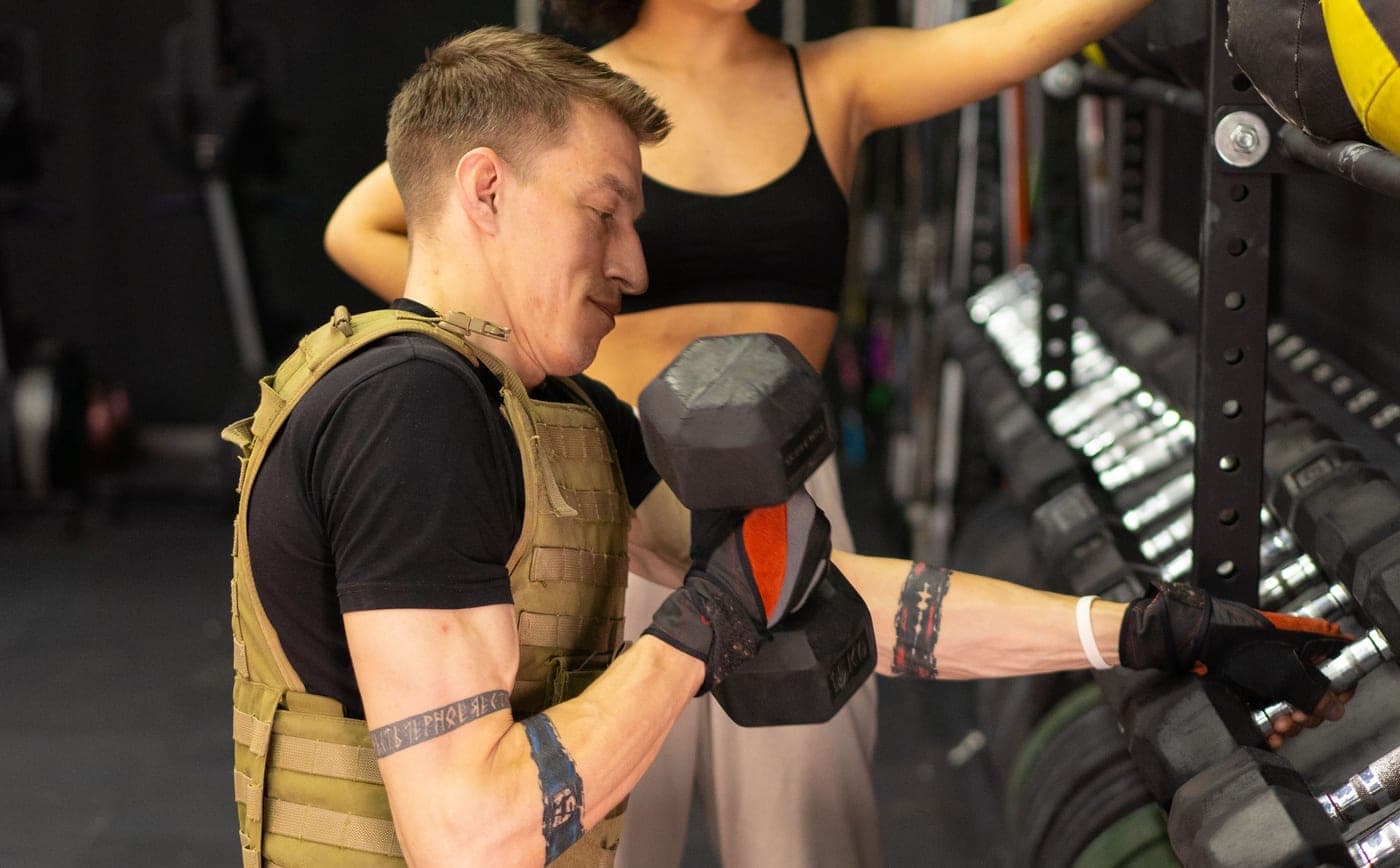
Side view of a person training with a dumbbell and a weighted vest. Licensed stock photograph of the category — not the specific product.
Quick picks
| # | Product | Best for | Score | Price |
|---|---|---|---|---|
| 1 | Hyperwear Hyper Vest FIT (10 lb, women's fit) The only vest here built on a women's contoured pattern: a zip-front CORDURA shell holding twenty half-pound weights to 10 lb — a walking and bone-loading vest, not a pull-up vest. | Loaded walking, hills and daily wear on a torso a unisex pocket vest doesn't fit | 8.1 | |
| 2 | CAP Barbell 20 lb Adjustable Weighted Vest A one-size mesh vest with removable 0.75 lb steel-shot packets to 20 lb, adjustable chest and waist belts and padded shoulders — the cheap entry into weighted pull-ups and walks. | A first light vest to add 5–20 lb to pull-ups, dips and walks | 8.1 | |
| 3 | Hyperwear Hyper Vest ELITE (10 lb, expandable to 42 lb) Hyperwear's heavy one: ships at 10 lb, takes weights to 42 lb total, two-way-stretch CORDURA with a front zip and side lacing — slim enough to walk in, heavy enough to load a pull-up. | One vest for the walk and the bar, when you don't want to own two | 8.5 |
Scores are our editorial judgment from published specs and mounting instructions, weighted for a renter or small-space trainer — not lab measurements. We have not tested these units.
Why the usual ranking is the wrong ranking
Weighted vest roundups rank on capacity, because capacity is the number on the box and the number in the product title. For a 62-year-old who wants to add load to a daily walk, capacity is close to irrelevant: you are never going to use 40 lb, and a vest built to hold 40 lb is a bulkier, heavier, harder-to-fasten object than one built to hold 10.
What decides whether a vest gets used is duller and more practical. Can you get it on by yourself on a morning when your shoulder is stiff? Can you add a pound, rather than being forced to add three? Does it stay exactly where you put it when you walk downhill? Those three questions produce a different order, and this page is that order.
The three, on wearability
| Vest | Getting it on | Smallest step | Load | Fit method |
|---|---|---|---|---|
| Hyper Vest FIT | Front zip | 0.5 lb | To 10 lb | Sized, women's contoured |
| CAP Barbell 20 lb | Over the head, two belts | ~0.75 lb | To 20 lb | One size, chest + waist belts |
| Hyper Vest ELITE | Front zip + side lacing | Micro-weights | 10 lb shipped, 42 lb max | Sized + lacing |
The pick: Hyper Vest FIT
It zips up the front, it is cut on a women's contoured pattern rather than scaled down from a men's one, and it holds twenty half-pound weights for a 10 lb maximum. From $84.99 on Hyperwear's own store, checked 29 September 2026. Every one of those facts is doing work here.
The front zip means you step into it rather than wrestling it over your head. The contoured pattern means the panel sits flush at the chest instead of gapping and then riding up when you cinch the waist — which is the mechanism behind almost every complaint women have about vests, and we go through it in detail on the women's vest page. And the half-pound weights mean your progression can be 3 lb, then 3.5 lb, then 4 lb across a season, rather than a 3 lb jump you feel in your knees the next day.
The 10 lb ceiling is not a limitation for this use. Five percent of a 140 lb body weight is 7 lb. A vest that holds 10 lb covers the useful range, and Hyperwear sells it explicitly for walking and daily loading rather than for the pull-up bar, which is an honest thing for a manufacturer to do.
The cheap alternative, with its catch
The CAP Barbell 20 lb is a fraction of the price and adjusts in roughly three-quarter-pound steps to 20 lb. It is breathable mesh, it washes with the packets out, it has reflective strips for evening walks, and for a lot of people it is a perfectly good first vest.
The catch is how it goes on and how it fits. It is a one-size straight-cut panel held by a chest belt and a waist belt, which means you pull it over your head and then tighten two straps. If overhead shoulder movement is not comfortable, that is a real obstacle, and a vest that is awkward to put on is a vest that stays in the cupboard. It also cannot be made flush — straps adjust circumference, not shape — so on a longer walk it is more likely to shift.
When the ELITE is worth it
If you want to progress past 10 lb, or you want the vest for step-ups and light strength work as well as walking, the ELITE is the one: front zip, sized, side lacing that pulls the whole panel in, thin plates rather than packets, and a 42 lb ceiling you will probably never approach. From $259.95, checked 29 September 2026. It is by a wide margin the most expensive vest on this site.
The reason it is here rather than excluded is the side lacing. On a body shape that a sized vest alone does not quite suit, lacing is the only adjustment that takes the panel in rather than pulling it up, and it is the difference between a vest that moves on a downhill and one that does not.
Load: start lower than the usual advice
The standard starting figure for a weighted vest is about 5% of body weight. For someone who has not trained under load before, starting at 2 to 3% and holding there for a few weeks is the more sensible route — 3 to 4 lb at 140 lb. You are not trying to make the walk hard. You are trying to find out how your back, hips and knees respond to any load at all, and that answer arrives in the second week, not the first session.
Then add half a pound at a time, no more than once every two weeks, and only if nothing new aches. This is the entire argument for a vest with half-pound weights, and it is why the FIT outranks vests that hold twice as much.
Balance is the risk nobody mentions
A vest raises your center of mass slightly and adds mass that moves a fraction of a second after you do. On flat sidewalk in daylight that is nothing. On a curb, a wet leaf, a dark street or a downhill it is a small, real change to your recovery from a stumble.
Practical consequences: walk your first loaded weeks on ground you know, in daylight, without a dog on a lead in one hand. Do not wear a vest on stairs you would normally hold the rail for. And if the vest shifts when you change direction, that is the fit talking, and it is worth fixing before you add another pound.
What we are not going to claim
We are not going to tell you a weighted vest will improve your bone density by any particular amount, or prevent anything. Weight-bearing exercise is broadly and routinely recommended for bone health, and that is as far as an equipment site should go. The specific question — whether added load is right for your bones, your spine and your balance, and how much — belongs to your clinician, who can see your scans. We also will not put a calorie figure on loaded walking, for the reasons on our methodology page.
How this list was built
Closure type, sizing method, weight increment, load range and shell material were read off Hyperwear's own weighted-vest collection and CAP Barbell's own product page on 29 September 2026, along with current prices and stock. Scoring used the site's weighted vest rubric — fit that stays put 30%, adjustability of load 25%, durability 25%, value 20% — with "stays put" read as stays put on a walk and "adjustability" weighted toward the smallest available step. We found no vest from any maker marketed specifically at women over 60, so this page ranks the general-sale vests on the criteria that actually apply. Nothing was tested in a lab; we own no lab and no test units.
The picks in detail
Every pick, reviewed
Key specs
- Weights
- 20 x 0.5 lb, to 10 lb
- Fit
- Women's contoured pattern, sized
- Shell
- CORDURA (PFAS-free), front zip
Scores · editorial, out of 10
- Fit for pull-ups (stays put)
- 8
- Adjustability of load
- 8
- Durability
- 9
- Value
- 7
Pick 1 · Weighted vests
Hyperwear Hyper Vest FIT (10 lb, women's fit)
Hyperwear
The only vest here built on a women's contoured pattern: a zip-front CORDURA shell holding twenty half-pound weights to 10 lb — a walking and bone-loading vest, not a pull-up vest.
Best for
Loaded walking, hills and daily wear on a torso a unisex pocket vest doesn't fit
Why it is #1. Front zip, a women's contoured pattern, and twenty half-pound weights to a 10 lb ceiling. From $84.99 on 29 September 2026. It is the easiest vest here to put on alone and the only one that lets you add half a pound at a time.
Pros
- Cut for a woman's torso and chest rather than cinched down from a men's pattern
- Half-pound weights mean you can start at 3 lb and add a pound at a time
- Front zip and a close fit, so it doesn't ride up on a walk or shift on a hill
Cons
- 10 lb ceiling; it is not a weighted-pull-up vest and isn't sold as one
- Costs more than a 20 lb one-size pocket vest that holds twice the weight
Specs from Hyperwear — Hyper Vest FIT (women's contoured fit, twenty half-pound weights, CORDURA shell).
Key specs
- Weights
- To 20 lb, ~0.75 lb packets
- Fit
- One size, chest + waist belts
- Shell
- Reinforced nylon/polyester mesh
Scores · editorial, out of 10
- Fit for pull-ups (stays put)
- 7
- Adjustability of load
- 9
- Durability
- 7
- Value
- 10
Pick 2 · Weighted vests
CAP Barbell 20 lb Adjustable Weighted Vest
CAP Barbell
A one-size mesh vest with removable 0.75 lb steel-shot packets to 20 lb, adjustable chest and waist belts and padded shoulders — the cheap entry into weighted pull-ups and walks.
Best for
A first light vest to add 5–20 lb to pull-ups, dips and walks
The budget option, with a caveat. Roughly three-quarter-pound packets to 20 lb, breathable mesh, reflective strips, washable, and a fraction of the price. But it goes on over your head and it is a one-size straight cut, so it can never be made truly flush.
Pros
- 0.75 lb packets allow almost any load from 5 to 20 lb
- Breathable mesh; machine-washable with packets removed
- Reflective strips for evening walks
Cons
- 20 lb ceiling — you'll outgrow it if weighted pull-ups become a focus
- Two-belt fit is less secure inverted or on kipping movements
Specs from CAP Barbell — 20 lb Adjustable Weighted Vest (packets, fit, materials).
Key specs
- Weights
- 10 lb shipped, 42 lb total capacity
- Fit
- Sized, front zip plus side lacing
- Shell
- Two-way stretch CORDURA (PFAS-free)
Scores · editorial, out of 10
- Fit for pull-ups (stays put)
- 10
- Adjustability of load
- 9
- Durability
- 9
- Value
- 5
Pick 3 · Weighted vests
Hyperwear Hyper Vest ELITE (10 lb, expandable to 42 lb)
Hyperwear
Hyperwear's heavy one: ships at 10 lb, takes weights to 42 lb total, two-way-stretch CORDURA with a front zip and side lacing — slim enough to walk in, heavy enough to load a pull-up.
Best for
One vest for the walk and the bar, when you don't want to own two
If you want the fit dialed in. Front zip plus side lacing that pulls the whole panel in, sized rather than one-size, thin plates instead of packets. From $259.95 — the most expensive vest on this site, bought for the fit rather than the 42 lb ceiling.
Pros
- 42 lb ceiling in a thin-plate vest — the usual trade between slim and heavy mostly disappears
- Side lacing tightens the whole panel, so the load doesn't swing on a hang
- Same micro-weight system as the PRO, so weights carry across
Cons
- The most expensive vest on this site by a wide margin
- Extra weights are a separate purchase to get past the 10 lb it ships with
Specs from Hyperwear — Hyper Vest ELITE (10 lb shipped, 42 lb capacity, CORDURA shell, side lacing).
Buying guide
Pick on three questions
- Can you put it on alone, easily? Front zip beats over-the-head. That is the Hyper Vest FIT.
- Can you add half a pound? Half-pound weights beat 3 lb packets, every time, for a slow build.
- Does it stay flush? Sized with lacing beats one-size with straps. That is the ELITE, if the budget allows.
Measure three things
Chest at the fullest point, underbust, and torso length from collarbone to waist. The third is why vests ride up and the one nobody checks.
Start at 2 to 3% of body weight
Lower than the usual 5% starting figure, held for a few weeks, then half a pound at a time no more than once a two weeks. Check with your clinician before the first pound.
FAQ
Questions readers ask
What is the best weighted vest for a woman over 60?
The Hyperwear Hyper Vest FIT. It zips at the front so you can get it on without raising both arms overhead, it is cut on a women's contoured pattern so it sits flush instead of riding up, and its twenty half-pound weights let you build load a pound at a time. From $84.99 on Hyperwear's own store, checked 29 September 2026.
How much weight should a woman over 60 start with in a weighted vest?
Lower than the usual advice — around 2 to 3% of body weight, so roughly 3 to 4 lb at 140 lb, held for a few weeks before adding anything. Then half a pound at a time, no more than once every two weeks. Ask your clinician what is appropriate for you before the first session.
Are weighted vests safe for older adults?
It depends on the person, not the vest. Weight-bearing exercise is routinely recommended, and added load is also routinely ruled out for specific conditions — osteoporosis with fracture history, spinal stenosis, recent joint replacement, or a recent fall. That is a conversation with a doctor or physiotherapist who can see your history, and it should happen before you buy.
Does a weighted vest help with bone density?
Weight-bearing exercise is broadly recommended for bone health, and a vest is one way to add load to walking. We are not going to put a number on the effect or promise an outcome — that depends on your starting point, medication and program, and it is your clinician's question, not an equipment site's.
Will a weighted vest affect my balance?
Slightly, and it is worth respecting. A vest adds mass that moves a fraction after you do, which changes how you recover from a stumble. Walk your first loaded weeks on familiar ground in daylight, keep a hand free, and skip the vest on stairs where you would normally use the rail.
Should the vest go over or under a jacket?
Over a close-fitting top and under nothing, ideally. The panel needs to sit against a fitted layer to stay flush — a loose shirt or a coat under the vest bunches and then rubs where it bunches. In cold weather, a thin technical layer under the vest and a jacket left at home works better than a bulky coat beneath it.
Related
Keep reading
- Best weighted vests for women
The fit problem, in full.
- Best weighted vests for walking
Ranked for an hour on foot.
- Weighted vest vs ankle weights
Why ankle load is not the walking answer.
- Best adjustable weighted vests
Ranked on the smallest weight step.
- Bodyweight training for beginners
The unloaded base, first.
Sources