Comparison · Rings & Bars
Suspension trainer vs resistance bands: one moves your bodyweight, the other sets a number
They sell to the same person - renter, no rack, nowhere to drill - and they solve opposite halves of the problem. A suspension trainer makes your own bodyweight adjustable by changing your angle. A band set lets you choose a load in pounds. Which matters depends almost entirely on whether you are pulling or pressing.
Rope & Rep is reader-supported. Product links go through our affiliate resolver and we may earn a commission from qualifying purchases at no cost to you. Prices are the retailer's and change — every button opens the live price on Amazon rather than showing a stale number.
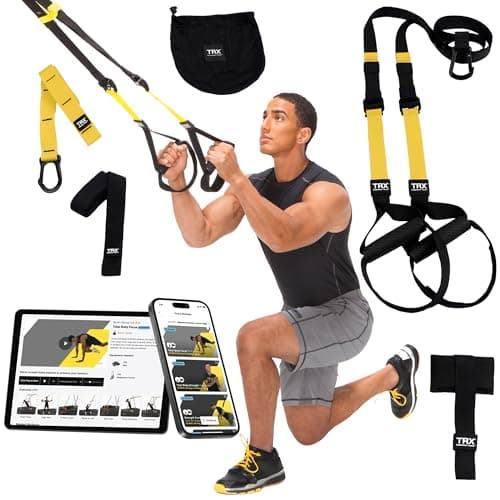
TRX Pro3 Suspension Trainer. Licensed stock photograph of the category — not the specific product.
The one difference everything else follows from
A suspension trainer does not supply any resistance. It is two straps and a pair of handles; the load is your own bodyweight, and the only variable is how much of it you have put on your hands. Walk your feet forward on a row and it gets harder. Stand up more on a push-up and it gets easier. The hardware is an anchor and an angle, nothing more.
A resistance band supplies the load itself and your body position barely matters. Pick a tube and you have chosen a tension range in pounds; stack two and you have chosen a bigger one. You are not adjusting leverage, you are adjusting the spring.
That is a bigger difference than it sounds, because it also inverts the shape of the load through the rep - and the shape of the load is what decides which movements each tool is good at.
The load curves run opposite ways
On a suspension trainer, a pull is hardest at the start. Lying back under the straps, the moment arm on your arms is longest at the bottom of a row and shortens as you pull in toward the anchor. The rep gets easier as you finish it. That is a flattering curve for a pulling movement, because the bottom of a row is where most people are weakest anyway and the tool loads it most.
On a band, everything is hardest at the end. Elastic tension rises as the tube stretches, so the top of a press, the end of a curl and the lockout of a row are the hardest part of the rep. That is an unusual curve and it has two consequences. It is excellent for anything where you want to be strongest at full extension - presses, triceps work, lateral raises, any kind of push. And it is poor at loading the stretched, bottom position of a movement, which is exactly where a pulling muscle wants work.
Which is why the division of labor is so clean. Pulling patterns suit the suspension trainer. Pressing and isolation suit the bands. Almost everything people argue about in this comparison resolves once you notice the curves point in opposite directions.
If you want resistance that behaves like a dumbbell at every point in the rep, neither of these is that tool - that is a weight, and for a small space the honest version of a weight is a kettlebell. Our kettlebell versus bands comparison is the argument between elastic tension and real mass; this page is a narrower one between two no-weight options.
What each one needs before it works
A suspension trainer needs an anchor, every time. There is no suspension exercise without a fixed point above you. In practice that means a door anchor over a solid door that opens away from you, a joist or beam, a tree branch, or a pull-up bar you already own - and if you are a heavier lifter hanging straps from a bar, the bar's published rating becomes the real ceiling, which is what the bars ranked by rated load is about. That requirement is not a footnote - it is the single most common reason a suspension trainer sits in a cupboard. Our suspension trainer roundup is ranked on exactly this and nothing else, because what you can hang one from decides which one to buy.
Bands need an anchor for about half the list. Presses, curls, triceps extensions, lateral raises, upright rows, deadlift patterns and most leg work need nothing but the floor and your feet. Rows, pull-downs, face pulls and chest flys need a door anchor or a fixed point. That makes a band set the more forgiving purchase for a hotel room, a shared house or anywhere you cannot survey in advance.
Side by side
| Suspension trainer | Handled resistance bands | |
|---|---|---|
| Where the load comes from | Your bodyweight, modified by your angle | Elastic tension in the tube, chosen in pounds |
| How you make it harder | Walk your feet in, or lower your body angle | Clip on another tube, or shorten the slack |
| Load curve through the rep | Hardest at the start of a pull, easier as you finish | Easiest at the start, hardest at full extension |
| Loads lighter than bodyweight | Only by standing more upright - limited at the easy end | Yes - a set can start around 3 lb |
| Loads heavier than bodyweight | Only by adding a weighted vest | Yes - a stacked set reaches around 190 lb |
| Anchor needed | Always | For roughly half the exercise list |
| Best at | Rows, inverted rows, assisted squats and lunges, core and anti-rotation work | Presses, curls, triceps, lateral raises, face pulls, rehab-range work |
| Worst at | Pressing progressively, and any kind of isolation | Loading the bottom of a pull, where you are weakest |
| Parts that wear out | Webbing, buckles and the foot cradles | The tubes themselves - latex degrades and eventually fails |
| Pack size | About 2 lb in a mesh bag | A full set with handles and straps fits in a drawer |
Movement by movement
Rows and pulling - the trainer, clearly. An inverted row with your heels on the floor loads a large fraction of your bodyweight through the bottom of the movement, and you adjust it by walking your feet in or out an inch at a time, which is a finer progression than clipping on a tube. A band row is a perfectly good exercise and it is not the same exercise; the tension is lightest exactly where the row should be heaviest.
Pressing - the bands, clearly. A suspension push-up gets easier the more upright you stand, which means your progression runs toward the floor and stops when you are horizontal - at which point you are doing a normal push-up and the straps are decorative. A band press progresses forever: add a tube. For anyone whose pressing is the weak point, that is decisive.
Legs - a draw, and neither is good. The trainer gives you assisted squats, assisted pistols and good split-squat balance, which is real value for a beginner and runs out quickly. Bands give you squats and deadlift patterns whose ceiling is whatever your upper body can hold, which is well below what your legs can do. If legs are the goal, the honest answer is a kettlebell or a sandbag, not either of these.
Core - the trainer, by a distance. Fallouts, body saws, pikes, knee tucks and anti-rotation presses all come from putting your hands or feet in a pair of unstable handles, and that instability is the training effect. A band gives you decent anti-rotation work and nothing resembling a suspended pike.
Isolation and rehab - the bands, by a distance. Lateral raises, external rotations, biceps curls, triceps work, light shoulder-range work after an injury. These all need a load lighter than a fraction of your bodyweight and a tension you can choose precisely, and a suspension trainer cannot produce either.
Pull-ups - neither, and this trips people up. Handled tubes are the wrong tool for assisted pull-ups; that job needs a long loop band around the bar. If that is what brought you here, our assistance band roundup is the right page, and how to get your first pull-up is the plan.
Durability, and what actually fails
Bands are a consumable and nobody says so loudly enough. Latex degrades - with use, with UV, with heat, with time in a hot car - and a tube that fails under tension snaps toward you. This is the one real safety difference between the two categories, and it is also why the internal safety cord in the Bodylastics tubes is the feature worth paying for rather than a marketing line: a tube that fails around a cord goes slack instead of whipping. Plan on replacing tubes periodically and inspect them for nicks and cloudiness before heavy sets.
A suspension trainer mostly does not fail; its anchor does. Industrial webbing and buckles outlast almost any home use. What goes wrong is the attachment - a door anchor on a door that opens the wrong way, a strap over a hollow-core door, a branch that was not as sound as it looked. Check the anchor, not the strap, and take the three minutes to confirm the door opens away from you before the first rep.
So which one
If you own nothing at all and can buy one thing, buy the band set. It covers more of a week's training than the trainer does, it gives you an actual load ladder, it needs no anchor for half its exercise list, and the cheapest competent set costs a fraction of the category-leading trainer. If pulling is specifically what you are missing - you can press and you cannot row - buy the suspension trainer, and buy whichever one suits what you can hang it from. If you already own gymnastic rings, you have the suspension side covered and the only sensible purchase here is bands.
The four picks, and what each one is not
Two from each side, all four already in our registry with their specs read from the maker's own page or listing. The cards below carry the full spec, pros and cons; this is the editorial case for each.
TRX Pro3 — the suspension side's default
The hardware every suspension program assumes you own. Three anchoring solutions ship in the box - a door anchor, a suspension anchor and an extender - which is the reason to pay for it: the single biggest failure mode in this category is having nowhere to hang the thing, and this is the kit least likely to leave you stuck. Barrel-lock adjusters change strap length one-handed mid-set, textured rubber handles, padded adjustable foot cradles, about 2 lb in a mesh bag.
Three honest cautions. It costs three to four times a competent alternative and the money buys hardware rather than exercises. TRX publishes no rated user weight capacity on its own pages - the 1,300 lb figure that circulates is a carabiner test, a different claim. And TRX's own store has moved on to the Pro4, with the locking carabiner exclusive to Pro4 models, so do not assume a Pro3 has one. Also note its own skip line: if you already own rings, the overlap is most of the exercise list.
Lifeline Jungle Gym XT — the better geometry, for a third of the money
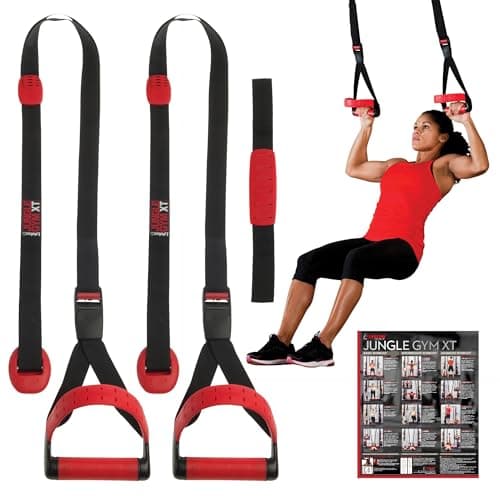
The better geometry at roughly a third of the price. Its split anchor gives you two independent straps rather than a fixed V from one point, which means you can train at ring width, shoulder width or wide - and a neutral, ring-like hand position is exactly what a fixed-V trainer cannot give you. Two non-scuff door anchors ship with it, so it can live on two different doors without buying hardware, and both the length and the spread adjust.
The caveats are disclosure rather than design. Lifeline publishes no rated weight capacity and no strap length on any page we could read, so we have scored that as unverified rather than assuming a number. Independent straps are harder to set level than a single anchor, and an uneven pair is immediately obvious in a press. And it read as unavailable at a Lifeline retail channel on 21 October 2026 while staying live on Amazon - worth a glance at stock before you commit.
Bodylastics 5 Band PRO Set — the band side's answer
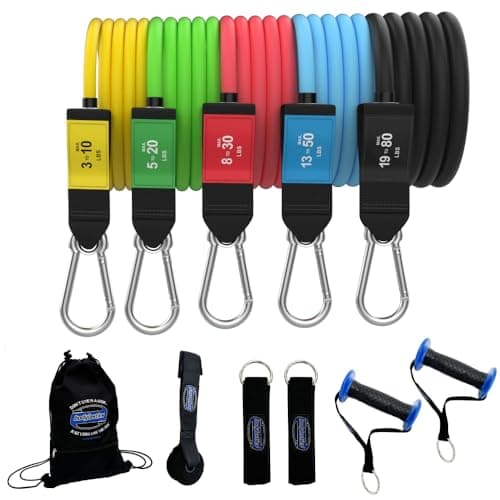
The reason this comparison is not a walkover. Five clip-on latex tubes at 3 to 10, 5 to 20, 8 to 30, 13 to 50 and 19 to 80 lb, which stack to a published 190 lb - so the load ladder is effectively continuous from genuinely light rehab tension up to a load most people will not exhaust. Two handles, two ankle straps, a door anchor and a pack, with no drilling and nothing for a landlord to notice.
The inner safety cord in every tube is the feature to buy this for rather than an unbranded set: a tube that fails around a cord goes slack instead of whipping. Against it - five tubes, clips and two straps is more to keep track of than a pair of dumbbells, and the resistance is not constant through a rep, so the top of a press is far harder than the bottom. And note the limit it states for itself: handled tubes are the wrong tool for assisted pull-ups, which need a long loop band.
Lifeline Resistance Trainer Kit — the simpler band kit
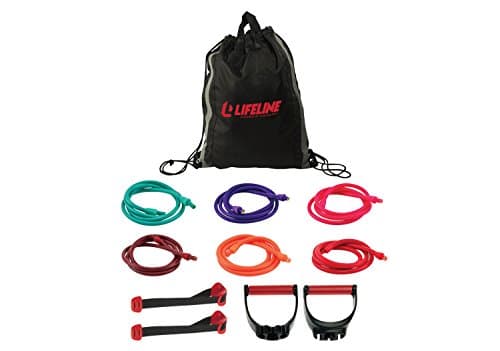
The better one for pressing and rowing each arm independently. It adjusts from 10 to 100 lb, and the cables pull out of a pocket in the grip so resistance changes without unclipping hardware - which in practice means you change load mid-circuit instead of stopping. Triple-grip handles give three hand positions, so your wrist is not locked into one angle through a press. Two handles, a door anchor, 5 ft tubes and a bag; nothing else to buy.
Why it is not the first band pick: it tops out at 100 lb, well short of a stacked set, so it is the wrong buy if you want one purchase to cover 3 lb through 190 lb. The tubes are latex, which rules it out for a household with a latex allergy. Within those limits it is the more pleasant kit to actually use, and the rotating-handle advantage is real on unilateral work.
Picks
The picks for each side
Two suspension trainers and two band kits from our registry - the category original and the split-anchor alternative on one side, the stackable 190 lb set and the adjustable cable kit on the other.
Key specs
- Geometry
- Fixed V from a single anchor point
- Anchors
- Three solutions, incl. a door anchor
- Weight
- About 2 lb; mesh carry bag included
Scores · editorial, out of 10
- Anchor options a renter can actually use
- 10
- Strap geometry (fixed V vs independent straps)
- 8
- Adjusters, buckles & hardware
- 10
- Handles & foot cradles
- 10
- Value
- 8
Pick 1 · Suspension trainers
TRX Pro3 Suspension Trainer
TRX
The trainer the category was built around: three anchor solutions in the box, textured rubber handles, padded adjustable foot cradles and barrel-lock adjusters that move one-handed mid-set.
Best for
Someone who wants the hardware every suspension workout video assumes you own
Why we picked it
- Three anchoring solutions in one box - door anchor, suspension anchor and an extender - so it hangs almost anywhere without a second purchase
- Barrel-lock adjusters shorten and lengthen the straps one-handed, which is the difference between a circuit and a series of pauses
- Textured rubber handles and adjustable padded foot cradles are the most finished hardware in the category
- Every suspension-training program, class and video is written for this geometry
Good to know
Three to four times the price of a competent alternative, and the money buys hardware rather than exercises
Key specs
- Geometry
- Split anchor - two independent straps
- Anchors
- 2 non-scuff door anchors + Duro-Link anchor
- Adjusters
- 2 inline buckles + 2 strap-end adjustors
Scores · editorial, out of 10
- Anchor options a renter can actually use
- 10
- Strap geometry (fixed V vs independent straps)
- 10
- Adjusters, buckles & hardware
- 9
- Handles & foot cradles
- 9
- Value
- 10
Pick 2 · Suspension trainers
Lifeline Jungle Gym XT
Lifeline
Two independent straps on a patented split anchor instead of one fixed V, which lets you train at ring width, at shoulder width or wide - and it ships with two non-scuff door anchors rather than one.
Best for
A renter who wants ring-style independent straps and has only a door to hang them from
Why we picked it
- The split anchor is the real feature: independent straps give you the neutral, ring-like width that a fixed-V trainer cannot
- Two non-scuff door anchors, so it can live on two different doors without buying hardware
- Inline buckles plus strap-end adjustors means both the length and the spread adjust
- Roughly a third of the price of the TRX, with the more versatile geometry
Good to know
Lifeline publishes no rated weight capacity and no strap length on a page we could read - scored as unverified, not as a number
Key specs
- Resistance
- 5 tubes, 3-80 lb each; 190 lb stacked
- Included
- 2 handles, 2 ankle straps, door anchor, pack
- Safety
- Inner safety cord in each tube (snap-reduction design)
Scores · editorial, out of 10
- Resistance range & stacking
- 10
- Handles & attachments
- 10
- Anchor options for a renter
- 10
- Snap safety & build
- 10
- Value
- 9
Pick 3 · Resistance bands with handles
Bodylastics 5 Band PRO Series Set (190 lb max)
Bodylastics
Five clip-on latex tubes (3-10, 5-20, 8-30, 13-50 and 19-80 lb) that stack to 190 lb, with two handles, two ankle straps, a door anchor and a pack — and an inner safety cord in every tube.
Best for
Replacing a rack of dumbbells in an apartment, at any load from 3 lb to 190 lb
Why we picked it
- Clip any combination of tubes to one handle — the load ladder is effectively continuous
- The inner cord is the reason to buy this over an unbranded set: a tube that fails doesn't whip
- The door anchor means no drilling, no wall plate and nothing for a landlord to notice
Good to know
Five tubes, clips and two straps is more to keep track of than a pair of dumbbells
Specs from Bodylastics — 5 Band Pro Series Set (per-tube tensions, contents, price).
Key specs
- Resistance
- Adjustable, 10–100 lb
- Handles
- Triple-grip, with a cable pocket for quick swaps
- Included
- 2 handles, door anchor, 5 ft tubes, carry bag
Scores · editorial, out of 10
- Resistance range & stacking
- 8
- Handles & attachments
- 10
- Anchor options for a renter
- 8
- Snap safety & build
- 10
- Value
- 10
Pick 4 · Resistance bands with handles
Lifeline Resistance Trainer Kit (10–100 lb)
Lifeline
A two-handle cable trainer that adjusts from 10 to 100 lb, with triple-grip handles, 5 ft latex tubes, a door anchor and a carry bag — cables pull out of a pocket in the grip so you can swap or double up.
Best for
Pressing and rowing each arm independently, where a rotating handle genuinely matters
Why we picked it
- Triple-grip handles give three hand positions, so the wrist is not locked into one angle through a press
- Cables come out of the handle pocket, so resistance changes without unclipping hardware
- Arrives as a complete kit — tubes, handles, door anchor and bag, nothing else to buy
Good to know
Tops out at 100 lb — well short of a stacked handled-band set
Specs from Lifeline — Resistance Trainer Kit listing (10–100 lb adjustable range, handles, door anchor, tubes, bag).
FAQ
Questions readers ask
Is a suspension trainer better than resistance bands?
Neither is better in general - they load you in opposite ways. A suspension trainer makes your own bodyweight adjustable by changing your angle, which is excellent for rows and core work and poor for progressive pressing. Bands let you choose a load in pounds, which is excellent for pressing, isolation and light rehab-range work and poor at loading the bottom of a pull. If you can only buy one and own nothing else, the band set covers more of a week.
Can resistance bands replace a TRX?
For pressing and isolation work, comfortably. For the suspension trainer's best exercises - inverted rows, suspended pikes, body saws, knee tucks - no, and nothing elastic will, because the training effect there comes from hanging in an unstable pair of handles. What can replace a suspension trainer is a pair of gymnastic rings, which do the same jobs and more for less money. Rings versus TRX works that through.
Which is better for building muscle?
The one that lets you add load over time for the movement you are training, which is the bands for pressing and the trainer for pulling. The suspension trainer's ceiling is your bodyweight at the steepest angle you can hold, and once you reach it the only way up is a weighted vest. A stackable band set keeps adding tension to about 190 lb. Neither replaces real mass for legs - that is a kettlebell or a sandbag.
Do I need a door anchor for both?
You need an anchor for every suspension exercise - there is no suspension movement without a fixed point above you. For bands you need one for roughly half the list: rows, pull-downs, face pulls and flys. Presses, curls, triceps work, raises and most leg work need nothing but the floor. That makes a band set the easier thing to travel with, because you are not depending on finding a suitable door.
Which is safer?
The suspension trainer, marginally, and for a specific reason: the thing that fails on a band is the latex tube, and it fails toward you. Latex degrades with use, heat and UV, so bands are a consumable to inspect and replace - and a set with an internal safety cord is worth the premium because a tube that fails around a cord goes slack instead of whipping. On a suspension trainer the webbing rarely fails; the anchor does, so the check is the door or the beam rather than the strap.
Can I use both together?
That is the best answer if the budget allows, and together they still cost less than one mid-range kettlebell. They divide cleanly: the trainer takes rows, assisted leg work and the whole suspended core list; the bands take presses, isolation and anything that needs a load lighter or heavier than your bodyweight at an angle. Our apartment gym setup guide puts both into a corner-sized kit.
Which is better for a beginner?
Bands, in most cases. A beginner needs loads lighter than bodyweight far more often than they need loads heavier, and a band set starting around 3 lb gives you that where a suspension trainer cannot. The exception is a beginner whose goal is a pull-up: in that case the inverted row on a suspension trainer is the single most useful exercise either tool offers, and it belongs in a pull-up progression from week one.
How much weight can a suspension trainer hold?
Nobody in the category publishes a rated user capacity, and we are not going to invent one. TRX publishes a 1,300 lb carabiner test figure, which is a claim about one component rather than about the system; Lifeline publishes no rated capacity at all on any page we could read. The practical limit is the anchor you hang it from - a door, a beam, a joist - which is also where the real risk sits. How to hang rings and straps at home covers the anchoring options properly.
Related
Keep reading
- Best suspension trainers
Four trainers, ranked by what you can hang them from.
- Best resistance bands with handles
The band side in full, ranked on the load ladder.
- Gymnastic rings vs TRX
Why rings usually beat a trainer - unless a door is your only anchor.
- Kettlebell vs resistance bands
Elastic tension against real mass, for the same corner.
- Apartment gym setup
Where both of these fit in 40 square feet.
Sources
- —TRX - PRO system product page, read 21 October 2026 (door anchor, suspension anchor and Xtender included, textured rubber handles, adjustable padded foot cradles, 2 lb, mesh carry bag, two-year warranty, locking carabiner exclusive to Pro4 models, PRO4 priced $289.95), cross-read against the Power Systems TRX Pro listing (1,300 lb-tested carabiner, equalizing and locking loops, barrel lock adjusters, three anchors). The ASIN above is the Pro3, the version live on Amazon the same day; no maker page publishes a rated user weight capacity. · trxtraining.com
- —Lifeline Jungle Gym XT retail product page, read 21 October 2026 (patented split anchor for wider angles of resistance, two non-scuff door anchors, two strap-end adjustors, industrial-strength straps with adjustable inline buckles, easy-in foot cradles, workout wall chart; no rated capacity, strap length or product weight published). lifelinefitness.com would not return a readable product page to an automated read on the same day. · elitefts.com
- —Bodylastics — 5 Band Pro Series Set (per-tube tensions, contents, price) · bodylastics.com
- —Lifeline — Resistance Trainer Kit listing (10–100 lb adjustable range, handles, door anchor, tubes, bag) · amazon.com