Best for Heavy Users · Pull-Up Bars
The best pull-up bars for heavy people: the rating on the box is the bar's, not your door frame's
Every doorway bar on the market publishes a number between 300 and 500 pounds, and not one of those numbers describes the piece of pine trim the bar is resting on. If you are over about 230 pounds, the question stops being which bar and becomes what is carrying you.
Rope & Rep is reader-supported. Product links go through our affiliate resolver and we may earn a commission from qualifying purchases at no cost to you. Prices are the retailer's and change — every button opens the live price on Amazon rather than showing a stale number.
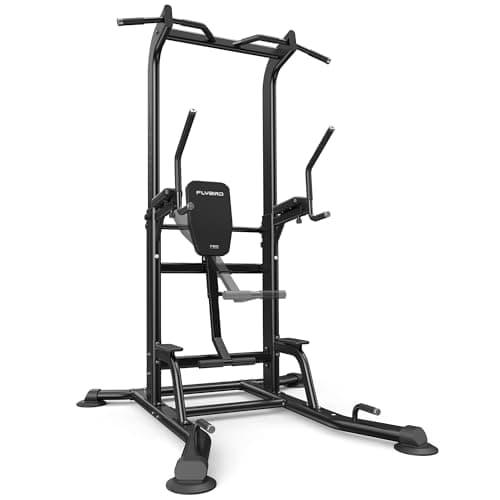
FLYBIRD Heavy-Duty Power Tower. Licensed stock photograph of the category — not the specific product.
Quick picks
| # | Product | Best for | Score | Price |
|---|---|---|---|---|
| 1 | FLYBIRD Heavy-Duty Power Tower The heaviest free-standing frame here: 104.5 lb of steel on a widened base with four non-slip feet, rated to 800 lb, with nine bar heights, four dip-handle positions and twelve foot-bar positions — and a core station you can load with plates or bands. | A garage tower that does not move, for a heavy lifter who wants to add load | 9.3 | |
| 2 | 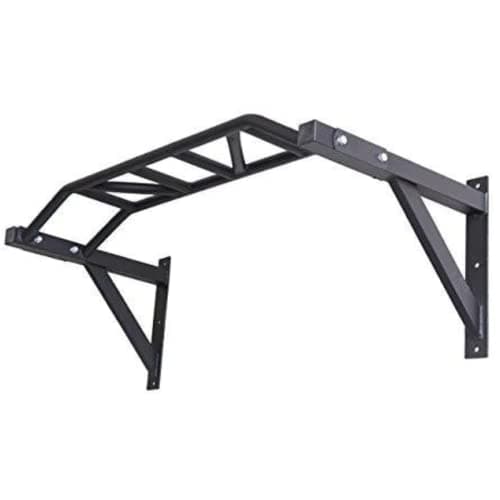 Gronk Fitness Wall Mounted Multi-Grip Pull Up Bar A commercial-grade stud-mounted station: 37 lb of powder-coated steel, a published 800 lb capacity, multiple grip positions and an assembled 49 × 24 × 20 in. frame — the one wall bar here you can hang rings and bands from without thinking about it. | A garage wall you are allowed to drill, where the bar has to outlast the house | 8.9 | |
| 3 | 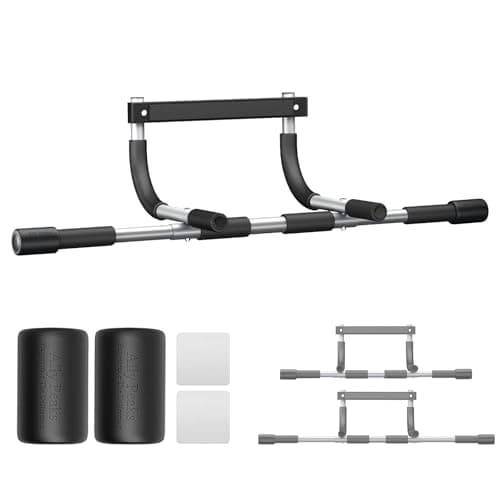 Ally Peaks Pull Up Bar for Doorway A heavier-gauge leverage bar: 1.7 mm thickened chrome steel rated to 500 lb, elastic silicone frame pads, three grips and five width settings — the one to buy if you're big or plan to add a vest. | Heavier lifters or weighted pull-ups in a standard doorway | 9.3 | |
| 4 | 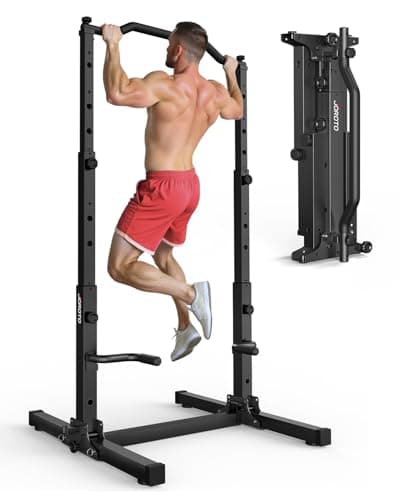 JOROTO Foldable Pull Up Dip Station The free-standing bar that folds: 2 mm steel rated 450 lb, a top bar with four heights from 40.4 to 82.8 in., seven dip-bar positions, levelling knobs for an uneven floor, and a collapsible base that packs down to a 41.5 in. footprint. | An apartment or shared room where the bar has to disappear between sessions | 9.2 | |
| 5 | 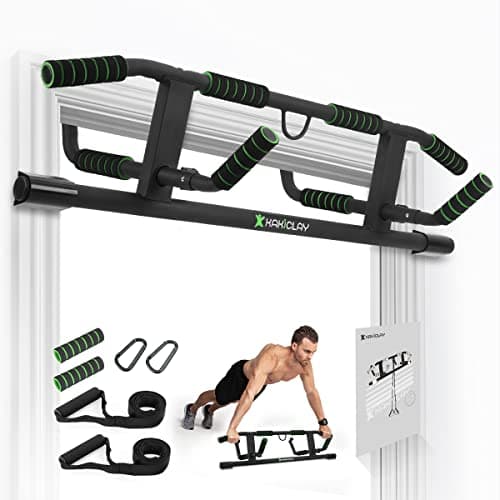 KAKICLAY Multi-Grip Pull Up Bar A leverage bar with oversized hooks that fit 21.7 to 36.2 in. doors, 440 lb rating and a foldable option — the widest range plus the highest rating in one bar. | Narrow closets and wide doorways alike, with a 440 lb margin | 9.4 |
Scores are our editorial judgment from each maker's published specs and mounting instructions, weighted for a renter or small-space trainer.
Why this page exists separately from the main roundup
Our main pull-up bar roundup ranks by the space you have, because for most readers space is the binding constraint. If you are a heavier lifter, it is not. You can have a perfect 32 in. doorway, 9 ft of ceiling and all the floor in the world, and still have the one problem that page does not solve: the bar that fits is rated for 300 lb and you weigh 260.
That is a real and common situation, and the honest answer is not “you'll be fine.” It is that the purchase changes. A heavier lifter should be shopping for a load path first and a product second, which is the reverse of how the category is sold. Everything below is ordered on published rated load, highest first, and the editorial work of the page is explaining which of those numbers you can actually use.
The arithmetic nobody puts on the box
Your dead-hang is not your peak load. Hanging still from a bar puts roughly your bodyweight into it. Pulling hard from the bottom, kipping, or jumping up to the bar and catching it puts in a multiple - the force is your mass times the acceleration you add, and the acceleration is the part that varies. Nobody publishes a figure for the home-gym case, and we are not going to invent one. What we will say is that the margin people assume is there usually is not: if you weigh 250 lb, a 300 lb bar gives you 50 lb of headroom on a movement you are deliberately trying to make explosive. That is why this page starts at 440 lb and goes up.
Then add what you are wearing. A weighted vest, a dip belt or a kettlebell between the ankles goes straight onto the same number. Our weighted vest guide for pull-ups talks about 20 to 40 lb as a normal working load, and a dip belt will take you well past that. A 260 lb lifter in a 30 lb vest is a 290 lb hanging load before anything moves.
And then find the weakest link, because it is not the bar. This is the part that matters most and gets written about least. A leverage-style doorway bar does not hang from the door frame - it uses the frame as a fulcrum and presses a backplate against the wall above the opening. The load ends up spread across the trim, the frame and the drywall behind it. Those components have a capacity too. It is not published anywhere, it varies with the age of the building, whether the trim is solid wood or finger-jointed pine, and whether anyone hit the studs when they installed it. We have a whole page on whether doorway bars damage door frames and how to check yours, and for a heavier lifter it is required reading before you buy anything from the doorway half of this list.
The criteria, in the order they matter here
1. Published rated load. This page is ordered by it, highest first. Not because the number is a certification - none of these is third-party tested as far as any maker publishes - but because it is the one comparable figure in the category, and a maker who prints 800 lb has made a different engineering decision from one who prints 300 lb. Where two products tie, the tiebreaker is the load path (see below).
2. Where the load goes. Three routes, in descending order of how much of the building you have to trust. Free-standing puts everything into the floor through the frame's own base - no frame, no studs, no trim, nothing you do not own. Wall or ceiling mounted puts it into structural lumber, which is strong but requires you to find it, hit it and be allowed to drill it. Leverage doorway puts it into trim and drywall, which is the only route available to most renters and the one with the biggest unpublished unknown. Our doorway vs wall-mount vs free-standing guide walks the whole decision for any bodyweight.
3. What the maker publishes besides the rating. Steel gauge, tube wall thickness, frame weight, assembled dimensions. A brand that publishes 14-gauge tubing and a 104.5 lb frame weight has given you something to check the rating against. A brand that publishes only “800 LBS” in a listing title has not, and this page scores that difference rather than ignoring it.
4. Frame mass, for anything free-standing. A tower that is rated for 800 lb and weighs 40 lb will not fall over, but it will flex and walk. Heavy lifters notice this far more than light ones, because the same movement puts more sideways energy into the frame. Mass is the cheap fix and it is always published.
The five, by the number on the box
| Bar | Rated load | Load path | What else the maker publishes | Drilling? |
|---|---|---|---|---|
| FLYBIRD Heavy-Duty Power Tower | 800 lb | Free-standing - into the floor | 104.5 lb frame, widened base, 4 non-slip feet, 9 bar heights | None |
| Gronk Fitness Wall Mounted Multi-Grip | 800 lb | Wall studs | 37 lb of powder-coated steel, assembled 49 x 24 x 20 in. | Yes - lag bolts into studs |
| Ally Peaks Doorway Bar | 500 lb | Leverage on the door frame | 1.7 mm thickened chrome steel, 5 width levels, silicone frame pads | None |
| JOROTO Foldable Pull Up Dip Station | 450 lb | Free-standing - into the floor, and it folds | 2 mm steel, 4 bar heights 40.4-82.8 in., 7 dip positions, levelling knobs | None |
| KAKICLAY Multi-Grip Pull Up Bar | 440 lb | Leverage on the door frame | Fits 21.7-36.2 in. doors, trim to 3.5 in. on some models | None |
What we did not rank, and the honest gap in this category
We did not rank any bar whose only published spec is the rating itself, and in the heavy-duty end of this category that excludes a lot of listings - you will find doorway bars claiming 500, 600 and 800 lb from brands that publish no steel gauge, no tube thickness and no maker's page at all. A number with nothing behind it is not a stronger bar, it is a bolder listing. We also left out the whole ceiling-mount route from the ranking, not because it is weak but because its real capacity is your joists, which is a number we cannot see from here; the joist-mounting guide is the right page for that and the ceiling-mount roundup ranks the hardware.
The gap worth naming: nobody in home fitness publishes a load-test standard. In commercial gym equipment there are published standards and stated test loads. In the doorway-bar aisle there is a number in a listing title. We have ranked on those numbers because they are the only comparable data that exists, and we would rather tell you that plainly than imply a rating means more than it does.
The picks in detail
Every pick, reviewed
Key specs
- Height
- 9 bar settings; fits users to 6 ft 6 in.
- Frame
- 104.5 lb steel, widened base, 4 non-slip feet
- Rated load
- 800 lb
Scores · editorial, out of 10
- Fit & clearance (door, ceiling, depth)
- 9
- Reversibility (no drill, no marks, takedown)
- 10
- Rated load & build
- 10
- Grip options
- 10
- Value
- 9
Pick 1 · Pull-up bars
FLYBIRD Heavy-Duty Power Tower
FLYBIRD
The heaviest free-standing frame here: 104.5 lb of steel on a widened base with four non-slip feet, rated to 800 lb, with nine bar heights, four dip-handle positions and twelve foot-bar positions — and a core station you can load with plates or bands.
Best for
A garage tower that does not move, for a heavy lifter who wants to add load
First, and the one to buy if you are heavy and cannot or will not drill. Two things put it here. The rating is 800 lb, which is the joint highest number on this page and nearly twice what any doorway bar claims. And the load path is the only one that touches nothing you do not own: it goes down the frame, through four non-slip feet, into the floor. No trim, no studs, no landlord, no stud finder, no unknown.
The 104.5 lb frame weight is the spec that matters second, and it is the reason this tower rather than a cheaper 800 lb claim. Mass is what stops a free-standing frame flexing and walking under a heavy lifter, and a hundred pounds of steel on a widened base does not move the way a 40 lb tower does. Nine bar heights, four dip-handle positions and twelve foot-bar positions mean it fits a tall heavy lifter as well as a short one - relevant here, because bar height and bodyweight are independent problems and a lot of people have both.
Three honest marks against it. It is among the most expensive towers on this site, and for a reader whose constraint is money rather than load that is disqualifying on its own. It ships in two boxes that may arrive on different days, which is a genuinely annoying thing to discover on a Saturday. And 104.5 lb assembled means it is furniture: you build it where it lives and it does not move to vacuum. If any of those three is a problem, the folding option at number four is the better purchase even though it is rated 350 lb lower.
Why we picked it
- 800 lb rating and 104.5 lb of frame — the only tower here that does not flex under a kip
- Seated leg-raise station takes plates or bands, so core work progresses instead of plateauing
- Nine bar heights, four dip positions and twelve foot-bar positions — it fits whoever is using it
Good to know
Ships in two boxes that may arrive on different days
Specs from FLYBIRD — Heavy-Duty Power Tower listing (frame weight, base, rating, adjustment positions, warranty).
Key specs
- Mounting
- Wall studs; assembled 49 × 24 × 20 in.
- Grips
- Multi-grip — wide, neutral and close positions
- Rated load
- 800 lb
Scores · editorial, out of 10
- Fit & clearance (door, ceiling, depth)
- 9
- Reversibility (no drill, no marks, takedown)
- 7
- Rated load & build
- 10
- Grip options
- 10
- Value
- 9
Pick 2 · Pull-up bars
Gronk Fitness Wall Mounted Multi-Grip Pull Up Bar
Gronk Fitness
A commercial-grade stud-mounted station: 37 lb of powder-coated steel, a published 800 lb capacity, multiple grip positions and an assembled 49 × 24 × 20 in. frame — the one wall bar here you can hang rings and bands from without thinking about it.
Best for
A garage wall you are allowed to drill, where the bar has to outlast the house
Second, and first if you are allowed to drill. Same 800 lb published rating, and a better rating-per-dollar than the tower, with the highest build score of anything in our pull-up bar registry. It bolts to wall studs, which means the load goes into structural lumber rather than into trim - the second-strongest route available and the one most garage owners should take. 37 lb of powder-coated steel in an assembled 49 x 24 x 20 in. frame, with wide, neutral and close grip positions.
The powder-coated smooth tube deserves a line of its own for this reader. Heavier lifters spend more of a set fighting their grip, and a knurled or welded-seam bar chews hands and band loops in a way a smooth coated tube does not. It is also a deliberate anchor point for rings, ab straps and bands, so at 800 lb you can hang rings from it and keep adding load for years.
Why it is second rather than first: lag bolts into studs is a drilled installation, full stop, which rules it out for the renter this site is mostly written for. It is a two-person job to hold 37 lb of steel at 49 in. wide while you bolt it. It is the most expensive wall bar in our registry by a clear margin. And the maker publishes a capacity, a coating, an assembled size and a weight - but not a steel gauge, so the 800 lb figure has slightly less behind it than the frame weight on the FLYBIRD does.
Why we picked it
- 800 lb rated, which takes a heavy adult plus a weight vest and a band without a second thought
- Powder-coated smooth tube — it does not shred hands or band loops the way a knurled or welded bar does
- A deliberate anchor for rings, ab straps and bands, so one mount becomes the whole wall setup
Good to know
Lag bolts into studs: this is a drilled installation and not a renter's option
Specs from Gronk Fitness — Wall Mounted Multi Grip Pull Up Bar listing (capacity, coating, assembled size, weight).
Key specs
- Door width
- 5 width levels, 2 thickness levels
- Mounting
- Leverage, no screws
- Rated load
- 500 lb
Scores · editorial, out of 10
- Fit & clearance (door, ceiling, depth)
- 9
- Reversibility (no drill, no marks, takedown)
- 10
- Rated load & build
- 10
- Grip options
- 9
- Value
- 9
Pick 3 · Pull-up bars
Ally Peaks Pull Up Bar for Doorway
Ally Peaks
A heavier-gauge leverage bar: 1.7 mm thickened chrome steel rated to 500 lb, elastic silicone frame pads, three grips and five width settings — the one to buy if you're big or plan to add a vest.
Best for
Heavier lifters or weighted pull-ups in a standard doorway
Third overall and the pick for the reader this page was mostly written for: heavy, renting, no drilling, no floor space for a tower. At a published 500 lb it is the highest-rated doorway bar in our registry, and the rating has something behind it - Ally Peaks publishes 1.7 mm thickened chrome steel, which is the kind of figure you can sanity-check a rating against. Five width settings and two thickness settings, three grip positions, and double silicone pads on the frame contacts rather than bare foam.
The silicone pads matter more at a heavy bodyweight than they sound like they do. Every pound you add presses the contact points harder into the trim, so the difference between a flat padded contact and a narrow bare one is the difference between a mark and a dent. Our doorway bar roundup ranks on exactly that frame contact for a lighter reader, and the two pages agree about this bar for different reasons.
The costs. The 500 lb rating is the bar's and not your frame's, which is the whole argument of this page and the reason a 500 lb doorway bar ranks below a 450 lb tower in our build score. Heavier steel means a heavier bar to lift into position every session, and at this bodyweight you will be checking the seat of the hooks every time. And it still relies on the frame rather than screws: if the trim above your door is split, hollow or badly installed, no rating on the box fixes that.
Why we picked it
- 500 lb rating from 1.7 mm thickened chrome steel — a big margin over the 300 lb standard bars
- Double silicone pads on the frame contacts instead of bare foam
- Non-slip foam handles at wide, narrow and neutral spacing
Good to know
Five width settings cover narrow and wide frames, but the bar still relies on the frame, not screws
Key specs
- Height
- 4 levels, 40.4–82.8 in.; 82 in. tall assembled
- Footprint
- 44 × 41 in.; folds to a 41.5 in. footprint
- Rated load
- 450 lb
Scores · editorial, out of 10
- Fit & clearance (door, ceiling, depth)
- 9
- Reversibility (no drill, no marks, takedown)
- 10
- Rated load & build
- 10
- Grip options
- 8
- Value
- 8
Pick 4 · Pull-up bars
JOROTO Foldable Pull Up Dip Station
JOROTO
The free-standing bar that folds: 2 mm steel rated 450 lb, a top bar with four heights from 40.4 to 82.8 in., seven dip-bar positions, levelling knobs for an uneven floor, and a collapsible base that packs down to a 41.5 in. footprint.
Best for
An apartment or shared room where the bar has to disappear between sessions
Fourth on rating and arguably the best all-round purchase on this page for a heavy renter. 450 lb published on 2 mm steel - and unlike the two doorway bars above and below it, all 450 lb of that goes into the floor. It carries the highest build score in our registry alongside the Gronk wall bar, and it is the only free-standing frame here that genuinely folds: the collapsible base packs down to a 41.5 in. footprint, which is what makes a 450 lb-rated station viable in a one-bedroom flat.
Two details are worth more to a heavy lifter than the fold is. The levelling knobs on the base kill the rock a tower develops on an uneven garage slab, and a heavier user feels that rock much sooner than a light one. And the 40.4 in. low bar setting turns it into a dip and row station, which is how a heavy beginner should actually be training before they are pulling reps - rows at a bodyweight you can handle beat failed pull-ups at one you cannot. The same logic runs through the free-standing roundup.
Against it: it is the most expensive free-standing bar in our registry, 65 lb assembled, and folding it is a chore rather than a flick of the wrist - do not buy it imagining a daily pack-down. The instructions are also specific that the bolts must be fully tightened only after the whole frame is assembled, which is exactly the step a heavy user cannot afford to skim. And 450 lb is 350 lb less headroom than the top two, so if you are at the far end of this page's audience and planning to add a vest, buy up.
Why we picked it
- It genuinely folds — the collapsible base is why this works in a flat where a fixed tower does not
- Levelling knobs on the base kill the wobble a tower gets on an uneven garage slab
- The 40.4 in. low setting turns it into a dip and row station, and doubles as a kid's bar
Good to know
The most expensive free-standing bar here
Key specs
- Door width
- 21.7–36.2 in. (trim to 3.5 in.)
- Mounting
- Leverage, no screws
- Rated load
- 440 lb
Scores · editorial, out of 10
- Fit & clearance (door, ceiling, depth)
- 10
- Reversibility (no drill, no marks, takedown)
- 10
- Rated load & build
- 10
- Grip options
- 9
- Value
- 9
Pick 5 · Pull-up bars
KAKICLAY Multi-Grip Pull Up Bar
KAKICLAY
A leverage bar with oversized hooks that fit 21.7 to 36.2 in. doors, 440 lb rating and a foldable option — the widest range plus the highest rating in one bar.
Best for
Narrow closets and wide doorways alike, with a 440 lb margin
Fifth, and the answer when the doorway is the wrong size for everything else. 440 lb published, and a fit range nothing else here touches: 21.7 to 36.2 in., which covers closet doors at one end and 36 in. openings at the other. Oversized hook faces spread the load over more of the trim than a standard bar does, which is a real advantage at a heavy bodyweight even though it is sold as a fit feature.
If your only option is a doorway and that doorway is not a standard 28 to 32 in., this is very likely the strongest bar that will physically fit it - and “fits and is rated 440 lb” beats “rated 500 lb and does not fit.” Our wide door frame page has the full measuring exercise if you are near the limits.
Why last. It is the lowest rating on the page, and it is a leverage bar, so it carries both the lower number and the unpublished frame unknown at the same time. KAKICLAY also sells several models under similar listings whose depth requirement varies from 4.7 to 8.3 in. and whose trim tolerance is 3.5 in. on some and only 2.6 in. on others - at a heavy bodyweight, buying the wrong variant is not a cosmetic mistake, so confirm which one is in the box before it goes up. And the maker publishes no steel gauge, so the 440 lb is a number with less behind it than the Ally Peaks figure above.
Why we picked it
- Fits doors as narrow as 21.7 in. — closets and small-bathroom doors — up to 36.2 in.
- 440 lb rating; foldable version stores flat
- Larger hook faces spread the load over more of the trim
Good to know
Needs 4.7–8.3 in. of door depth depending on the model — check which one you're buying
Specs from KAKICLAY — Multi-Grip Pull Up Bar listing (door range, depth, trim, capacity).
Buying guide
How to pick, in four questions
Can you drill? If yes, and you have a garage or a wall with locatable studs, stop here and buy the Gronk wall mount. 800 lb into structural lumber is the strongest answer on this page and it costs less than the tower. If no, do you have about 9 sq ft of permanent floor? Then the FLYBIRD tower, which gives you the same 800 lb with no fasteners anywhere. If no, can the frame fold between sessions? Then the JOROTO, which is 450 lb into the floor and packs to a 41.5 in. footprint. If none of those - doorway only? Then the Ally Peaks if your door is standard and the KAKICLAY if it is not, and read the frame-check callout above before the first rep.
What to do if you already own a 300 lb bar
Do not panic and do not necessarily replace it. A 300 lb bar is fine for a 300 lb-and-under dead hang and for slow, controlled work - negatives, scapular pulls, assisted reps with a band. What it is not fine for is kipping, jumping up to catch the bar, or adding a vest. If that describes your training and you are near the rating, the cheap intermediate step is to change the movement rather than the hardware: band-assisted reps put less peak load into a bar than a failed explosive one, and the assistance band roundup covers that properly. Replace the bar when you start loading up, not when you read a number.
Weighted work at a heavy bodyweight
This is where ratings get consumed quickly, and it is worth being blunt about the order of operations. Add load only once you can do clean, controlled reps at bodyweight. When you do, the load goes onto the same published rating as your bodyweight, so a 260 lb lifter with a 30 lb vest is working at 290 lb and every 300 lb bar in the category is out. Our pages on vests for pull-ups and vest versus dip belt cover which implement suits which movement; the relevant point for this page is that both of them spend your bar's margin.
Grip, which gets harder faster than you expect
At a heavier bodyweight your grip is loaded more than a lighter lifter's for the same set, so bar diameter and finish stop being a comfort question. A smooth powder-coated tube of moderate diameter is the easiest thing to hold for the longest; a very thick bar is harder to grip and a knurled one abrades. This is the single most common reason a heavy beginner's sets end before their lats do, and it is worth factoring into the choice when two bars are otherwise close. It is also an argument for a station with multiple grip positions, because rotating between wide, neutral and close spreads the work across different parts of the hand.
Installation checks that matter more at this weight
Free-standing: build on the flattest part of the floor, tighten every bolt only after the frame is fully assembled where the instructions say so, and re-check the fasteners after the first week - a heavy user beds a new frame in faster. Wall mounted: find the studs with a finder and confirm with a small pilot hole, use the lag bolts the maker supplies rather than whatever is in the drawer, and never mount into drywall anchors at any bodyweight. Doorway: check the hooks sit flat on solid frame rather than on a molding bead, hang with both feet down first, and look at the trim after the first few sessions for compression marks. Our door frame damage page has the full inspection.
How this list was built
Every product here is already in our registry with its specs read from the maker's own page or listing, named under each product, and every one was re-confirmed as a live purchasable listing on 4 November 2026 through our price pipeline. The order on this page is deliberately not the registry's weighted overall score: it is published rated load, highest first, with ties broken by which load path is available without drilling. That is a different ordering from every other pull-up bar page on this site, all of which rank on fit, reversibility or bar height. Ratings are manufacturer figures and not third-party certifications - no maker in this category publishes a test standard, and where a maker publishes only a number with no gauge or thickness behind it, the entry says so. The methodology page sets out exactly what our scores are and are not.
FAQ
Questions readers ask
What is the best pull-up bar for a heavy person?
If you can drill, the Gronk Fitness wall-mounted multi-grip bar at a published 800 lb into wall studs. If you cannot drill, the FLYBIRD heavy-duty power tower - the same 800 lb rating, carried into the floor by a 104.5 lb frame, with no fasteners anywhere. For a doorway only, the Ally Peaks bar is the highest-rated doorway bar in our registry at 500 lb, but read the frame-check callout first: that number describes the bar, not your trim.
Can a 300 lb person use a doorway pull-up bar?
On the bar's published numbers, a 440 or 500 lb doorway bar has margin for a 300 lb dead hang. The real question is the door frame, and no manufacturer publishes a capacity for that because they cannot see your building. At 300 lb we would take the free-standing route if there is any floor for it at all, and if a doorway is genuinely the only option, inspect the trim for flex and splitting first, keep the work slow and controlled rather than explosive, and check the trim again after a few sessions.
How much weight can a pull-up bar hold?
Published ratings in this category run from about 300 lb on standard doorway bars to 800 lb on the heaviest wall mounts and towers - the five bars on this page are 440, 450, 500, 800 and 800 lb. Every one of those is a manufacturer figure rather than a third-party certification; nobody in home fitness publishes the test standard behind their number. And on any mounted bar, the lower limit is usually whatever the bar is attached to, not the bar.
Do I need a heavy-duty pull-up bar if I weigh 250 lb?
For slow controlled work, a 300 lb bar has 50 lb of margin, which is thin but real. For kipping, jumping up to the bar, or anything with a vest or a dip belt, no - 250 lb plus a 30 lb vest is 280 lb before you accelerate, and the margin is gone. The honest answer is that the bodyweight number matters less than what you do on the bar. If your training is explosive or loaded, buy up.
Is a power tower better than a wall-mounted bar for a heavy lifter?
Neither is stronger in principle - the best of each here is rated 800 lb. The difference is the load path. A wall mount transfers into structural studs, which is extremely strong but needs a drill, a stud finder and permission. A tower transfers into the floor through its own base, which needs nothing but floor and frame mass. For a renter the tower is the better buy; for a garage owner the wall mount costs less for the same rating. Our pull-up bar vs power tower comparison works through the rest of the trade.
Will a pull-up bar damage my door frame if I am heavy?
It can, and the risk rises with bodyweight because every pound presses the contact points harder into the trim. Sound, solid trim with a padded wide-contact bar usually survives; split, hollow or badly installed trim may not. The checks are the same whatever you weigh, they just matter more: our door frame page has the inspection in full, and a bar with flat silicone or foam pads over a wide contact area is the one to choose.
Are the 800 lb ratings on pull-up bars real?
They are real published manufacturer ratings, not independently certified test results, and that distinction is worth holding on to. What separates a credible 800 lb from a bold one is whether the maker publishes anything else - steel gauge, tube wall thickness, frame weight, assembled dimensions. The two 800 lb products on this page publish frame weight and assembled size; plenty of listings elsewhere publish a big number and nothing at all, and those are not on this page.
What should a heavy beginner buy first?
Not the strongest bar - assistance. A pair of assistance bands and the progression in how to get your first pull-up will get you further in three months than any frame will, and band-assisted reps and negatives put much less peak load into a bar than explosive attempts do. Buy the heavy-duty station when you are pulling for reps or adding external load.
Related
Keep reading
- Best pull-up bars for home
The main roundup, ranked by the space you have rather than the load.
- Do doorway bars damage door frames?
The frame inspection every heavy lifter should do before hanging anything.
- Doorway, wall-mount or free-standing?
Four questions that settle the load path before you shop.
- Best free-standing pull-up bars
The no-drill route in full, ranked on footprint and stability.
- Best weighted vests for pull-ups
What adding load does to the number on your bar.
Sources
- —FLYBIRD — Heavy-Duty Power Tower listing (frame weight, base, rating, adjustment positions, warranty) · amazon.com
- —Gronk Fitness — Wall Mounted Multi Grip Pull Up Bar listing (capacity, coating, assembled size, weight) · amazon.com
- —Ally Peaks — Pull Up Bar for Doorway listing (steel gauge, 500 lb capacity, width and thickness adjustment, silicone pads) · amazon.com
- —JOROTO — Foldable Pull Up Dip Station listing (capacity, steel gauge, heights, dip positions, folded footprint, weight) · amazon.com
- —KAKICLAY — Multi-Grip Pull Up Bar listing (door range, depth, trim, capacity) · amazon.com