Comparison · Kettlebells
Kettlebell vs resistance bands: gravity against elastic, and why it changes every rep
A bell is heaviest where gravity says so. A band is heaviest where it is most stretched. That single difference decides which exercises each one is good at - and it is why most small gyms end up owning both.
Rope & Rep is reader-supported. Product links go through our affiliate resolver and we may earn a commission from qualifying purchases at no cost to you. Prices are the retailer's and change — every button opens the live price on Amazon rather than showing a stale number.
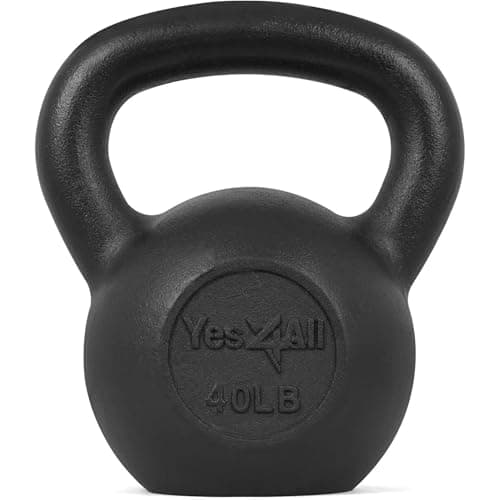
Yes4All Solid Cast Iron Kettlebell. Licensed stock photograph of the category — not the specific product.
Where the resistance comes from
A kettlebell resists you because of gravity, which means the load is constant in magnitude and always points down. What changes through a rep is the leverage: a goblet squat is hardest at the bottom, a press is hardest off the shoulder, a row is hardest at the mid-point. Those are the positions where your joints are at their worst mechanical advantage, which is exactly where strength is built.
A band resists you because it is stretched, and the force climbs as the stretch increases. A banded chest press is almost weightless at the chest and hardest at full extension — the opposite profile. That ascending resistance is genuinely useful for some things, mostly things where you are strongest at the end of the range, and genuinely unhelpful for others.
Neither profile is right or wrong. But it does mean the two tools are good at different exercises rather than being cheap and expensive versions of the same thing.
Side by side
| Kettlebell | Resistance bands | |
|---|---|---|
| Resistance profile | Constant force, varying leverage | Ascending - hardest at full stretch |
| Explosive work | Yes - swings, cleans, snatches | No - a band snaps you back |
| Horizontal pulling | Limited - single-arm rows only | Yes, with a door anchor |
| Vertical pulling (lat work) | No | Yes, with a high anchor |
| Load measurement | Exact - the number is on the bell | Approximate - stated at a given stretch |
| Load range from one purchase | One weight | 3 lb to 190 lb in a stacked set |
| Noise | The loudest object in a flat | Silent |
| Storage | A dense object on the floor | A drawer |
| Travel | No | Yes - a set fits in hand luggage |
| Lifespan | Decades; it is a lump of iron | Years; latex perishes and tubes eventually fail |
What a kettlebell does that bands cannot
Anything ballistic. The swing, the clean and the snatch all depend on momentum carrying a free weight through an arc. A band does not fly; it recoils. There is no band equivalent of a hip-driven swing, and the swing is the single most useful conditioning movement a small gym can own.
Loaded carries. A farmer's carry, a suitcase carry or a rack walk loads the trunk asymmetrically while you move. Bands are anchored; you cannot walk with one.
The Turkish get-up. Needs a fixed mass held overhead while you change levels, which only a free weight provides.
Hard resistance at the bottom of a squat. A goblet squat loads the position you are weakest in. A banded squat loads the top, which is the position you did not need help with.
What bands do that a kettlebell cannot
Pull-downs and horizontal rows against a fixed anchor. A door anchor turns a band set into a cable machine, which is a whole category of back work a single bell simply has no answer to.
A continuous load ladder. A stackable tube set clips any combination onto one handle, which means effectively continuous resistance from about 3 lb to 190 lb. Matching that with bells means buying eight of them.
Assisted pull-ups. A long loop band under the foot is the standard way to bridge the gap to a first pull-up. Note that this is a different product from a handled tube set — our pull-up assistance bands page covers those, and the handled band roundup covers these.
Training in a hotel room. A full set weighs a couple of pounds and fits in a bag. This is not a small advantage if you travel.
Which is better in an apartment?
Bands, on almost every axis that matters upstairs. They are silent, they anchor to a door rather than a wall, they leave no marks, and the entire gym lives in a drawer. For someone in a rented flat whose main constraint is the lease and the neighbour below, a stackable band set is the most capable thing you can buy per cubic inch.
Kettlebells can work upstairs with a vinyl coating and a thick mat — the apartment kettlebell guide covers how — but you are managing a problem rather than avoiding one. The apartment gym setup page puts both in context with the rest of a small-space inventory.
Which is better for building strength?
The kettlebell, with one caveat. Free weights load the weak positions in a range of motion, they let you measure progress exactly, and they transfer better to anything you do with a real object. For a beginner wanting to get stronger, one bell beats one band set.
The caveat is that a 190 lb stacked band set outloads any single kettlebell most people will own, and for pressing and pulling at high loads that is not nothing. The honest summary is that bands build real strength in the ranges they load, which is a narrower claim than "bands build strength" but not a dismissal.
Which to buy first
Garage or spare room, want to get stronger: the kettlebell. Start with one bell at the weight our size guide recommends, learn the swing, and add a second bell before you add anything else.
Apartment, noise or storage is the constraint: the band set. Buy a stackable set with an inner safety cord and a door anchor, and you have a complete upper-body gym immediately.
You travel a lot: the band set, regardless of everything else.
You already own a pull-up bar: the kettlebell. The bar already covers your vertical pulling, which is the main thing bands add.
Owning both
This is what most well-equipped small gyms converge on, and the split is clean: the bell does hinge, squat, carry and conditioning; the bands do rows, pulldowns, chest press, face pulls and everything that wants a horizontal anchor. Neither duplicates the other, which is unusual for two pieces of equipment at this price.
The build order that works is bell first, bar second, bands third — and if the flat is small enough that a bar is out, bands first and bell later.
Picks
The two sides of this decision
Two bells - plain cast iron for a garage, vinyl for a floor you do not own - and two band systems, one stackable to 190 lb and one adjustable cable kit.
Key specs
- Weights
- 5–80 lb in 5 lb steps
- Handle
- ~1.25 in. (35 mm), textured
- Base
- Flat
Scores · editorial, out of 10
- Handle & finish
- 7
- Weight increments / adjustability
- 9
- Footprint & floor safety
- 7
- Build (casting, seams)
- 8
- Value
- 10
Pick 1 · Kettlebells
Yes4All Solid Cast Iron Kettlebell
Yes4All
The one-piece cast iron bell sold in 5 lb steps from 5 to 80 lb with a 1.25 in. handle and a flat base — the default first kettlebell because you can buy exactly the size you need.
Best for
A first bell in the exact weight you need without paying for a coating you don't
Pros
- 5 lb increments across the whole range — 15, 20, 25, 30, 35 lb are all there for a beginner's first two bells
- One-piece casting, no welded handle to fail
- Flat base sits still for rows, push-ups and storage
Cons
- Painted (not powder-coated) finish on the basic version chips and can leave marks on a wood floor — use a mat
- 35 mm handle is a bit thick for smaller hands on high-rep snatches
Specs from Yes4All — Solid Cast Iron Kettlebell listing (weights, handle, base).
Key specs
- Weights
- 5–100 lb across the range
- Coating
- Vinyl over cast iron
- Handle
- Solid steel, 8.86 in. wide
Scores · editorial, out of 10
- Handle & finish
- 8
- Weight increments / adjustability
- 8
- Footprint & floor safety
- 10
- Build (casting, seams)
- 7
- Value
- 9
Pick 2 · Kettlebells
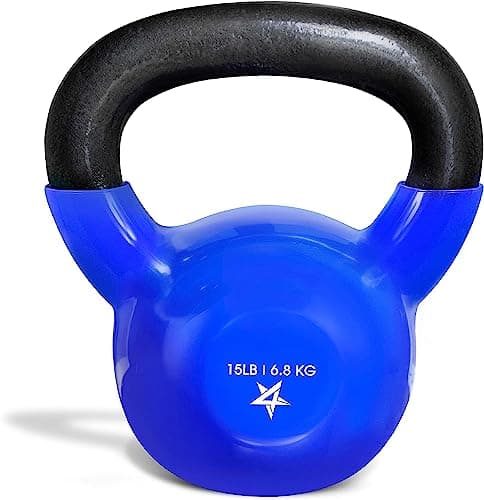
Yes4All Vinyl Coated Kettlebell
Yes4All
The same cast iron bell in a vinyl jacket, 5–100 lb across the range — the apartment kettlebell: quieter to set down and kinder to a floor you don't own.
Best for
Kettlebell training on an apartment floor with neighbors below
Pros
- Vinyl coating dampens the clank on a hard floor and won't scratch it
- PVC-coated shell takes a knock on a hard floor without chipping the way enamel does
- Color-coded — the fastest way to grab the right weight
Cons
- Vinyl adds a little bulk to the bell and can crack if dropped on concrete
- Color varies by weight, so a matched-looking pair means buying one weight twice
Specs from Yes4All — Vinyl Coated Kettlebell listing (weights, coating, handle).
Key specs
- Resistance
- 5 tubes, 3-80 lb each; 190 lb stacked
- Included
- 2 handles, 2 ankle straps, door anchor, pack
- Safety
- Inner safety cord in each tube (snap-reduction design)
Scores · editorial, out of 10
- Resistance range & stacking
- 10
- Handles & attachments
- 9
- Anchor options for a renter
- 9
- Snap safety & build
- 10
- Value
- 8
Pick 3 · Resistance bands with handles
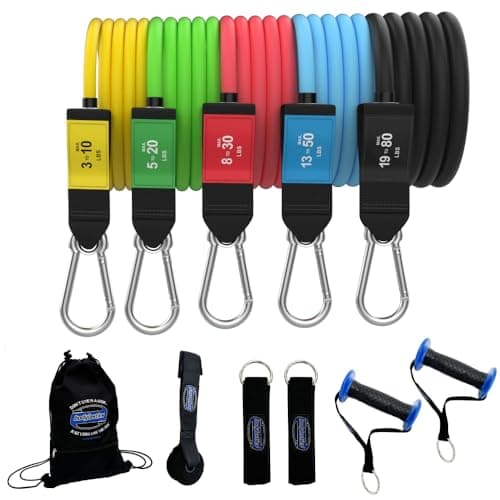
Bodylastics 5 Band PRO Series Set (190 lb max)
Bodylastics
Five clip-on latex tubes (3-10, 5-20, 8-30, 13-50 and 19-80 lb) that stack to 190 lb, with two handles, two ankle straps, a door anchor and a pack — and an inner safety cord in every tube.
Best for
Replacing a rack of dumbbells in an apartment, at any load from 3 lb to 190 lb
Pros
- Clip any combination of tubes to one handle — the load ladder is effectively continuous
- The inner cord is the reason to buy this over an unbranded set: a tube that fails doesn't whip
- The door anchor means no drilling, no wall plate and nothing for a landlord to notice
Cons
- Five tubes, clips and two straps is more to keep track of than a pair of dumbbells
- Resistance is not constant through a rep — the top of a press is far harder than the bottom
Specs from Bodylastics — 5 Band Pro Series Set (per-tube tensions, contents, price).
Key specs
- Resistance
- Adjustable, 10–100 lb
- Handles
- Triple-grip, with a cable pocket for quick swaps
- Included
- 2 handles, door anchor, 5 ft tubes, carry bag
Scores · editorial, out of 10
- Resistance range & stacking
- 6
- Handles & attachments
- 10
- Anchor options for a renter
- 6
- Snap safety & build
- 9
- Value
- 9
Pick 4 · Resistance bands with handles
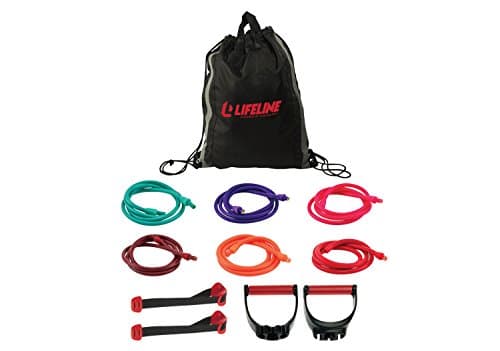
Lifeline Resistance Trainer Kit (10–100 lb)
Lifeline
A two-handle cable trainer that adjusts from 10 to 100 lb, with triple-grip handles, 5 ft latex tubes, a door anchor and a carry bag — cables pull out of a pocket in the grip so you can swap or double up.
Best for
Pressing and rowing each arm independently, where a rotating handle genuinely matters
Pros
- Triple-grip handles give three hand positions, so the wrist is not locked into one angle through a press
- Cables come out of the handle pocket, so resistance changes without unclipping hardware
- Arrives as a complete kit — tubes, handles, door anchor and bag, nothing else to buy
Cons
- Tops out at 100 lb — well short of a stacked handled-band set
- Latex tubes, so this is the wrong kit if anyone in the house has a latex allergy
Specs from Lifeline — Resistance Trainer Kit listing (10–100 lb adjustable range, handles, door anchor, tubes, bag).
FAQ
Questions readers ask
Are resistance bands as effective as kettlebells?
For pressing and pulling against an anchor, close — a stacked tube set reaches 190 lb, which outloads any single bell. For ballistic work, carries and anything needing a fixed mass overhead, no; bands cannot do those at all. They are complementary rather than substitutes.
Can you build muscle with resistance bands alone?
Yes, within their resistance profile. Bands provide progressive overload as long as you can keep adding tension, and a stackable set gives plenty of room to do that. The limitation is the profile: the load is lightest at the start of a rep, which is often the position where muscle responds best to being challenged.
Which is better for a small apartment, kettlebells or bands?
Bands. They are silent, they store in a drawer, they anchor to a door rather than a wall, and they leave nothing behind when the lease ends. A kettlebell can be made to work with vinyl coating and a thick mat, but you are managing noise rather than avoiding it.
Can you do kettlebell swings with resistance bands?
Not meaningfully. A swing depends on momentum carrying a free mass through an arc; a band recoils instead of flying, so the hip drive has nowhere to go. Banded hip thrusts and pull-throughs train the same muscles differently, but they are not swings.
How long do resistance bands last?
Years with care, considerably less with sunlight, heat or a sharp edge. Latex perishes, and a failing tube snaps suddenly and recoils toward the anchor. Check for nicks and cloudiness before each session, avoid stretching past about three times resting length, and buy a set with an inner safety cord. A cast iron kettlebell, by contrast, has no meaningful lifespan.
Related
Keep reading
- Best resistance bands with handles
If the bands won: which stackable set, and why the safety cord matters.
- Best kettlebells for beginners
If the bell won: which weight and finish to start with.
- Kettlebell vs dumbbell
The other free-weight comparison worth reading before buying.
- Apartment gym setup
Where both of these sit in a small-space inventory.
Sources
- —Yes4All — Solid Cast Iron Kettlebell listing (5-80 lb in 5 lb steps, ~1.25 in. handle, flat base) · amazon.com
- —Yes4All — Vinyl Coated Kettlebell listing (5-100 lb, vinyl over cast iron, solid steel handle) · amazon.com
- —Bodylastics — 5 Band Pro Series Set (per-tube tensions 3-80 lb, 190 lb stacked, inner safety cord, handles, ankle straps, door anchor) · bodylastics.com
- —Lifeline — Resistance Trainer Kit listing (10-100 lb adjustable range, triple-grip handles, 5 ft latex tubes, door anchor) · amazon.com