Comparison · Pull-Up Bars
Doorway, wall-mount or free-standing? Answer four questions and the bar picks itself
Can you drill? How wide is the door? How high is the ceiling? How much floor can you give up? Four questions, one table, and the right bar for every combination of lease and room.
Rope & Rep is reader-supported. Product links go through our affiliate resolver and we may earn a commission from qualifying purchases at no cost to you. Prices are the retailer's and change — every button opens the live price on Amazon rather than showing a stale number.
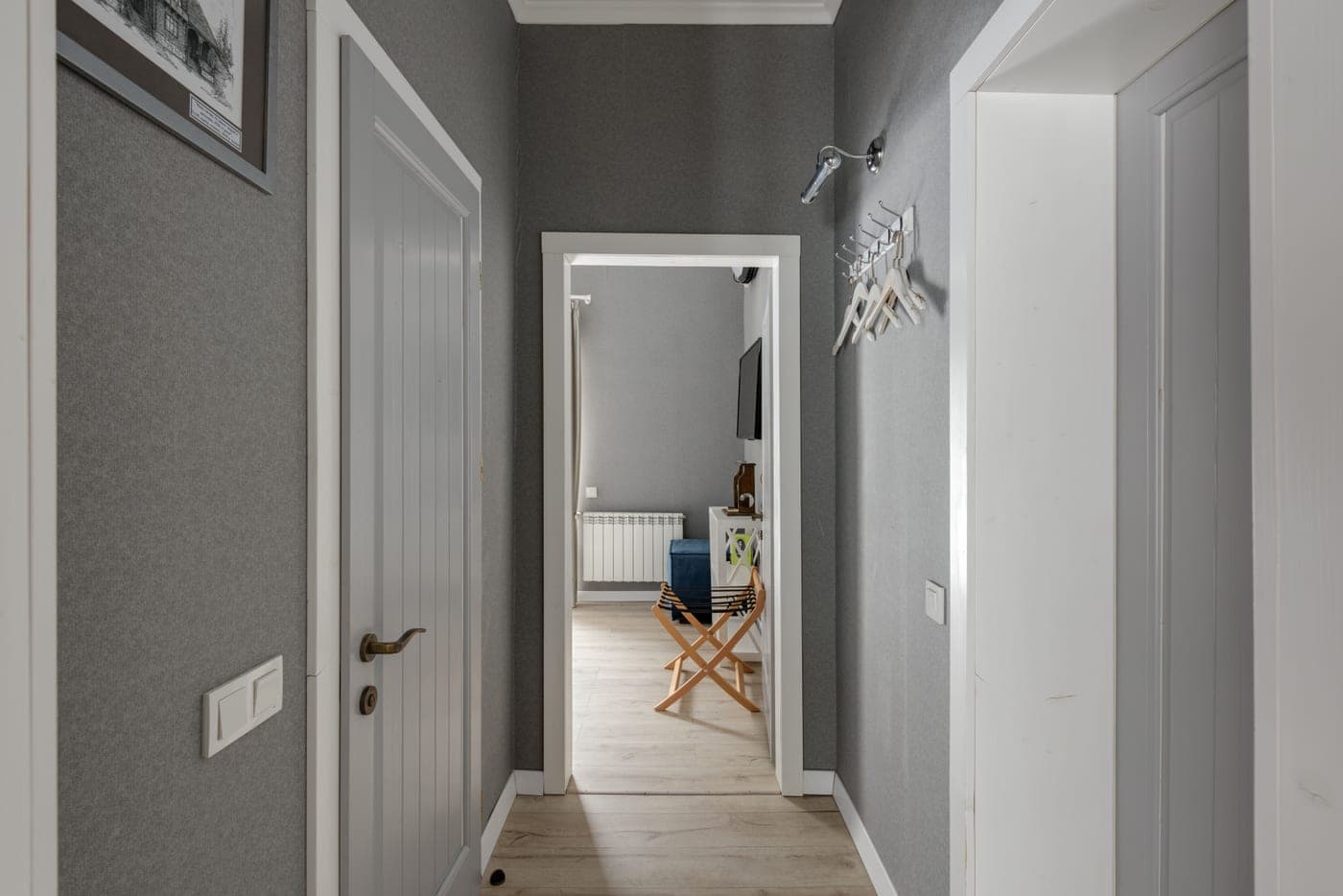
A hallway in a home with wooden doors, the kind of doorway a leverage bar hooks over. Licensed stock photograph of the category — not the specific product.
Question 1: can you drill?
This is the only question that removes a whole category. If the answer is no — a lease, a landlord, a rental basement, a wall you don't own — wall and ceiling mounts are out, and the decision is between a doorway bar and a free-standing bar. If the answer is yes, a stud-mounted bar is the best pull-up bar money buys and you should read the wall bar roundup with a stud finder in hand. “Probably fine, the landlord won't notice” is a no.
Question 2: how wide is the door, and does it have trim?
A leverage bar hooks over the door casing and braces against the wall above. It needs a door opening inside its range (24–32 in. for the fixed bars, 21.7–36.2 in. for the telescoping ones), solid trim on both sides, and about 12 in. of flat wall above. Cased openings with no trim, metal frames, and doors over 36 in. fail the test; so does thick decorative molding over about 3.5 in. If one doorway in the home passes, a doorway bar is the answer for almost everyone who can't drill. The doorway bar roundup has the six bars by their exact ranges.
Question 3: how high is the ceiling?
Ceiling height changes the wall-vs-ceiling choice and the tower setting; it barely affects a doorway bar, which sits at the top of the door (about 80 in.) regardless.
| Ceiling | Doorway bar | Wall bar (you choose) | Ceiling mount (14 in. drop) | Tower |
|---|---|---|---|---|
| 8 ft (96 in.) | ~80 in., knees bent | 84 in. | 82 in. — bracket in the way | Set to ~78–84 in. |
| 9 ft (108 in.) | ~80 in. | 88–92 in., dead hang | 94 in. — good | Any setting |
| 10 ft+ | ~80 in. | 90–96 in. | 106 in. — good | Any setting |
Under 8 ft, a ceiling mount buys you nothing over a doorway bar and costs four lag holes. Over 9 ft, a ceiling mount into joists is a fine bar and keeps the walls free. The numbers by user height are in ceiling height for a pull-up bar.
Question 4: how much floor can you give up, permanently?
A doorway bar and a wall bar take none. A power tower takes 27–38 in. by 40–43 in. and does not fold; in a studio it is furniture. The BaseBlocks Big Bar takes 59 × 35 in. in use and folds to 29 × 35 in. If you can't drill and no door qualifies, this question decides between the tower (dips and leg raises, permanent footprint) and the folding bar (a full dead hang, floor back between sessions). See the free-standing roundup.
The decision table
| Drill? | Qualifying door? | Ceiling | Floor to spare? | Buy |
|---|---|---|---|---|
| No | Yes | Any | Any | Doorway leverage bar |
| No | No | Any | Yes, permanently | Power tower |
| No | No | Any | No — must fold | BaseBlocks Big Bar |
| Yes | Any | 9 ft+ | Any | Wall-mount multi-grip (or ceiling mount) |
| Yes | Any | 8 ft | Any | Wall-mount at 84 in., or doorway bar |
| Yes | Any | Any | Walls full of shelves | Ceiling mount into joists (9 ft+) |
What each type is like to actually use
Doorway. Strict pull-ups and chin-ups, three grips, bent knees for anyone over about 5 ft 8 in. No swinging, ever. Comes down in seconds; most people leave it up. Rings hang from it for dips and rows (see hanging rings at home).
Wall-mount. Rigid. Mounted at 22–26 in. off the wall it takes kipping, muscle-up transitions, rings with room to swing, and a weighted vest with no thought about the rating. The bar most serious calisthenics happens on.
Free-standing. A tower rocks a little on wide grips and gives you dips and knee raises in return; the folding bar is rigid and does one thing. Both are the answer when the building says no.
What we'd skip
Friction tension bars with no hooks (not rated for a person), screw-in doorway bars (holes for a worse bar), and any tower rated under 300 lb. The no-screw roundup covers what to avoid in the no-drill category.
Picks
The bar for each answer
One pick per type — the doorway bar for the most doors, the tower for no doors, the wall bar for owners.

Key specs
- Door width
- 24–32 in. (trim to 3.5 in.)
- Mounting
- Leverage, no screws
- Rated load
- 300 lb
Scores · editorial, out of 10
- Fit & clearance (door, ceiling, depth)
- 7
- Reversibility (no drill, no marks, takedown)
- 9
- Rated load & build
- 7
- Grip options
- 8
- Value
- 10
Pick 1 · Pull-up bars
Iron Gym Total Upper Body Workout Bar
Iron Gym
The doorway bar everyone copies: three grips, a 300 lb rating, fits a 24–32 in. door with trim up to 3.5 in., and it leaves with you when the lease ends.
Best for
A first bar in a standard apartment doorway
Pros
- Fits the most common US interior door range and trim depth without tools
- Three grip positions (wide, narrow, neutral) on a bar this cheap is rare
- Flips to the floor for push-ups and dips — one piece of gear, four movements
Cons
- The leverage design needs a door with trim on both sides; flat, trimless frames won't hold it
- Grip width is fixed — taller lifters may find the wide grip a touch narrow
Specs from Iron Gym — Total Upper Body Workout Bar listing (door width, trim, load).
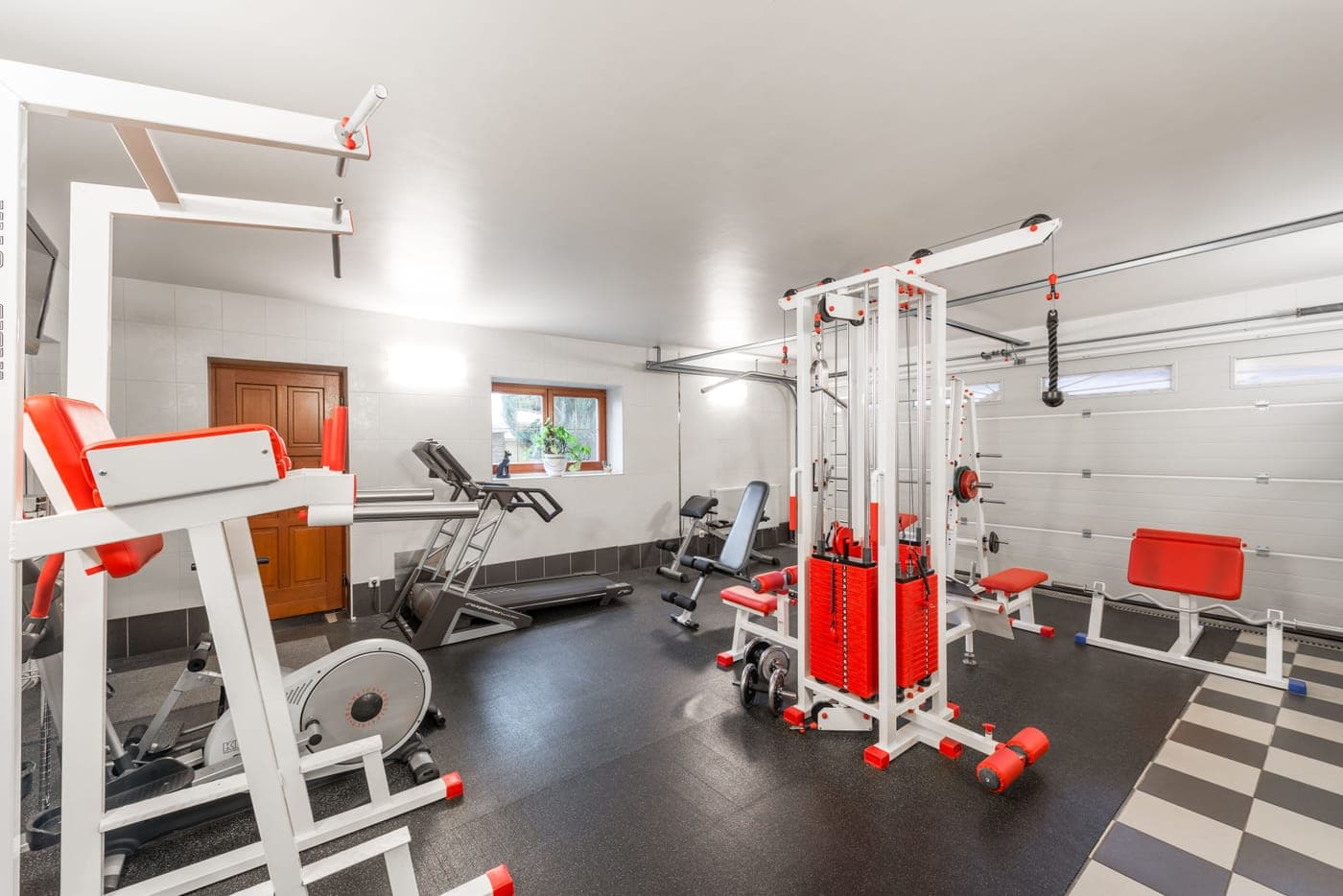
Key specs
- Height
- 9 levels, ~57–87 in.
- Footprint
- 26.6 × 43.2 in.
- Rated load
- 400 lb
Scores · editorial, out of 10
- Fit & clearance (door, ceiling, depth)
- 8
- Reversibility (no drill, no marks, takedown)
- 9
- Rated load & build
- 8
- Grip options
- 7
- Value
- 8
Pick 2 · Pull-up bars
Sportsroyals Power Tower Dip Station
Sportsroyals
The best-selling power tower: pull-up bar adjustable across nine heights (about 57–87 in.), dip handles, knee-raise pads, a 26.6 × 43.2 in. base, and a 400 lb rating — no drilling anywhere.
Best for
A pull-up and dip station in a rental where nothing can touch the walls
Pros
- Nine bar heights cover 8 ft ceilings at the low end and tall lifters at the top
- Pull-ups, dips, leg raises and push-ups on one 58 lb frame
- Pi-shaped base with adjustable foot covers for uneven garage floors
Cons
- Sways a little at full height on wide-grip pull-ups — normal for a tower, but it isn't a wall bar
- Takes a permanent 2 × 3.6 ft of floor; it does not fold
Specs from Sportsroyals — Power Tower listing (height range, footprint, capacity).

Key specs
- Mounting
- Wall studs; 14 or 26 in. projection
- Bar
- 50 in. wide, 46 in. usable, 1.25 in.
- Rated load
- 700 lb (properly installed)
Scores · editorial, out of 10
- Fit & clearance (door, ceiling, depth)
- 7
- Reversibility (no drill, no marks, takedown)
- 3
- Rated load & build
- 10
- Grip options
- 10
- Value
- 8
Pick 3 · Pull-up bars
REP Fitness Wall-Mounted Multi-Grip Pull-Up Bar
REP Fitness
The wall bar with the most grips: 46 in. of usable 1.25 in. bar with neutral, close, wide and angled handles, mountable at 14 or 26 in. from the wall, rated 700 lb into studs.
Best for
A garage or basement wall where you can hit two studs and want every grip
Pros
- Traditional, neutral, close, wide and angled grips on one bar
- Two projection options — 26 in. lets you swing for kipping or muscle-ups, 14 in. saves space
- 700 lb rating with a 2 in. back bar; nonslip powder coat
Cons
- Needs lag bolts into two studs — not a rental-friendly install unless the landlord agrees
- At 50 in. wide it takes real wall space; check the stud spacing matches before ordering
Specs from REP Fitness — Wall-Mounted Multi-Grip Pull-Up Bar (dimensions, projection, rating).
FAQ
Questions readers ask
Is a doorway pull-up bar or a wall-mounted one better?
A wall-mounted bar is better to use — rigid, higher rated, mountable at any height. A doorway bar is better to own in a rental — no holes, no floor, seconds to remove. If you can drill, wall; if you can't, doorway.
Should a pull-up bar be mounted on the wall or the ceiling?
Wall if you want to choose the height or have an 8 ft ceiling. Ceiling if the ceiling is 9 ft or more and the walls are taken. A ceiling bar drops a fixed 14 in.
What pull-up bar is best for a renter?
A leverage doorway bar if any door qualifies; a folding free-standing bar or a tower if none does. Nothing that leaves a hole.
Do I need a power tower or just a pull-up bar?
Just a bar, unless you have no usable doorway or you specifically want dips and leg raises on a frame. See pull-up bar vs power tower.
Related
Keep reading
- Ceiling height for a pull-up bar
Reach and bar height by user height.
- Best pull-up bars with no screws
The whole no-drill field.
- How to hang gymnastic rings at home
Rings from a doorway bar, a tower or a beam.
- How to get your first pull-up
The plan, once the bar is up.
Sources