Guide · Pull-Up Bars
How to mount a pull-up bar to ceiling joists — and when not to
Joists, not drywall. Confirm them with a pilot hole, match the bar to 16 or 24 in. spacing, drive the lags the maker specifies, and test-hang before you trust it. Eight steps, and the cases where a wall bar is the right call instead.
Rope & Rep is reader-supported. Product links go through our affiliate resolver and we may earn a commission from qualifying purchases at no cost to you. Prices are the retailer's and change — every button opens the live price on Amazon rather than showing a stale number.
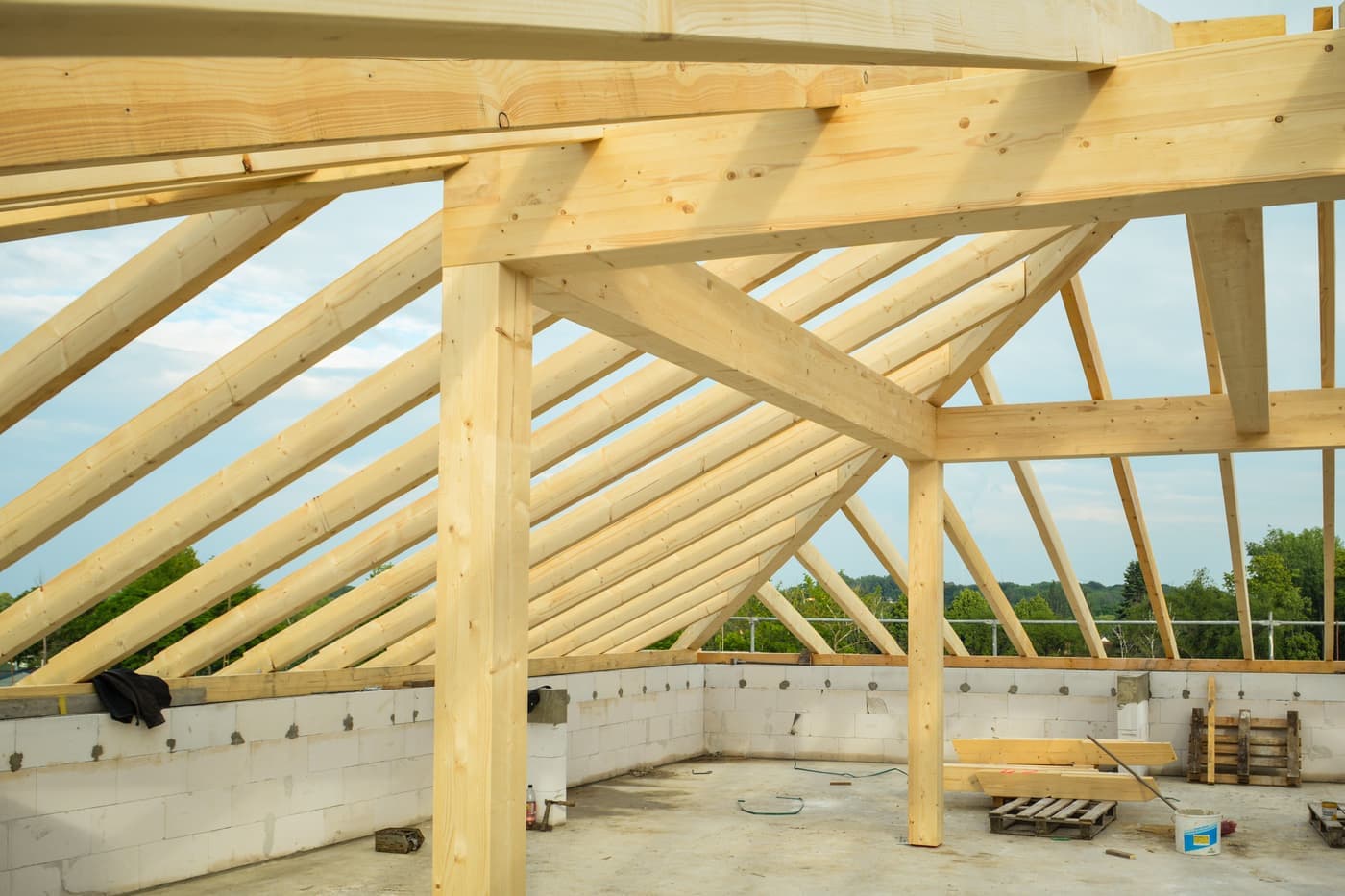
Exposed wooden roof trusses in an unfinished building. Licensed stock photograph of the category — not the specific product.
Mounting a ceiling pull-up bar · 8 steps
1
Check the ceiling height
Measure floor to ceiling. A ceiling bar drops 14 in. or more; under 9 ft (108 in.) a wall bar mounted at your chosen height is the better bar.
2
Find the joists
Use a stud finder across the ceiling to find two parallel joists. Mark both edges of each and the center line. Typical US spacing is 16 in. on center, sometimes 24 in.
3
Confirm with a pilot hole
Drill a small pilot hole at each marked center. Solid wood resistance for the full depth of the bit means a joist; punching through into air means you found drywall or the edge of a joist — move and re-check.
4
Match the bar to the spacing
Set the bar's mounting brackets or risers to your measured spacing (the Ultimate Body Press risers reverse between 16 and 24 in.). Hold the bar up and confirm every bolt hole lands on a joist center.
5
Drill pilot holes for the lags
With the bar or its template held level against the ceiling, drill each hole to the diameter and depth the maker specifies for its lag bolts — usually slightly smaller than the lag shank, into solid wood.
6
Drive the lag bolts
With a helper holding the bar, drive every lag with a socket wrench until the washers seat firmly. Don't skip holes, don't substitute shorter bolts, and don't overtighten into stripping.
7
Test hang
Hang with partial weight, then full weight, then bounce gently. Watch the brackets and listen. Any movement or creak: take it down and re-check the joists.
8
Re-check after a week
Re-torque every lag after the first week of use, then check monthly. Wood settles and lags can loosen a quarter turn.
Are ceiling-mounted pull-up bars safe?
Into joists, with the specified lags, yes — ceiling bars are rated 500 lb and up and a joist that holds a ceiling holds a person with a large margin. Into drywall, no, and there is no anchor that changes that: a person on a bar is a cyclic load on a lever, and drywall anchors are for pictures. The whole question of safety is whether the bolts are in wood. Everything below is about making sure they are.
What you're mounting into
| Ceiling | Mount? | Notes |
|---|---|---|
| Dimensional lumber joists (2×8, 2×10), 16 or 24 in. OC | Yes | The design case — lags into the center of two joists |
| Engineered I-joists | Ask | The flange is thin; many makers require blocking between joists — check the bar's instructions |
| Roof trusses (garage, attic) | Usually yes, with care | Lag into the bottom chord center; never into a gusset plate or the web |
| Drywall only, no joist under the hole | No | Move to the joist |
| Drop ceiling / suspended tiles | No | Mount to the structure above, which usually means a wall bar instead |
| Concrete slab (condo, basement) | Yes, with masonry anchors | Wedge or sleeve anchors rated for the load — not supplied with the bar |
16 in. or 24 in. on center?
Measure from the center of one joist to the center of the next. Most US homes frame ceilings at 16 in.; garages and some newer builds use 24 in. A bar with fixed brackets fits only one spacing; the Ultimate Body Press bar reverses its risers to fit either, which is why it is the pick here. If your joists run at an odd spacing, a wall bar with brackets that reach to 50 in. (the Titan) is the easier solve.
The drop, and the ceiling height it needs
The Ultimate Body Press bar hangs 14 in. below the ceiling. Under an 8 ft ceiling that puts the bar at 82 in. with the bracket above your head at the top of the rep — no better than a doorway bar, with four holes. Under 9 ft it sits at 94 in., a straight-leg dead hang for most people. The arithmetic is in ceiling height for a pull-up bar.
Tools
- Stud finder (a magnetic one finds the drywall screws in the joists if the electronic one struggles).
- Drill, small bit for pilot holes, the lag pilot bit the instructions specify.
- Socket wrench for the lags; a level; a pencil; a step; a helper.
When a wall bar is the better call
Under 9 ft of ceiling; when the joists run the wrong way for where you want the bar; when the ceiling is engineered joists or a drop ceiling; when you want to choose the height. A wall bar into two studs at 84–92 in. is rigid, rated 400–700 lb, and adjustable in projection. The wall bar roundup has both options.
Picks
The bars this guide is written for
A ceiling bar built for 16 and 24 in. joists, and the wall bar to mount instead when the ceiling is under 9 ft.

Key specs
- Mounting
- Ceiling joists, 16 or 24 in. OC
- Drop
- 14 in. below ceiling
- Grips
- 4 positions, 20 in. parallel spacing
Scores · editorial, out of 10
- Fit & clearance (door, ceiling, depth)
- 8
- Reversibility (no drill, no marks, takedown)
- 3
- Rated load & build
- 9
- Grip options
- 8
- Value
- 8
Pick 1 · Pull-up bars
Ultimate Body Press Ceiling Mount Pull Up Bar
Ultimate Body Press
The ceiling bar built for real joists: reversible risers fit 16 or 24 in. on-center joists, it drops 14 in. from the ceiling, and the parallel grips sit a natural 20 in. apart.
Best for
A garage or basement with exposed or locatable joists and at least 8 ft of ceiling
Pros
- Reversible dual-position risers mount to either 16 in. or 24 in. joist spacing without shims
- 14 in. drop keeps headroom under an 8–9 ft ceiling
- 3/16 in. plate-steel mounting plates; template and hardware included
Cons
- You must find and hit the joists — drywall ceilings need a stud finder and care
- Once mounted it is a fixture; four lag holes stay in the ceiling
Specs from Ultimate Body Press — Ceiling Mount Pull Up Bar (joist spacing, drop, grips).
Key specs
- Mounting
- Wall studs; 14 or 22 in. projection
- Bar
- 52 in., 11-gauge steel
- Rated load
- 400 lb
Scores · editorial, out of 10
- Fit & clearance (door, ceiling, depth)
- 7
- Reversibility (no drill, no marks, takedown)
- 3
- Rated load & build
- 9
- Grip options
- 5
- Value
- 9
Pick 2 · Pull-up bars
Titan Fitness Adjustable Depth Wall Mounted Pull Up Bar
Titan Fitness
A plain 52 in. straight bar you can set 14 or 22 in. off the wall, 400 lb rating, 11-gauge steel, and brackets that reach stud spacing up to 50 in. — the value wall bar.
Best for
A simple, strong straight bar on a garage wall for the least money
Pros
- Adjustable projection: 14 in. for tight spaces, 22 in. for room to swing
- Brackets accommodate stud spacing up to 50 in. — forgiving on odd framing
- 20 lb of 11-gauge steel; 400 lb rating
Cons
- Straight bar only — no neutral or angled grips
- Permanent install; leaves lag-bolt holes when you take it down
Specs from Titan Fitness — Adjustable Depth Wall Mounted Pull Up Bar (projection, gauge, capacity).
FAQ
Questions readers ask
Are ceiling mounted pull-up bars safe?
Yes when lag-bolted into the center of two ceiling joists per the maker's instructions — they are rated 500 lb and up. Never into drywall alone, and never into a single joist.
Can you mount a pull-up bar to ceiling joists that are 24 inches apart?
Yes with a bar that fits 24 in. spacing — the Ultimate Body Press reverses its risers between 16 and 24 in. Fixed-bracket bars fit one spacing only.
What ceiling height do you need for a ceiling-mounted pull-up bar?
At least 9 ft to be worth it: the bar drops about 14 in., so under 8 ft it sits no higher than a doorway bar.
Can I mount a pull-up bar to roof trusses in a garage?
Usually — lag into the center of the bottom chord, never into a gusset plate or the diagonal web members, and follow the bar maker's instructions.
Related
Keep reading
- Best wall-mounted pull-up bars
Wall and ceiling bars, with what each needs from your framing.
- Ceiling height for a pull-up bar
The drop and the headroom, by user height.
- How to hang gymnastic rings at home
Rings from the same joists, or without any drilling.
- Garage gym essentials
The bar is the first thing on the ceiling; here's the rest of the garage.
Sources
- —Ultimate Body Press — Ceiling Mount Pull Up Bar (joist spacing, drop, grips) · ultimatebodypress.com
- —Titan Fitness — Adjustable Depth Wall Mounted Pull Up Bar (projection, gauge, capacity) · titan.fitness