Best Ceiling-Mounted Bar · Pull-Up Bars
The best ceiling-mounted pull-up bars, ranked by the drop they cost you
A ceiling bar is the strongest place to hang in a house and the one that eats the most headroom. The spec that decides the purchase is not the load rating — it is how many inches the bar sits below the joists, measured against the ceiling you actually have.
Rope & Rep is reader-supported. Product links go through our affiliate resolver and we may earn a commission from qualifying purchases at no cost to you. Prices are the retailer's and change — every button opens the live price on Amazon rather than showing a stale number.
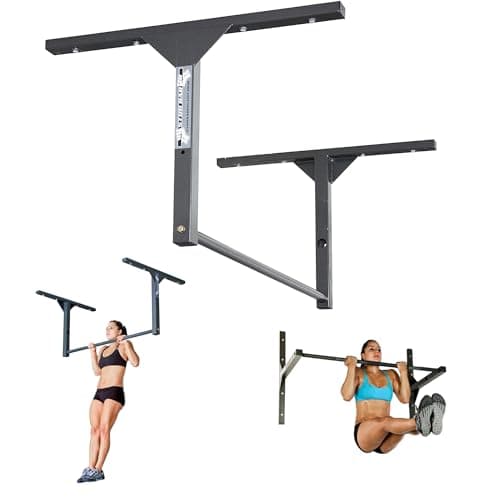
Stud Bar Pull-Up Bar (9 ft Ceiling). Licensed stock photograph of the category — not the specific product.
Quick picks
| # | Product | Best for | Score | Price |
|---|---|---|---|---|
| 1 | Stud Bar Pull-Up Bar (9 ft Ceiling) The only ceiling bar here that publishes a 600 lb rating and a choice of drop distance, and the only one sold in three versions so the drop matches your ceiling instead of fighting it. | A 9 ft garage or basement ceiling where the bar has to take kipping, a weight vest and a second person | 6.7 | |
| 2 | 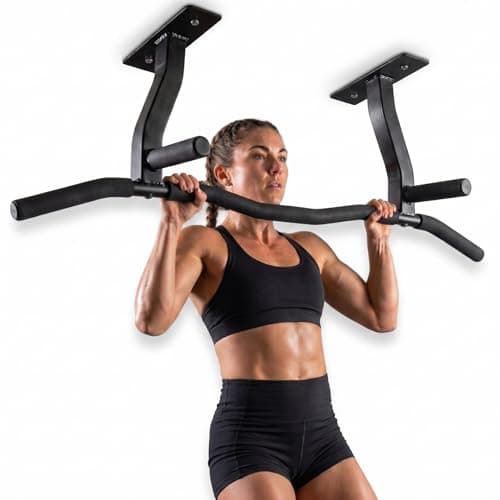 Ultimate Body Press Ceiling Mount Pull Up Bar The ceiling bar built for real joists: reversible risers fit 16 or 24 in. on-center joists, it drops 14 in. from the ceiling, and the parallel grips sit a natural 20 in. apart. | A garage or basement with exposed or locatable joists and at least 8 ft of ceiling | 7.0 | |
| 3 | 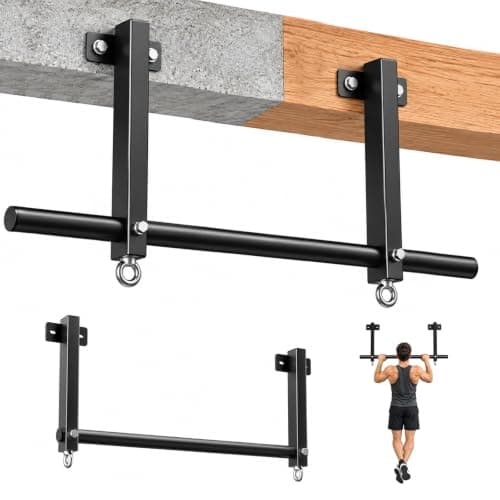 HWOOUSA Joist-Mounted Pull-Up Bar (500 lb) A split-bracket joist bar whose mounts slide to fit 16, 24 or 32 in. spacing, in powder-coated alloy steel at a published 500 lb, with the concrete anchors and wood screws in the box — and it bolts flat to the joists, so there is almost no drop. | A garage or basement whose joist spacing you will not know until you find it | 6.1 | |
| 4 | 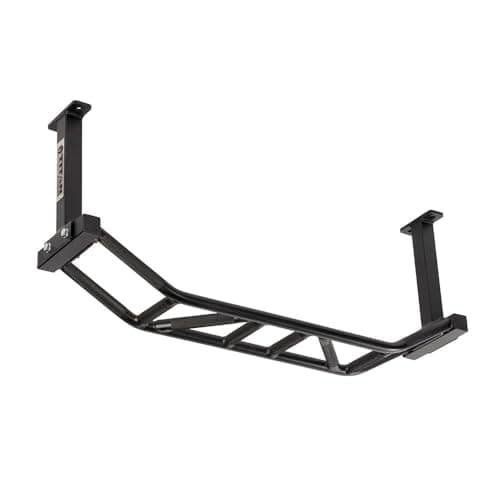 Titan Fitness Ceiling Mounted Multi-Grip Pull-Up Bar A 50 in. frame rather than a bar: four grip angles including two neutral handles, knurled instead of powder coated, hanging 16 in. below the ceiling. | A 9 ft or higher ceiling where elbow-friendly neutral and angled grips matter more than price | 5.2 |
Scores are our editorial judgment from each maker's published specs and mounting instructions, weighted for a renter or small-space trainer.
Why a ceiling bar at all
A ceiling-mounted bar is the strongest, quietest and most permanent way to hang in a house, and it is the only mounting type that puts the bar in the middle of a room instead of against a surface. That last part matters more than people expect. On a wall-mounted bar your knees and feet have a wall in front of them, which rules out knee raises with any real range and makes kipping feel like a bad idea. On a doorway bar you are inside a frame. Hanging from a joist, you have air on all four sides — which is the difference between owning a pull-up bar and owning the beginnings of a gymnastics setup.
It is also the only mounting type where the structure is not the weak link. A doorway bar leans on a trim board; a wall mount depends on finding two studs and hitting them squarely. Joists are the part of a house designed to carry load, and a bar lagged into two of them is working the way the lumber already works. Our joist-mounting guide covers how to find them and what the lag bolts need to be; this page is about which fixture to hang off them.
The cost is headroom, and it is a real cost. That is why this page is ordered by drop and published rating rather than by price, and why the buying guide below is mostly arithmetic.
The criteria, in the order they matter
1. Drop below the ceiling. The single number that decides whether a bar is usable in your room. A 22 in. drop in a 10 ft basement is luxurious; the same 22 in. under an 8 ft ceiling leaves the bar at about 6 ft 2 in., which is a dead hang with bent knees for anyone tall. Bars that offer two drop settings are worth more than their price difference suggests, because they turn a fixed constraint into a choice.
2. A published rated load. Not because 600 lb is better than 500 lb for a human being — it is not, both are enormous — but because a maker who publishes a figure has committed to it. In this category, two of the four bars publish one and two do not, and that split tracks almost perfectly with how much else the maker is willing to tell you.
3. What framing it will actually fit. Joists run at 16 in. or 24 in. on center, and which one you have is not up to you. A bar with reversible or adjustable mounting plates fits whichever you find; a bar with one fixed hole spacing is a gamble you take before you open the ceiling.
4. Grip. Fourth, and lower than the category usually puts it. A 1.25 in. powder-coated tube is fine and it is what most of these are. Knurling and multiple grip angles are genuinely nice and genuinely help a sore elbow, but they do not rescue a bar that hangs at the wrong height.
5. Value. Last. The spread here runs about three to one, and the expensive end buys a bigger published number and a choice of drop rather than a different exercise.
How the four compare
| Bar | Drop below ceiling | Published rated load | Framing it fits | Grip |
|---|---|---|---|---|
| Stud Bar (9 ft version) | 14 in. or 22 in. | 600 lb | Wood studs or ceiling joists | 48 in., powder-coated tube |
| Ultimate Body Press ceiling mount | 14 in. | Not published for this model | 16 or 24 in. OC, reversible risers | 4 positions, 20 in. parallel |
| HWOOUSA joist-mounted bar | Effectively none - mounts flat | 500 lb (listing only) | Split brackets, 16 / 24 / 32 in. | Length and diameter not published |
| Titan ceiling multi-grip frame | 16 in. (plus 20.5 in. of frame) | Not published | 4 in. hole spacing on cross members | 33 mm knurled, 4 angles |
What goes on the ceiling when the ceiling says no
Three situations rule out every bar on this page, and it is cheaper to find out here than after the holes are drilled. An 8 ft ceiling. 96 in. minus a 14 in. drop is a bar at 6 ft 10 in., which is a bent-knee pull-up for anyone near six feet; our ceiling height guide works through exactly where the cutoff falls and the low-ceiling roundup covers what to buy instead. A lease. Four lag holes in a ceiling is not a reversible modification; a doorway bar is, and the no-screws roundup is the page for that. Steel framing or concrete above a dropped ceiling. Every rating on this page assumes lags into solid wood. If you cannot find wood, you need a different fixture and probably a different plan.
If none of those apply — a garage with exposed joists, a basement at 9 ft, a spare room where you can find the lumber — a ceiling bar is the best pull-up bar money buys, and the cheapest of the four below will outlast the most expensive doorway bar on the market.
Why these four and not the forty others
Searching “ceiling mounted pull up bar” returns dozens of near-identical 48 in. bars from brands that exist only as a marketplace storefront. Several are perfectly serviceable. They are not on this page for one reason: there is no page anywhere — maker site, spec sheet, manual — that states what they are rated for or what their risers are made of. On a fixture you bolt over your own head, “supports up to 500 lb” in a listing title with nothing behind it is not a specification, and we are not going to score it as if it were. What is listed below, in every case, has either a maker's published spec page or a live listing whose title states the figures we quote. Where even that stops short, the entry says so.
The picks in detail
Every pick, reviewed
Key specs
- Rated load
- 600 lb (published)
- Drop
- 14 in. or 22 in. below the ceiling
- Bar
- 48 in. wide, 14-gauge steel
Scores · editorial, out of 10
- Fit & clearance (door, ceiling, depth)
- 9
- Reversibility (no drill, no marks, takedown)
- 2
- Rated load & build
- 10
- Grip options
- 6
- Value
- 7
Pick 1 · Pull-up bars
Stud Bar Pull-Up Bar (9 ft Ceiling)
Stud Bar
The only ceiling bar here that publishes a 600 lb rating and a choice of drop distance, and the only one sold in three versions so the drop matches your ceiling instead of fighting it.
Best for
A 9 ft garage or basement ceiling where the bar has to take kipping, a weight vest and a second person
It wins on the one thing nothing else here offers: the drop is a setting rather than a fact. 14 in. or 22 in. on the same bar means you can hang it low in a 10 ft basement for full range, or tight to the joists in a 9 ft garage, and change your mind later with a wrench. Everything else on this page hangs where it hangs.
The 600 lb published rating is the other reason, and not because anyone weighs 600 lb. It is the headroom that lets you add a weight vest, a child on your back, or a kipping swing without thinking about the ceiling — and 14-gauge steel with welded gussets is a build you can see the logic of. Stud Bar also sells the bar in three ceiling-height versions, which is the most honest thing in the category: the maker has accepted that one drop cannot suit every room.
The honest marks against it. It costs roughly twice what the mainstream ceiling bars cost. It is permanent once lagged in. And studbar.com would not return a readable product page to an automated read on the day we checked, so every figure above comes from the live Amazon listing title rather than the maker's own spec sheet — which is better than most of this category manages, and still not what we would prefer. The powder-coated tube also goes slippery once your hands are wet, which is a five-dollar problem solved with chalk.
Pros
- 600 lb published rating — roughly a third more than anything else on this page publishes
- Two drop settings on one bar, so the hanging height is a decision rather than a given
- Mounts to wood studs OR ceiling joists, which makes it the one bar that can move to a wall later
- Sold in three ceiling-height versions, so you buy the drop that suits an 8, 9 or 10 ft room
Cons
- Twice the price of the mainstream ceiling bars, and it is a fixture once it is lagged in
- studbar.com would not return a readable product page to an automated read on 21 October 2026, so the specs above come from the live Amazon listing rather than the maker's own sheet
- Powder coat over a 1.25 in. tube goes slick once your hands are wet — chalk or grip sleeves help
Key specs
- Mounting
- Ceiling joists, 16 or 24 in. OC
- Drop
- 14 in. below ceiling
- Grips
- 4 positions, 20 in. parallel spacing
Scores · editorial, out of 10
- Fit & clearance (door, ceiling, depth)
- 8
- Reversibility (no drill, no marks, takedown)
- 3
- Rated load & build
- 9
- Grip options
- 8
- Value
- 8
Pick 2 · Pull-up bars
Ultimate Body Press Ceiling Mount Pull Up Bar
Ultimate Body Press
The ceiling bar built for real joists: reversible risers fit 16 or 24 in. on-center joists, it drops 14 in. from the ceiling, and the parallel grips sit a natural 20 in. apart.
Best for
A garage or basement with exposed or locatable joists and at least 8 ft of ceiling
The one to buy if you do not yet know what your joist spacing is, which is most people. The risers are reversible: flip them and the same bar mounts to 16 in. or 24 in. on-center joists with no shims and no second order. That removes the one failure mode that actually ruins a ceiling-bar purchase — finding out after delivery that your framing is the other spacing.
The 14 in. drop is the sweet spot for an 8 to 9 ft room: enough clearance above the bar for your head at the top of the rep, not so much that a tall person is folding their knees. Four grip positions with the parallel pair 20 in. apart is a genuinely useful spread, and the mounting plates are 3/16 in. plate steel with the template and hardware in the box, which is the difference between a two-hour job and a four-hour one.
Against it: Ultimate Body Press does not publish a rated load for this model, so you are buying on construction rather than on a number. It is also, like all of these, a fixture — four lag holes stay in the ceiling whatever you do next. And it does need the joists found properly; a drywall ceiling and a cheap stud finder is how this goes wrong.
Pros
- Reversible dual-position risers mount to either 16 in. or 24 in. joist spacing without shims
- 14 in. drop keeps headroom under an 8–9 ft ceiling
- 3/16 in. plate-steel mounting plates; template and hardware included
Cons
- You must find and hit the joists — drywall ceilings need a stud finder and care
- Once mounted it is a fixture; four lag holes stay in the ceiling
Specs from Ultimate Body Press — Ceiling Mount Pull Up Bar (joist spacing, drop, grips).
Key specs
- Rated load
- 500 lb (published)
- Mount spacing
- Split brackets, 16 / 24 / 32 in.
- Mounting
- Joists or studs; solid concrete, brick or wood
Scores · editorial, out of 10
- Fit & clearance (door, ceiling, depth)
- 6
- Reversibility (no drill, no marks, takedown)
- 3
- Rated load & build
- 8
- Grip options
- 6
- Value
- 9
Pick 3 · Pull-up bars
HWOOUSA Joist-Mounted Pull-Up Bar (500 lb)
HWOOUSA
A split-bracket joist bar whose mounts slide to fit 16, 24 or 32 in. spacing, in powder-coated alloy steel at a published 500 lb, with the concrete anchors and wood screws in the box — and it bolts flat to the joists, so there is almost no drop.
Best for
A garage or basement whose joist spacing you will not know until you find it
The pick for the person who has not found the joists yet. Its split brackets slide to fit 16, 24 or 32 in. spacing — standard centers, a doubled span, or a wide reach across three joists — so you can buy it before you know exactly what is above the drywall. The concrete anchors and wood screws are in the box. Our doorway vs wall-mount vs free-standing comparison is the page for making that call before you drill.
Powder-coated alloy steel and a stated 500 lb at the cheap end of the category is a good deal on paper. Read that figure for what it is, though: it comes from the Amazon listing, not from a maker spec page with a material grade behind it, which is the same caveat we apply to every bar on this page.
Two things to know before you buy. The listing publishes no bar length, no grip diameter and no steel gauge, so you cannot check the tube against the bar you are used to — and on a straight bar, diameter is the spec your grip notices. More importantly, bolted flat to the ceiling there is almost no drop at all — fine at 9 or 10 ft and useless at 8, because your head has nowhere to go at the top of the rep.
Pros
- Split-bracket mounts cover 16, 24 and 32 in. spacing, so whatever framing you find is likely to work
- The mounting hardware is in the box — concrete anchors and wood screws, no second trip
- Two O-rings take bands or straps without an adapter
- A published 500 lb on powder-coated alloy steel at the cheap end of drilled bars
Cons
- The listing publishes no bar length, grip diameter or steel gauge — you are buying on the rating, not a spec sheet
- Bolted flat to the joists there is almost no drop, so an 8 ft ceiling leaves your head in the framing
- Solid concrete, brick or solid wood only — not drywall or a hollow panel
Key specs
- Drop
- 16 in. below the ceiling
- Grips
- Traditional, narrow, angled, neutral (27.5 / 6 in.)
- Frame
- 50 in. wide x 20.5 in. tall, 33 mm knurled handles
Scores · editorial, out of 10
- Fit & clearance (door, ceiling, depth)
- 5
- Reversibility (no drill, no marks, takedown)
- 2
- Rated load & build
- 5
- Grip options
- 10
- Value
- 6
Pick 4 · Pull-up bars
Titan Fitness Ceiling Mounted Multi-Grip Pull-Up Bar
Titan Fitness
A 50 in. frame rather than a bar: four grip angles including two neutral handles, knurled instead of powder coated, hanging 16 in. below the ceiling.
Best for
A 9 ft or higher ceiling where elbow-friendly neutral and angled grips matter more than price
Fourth here, and still the one we would choose if elbows were the limiting factor. This is a 50 in. welded frame rather than a single bar, giving traditional, narrow, angled and two neutral grips — 27.5 in. apart on the outside pair, 6 in. on the inside. Neutral-grip pull-ups are the version that people with cranky elbows can keep doing, and having them permanently available on the ceiling rather than as an attachment is a real argument for spending the extra.
The knurled 33 mm handles are the best grip on this page by a distance. Every other bar here is powder coat over tube, which is slick inside ten minutes of sweating; knurling is not. At 35 lb of steel with expansion bolts included, the build is not in question either.
It ranks fourth for two specific reasons. Titan publishes no rated weight capacity for this model anywhere we could read, which on a ceiling fixture at this price is a gap we are not willing to score as if it were a number — so the rated-load metric here reflects “unverified”, not “weak”. And 16 in. of drop plus 20.5 in. of frame is close to three feet of ceiling spent, which makes this a 9 ft-plus product only. In a 10 ft basement it is lovely. Under an 8 ft ceiling it is not a candidate.
Pros
- Four grip positions on one fixture, including the neutral handles that let sore elbows keep training
- Knurled handles instead of powder coat — the only grip on this page that does not go slick when wet
- 35 lb of welded steel frame, and expansion bolts are included rather than sold separately
Cons
- Titan publishes no rated weight capacity for this model anywhere we could read, which on a fixture at this price is a genuine gap — scored as unverified rather than as a number
- A 16 in. drop plus 20.5 in. of frame is a lot of headroom to give away under a low ceiling
- Roughly twice the price of a plain ceiling bar, and the money buys grips rather than strength
Buying guide
Work out your drop before you choose a bar
Stand under the spot and measure three things: ceiling height, your overhead wrist height with arms straight, and whether the joists run across the space you want to swing in or along it. Then the rule is simple. You want the bar high enough that your feet clear the floor on a dead hang with knees bent, and low enough that your head clears the ceiling at the top of the rep — about 10 in. of air above the bar. On a 9 ft ceiling a 14 in. drop satisfies both for almost everybody. On a 10 ft ceiling you want 22 in. or more, or you will be jumping to reach it. On an 8 ft ceiling the honest answer is usually a different product class entirely.
16 in. or 24 in. on center — find out first
Residential joists are almost always one or the other, and a bar whose mounting plates only span one spacing is a 50/50 bet. Tap along the ceiling, use a magnet to find the drywall screws, or look at the exposed framing in a garage, and count the centers. If you cannot determine it confidently, buy the bar with reversible or adjustable plates and keep the choice open. Hitting a joist at the edge rather than the center is the most common way a correctly rated bar still ends up loose.
What the lag bolts need to be
The fixture is rarely the failure point; the fasteners are. Use the bolts the maker specifies, in the size and length they specify, into the center of the joist, with a pilot hole drilled to the recommended diameter — too wide and the threads have nothing to bite, too narrow and you split the joist. Four correctly placed 3/8 in. lags into two joists hold vastly more than any human load. Four drywall anchors hold nothing at all, and that difference is what the joist-mounting guide exists to keep you on the right side of.
What a ceiling bar unlocks beyond pull-ups
This is the honest reason to spend the money. A bar in open air is also a ring anchor, which makes it the cheapest route into dips, rows and eventually a muscle-up at home — see how to hang gymnastic rings at home and the muscle-up progression. It takes a band for assisted reps, a vest for loaded ones, and a hanging strap for core work, none of which a doorway bar does properly. If you are buying your first bar and you have the ceiling for it, the ceiling mount is the one that does not need replacing in two years.
What we did not rank, and why
Ultimate Body Press joist mount (42 in.). Real, cheap and from a maker who publishes specifics — 42 in. bar, 14 in. riser, four grip positions with the parallel pair 21 in. apart, template and thru-bolts included. Left out only to avoid two entries from the same maker in a four-bar list; it is a sensible budget alternative to the pick at number two. Kipika, SELEWARE and the adjustable-height ceiling bars generally. Live, cheap, and several of them list 500 to 800 lb in the title, but none publishes a spec page, a material grade or a test behind that figure, and the adjustable-drop designs add a pinned joint directly above your head. Not scored. The HWOOUSA joist bar at number three carries the same listing-only caveat and is scored with it stated. Rogue Fitness. roguefitness.com returns 403 to automated reads, as it has every time we have checked this year, so its ceiling-mount hardware could not be priced or specced and is not featured. Titan's adjustable ceiling/wall bars. The medium version publishes 48 in., 32 mm, 350 lb, 14-gauge and a 15 or 23 in. drop, which is a genuinely interesting middle option, but it read “Low Inventory” on Titan's own store and we could not match it to a live Amazon listing whose title identifies the same model.
How this list was built
Each bar's ASIN was confirmed live on 21 October 2026 with a title-verified lookup — brand and model tokens present in the listing title, with a purchasable offer. Drops, ratings, dimensions, steel gauges and hardware come from the page named under each product; where a maker publishes no rated load, the entry says so and the score reflects the absence rather than a guessed number. Scores are editorial judgments from those published specs against the pull-up bar rubric, weighted for someone deciding against a real ceiling height and a real lease. Nothing here was hands-on or lab tested; the methodology page sets out exactly what the scores are and are not.
FAQ
Questions readers ask
What ceiling height do you need for a ceiling-mounted pull-up bar?
Nine feet is the comfortable minimum for a bar with a 14 in. drop, and ten feet is where you stop thinking about it. The arithmetic is ceiling height minus the bar's drop minus your overhead wrist reach, with about 10 in. of clear air left above the bar for your head at the top of the rep. At eight feet a 14 in. drop puts the bar near 6 ft 10 in., which works for a shorter trainer with bent knees and does not work for most adults. Our ceiling height guide has the numbers by bar type.
Are ceiling-mounted pull-up bars safe?
Yes, when they are lagged into the center of two solid wood joists with the fasteners the maker specifies. Joists are the part of a house built to carry load, and the fixture is almost never the weak link — the bolts and the hit on the joist are. What is not safe is lags into drywall, lags into the edge of a joist, substituted hardware, or any mounting into steel framing or a dropped ceiling, where the published ratings do not apply at all.
Can you put a ceiling pull-up bar in an apartment?
Technically yes, practically no. It needs four lag holes in a ceiling you do not own, the joists above you are usually the floor of the unit upstairs, and the noise travels straight into their room. Nearly every lease treats it as an unapproved alteration. If you rent, buy a doorway or no-screws bar instead — our apartment pull-up bar roundup and no-screws roundup are the pages for that, and the apartment gym setup guide covers what else survives a shared floor.
Ceiling mount or wall mount — which is better?
Ceiling, if your height allows it. A ceiling bar puts air on all four sides of you, which means full-range knee raises, rings, and a kip that is not heading for a wall. A wall mount wins when your ceiling is too low to give up any headroom, when the joists are inaccessible, or when you want the bar permanently out of a walkway. The comparison in full is in doorway vs wall-mount vs free-standing, and the wall-mounted roundup ranks the bars for the other answer.
How much weight can a ceiling-mounted pull-up bar hold?
Of the four here, two state a figure: 600 lb for the Stud Bar, on its own spec page, and 500 lb for the HWOOUSA joist bar, in its listing only. The other two publish nothing, which is why this page scores a published rating as a criterion in its own right. In practice the fixture's rating is rarely the limit — the limit is the fasteners and whether they are centered in solid wood. Any of these will take an adult plus a weight vest when mounted properly, and none of them will take an adult at all when mounted into drywall.
Can you hang gymnastic rings from a ceiling pull-up bar?
Yes, and it is one of the best reasons to choose a ceiling mount. A bar hanging in open air takes ring straps directly, which gets you dips, rows, support holds and eventually a muscle-up without buying another fixture. Keep the straps inside the mounting plates rather than at the bar's ends, so the load stays near the joists. How to hang gymnastic rings at home covers the spacing and the clearance you need below.
Do you need to know your joist spacing before ordering?
Ideally yes, and it takes five minutes. Residential joists sit at 16 in. or 24 in. on center; find the drywall screws with a magnet, or just look at the framing in a garage, and count the centers. If you cannot tell confidently, choose a bar with reversible or adjustable mounting plates so either spacing works. A bar with one fixed hole pattern is a coin flip you pay shipping on.
Is a ceiling bar better than a power tower?
For pull-ups, yes — it is stronger, quieter, takes no floor space and does not rock. A power tower wins when you cannot drill at all, when you want dips and a bar in one purchase, or when the thing has to move. The trade is floor area against four holes. Pull-up bar vs power tower works the decision through, and the power tower roundup covers the other route.
Related
Keep reading
- How to mount a pull-up bar to ceiling joists
Finding the joists, the lag bolts, and the pilot hole that decides it.
- Ceiling height for a pull-up bar
The minimum clearance by bar type, before you buy the bar.
- Best wall-mounted pull-up bars
The other drilled option, when headroom is the constraint.
- Doorway vs wall-mount vs free-standing
The whole mounting decision in one page.
- How to hang gymnastic rings at home
What a bar in open air is really worth.
Sources
- —Stud Bar — live Amazon listing, verified 21 October 2026 (9 ft ceiling version, wall/ceiling mount, 600 lb capacity, 48 in. wide bar, adjustable 14 in. or 22 in. drop distance from the ceiling, mounts to wood studs or ceiling joists, 14-gauge steel). studbar.com would not return a readable product page to an automated read on the same day. · amazon.com
- —Ultimate Body Press — Ceiling Mount Pull Up Bar with reversible risers (16 or 24 in. joist spacing, 14 in. drop, four grip positions with 20 in. parallel spacing, 3/16 in. plate-steel mounting plates, template and hardware included) · ultimatebodypress.com
- —HWOOUSA — Joist Mounted Pull Up Bar Amazon listing (states 500 lb support, split-bracket design fitting 16/24/32 in. stud spacing, alloy steel, black powder coat, 2 O-rings, concrete anchors and wood screws included; no maker spec page, bar length, grip diameter or steel gauge published) · amazon.com
- —Titan Fitness — Ceiling Mounted Multi-Grip Pull Up Bar product page (50 in. wide x 20.5 in. tall, extends 16 in. from the ceiling, 33 mm handles, 27.5 in. outside and 6 in. inside neutral spacing, powder-coated steel, 35 lb, expansion bolts included, no weight capacity published) · titan.fitness
- —Ultimate Body Press — Ceiling Mount Pull Up Bar for 8 ft ceilings (48 in. bar, 1.25 in. diameter, 14 in. square-tube risers, spans 16 or 24 in. joists, 450 lb, 5 mm mounting plates) and Joist Mount Pull Up Bar (42 in. bar, 14 in. riser, four grip positions, 21 in. parallel spacing, template and thru-bolts included) — the two models named in “what we did not rank” · ultimatebodypress.com
- —Titan Fitness — Medium Adjustable Ceiling Wall-Mount Pull-Up Bar product page (48 in. bar, 32 mm, 350 lb, 15 or 23 in. drop, 14-gauge steel, 24 lb; read “Low Inventory” on 21 October 2026) · titan.fitness