Best for Beginners · Conditioning
The best plyo box for beginners is shorter than the one you were about to buy
Every beginner buys a 20/24/30 box because that is what the gym has, then jumps at 20 in. for a year. The right first box starts at 16 in. and has an edge that forgives a missed rep — which is a different box entirely.
Rope & Rep is reader-supported. Product links go through our affiliate resolver and we may earn a commission from qualifying purchases at no cost to you. Prices are the retailer's and change — every button opens the live price on Amazon rather than showing a stale number.
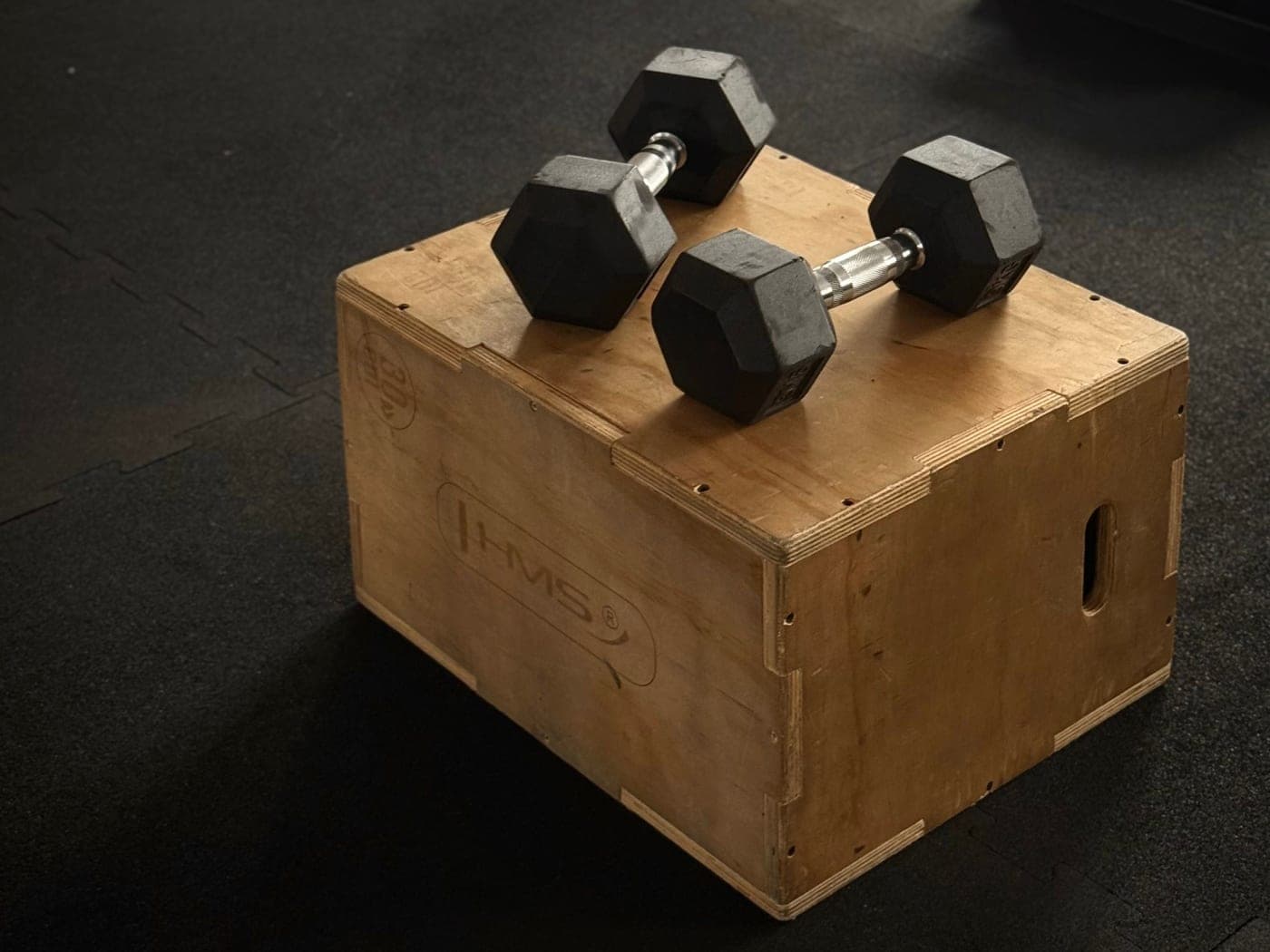
Pair of hex dumbbells on a wooden plyo box in a gym setting. Licensed stock photograph of the category — not the specific product.
Quick picks
| # | Product | Best for | Score | Price |
|---|---|---|---|---|
| 1 | Yes4All 3-in-1 Wooden Plyo Box (24 × 20 × 16 in.) A plywood puzzle-joint box in 16, 20 and 24 in. heights, 450 lb rating, about 34 lb — the cheapest real plyo box and the right heights for someone starting box jumps. | A first box for step-ups, box squats and low jumps on a budget | 8.2 | |
| 2 | Titan Fitness 3-in-1 Heavy Foam Plyometric Box (20 × 24 × 30 in.) An all-foam box — no wood core — in 20, 24 and 30 in., 66 lb of dense foam under vinyl, rated 330 lb, that stays put and can't hurt a shin anywhere on its surface. | The softest possible landing for nervous jumpers, on a hard garage floor | 8.4 | |
| 3 | 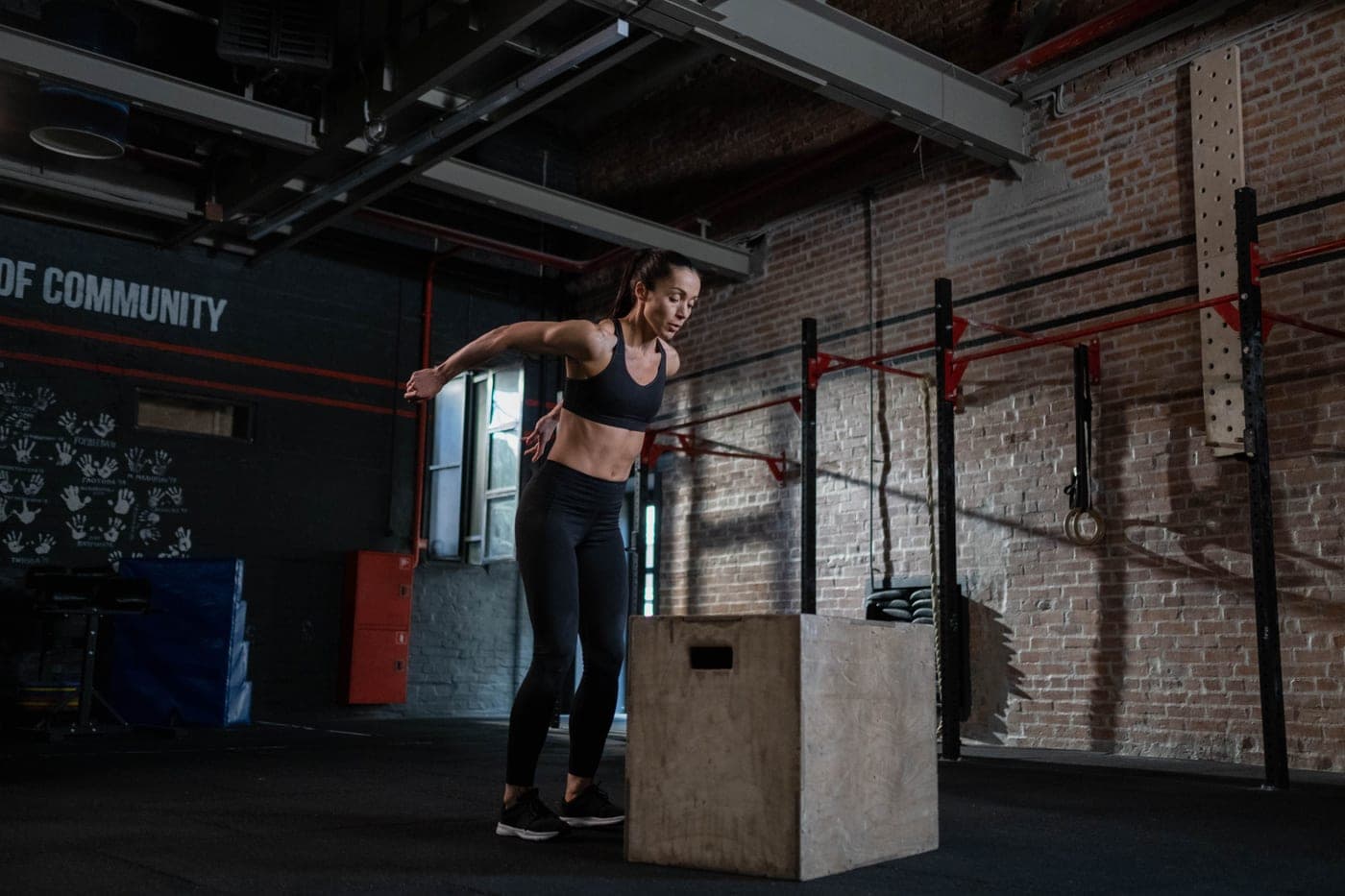 Yes4All 3-in-1 Soft Plyo Box (30 × 24 × 20 in.) A foam-padded box with a wood core: three heights (20, 24, 30 in.) in one 64 lb unit, vinyl cover, 440 lb rating — the box that won't take skin off a shin when you miss. | Box jumps at home where a missed rep on a wood edge is the real risk | 9.0 | |
| 4 | REP Fitness 3-in-1 Soft Plyo Box (30 × 24 × 20 in.) REP's foam-over-wood box: 20, 24 and 30 in. heights, 58 lb, textured zippered vinyl, 400 lb rating — the same idea as the Yes4All from a rack-and-bench brand. | A soft box from an equipment brand with a broader gear ecosystem | 8.7 |
Scores are our editorial judgment from published specs and mounting instructions, weighted for a renter or small-space trainer — not lab measurements. We have not tested these units.
Why this page reorders our main roundup
Our plyo box roundup ranks the Yes4All soft box first, because for someone who already jumps, a foam-over-wood box in 20/24/30 is the best object: shin-safe, 440 lb rated, and the three heights an adult will grow into.
For a beginner the ranking inverts, for one reason. A box's useful starting height is its lowestside, and on a 20/24/30 box that is 20 in. A new jumper who should be working at 14 to 18 in. has no legal starting point on it — so they either jump too high on day one, or they stack books on the floor, or they stop using it. The 16/20/24 box solves that, and the 16 in. side is also the best step-up and box-squat height for most people.
The four, reordered for a first box
| Box | Heights | Lowest side | Missed jump hits | Rated |
|---|---|---|---|---|
| Yes4All Wooden 3-in-1 | 16 / 20 / 24 in. | 16 in. — a real starting height | Plywood edge | 450 lb |
| Titan Heavy Foam | 20 / 24 / 30 in. | 20 in. | Dense foam, no wood at all | 330 lb |
| Yes4All Soft Plyo | 20 / 24 / 30 in. | 20 in. | EVA foam over a wood core | 440 lb |
| REP Soft Plyo | 20 / 24 / 30 in. | 20 in. | Foam over a wood core | 400 lb |
The landing test, which decides your height
Stand facing the box and jump onto it. If you land with both feet flat, in about a quarter squat, with no need to tuck your knees to your chest to clear the edge — that height is yours. If you land on your toes, on the balls of your feet, or you have to snap your knees up, the box is too tall. That is the whole test, and it is more reliable than any chart.
Most untrained adults pass that test somewhere between 12 and 18 in. and fail it at 24. Our full sizing treatment, including step-up and box-squat heights by your own height, is in what size plyo box should I get — read it before ordering, because it is the page that stops you buying the wrong box.
Wood edge or foam edge, for a beginner
This is a genuine trade and the reason this page does not simply recommend the cheapest box. A beginner misses jumps — that is what being a beginner is. The question is what the shin hits when they do.
The wood box gives you the right heights, half the price, about 34 lb of weight, and a hard edge. The all-foam Titan gives you a landing that forgives anything and a 330 lb rating, with the wrong starting height and 66 lb of bulk. There is, frustratingly, no box on the market that is both 16 in. at its lowest side and foam-edged.
Our resolution: buy the wood 16/20/24 and reduce the risk by being honest about height. At 16 in. on the correct landing test, you are not going to miss often, and if you do you are barely off the floor. The foam box is the right answer for someone who has already scraped a shin once, or who knows they are going to be timid about it. The full argument is foam vs wood plyo boxes.
You may not need a box yet at all
Worth saying on a page aimed at beginners: box jumps are a power exercise that assumes you can already squat and land. If you cannot yet do twenty bodyweight squats and ten controlled single-leg step-downs from a stair, a box is not the next purchase — the strength is.
And if you live in an apartment, a plyo box is close to the worst piece of equipment you can own: 20 in. of jumping transmits straight into the floor below, and none of these boxes fold. A jump rope and a kettlebell give a beginner far more for far less floor and far less noise. This page assumes a garage, a basement or a driveway.
A first month with a box
Weeks one and two, no jumping at all: step-ups on the 16 in. side, three sets of eight each leg, and box squats to the same height. That teaches your knees and ankles the position.
Weeks three and four, jumps: three sets of five onto the 16 in. side, stepping down between every rep, with a full breath between reps. Box jumps are not a conditioning exercise and should never be done for time or to failure — quality drops, the shin finds the edge.
Month two, either add reps or turn the box to 20 in., not both. There is more in conditioning workouts at home.
How this list was built
We compared heights, construction, surface, rated load and weight from the makers' own listings, then scored on the plyo box rubric — heights offered 25%, surface 25%, footprint and stackability 20%, rated load 15%, value 15%. This page reads "heights offered" as lowest usable height for a new jumper rather than range, which is what reorders it against our main roundup. Same four boxes, same specs, different buyer. No boxes were tested; we own no lab and say so on our methodology page.
The picks in detail
Every pick, reviewed
Key specs
- Heights
- 16 / 20 / 24 in.
- Surface
- Non-slip plywood
- Rated load
- 450 lb
Scores · editorial, out of 10
- Heights offered
- 8
- Surface (shin-safe vs load-bearing)
- 6
- Footprint & stackability
- 9
- Rated load
- 9
- Value
- 10
Pick 1 · Plyo boxes
Yes4All 3-in-1 Wooden Plyo Box (24 × 20 × 16 in.)
Yes4All
A plywood puzzle-joint box in 16, 20 and 24 in. heights, 450 lb rating, about 34 lb — the cheapest real plyo box and the right heights for someone starting box jumps.
Best for
A first box for step-ups, box squats and low jumps on a budget
Why it is #1 for a beginner. 16, 20 and 24 in. — a real 16 in. starting height, which no soft box here offers — at 450 lb rated, about 34 lb, and half the price of the foam boxes. It also ships flat and stacks. The hard plywood edge is the trade, and jumping at 16 in. is how you manage it.
Pros
- 16 in. low side is the honest starting height most beginners need
- Puzzle joints and internal bracing assemble without tools; ships flat
- Doubles as a bench for dips and a platform for elevated push-ups
Cons
- A wood edge will cut a shin on a missed jump — jump conservatively
- Plywood on a concrete floor slides; put it on a mat
Specs from Yes4All — 3-in-1 Wooden Plyo Box 24×20×16 listing (heights, capacity, weight).
Key specs
- Heights
- 20 / 24 / 30 in.
- Surface
- Dense foam core, vinyl exterior
- Rated load
- 330 lb
Scores · editorial, out of 10
- Heights offered
- 10
- Surface (shin-safe vs load-bearing)
- 10
- Footprint & stackability
- 7
- Rated load
- 6
- Value
- 7
Pick 2 · Plyo boxes
Titan Fitness 3-in-1 Heavy Foam Plyometric Box (20 × 24 × 30 in.)
Titan Fitness
An all-foam box — no wood core — in 20, 24 and 30 in., 66 lb of dense foam under vinyl, rated 330 lb, that stays put and can't hurt a shin anywhere on its surface.
Best for
The softest possible landing for nervous jumpers, on a hard garage floor
For the nervous jumper. 66 lb of dense foam with no wood anywhere, so a missed rep is a bruise rather than a cut. The 20 in. lowest side is higher than a beginner wants and the 330 lb rating is the lowest here — but if fear of the edge is what is stopping you, this is the box.
Pros
- No wood anywhere — a missed jump hits foam, full stop
- 66 lb of dense foam doesn't skid on concrete
- Titan also sells a 16 lb soft-foam version (350 lb rating) if you need to carry it
Cons
- 330 lb rating is the lowest here
- Foam compresses slightly under a heavy step-up — less precise than wood
Specs from Titan Fitness — 3-in-1 Heavy Foam Plyometric Box listing (heights, weight, capacity).
Key specs
- Heights
- 20 / 24 / 30 in.
- Surface
- EVA foam over wood core, vinyl cover
- Rated load
- 440 lb
Scores · editorial, out of 10
- Heights offered
- 10
- Surface (shin-safe vs load-bearing)
- 10
- Footprint & stackability
- 7
- Rated load
- 9
- Value
- 8
Pick 3 · Plyo boxes
Yes4All 3-in-1 Soft Plyo Box (30 × 24 × 20 in.)
Yes4All
A foam-padded box with a wood core: three heights (20, 24, 30 in.) in one 64 lb unit, vinyl cover, 440 lb rating — the box that won't take skin off a shin when you miss.
Best for
Box jumps at home where a missed rep on a wood edge is the real risk
The better box, later. Foam over a wood core, 20/24/30, 440 lb, no assembly. Our overall pick on the main roundup and the box most people should end up with — just not the box to learn on, because 20 in. is where it starts.
Pros
- Shin-safe foam edges; a wood core keeps it from squashing under step-ups
- Three heights from one box — 20 in. for beginners, 30 in. later
- Vinyl grips shoes and wipes clean; no assembly
Cons
- 64 lb and a 30 × 24 in. footprint — this is a permanent resident of a garage corner
- Foam rounds the top edge, so it's slightly less precise for box squats than wood
Specs from Yes4All — 3-in-1 Soft-Padded Plyo Box listing (heights, construction, capacity).
Key specs
- Heights
- 20 / 24 / 30 in.
- Surface
- Foam over wood core, zippered vinyl
- Rated load
- 400 lb
Scores · editorial, out of 10
- Heights offered
- 10
- Surface (shin-safe vs load-bearing)
- 10
- Footprint & stackability
- 7
- Rated load
- 8
- Value
- 7
Pick 4 · Plyo boxes
REP Fitness 3-in-1 Soft Plyo Box (30 × 24 × 20 in.)
REP Fitness
REP's foam-over-wood box: 20, 24 and 30 in. heights, 58 lb, textured zippered vinyl, 400 lb rating — the same idea as the Yes4All from a rack-and-bench brand.
Best for
A soft box from an equipment brand with a broader gear ecosystem
Near-twin of the Yes4All soft. Same construction with a zippered replaceable cover, 58 lb, 400 lb rated. Same reason it is not a beginner's box: nothing below 20 in. Buy whichever of the two soft boxes is cheaper when you upgrade.
Pros
- Zippered vinyl cover comes off to clean or replace
- Textured surface keeps feet and the box in place
- Lighter (58 lb) than the Yes4All soft box
Cons
- 400 lb rating versus 440 lb — fine for anyone, but a smaller margin
- Usually costs more than the Yes4All equivalent
Specs from REP Fitness — 3-in-1 Soft Plyo Boxes (dimensions, weight, capacity).
Buying guide
Which box for which beginner
- Garage, starting from nothing: Yes4All Wooden 16/20/24.
- Already scraped a shin, or dreading it: Titan all-foam.
- Mostly step-ups, box squats and a bench: the wood box — cheaper and more precise.
- Upstairs apartment: none of them. Buy a rope and a bell.
What to buy alongside it
A mat under the box so it cannot skid on a slab, and shoes with a flat sole. Neither is optional and both are cheap.
When to move up a height
When you pass the flat-foot landing test on the next side up, on a fresh day, not at the end of a session. Turn the box; do not buy a taller one.
FAQ
Questions readers ask
What size plyo box should a beginner get?
A 16/20/24 in. box, so you have a genuine 16 in. starting height. Most untrained adults should be jumping at 14 to 18 in. for their first couple of months, which a 20/24/30 box cannot give them.
What is the best plyo box for beginners?
The Yes4All 3-in-1 Wooden Plyo Box at 16/20/24 in. — the right heights, 450 lb rated, about 34 lb and half the price of a soft box. If you are worried about the hard edge, the all-foam Titan box is the alternative, at the cost of a 20 in. starting height.
Are soft plyo boxes better for beginners?
The edge is, yes — a missed rep hits foam. But every soft box we could find starts at 20 in., which is too tall for a new jumper. Getting the height right prevents more missed reps than a soft edge forgives.
How high should a beginner jump on a box?
Whatever height you can land on with both feet flat in about a quarter squat, without snapping your knees up to clear the edge. For most beginners that is 12 to 18 in. Test it rather than guessing.
Should you jump down off a plyo box?
No. Step down, every rep. The landing from the box is where knees and ankles are most often hurt, and stepping down costs you nothing in training effect.
Can I use a plyo box in an apartment?
Realistically, no. Jumping transmits straight into the floor below and none of these boxes fold away. A jump rope on a mat, or a kettlebell, gives a beginner far more in an apartment.
Related
Keep reading
- What size plyo box should I get?
The landing test and heights by your height.
- Best plyo boxes
The same four boxes, ranked for everyone else.
- Foam vs wood plyo boxes
The edge argument in full.
- Conditioning workouts at home
Where box jumps fit a week.
- Garage gym essentials
What else earns the floor space.
Sources
- —Yes4All — 3-in-1 Wooden Plyo Box 24×20×16 listing (heights, capacity, weight) · walmart.com
- —Titan Fitness — 3-in-1 Heavy Foam Plyometric Box listing (heights, weight, capacity) · amazon.com
- —Yes4All — 3-in-1 Soft-Padded Plyo Box listing (heights, construction, capacity) · amazon.com
- —REP Fitness — 3-in-1 Soft Plyo Boxes (dimensions, weight, capacity) · repfitness.com