Comparison · Conditioning
Plyo box vs bench: which one earns the corner of a small gym?
They look interchangeable and they are not. A bench gives you one height and a back pad; a 3-in-1 box gives you three heights and a surface you can land on. If there is only room for one object, the answer depends on whether you own dumbbells.
Rope & Rep is reader-supported. Product links go through our affiliate resolver and we may earn a commission from qualifying purchases at no cost to you. Prices are the retailer's and change — every button opens the live price on Amazon rather than showing a stale number.
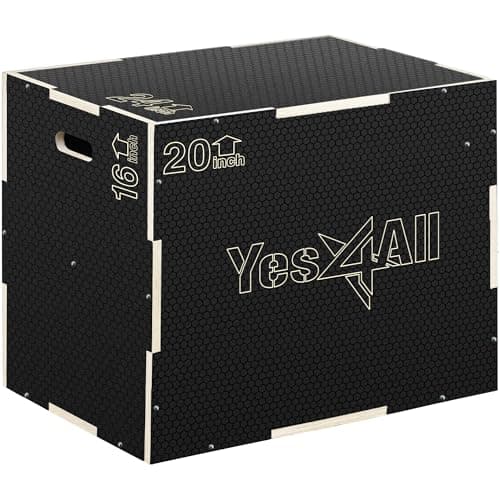
Yes4All 3-in-1 Non-Slip Wooden Plyo Box (24 × 20 × 16 in.). Licensed stock photograph of the category — not the specific product.
The honest answer, before the detail
These two objects overlap on exactly one movement — the step-up — and diverge on everything else. If you already own dumbbells or a barbell and you want to press, a bench is not optional and a box will not substitute for it. If your training is bodyweight and conditioning, the bench is the piece that sits unused in the corner while the box does step-ups, jumps, dips, elevated push-ups and split squats.
The confusion comes from the fact that both are roughly knee height and both hold a foot. That similarity is real and it is also where it ends.
What each one actually does
| Movement | Plyo box | Flat bench |
|---|---|---|
| Step-ups | Yes - three heights | Yes - one height, usually 17-18 in. |
| Box jumps | Yes, this is the point | No - do not do this |
| Bulgarian split squats | Yes, if the top edge is padded or you fold a towel | Yes - the pad is kinder on the instep |
| Elevated push-ups / feet-up push-ups | Yes | Yes |
| Bench press, floor-to-pad dumbbell work | No | Yes - this is the point |
| Dumbbell rows with a knee on the surface | Hard - too tall, too wide | Yes |
| Hip thrusts | No - the edge is square and too high | Yes |
| Box squats | Yes - set the height to your depth | Usually too tall, and the pad compresses |
| Dips (between two) | Possible with two boxes | Possible with two benches |
| Incline / decline work | No | Yes, on an adjustable bench |
The case for the bench
A bench exists to support your back under a load. That is a narrow job and nothing else does it. The moment you own a pair of dumbbells, a long list of useful movements — flat press, incline press, supported rows, chest-supported work, hip thrusts, skull crushers — needs a padded surface that will not tip when the load is off-centre.
It is also the better surface for a Bulgarian split squat, which is the one movement where the pad genuinely earns its keep. The back foot sits on the top of your instep, and a vinyl-wrapped foam pad is considerably kinder there than a plywood edge.
And it has one practical advantage that gets overlooked in small rooms: a bench is narrow. Most flat benches are 10 to 12 in. wide and slide under things. A 3-in-1 plyo box is a 24 by 30 in. cube that fits nowhere except where you put it.
The case for the box
A box is the more versatile object in a gym with no barbell. It changes height, which is the single capability a bench does not have, and height is the variable in almost every movement a box is used for. A 16 in. step-up and a 24 in. step-up are different exercises. A box squat to 16 in. and a box squat to 20 in. are different exercises. A bench gives you one of each, forever.
It is also the only one of the two you can land on. A plyo box is built to take an impact: a foam-over-wood or plywood top with a broad, low-centred footprint and, on the better boxes, a published load rating — 450 lb on the Yes4All wooden box, 400 lb on the REP soft box. A bench is built to hold a person lying still.
And on the movements the two share, the box usually wins on stability. A 53 lb box with a 24 by 30 in. base does not move. A 25 lb bench on four feet can rock when you drive off one end.
Which to buy first, by what you already own
You own dumbbells or a barbell: bench first. The pressing movements have no substitute, and step-ups at bench height will do until the box arrives.
You own a pull-up bar and not much else: box first. It adds step-ups, jumps, box squats, elevated push-ups, feet-elevated rows and split squats to a bodyweight setup, and it will not sit idle. Our garage gym essentials list puts it in the same tier as a bar for exactly this reason.
You are training in an apartment: box, and probably a foam one. It is the quieter object, it does double duty as a seat, and an all-foam box is light enough to move between a cupboard and the living room. The apartment gym setup guide works through the whole inventory.
You have room for both: get the bench second. Most people buy the bench first out of habit and then discover the box is the piece they use three times a week.
The compromise nobody mentions
A wooden 3-in-1 box with a folded towel on the top edge does a passable Bulgarian split squat, and a box set to its lowest height does a passable bench for seated dumbbell work. The reverse is not true: there is no way to make a bench into a jumpable surface, and no way to give it a second height.
That asymmetry is the strongest argument in this comparison. The box can imitate some of the bench. The bench cannot imitate the box at all.
If you are buying the box
The choice between them comes down to construction. Plywood is the firmest and cheapest and the harshest on a shin. Foam over a wood core is the compromise most people should take. All-foam is the softest landing and the one without a published load rating. The foam vs wood comparison covers that split properly, and the box height guide covers which three heights you want.
Picks
If the box is the right answer
Three 3-in-1 boxes that cover the heights a bench cannot, ranked by how firm the top stays and whether the maker publishes a load rating.
Key specs
- Heights
- 16 / 20 / 24 in.
- Surface
- Plywood, non-slip honeycomb coating
- Weight
- 35 lb, rated 450 lb
Scores · editorial, out of 10
- Heights offered
- 8
- Surface (shin-safe vs load-bearing)
- 6
- Footprint & stackability
- 9
- Rated load
- 9
- Value
- 10
Pick 1 · Plyo boxes
Yes4All 3-in-1 Non-Slip Wooden Plyo Box (24 × 20 × 16 in.)
Yes4All
A plywood puzzle-joint box in 16, 20 and 24 in. heights at 35 lb, rated to 450 lb — the cheapest real plyo box and the right heights for someone starting box jumps.
Best for
A first box for step-ups, box squats and low jumps on a budget
Pros
- 16 in. low side is the honest starting height most beginners need
- Thick plywood with puzzle joints and inner bracing, rated to 450 lb; pre-drilled holes make the build quick
- Doubles as a bench for dips and a platform for elevated push-ups
Cons
- A wood edge will cut a shin on a missed jump — jump conservatively
- Plywood on a concrete floor slides; put it on a mat
Specs from Yes4All — 3-in-1 Non-Slip Wooden Plyo Box 24×20×16 listing (heights, weight, 450 lb rating, construction).
Key specs
- Heights
- 20 / 24 / 30 in.
- Surface
- EVA foam over wood core, vinyl cover
- Weight
- 53 lb
Scores · editorial, out of 10
- Heights offered
- 10
- Surface (shin-safe vs load-bearing)
- 10
- Footprint & stackability
- 7
- Rated load
- 9
- Value
- 8
Pick 2 · Plyo boxes
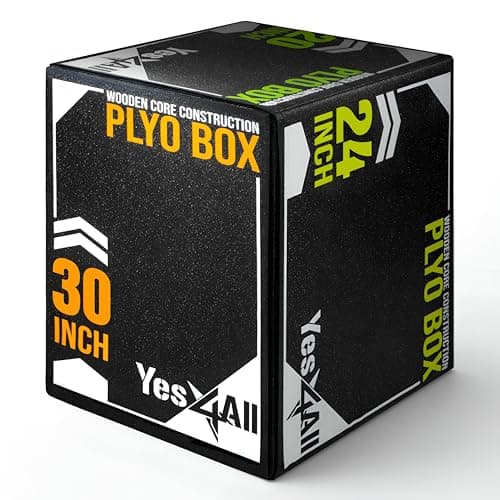
Yes4All 3-in-1 Soft Plyo Box (30 × 24 × 20 in.)
Yes4All
A foam-padded box with a wood core: three heights (20, 24, 30 in.) in one 53 lb unit under a wipe-clean vinyl cover — the box that won't take skin off a shin when you miss.
Best for
Box jumps at home where a missed rep on a wood edge is the real risk
Pros
- Shin-safe foam edges; a wood core keeps it from squashing under step-ups
- Three heights from one box — 20 in. for beginners, 30 in. later
- Vinyl grips shoes and wipes clean; no assembly
Cons
- 53 lb and a 30 × 24 in. footprint — this is a permanent resident of a garage corner
- Foam rounds the top edge, so it's slightly less precise for box squats than wood
Specs from Yes4All — 3-in-1 Soft-Padded Plyo Box 30×24×20 listing (heights, construction, weight).
Key specs
- Heights
- 20 / 24 / 30 in.
- Surface
- High-density EPE foam core, non-slip PVC leather cover
- Weight
- 16 lb
Scores · editorial, out of 10
- Heights offered
- 10
- Surface (shin-safe vs load-bearing)
- 10
- Footprint & stackability
- 7
- Rated load
- 6
- Value
- 7
Pick 3 · Plyo boxes
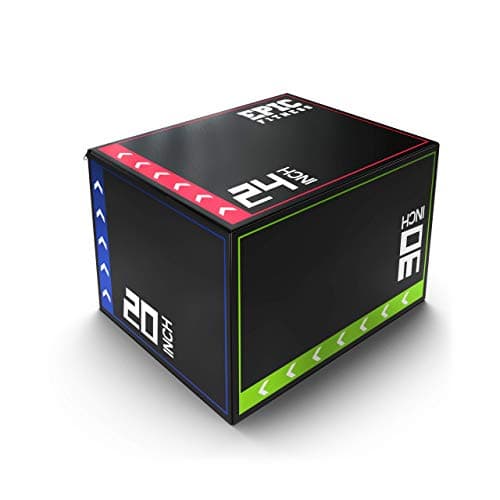
Epic Fitness 3-in-1 Foam Plyometric Jump Box (20 × 24 × 30 in.)
Epic Fitness
An all-foam box — a high-density EPE foam core under a wipe-clean PVC leather cover — in 20, 24 and 30 in. heights at 16 lb, so a missed jump hits foam anywhere on it and one person can still move it.
Best for
The softest landing for nervous jumpers, on a hard garage floor
Pros
- No wood anywhere — a missed jump lands on foam, full stop
- Three heights from one box: 20 in. to start, 30 in. later
- 16 lb, so it carries out to a driveway and back without help
Cons
- The listing publishes no weight rating — there is no capacity figure to check yourself against
- At 16 lb it is light enough to scoot on a slick floor; foam compresses slightly under a heavy step-up
Specs from Epic Fitness — 3-in-1 Foam Plyometric Jump Box listing (heights, foam core, cover, weight).
FAQ
Questions readers ask
Can I use a bench instead of a plyo box?
For step-ups, split squats and elevated push-ups, yes — a flat bench is usually 17 to 18 in. and stable enough. For box jumps, no. And a bench cannot change height, which is the main reason to own a box in the first place.
Is it safe to box jump on a weight bench?
No. Benches are rated for a static load on a stable base, not for an impact landing near one end. The risk is the bench tipping or sliding while both your feet are in the air. Use a plyo box, which has a broad low footprint and, on the better models, a published impact-capable load rating.
Which should I buy first for a home gym, a bench or a plyo box?
A bench if you own dumbbells or a barbell, because pressing has no substitute. A plyo box if your training is bodyweight and conditioning, because the box covers step-ups, jumps, box squats, split squats and elevated push-ups while the bench would mostly sit unused.
What height is a flat weight bench?
Most flat benches sit at 17 to 18 in. from the floor, which is close to the standard 18 in. a bench press setup assumes. That is a usable step-up height for someone around 5 ft 8 in., and it is the only height the bench will ever give you.
Can a plyo box be used as a bench?
For seated dumbbell work and as a platform for dips or elevated push-ups, yes. For anything where you lie back under a load, no — there is no back support, the top is usually wider than your torso, and the square edge sits in the wrong place. A box is a platform, not a bench.
Related
Keep reading
- Best plyo boxes for step-ups
If step-ups are the movement the purchase is really for.
- What size plyo box should I get
Which three heights you want, by height and by goal.
- Foam vs wood plyo boxes
The construction decision once you have chosen the box.
- Garage gym essentials
Where both of these sit in a build-it-once equipment list.
Sources
- —Yes4All — 3-in-1 Non-Slip Wooden Plyo Box 24x20x16 listing (heights, 450 lb rating, 35 lb weight) · amazon.com
- —Yes4All — 3-in-1 Soft-Padded Plyo Box 30x24x20 listing (heights, EVA foam over wood core, 53 lb weight, footprint) · amazon.com
- —Epic Fitness — 3-in-1 Foam Plyometric Jump Box listing (heights, EPE foam core, 16 lb weight) · amazon.com
- —REP Fitness — 3-in-1 Soft Plyo Boxes (400 lb capacity, assembled shipping) · repfitness.com