Guide · Training
Bodyweight training vs weight training: the same results until the legs
For the upper body, bodyweight work matches a gym closely enough that the difference barely matters. For the lower body it does not, and that single asymmetry is the whole honest answer to this question.
Rope & Rep is reader-supported. Product links go through our affiliate resolver and we may earn a commission from qualifying purchases at no cost to you. Prices are the retailer's and change — every button opens the live price on Amazon rather than showing a stale number.
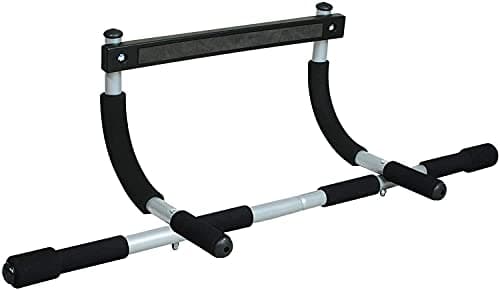
Iron Gym Total Upper Body Workout Bar. Licensed stock photograph of the category — not the specific product.
What the question is usually really asking
"Is bodyweight training enough?" is almost always three different questions wearing one coat: can I build muscle, can I get strong, and can I keep progressing. The answers are yes, mostly, and only if you are deliberate about it - and they differ sharply between the upper body and the lower body.
The underlying mechanism is not in dispute. Muscle grows in response to mechanical tension through a range of motion, taken reasonably close to failure, repeated with enough volume and enough progression. Your muscles cannot tell whether the tension comes from a barbell, a kettlebell, a band or your own ribcage. What differs is how easily you can keep increasing that tension over years - and that is where the two approaches genuinely part company.
Side by side
| Bodyweight training | Weight training | |
|---|---|---|
| Upper-body muscle | Very effective - pull-ups, dips, rows, push-up variations | Very effective, and easier to load precisely |
| Lower-body muscle and strength | Limited past the first year without external load | The clear winner - squats, hinges, loaded carries |
| Progression method | Harder variations, leverage, tempo, added weight late on | Add 2.5 kg. Clean, measurable, repeatable |
| Relative strength and skill | The clear winner - muscle-up, lever, handstand, L-sit | Not trained |
| Cost | A bar and bands. Less than a month of membership | A rack, a bar and plates, or a membership |
| Space | A doorway and a mat | A room, or a commute |
| Joint load | Generally lower - closed-chain, self-limiting | Higher, and more controllable |
| Isolation | Poor - everything is compound | Excellent, when you need it |
| Learning curve | Low to start, high for the skills | Moderate - squat and hinge technique matter |
Where bodyweight training genuinely runs out
The lower body, and it is not close. This is the one real limitation and it deserves to be stated plainly rather than argued around. Your legs are strong - strong enough that most people can do dozens of bodyweight squats - and the bodyweight answers to that problem are single-leg work (pistol squats, Bulgarian split squats, nordic curls) which are genuinely hard but also technically demanding, balance-limited and awkward to progress. You can build respectable legs with bodyweight work. You cannot build a 150 kg squat, and past about a year the honest answer is that legs want external load.
Precise progression anywhere. Going from a 10 rep push-up to a harder variation is a jump, not a step. Going from 60 kg to 62.5 kg on a bar is a step. Over months, steps beat jumps, which is why bodyweight training benefits enormously from a vest or a belt once the base movements are easy - weighted vest increments covers how small those steps can be.
Isolation, when you want it. If you specifically want bigger biceps or rear delts, a dumbbell will get you there faster than a creative bodyweight substitute. That is a real if narrow advantage.
Where weight training runs out
Relative strength and the skills. A muscle-up, a front lever, a handstand push-up, an L-sit - these are not available from a weight room, and they are not consolation prizes. They are a whole category of physical competence built on controlling your own body in space, and someone who can do them has something a strong bench presser does not.
Cost and space, by an order of magnitude. A doorway bar and a band set is a trivial purchase. A rack, a bar and a set of plates is not, and a membership is a recurring bill plus a commute. For most people reading this site, this is the decisive practical point - the training you will actually do is the training that is six feet from where you sit.
Joint load and self-limitation. Bodyweight movements are mostly closed-chain and the load is capped by your own mass, which makes them harder to get badly wrong. You can hurt yourself doing calisthenics, but you cannot load a bad squat with 120 kg if there is no 120 kg.
The hybrid, which is what we would actually recommend
Bodyweight for everything above the waist. Pull-ups and rows for the back, dips and push-up variations for the chest and shoulders, hanging work and holds for the trunk. A bar and a pair of rings cover all of that for a fraction of what any equivalent weight setup costs, in a fraction of the space, and they take you as far as a muscle-up.
External load for everything below the waist. One kettlebell is the cheapest honest answer: swings for hip extension and conditioning, goblet squats, single-leg deadlifts, loaded carries. One 16 to 24 kg bell occupies about a square foot and closes most of the gap this page is about. The kettlebell size guide picks the weight and one kettlebell workout for beginners is the programme.
Then add load to the bodyweight work as it gets easy. A vest or a dip belt turns pull-ups and dips back into a five-rep strength exercise, which restores the clean progression that weights have and bodyweight work otherwise lacks. That three-stage plan - bodyweight, one bell, then added weight - is the whole argument of this site in one paragraph.
How to choose, in four questions
Can you do a pull-up? If not, that is the next twelve weeks regardless of which camp you are in, and it needs a bar and a band. How to get your first pull-up is the route.
Do you want to be strong, or to be able to do things? A 150 kg squat is a weights goal. A muscle-up is a bodyweight goal. Most people want some of both, which is the hybrid.
How much space and money do you have? If the answer is "a corner of a rented flat", the question largely answers itself - and apartment gym setup is the practical plan.
What will you still be doing in two years? This is the one that matters most and the one nobody asks. The best programme is the one that survives contact with your actual life, and proximity beats optimality by a wide margin.
Picks
The three-item answer to this question
A bar and a pair of rings for the bodyweight side, and one kettlebell for the leg work bodyweight training genuinely cannot load.
Key specs
- Door width
- 24–32 in. (trim to 3.5 in.)
- Mounting
- Leverage, no screws
- Rated load
- 300 lb
Scores · editorial, out of 10
- Fit & clearance (door, ceiling, depth)
- 7
- Reversibility (no drill, no marks, takedown)
- 9
- Rated load & build
- 7
- Grip options
- 8
- Value
- 10
Pick 1 · Pull-up bars
Iron Gym Total Upper Body Workout Bar
Iron Gym
The doorway bar everyone copies: three grips, a 300 lb rating, fits a 24–32 in. door with trim up to 3.5 in., and it leaves with you when the lease ends.
Best for
A first bar in a standard apartment doorway
Pros
- Fits the most common US interior door range and trim depth without tools
- Three grip positions (wide, narrow, neutral) on a bar this cheap is rare
- Flips to the floor for push-ups and dips — one piece of gear, four movements
Cons
- The leverage design needs a door with trim on both sides; flat, trimless frames won't hold it
- Grip width is fixed — taller lifters may find the wide grip a touch narrow
Specs from Iron Gym — Total Upper Body Workout Bar listing (door width, trim, load).
Key specs
- Rings
- Birch wood, 1.25 in. (32 mm)
- Straps
- 2 × 14.76 ft, 1.5 in., numbered scale
- Rated load
- 1500 lb
Scores · editorial, out of 10
- Strap length & numbering
- 10
- Material & grip
- 9
- Rated load
- 10
- Setup where a renter can hang them
- 8
- Value
- 9
Pick 2 · Gymnastic rings
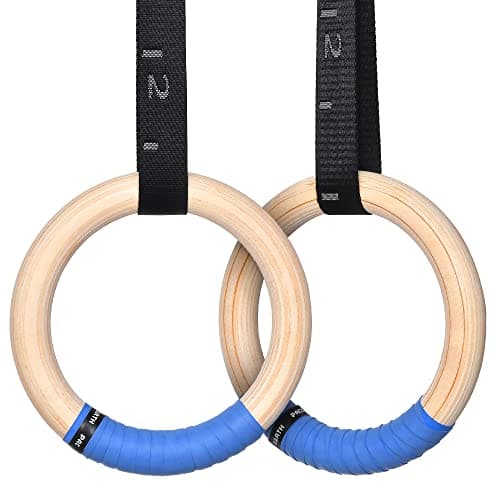
PACEARTH Wooden Gymnastic Rings (1500 lb)
PACEARTH
1.25 in. birch rings on 14.76 ft cam-buckle straps printed with a scale, rated 1500 lb — the wood ring set that makes leveling both rings under a ceiling a ten-second job.
Best for
A first pair of wood rings hung from a doorway bar, a beam or a tree
Pros
- Numbered straps — set both rings to the same mark and they're level, every time
- 1.5 in. straps are wider than most, so they dig into wrists less on dips
- Serrated cam buckles; birch grips well with or without chalk
Cons
- Wood must stay dry — not for a rainy balcony or an outdoor tree year-round
- 14.76 ft is long for an 8 ft ceiling; you'll coil the excess
Specs from PACEARTH — Wooden Gymnastics Rings listing (ring size, strap length/width, capacity).
Key specs
- Weights
- 5–80 lb in 5 lb steps
- Handle
- ~1.25 in. (35 mm), textured
- Base
- Flat
Scores · editorial, out of 10
- Handle & finish
- 7
- Weight increments / adjustability
- 9
- Footprint & floor safety
- 7
- Build (casting, seams)
- 8
- Value
- 10
Pick 3 · Kettlebells
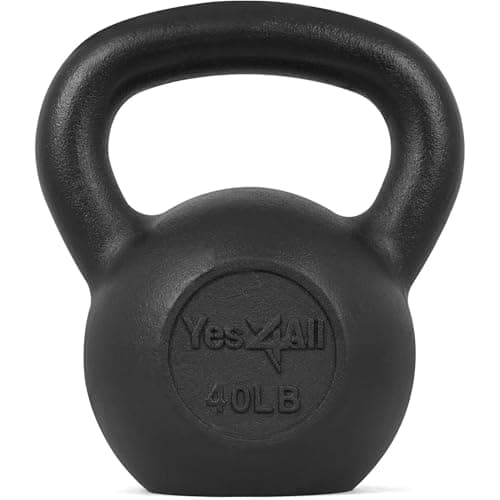
Yes4All Solid Cast Iron Kettlebell
Yes4All
The one-piece cast iron bell sold in 5 lb steps from 5 to 80 lb with a 1.25 in. handle and a flat base — the default first kettlebell because you can buy exactly the size you need.
Best for
A first bell in the exact weight you need without paying for a coating you don't
Pros
- 5 lb increments across the whole range — 15, 20, 25, 30, 35 lb are all there for a beginner's first two bells
- One-piece casting, no welded handle to fail
- Flat base sits still for rows, push-ups and storage
Cons
- Painted (not powder-coated) finish on the basic version chips and can leave marks on a wood floor — use a mat
- 35 mm handle is a bit thick for smaller hands on high-rep snatches
Specs from Yes4All — Solid Cast Iron Kettlebell listing (weights, handle, base).
FAQ
Questions readers ask
Is bodyweight training as effective as weight training?
For the upper body, close enough that the difference rarely matters - muscle responds to tension and effort, not to the source of resistance. For the lower body, no: legs are strong enough that bodyweight work runs out of load within about a year, and external weight closes that gap. The other difference is progression - adding 2.5 kg is a cleaner step than finding a harder variation.
Can you build muscle with bodyweight training alone?
Yes, particularly in the upper body, provided your sets are genuinely hard and you keep making them harder - by progressing variations, slowing the tempo, adding range, and eventually adding weight with a vest or belt. The thing that stalls people is not the modality, it is doing the same twenty push-ups for two years.
Is bodyweight training enough for legs?
For general health and the first several months, yes. Beyond that, honestly no. Single-leg work - pistols, Bulgarian split squats, nordic curl progressions - is hard and useful but balance-limited and awkward to progress. One kettlebell for swings, goblet squats and carries closes most of the gap for about a square foot of floor.
Is calisthenics better than the gym for beginners?
It is usually better in practice, because it starts today, in your home, for almost nothing, and the first six months of progress do not need equipment at all. The gym becomes the better answer when precise progressive overload and heavy lower-body loading become the priority - which is a year-two problem for most people.
Can I combine bodyweight training and weights?
That is the best plan for most home trainees: bodyweight for everything above the waist, one or two loaded implements for everything below it, and added weight on the bodyweight work once it gets easy. A bar, a pair of rings and one kettlebell is a complete setup in a very small space.
Does bodyweight training build strength or just endurance?
Strength, if the sets are short and hard. Three to six hard reps of a difficult variation is a strength stimulus; twenty-five easy push-ups is endurance. The tool for keeping bodyweight work in the strength range once the basics are easy is added weight - a vest or a dip belt - which is why those exist.
Related
Keep reading
- Bodyweight training for beginners
The programme for the bodyweight half of the answer.
- Calisthenics equipment for home
Which skill needs which piece of equipment, and what to skip.
- One kettlebell workout for beginners
The loaded half - the lower-body work bodyweight training cannot do.
- Best dip belts
How to put bodyweight work back into a five-rep strength range.
Sources
- —Iron Gym — Total Upper Body Workout Bar listing (fits 24-32 in. doors with trim up to 3.5 in., 300 lb rating, three grip positions) · amazon.com
- —PACEARTH — Wooden Gymnastics Rings listing (1.25 in. birch rings, 2 x 14.76 ft numbered cam-buckle straps, 1500 lb rating) · amazon.com
- —Yes4All — Solid Cast Iron Kettlebell listing (5-80 lb in 5 lb steps, textured handle of about 1.25 in., flat base) · amazon.com