Guide · Kettlebells
One kettlebell, five moves, three days a week: the beginner program
Everything a first bell needs to do for twelve weeks: the two-hand swing, the goblet squat, the press, the row and the carry. How to learn the hinge before the swing, the weekly plan, and the cues that keep a beginner's back happy.
Rope & Rep is reader-supported. Product links go through our affiliate resolver and we may earn a commission from qualifying purchases at no cost to you. Prices are the brand's and change — every button opens the live price on the brand's own store rather than showing a stale number.
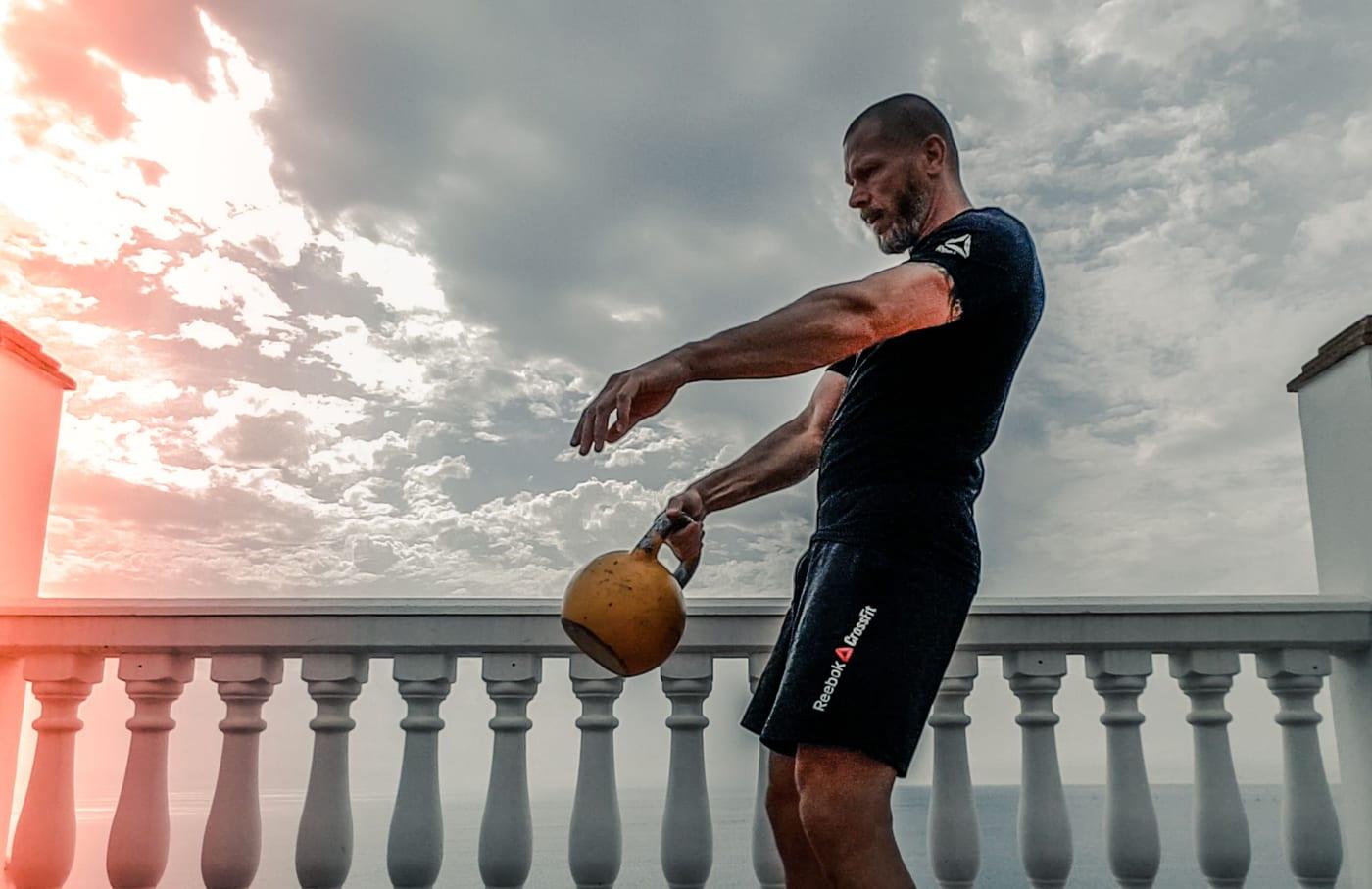
A man doing a kettlebell workout outdoors on a terrace. Licensed stock photograph of the category — not the specific product.
Learning the hip hinge (before your first swing) · 5 steps
1
Stand a foot from a wall, facing away
Feet shoulder width, soft knees, hands on hips.
2
Push the hips back to touch the wall
Keep the back flat and the shins nearly vertical — the knees bend a little, the hips travel back. Chest stays up.
3
Stand up by driving the hips forward
Squeeze the glutes at the top; don't lean back. Ten reps, then step an inch further from the wall.
4
Add the bell as a deadlift
Bell between the feet, hinge, grip, stand. Ten reps. The back never rounds.
5
Hike and swing
Hinge, hike the bell back between the legs like a football snap, drive the hips, let the bell float to chest height, hinge again as it falls. Sets of 5, building to 10.
Why these five
The swing is the reason to own a bell — hip power and conditioning together. The goblet squat teaches a squat with the weight where it helps you balance. The press is the upper-body strength lift and the one that sizes the bell. The row balances the press. The carry is the one people skip and the one that fixes grip, posture and core in a single walk down the hallway. Together they hit everything a beginner needs and nothing that needs a second bell. The bell size is in the sizing guide, and the swing broken down fault by fault is in kettlebell swing form.
The session
| Order | Exercise | Weeks 1–4 | Weeks 5–8 | Weeks 9–12 |
|---|---|---|---|---|
| 1 | Two-hand swing | 5 × 10 | 5 × 15 | 8 × 15 (or 5 × 20) |
| 2 | Goblet squat | 3 × 8 | 3 × 10 | 4 × 10 |
| 3 | Press (each arm) | 3 × 5 | 3 × 6 | 4 × 6 |
| 4 | Row (each arm) | 3 × 8 | 3 × 10 | 4 × 10 |
| 5 | Suitcase carry (each hand) | 3 × 20 steps | 3 × 30 steps | 3 × 40 steps |
Three days a week with a day between — Monday, Wednesday, Friday is the classic. Weeks 1–2, do the hinge drill above for five minutes before every session and keep the swings to sets of 5 until the hinge is automatic.
The cues
- Swing: hips back, not down. The bell floats to chest height from hip drive; the arms are ropes. If your shoulders are pulling it up, the bell is too light or the hinge is missing.
- Goblet squat: bell held by the horns at the chest, elbows inside the knees at the bottom, heels down.
- Press: from the rack, forearm vertical, press straight up and slightly back, lock out, lower slowly. No leg drive — that's a push press, later.
- Row: hinge and brace with the free hand on a chair or knee; pull the bell to the hip, not the chest.
- Carry: bell in one hand, walk tall, don't lean away from it. Switch hands each length.
When to add the second bell, and what changes
When the swings at 5 × 20 feel easy and the press hits 4 × 8, buy a bell 8–10 lb heavier. Swings, squats and carries move to the heavy bell; presses and the first one-hand swings stay on the light one. That is the program for the second three months, and it needs nothing else — a pull-up bar added to it is a complete home gym.
Where it fits with the rest of the site
On its own this is a strength-and-conditioning program. Pair it with the pull-up plan on the same days (pull-ups first, then the bell) or with a rope session on the off days, and you have the whole week. For an apartment floor, the set-down rules are in kettlebells in an apartment.
Picks
The bell and the mat
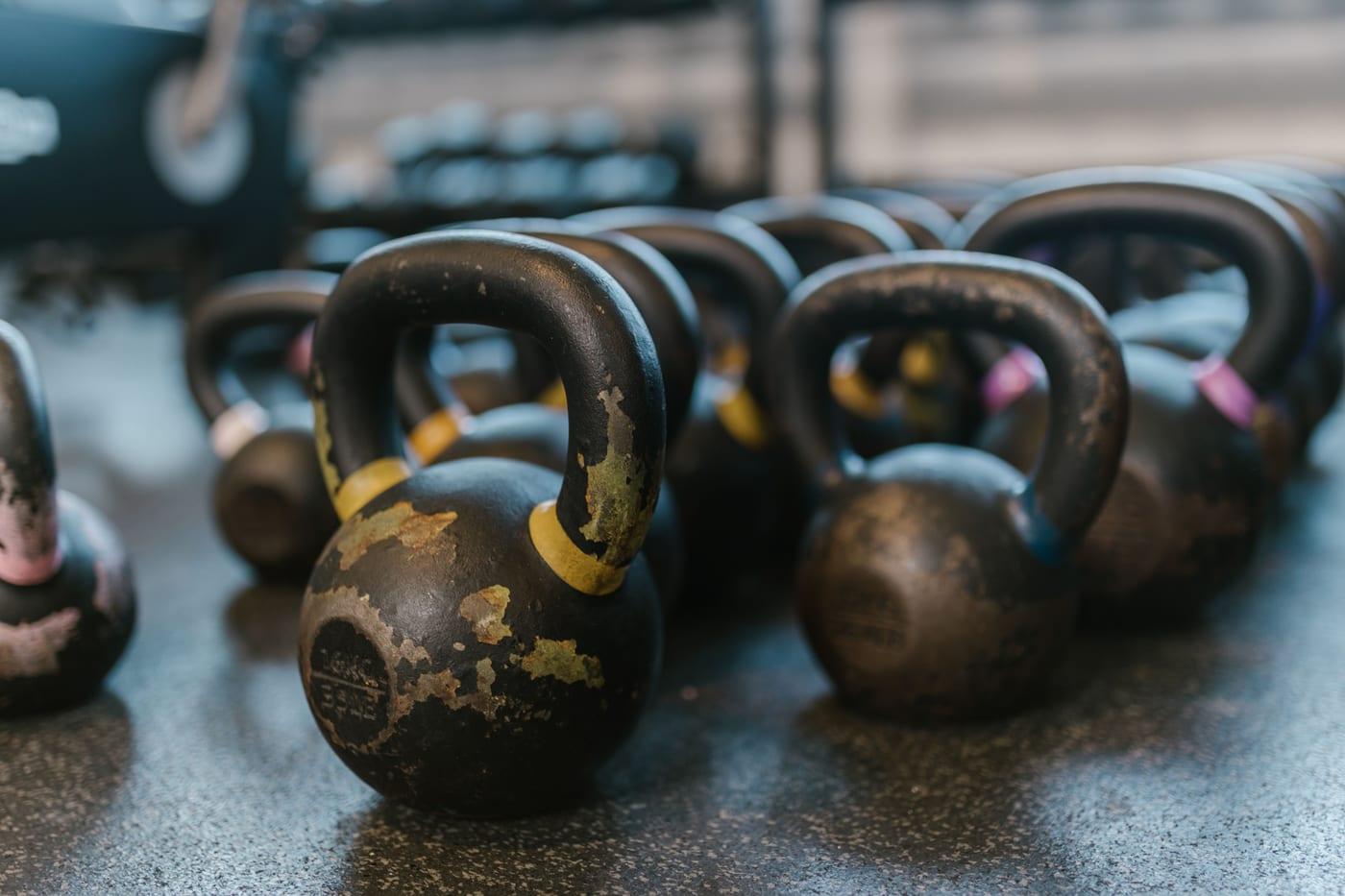
A cast iron bell in the exact size from the sizing table, the coated version for an apartment floor, and the mat both live on.
Key specs
- Weights
- 5–80 lb in 5 lb steps
- Handle
- ~1.25 in. (35 mm), textured
- Base
- Flat
Scores · editorial, out of 10
- Handle & finish
- 9
- Weight increments / adjustability
- 10
- Footprint & floor safety
- 9
- Build (casting, seams)
- 9
- Value
- 10
Pick 1 · Kettlebells
Yes4All Solid Cast Iron Kettlebell
Yes4All
The one-piece cast iron bell sold in 5 lb steps from 5 to 80 lb with a 1.25 in. handle and a flat base — the default first kettlebell because you can buy exactly the size you need.
Best for
A first bell in the exact weight you need without paying for a coating you don't
Why we picked it
- 5 lb increments across the whole range — 15, 20, 25, 30, 35 lb are all there for a beginner's first two bells
- One-piece casting, no welded handle to fail
- Flat base sits still for rows, push-ups and storage
Good to know
Painted (not powder-coated) finish on the basic version chips and can leave marks on a wood floor — use a mat
Specs from Yes4All — Solid Cast Iron Kettlebell listing (weights, handle, base).
Key specs
- Weights
- 5–45 lb, nine weights in 5 lb steps
- Coating
- Vinyl over one-piece cast iron
- Handle
- Smooth, slightly textured; flat base
Scores · editorial, out of 10
- Handle & finish
- 9
- Weight increments / adjustability
- 9
- Footprint & floor safety
- 10
- Build (casting, seams)
- 9
- Value
- 10
Pick 2 · Kettlebells
Yes4All Vinyl Coated Kettlebell
Yes4All
The same cast iron bell in a vinyl jacket, 5–45 lb in 5 lb steps — the apartment kettlebell: quieter to set down and kinder to a floor you don't own.
Best for
Kettlebell training on an apartment floor with neighbors below
Why we picked it
- Vinyl coating dampens the clank on a hard floor and won't scratch it
- PVC-coated shell takes a knock on a hard floor without chipping the way enamel does
- Color-coded — the fastest way to grab the right weight
Good to know
Vinyl adds a little bulk to the bell and can crack if dropped on concrete
Specs from Yes4All - Vinyl Kettlebell (Single) product page, yes4all.shop, read 19 November 2026 (nine weights, 5-45 lb in 5 lb steps; one-piece solid cast iron, no welds or seams; vinyl coating for noise, floor protection and corrosion resistance; smooth slightly textured handle; flat bottom; clear weight markings. No handle width published).
Key specs
- Size
- 54 × 36 in. rounded
- Thickness
- 7 mm (0.28 in.) PVC
- Weight
- 6.5 lb
Scores · editorial, out of 10
- Floor protection & grip
- 10
- Size for a rope
- 10
- Rolls up & stores
- 9
- Durability
- 10
- Value
- 9
Pick 3 · Jump rope mats
FEECCO Jump Rope Mat 54 × 36 in. (7 mm)
FEECCO Fitness
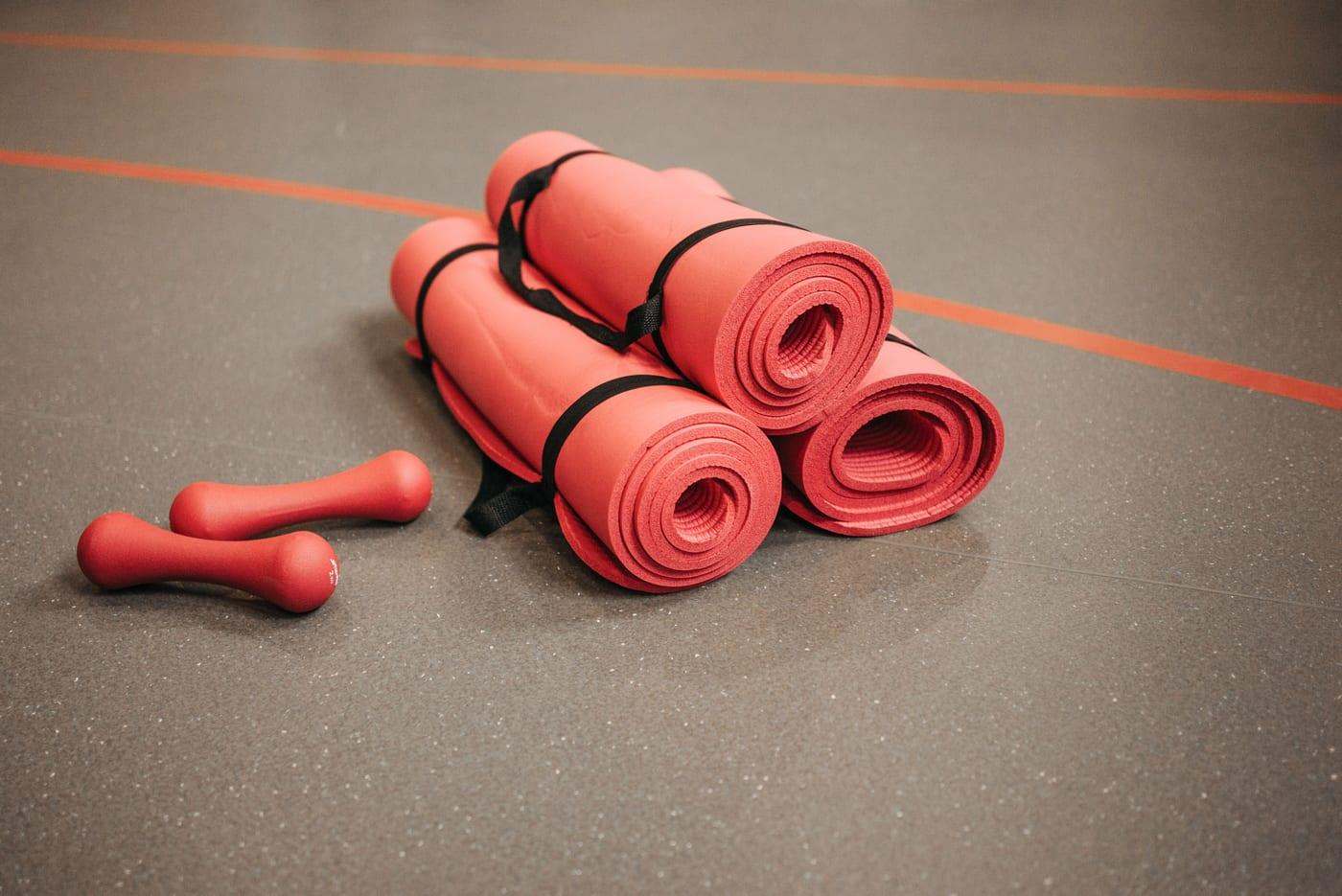
A 54 × 36 in. rounded mat in 7 mm high-density PVC that weighs 6.5 lb — the biggest, thickest and heaviest of the three, which is what keeps the rope on the mat and the mat on the floor.
Best for
Daily jumpers, especially with weighted ropes, on a floor you don't own
Why we picked it
- 54 in. long and 36 in. wide — the longest mat here, so the cord lands on mat instead of floor even when you drift
- 6.5 lb with a non-slip backing: the maker's point is that it stays put when a heavy rope strikes it
- 7 mm of high-density PVC, deliberately softer than the rock-hard PVC mats, and rated for indoor floors, outdoor concrete or grass
Good to know
The rim is a plain cut edge, not tapered — a drifting cable can still catch it
Specs from FEECCO Fitness — Jump Rope Mat 54 × 36 listing (size, 7 mm thickness, 6.5 lb weight, non-slip backing, surfaces).
FAQ
Questions readers ask
Can you get a full workout with one kettlebell?
Yes — swings, goblet squats, presses, rows and carries cover hips, legs, upper body, grip and conditioning. It is a full program for three months from one bell.
How often should a beginner do kettlebell workouts?
Three sessions a week with a day between, 20–25 minutes each.
How do you use a kettlebell for beginners?
Learn the hip hinge at a wall first, then deadlift the bell, then swing in sets of 5. Add goblet squats, presses, rows and carries. Set the bell down at the end of every set.
Why does my back hurt after kettlebell swings?
Almost always a rounded back at the bottom of the hinge or lifting with the arms. Go lighter, redo the wall drill, and stop each set before the form goes.
Our recommendation
What we'd buy
Top pick
Yes4All Solid Cast Iron Kettlebell
A first bell in the exact weight you need without paying for a coating you don't
Also worth buying
Yes4All Vinyl Coated Kettlebell
Kettlebell training on an apartment floor with neighbors below
Brands: want your product tested? For Brands.
Related
Keep reading
- What size kettlebell should a beginner buy?
The bell this program assumes.
- Best kettlebells for beginners
Bells sold in the right size.
- Kettlebells in an apartment
Doing this over a neighbor.
- Bodyweight training for beginners
The program to pair it with.
Sources
- —Yes4All — Solid Cast Iron Kettlebell listing (weights, handle, base)
- —Yes4All - Vinyl Kettlebell (Single) product page, yes4all.shop, read 19 November 2026 (nine weights, 5-45 lb in 5 lb steps; one-piece solid cast iron, no welds or seams; vinyl coating for noise, floor protection and corrosion resistance; smooth slightly textured handle; flat bottom; clear weight markings. No handle width published)
- —FEECCO Fitness — Jump Rope Mat 54 × 36 listing (size, 7 mm thickness, 6.5 lb weight, non-slip backing, surfaces)