Guide · Training
Calisthenics equipment for home, decided by the skill you are chasing
Most calisthenics shopping lists are written backwards - here is the gear, now find a use. Work the other way: pick the skills you want, and the equipment list writes itself. For a lot of people it is shorter than they expect.
Rope & Rep is reader-supported. Product links go through our affiliate resolver and we may earn a commission from qualifying purchases at no cost to you. Prices are the retailer's and change — every button opens the live price on Amazon rather than showing a stale number.
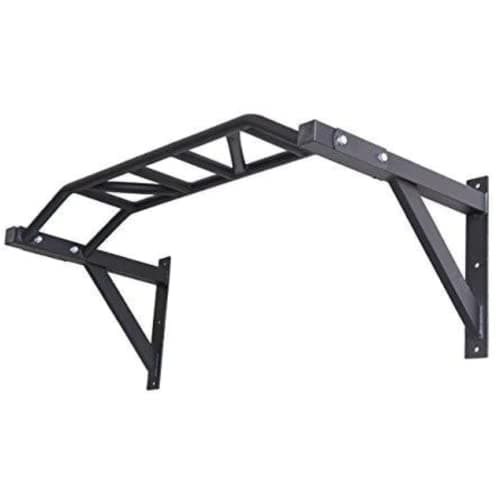
Gronk Fitness Wall Mounted Multi-Grip Pull Up Bar. Licensed stock photograph of the category — not the specific product.
Start from the skill, not the shop
The usual way this question gets answered is a list of five things to buy. That is useful once you know what you are training for, and we have that list too - the bodyweight training equipment roundup ranks the five pieces in the order a beginner should buy them.
This page answers the other question, which is the one most people are actually asking: what equipment does the thing I want to be able to do require? That matters because calisthenics has a very unusual property for a training discipline - the entry cost is genuinely zero, and the equipment requirements appear in a specific order as the skills get harder. Buying the whole list on day one is how people end up with parallettes in a cupboard.
The skill-to-equipment table
| Skill or movement | Minimum equipment | Nice to have | Honest substitute |
|---|---|---|---|
| Push-ups, squats, lunges, planks, hollow holds | Nothing | A mat | - |
| Pike push-ups, wall handstand holds | Nothing - a wall | A mat | - |
| First pull-up, chin-ups, dead hangs | A bar | Assistance bands | Park bar, playground bar, a beam |
| Hanging leg raises, toes-to-bar | A bar with floor clearance | - | Park bar |
| Rows (horizontal pulling) | A bar at hip height, or rings | Rings, for the wrist angle | A sturdy table edge, a broom across two chairs |
| Dips | Dip bars or rings | Parallettes for bent-leg dips | Two kitchen counters, a sturdy chair back |
| L-sit | Parallettes | - | The floor (harder), or a dip station |
| Deficit push-ups, planche leans | Parallettes | - | Two stacks of books is genuinely fine |
| Ring dips, ring rows, archer work | Rings | - | None - rings are the equipment |
| Muscle-up | A bar with full clearance, or rings | Thin rings for a false grip | Park bar with headroom |
| Front lever, back lever | A bar or rings | Bands for assistance | Park bar |
| Handstand push-ups | A wall | Parallettes, for wrist comfort | - |
Read down the first column until you hit the skill you want next, and buy what that row needs. If the first thing on your list is "be able to do a pull-up", you need a bar and probably a band, and that is the entire shopping list - a few tens of dollars standing between you and eighteen months of productive training.
The bar, and why it is the only unavoidable purchase
Calisthenics is a pulling discipline that most people enter through pushing. Push-ups are free, so everyone does them, and the result is a very common pattern: strong chest, rounded shoulders, no back. Somewhere to hang is what fixes it, and it is also what gates roughly half the table above.
There are three routes, and the right one depends on your building rather than your budget. A doorway leverage bar needs no tools and leaves no holes - the renter's answer, with the catch that headroom at the top of a door frame is tight. A wall-mounted bar bolted into studs gives you clearance, a much higher rating and the ability to add weight later - the right answer if you can drill. A free-standing frame needs no fixings and a lot of floor. The doorway vs wall mount vs free-standing comparison is the page that decides it, and ceiling height for a pull-up bar has the clearance numbers.
Rings or parallettes next? It depends entirely on the skill
These two are the pieces people buy in the wrong order, because the marketing is interchangeable and the function is not.
Rings give you an unstable handle, a free wrist angle and a height you can change in seconds. They are the single most versatile object in calisthenics: rows at any angle, dips, push-ups, support holds, face pulls, assisted pull-ups, lever work, and eventually the ring muscle-up. If you can hang them - a joist, a beam, a branch, or the bar you just bought - they are the better second purchase for almost everyone. Best gymnastic rings ranks them, and how to hang gymnastic rings at home is the prerequisite read.
Parallettes do one thing rings cannot: they put a fixed, straight-wristed handle a few inches off the floor. That unlocks the L-sit, deficit push-ups, tuck planche leans and comfortable handstand work. They are small, they are cheap, and they are useless for pulling. Buy them when the L-sit or the planche is the next skill, and the parallettes workout for beginners is the programme to run with them.
Bands sit alongside both and are the cheapest thing on this page. A graded set covering roughly 2 to 150 lb of assistance means the pull-up is trainable from your first session regardless of where you are starting, and the same bands assist dips, lever progressions and - loaded the other way - add resistance to push-ups. For anyone who cannot yet do a pull-up, this is the highest-value purchase after the bar itself.
What to skip, at least at first
Push-up handles that rotate. Marginal. If your wrists hurt on push-ups, parallettes solve it properly and do four other things.
Ab machines of every description. Hanging leg raises from the bar you already bought, plus hollow holds on the floor, outperform all of them. An ab roller is the one honest exception and it is cheap.
A weighted vest, on day one. It is a genuinely good purchase later, when bodyweight pull-ups and dips have stopped being hard - and a waste of money before that, because more reps are the progression. The vest roundup is there for when the time comes.
A full power tower, if space is tight. A tower gives you a bar, dip handles and a knee-raise station in one frame, which is excellent value and a large object. In a garage it is often the right call; in a one-bedroom flat it is furniture. Pull-up bar vs power tower works through that trade.
The free option, stated honestly
If there is a calisthenics park, an outdoor gym, or a fixed playground bar within a walk of your home, you have a complete calisthenics facility for nothing. Bars at two heights, usually something to dip on, and often rings or monkey bars. A set of rings in a bag plus a park is a better setup than most people's spare bedroom.
The honest limits: weather, opening hours, and the fact that a session you have to travel to is a session you will skip more often. Which is the real argument for buying a bar even when a park exists - the thing that builds a pull-up is doing it four times a week for a year, and proximity is most of what determines whether that happens.
The buying order, if you want one line
Nothing, then a bar, then bands, then rings, then parallettes - and never the next one until the current one has stopped being the limiting factor. Start the training today with the floor and a wall: bodyweight training for beginners is the programme, how to get your first pull-up is the first real goal, and apartment gym setup covers fitting all of it into six feet by four.
Picks
The four pieces that gate the most skills
A rated wall-mount bar, a pair of wood rings, parallettes with a handle worth holding, and a six-band assistance set - chosen by how many skills each one unlocks.
Key specs
- Mounting
- Wall studs; assembled 49 × 24 × 20 in.
- Grips
- Multi-grip — wide, neutral and close positions
- Rated load
- 800 lb
Scores · editorial, out of 10
- Fit & clearance (door, ceiling, depth)
- 7
- Reversibility (no drill, no marks, takedown)
- 3
- Rated load & build
- 10
- Grip options
- 10
- Value
- 8
Pick 1 · Pull-up bars
Gronk Fitness Wall Mounted Multi-Grip Pull Up Bar
Gronk Fitness
A commercial-grade stud-mounted station: 37 lb of powder-coated steel, a published 800 lb capacity, multiple grip positions and an assembled 49 × 24 × 20 in. frame — the one wall bar here you can hang rings and bands from without thinking about it.
Best for
A garage wall you are allowed to drill, where the bar has to outlast the house
Pros
- 800 lb rated, which takes a heavy adult plus a weight vest and a band without a second thought
- Powder-coated smooth tube — it does not shred hands or band loops the way a knurled or welded bar does
- A deliberate anchor for rings, ab straps and bands, so one mount becomes the whole wall setup
Cons
- Lag bolts into studs: this is a drilled installation and not a renter's option
- 37 lb of steel at 49 in. wide — a two-person lift to hold it in place while you bolt it
- The most expensive wall bar here by a clear margin
Specs from Gronk Fitness — Wall Mounted Multi Grip Pull Up Bar listing (capacity, coating, assembled size, weight).
Key specs
- Rings
- Birch wood, 1.25 in. (32 mm)
- Straps
- 2 × 14.76 ft, 1.5 in., numbered scale
- Rated load
- 1500 lb
Scores · editorial, out of 10
- Strap length & numbering
- 10
- Material & grip
- 9
- Rated load
- 10
- Setup where a renter can hang them
- 8
- Value
- 9
Pick 2 · Gymnastic rings
PACEARTH Wooden Gymnastic Rings (1500 lb)
PACEARTH
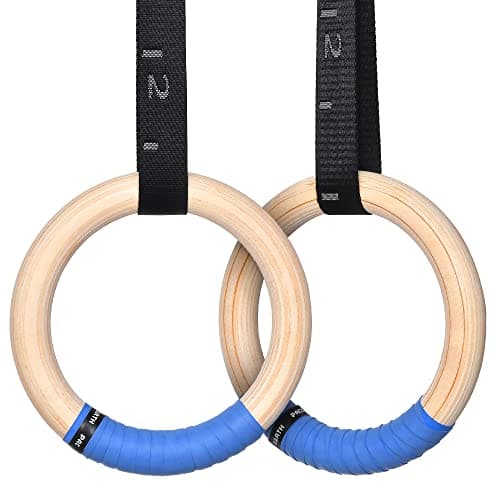
1.25 in. birch rings on 14.76 ft cam-buckle straps printed with a scale, rated 1500 lb — the wood ring set that makes leveling both rings under a ceiling a ten-second job.
Best for
A first pair of wood rings hung from a doorway bar, a beam or a tree
Pros
- Numbered straps — set both rings to the same mark and they're level, every time
- 1.5 in. straps are wider than most, so they dig into wrists less on dips
- Serrated cam buckles; birch grips well with or without chalk
Cons
- Wood must stay dry — not for a rainy balcony or an outdoor tree year-round
- 14.76 ft is long for an 8 ft ceiling; you'll coil the excess
Specs from PACEARTH — Wooden Gymnastics Rings listing (ring size, strap length/width, capacity).
Key specs
- Height
- About 4.9 in.
- Handles
- Ergonomic beech wood, non-slip
- Rated load
- 200 kg (about 440 lb)
Scores · editorial, out of 10
- Height & stability
- 9
- Grip & material
- 10
- Footprint & storage
- 8
- Rated load
- 10
- Value
- 7
Pick 3 · Parallettes
PULLUP & DIP Parallettes (beech wood)
PULLUP & DIP
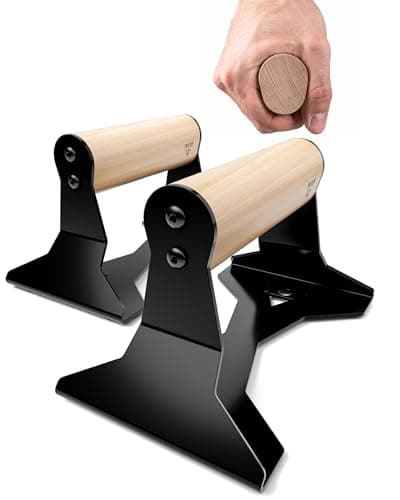
Ergonomic beech-wood handles on heavy-duty steel feet, about 4.9 in. tall, 4.2 lb for the pair, rated 200 kg and shipped fully assembled — wood and steel where the budget pairs use plastic and foam.
Best for
L-sits, deficit push-ups and handstand work where a wooden handle is worth paying for
Pros
- Shaped beech handles put the wrist in a neutral position — the reason to buy wood over tube steel
- Heavy steel feet with anti-slip pads: no wobble, and no marks on a floor
- Ships assembled, with a free exercise eBook, and packs into a backpack at 4.2 lb
Cons
- Roughly twice the price of the budget wooden pairs
- About 4.9 in. tall: fine for L-sits and push-ups, too low for real dips
- Wood needs wiping down and keeping dry
Specs from PULLUP & DIP — Parallettes listing (handle material, steel feet, height, max load, weight, assembly).
Key specs
- Length
- 41 in. loop, 4.5 mm thick
- Assistance
- #0 2–15 lb through #5 60–150 lb
- Bands
- 6 graded bands, 2.5–4.5 mm thick
Scores · editorial, out of 10
- Assistance range
- 10
- Material & safety
- 9
- Sizing clarity
- 8
- Bar compatibility
- 10
- Value
- 6
Pick 4 · Assistance bands
Serious Steel Fitness Assisted Pull-Up Band Set (#0–#5)
Serious Steel Fitness
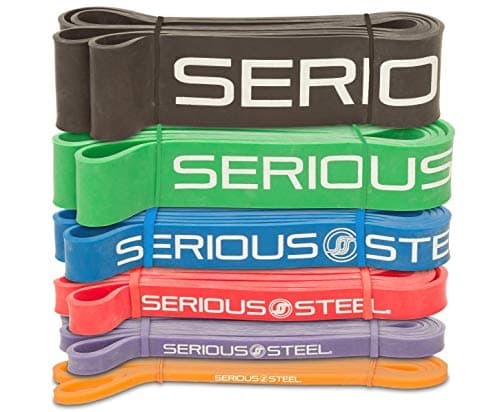
Nine graded 41 in. bands from 2–15 lb up to 120–300+ lb, sold singly or in sets — the finest steps between assistance levels of any band line here.
Best for
Small, precise steps down in assistance, or a very light finishing band
Pros
- Nine sizes — the #0 orange (2–15 lb) is the lightest true pull-up band you can buy
- Sold individually, so you only buy the step you need next
- Layered latex construction; used as the reference band by several gyms
Cons
- Nine near-identical colors across brands is confusing — go by the number, not the color
- Individually they cost more than a bundled set from a house brand
FAQ
Questions readers ask
What equipment do you need for calisthenics?
Strictly, nothing to start - push-ups, squats, lunges, planks and hollow holds need no equipment and cover the first several months. The one purchase that genuinely changes your training is somewhere to hang: a pull-up bar. After that, assistance bands, then rings, then parallettes, each bought when the skill it unlocks is the one you are working on.
Can you do calisthenics at home with no equipment?
Yes, for a long time. Pushing, squatting, hinging and core work are all free, and the handstand only needs a wall. What you cannot train without equipment is pulling - and a programme with no pulling in it produces exactly the imbalance calisthenics is supposed to fix. Find a park bar or buy one.
Should I buy rings or parallettes first?
Rings, for almost everyone, if you have somewhere to hang them. They cover rows, dips, push-ups, support holds, assisted pull-ups and lever work. Parallettes do one thing rings cannot - a fixed straight-wristed handle near the floor - which is what the L-sit, deficit push-ups and planche work need. Buy them when that is the next skill.
What is the best calisthenics equipment for an apartment?
A doorway leverage bar that leaves no holes, a band set, and a pair of rings you can hang from that bar or a ceiling fixing if the lease allows. All three fit in a cupboard. Avoid a power tower unless you have the floor to spare - it is excellent value and it is a piece of furniture.
Do I need a dip station for calisthenics?
Not if you have rings - ring dips are harder and better. If you do not, a dip station or a pair of dip bars is the cleanest way to train dips, and parallettes give you a bent-leg version with your feet forward on the floor. A pair of sturdy kitchen counters has launched a lot of dip progressions, with the usual caveat about testing anything you improvise.
Is a pull-up bar enough for calisthenics?
For a year or more, yes. A bar plus the floor covers pulling, pushing, core and the first pull-up, muscle-up and front lever progressions. The things it cannot give you are the L-sit and planche family, which need parallettes, and the unstable-handle work that needs rings.
What calisthenics equipment is a waste of money?
Rotating push-up handles, ab machines of any kind, and a weighted vest bought before bodyweight pull-ups have stopped being hard. The first two are solved better by parallettes and hanging leg raises; the third is a good purchase at the right time and a dust-collector before it.
Related
Keep reading
- Best bodyweight training equipment
The same gear ranked in buy order, with the picks scored.
- How to get your first pull-up
The first real goal, and the only one that needs a bar and a band.
- Parallettes workout for beginners
The programme to run once the L-sit is the next skill.
- Apartment gym setup
Fitting all of it into six feet by four, with no holes.
Sources
- —Gronk Fitness — Wall Mounted Multi-Grip Pull Up Bar listing (wall-stud mounting, assembled 49 x 24 x 20 in., multi-grip positions, 800 lb rating) · amazon.com
- —PACEARTH — Wooden Gymnastics Rings listing (1.25 in. birch rings, 2 x 14.76 ft numbered cam-buckle straps, 1500 lb rating) · amazon.com
- —PULLUP & DIP — Parallettes listing (beech wood ergonomic handles, about 4.9 in. tall, rated 200 kg / 440 lb) · amazon.com
- —Serious Steel Fitness — Assisted Pull-Up Band Set listing (six graded bands #0 at 2-15 lb through #5 at 60-150 lb, 41 in. loops, 2.5-4.5 mm thick) · amazon.com