Comparison · Kettlebells
Cast iron vs competition kettlebells: the handle decides it
A cast iron bell grows with its weight; a competition bell is the same size at 8 kg and 32 kg with the same 33 mm handle. That one difference is the whole comparison — and it matters most to people who snatch and press for reps.
Rope & Rep is reader-supported. Product links go through our affiliate resolver and we may earn a commission from qualifying purchases at no cost to you. Prices are the retailer's and change — every button opens the live price on Amazon rather than showing a stale number.
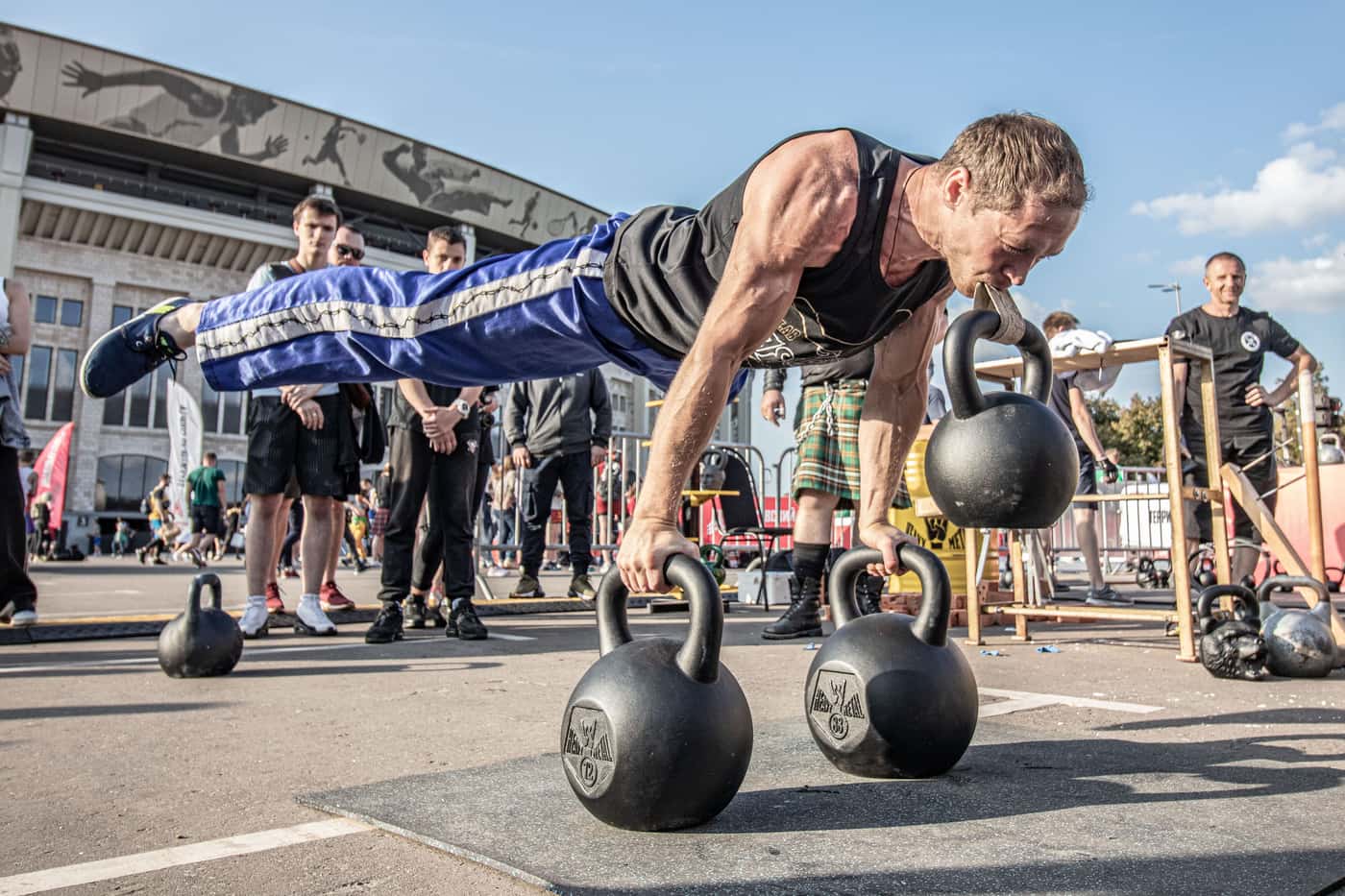
A man balancing on kettlebells at an outdoor fitness event. Licensed stock photograph of the category — not the specific product.
What each one is
A cast iron kettlebell is a solid casting whose body and handle scale with the weight: an 8 kg is small with a thin handle, a 32 kg is large with a thick one. A competition kettlebell is a hollow cast steel shell of fixed external dimensions — the same height, diameter and handle at every weight — filled to weight, so a 12 kg is the size of a 32 kg. It was standardized for kettlebell sport so a lifter's technique doesn't change between weights.
Side by side
| Cast iron | Competition | |
|---|---|---|
| Material | Cast iron, one piece | Cast steel, hollow core |
| Size | Grows with weight | Fixed at every weight |
| Handle | Scales (~29–38 mm); thick at heavy weights | 33 or 35 mm at every weight |
| Handle window | Wide — two hands fit | Narrow — one hand, top-heavy |
| Rack position | Changes with weight | Identical at every weight |
| Two-hand swings | Better (wide handle) | Cramped for big hands |
| Snatches, cleans for reps | Good at light weights; thick handle at heavy | Its purpose |
| Storage | Light bells are small | Every bell is big |
| Finish | Powder coat / paint / vinyl / enamel | Painted steel, untreated handle |
| Price | Less | More |
| Sizes | 5 lb steps (or kg) | 4 kg steps, sport colors |
The handle
This is the decision. A heavy cast iron bell has a thick handle — 38 mm on a 48 lb Kettlebell Kings — which is fine for a two-hand swing and hard on the grip for one-hand snatches at rep 15. A competition bell's 33 mm handle is the same at 12 kg and 24 kg, so your grip technique transfers exactly as the weight goes up. If your training is swings, squats, presses and carries, the cast iron handle is fine and its wide window is better. If it is snatches and long cycle, the competition handle is why the type exists.
Size and storage
For a renter this cuts the other way. A 12 kg cast iron bell fits on a shelf; a 12 kg competition bell is a 32 kg-sized object. Two competition bells take the floor of four cast iron bells. If space is the constraint, cast iron.
Feel
Competition bells are top-heavy by design and sit differently in the rack — the weight sits against the forearm in a consistent spot. Cast iron bells at heavier weights have a bigger, rounder body that some people find more comfortable on goblet squats and less comfortable on presses. Neither is better; they are built for different lifts.
“Competition-style” cast iron
Several makers sell cast iron bells labeled “competition” (the CAP in our roundup is one). They are good cast iron bells with a seam-free finish and a wide handle — not fixed-size steel bells. The name refers to the finish and the color band, not the standard.
Picks
One of each, from the same maker
The powder-coat cast iron bell and the 33 mm competition bell — same brand, so the difference is the type, not the quality.

Key specs
- Weights
- 9–97 lb (kg sizes)
- Handle
- 29–38 mm, scaled to weight
- Warranty
- Lifetime
Scores · editorial, out of 10
- Handle & finish
- 10
- Weight increments / adjustability
- 7
- Footprint & floor safety
- 7
- Build (casting, seams)
- 10
- Value
- 6
Pick 1 · Kettlebells
Kettlebell Kings Powder Coat Kettlebell
Kettlebell Kings
The single-cast, gravity-cast bell with a powder coat that holds chalk, handles from 29 to 38 mm scaled to weight, 9–97 lb, and a lifetime warranty — the buy-once cast iron bell.
Best for
A bell you'll still be swinging in twenty years
Pros
- Handle diameter scales with weight — 29–33 mm on the lighter bells is friendlier for snatches
- Recessed logos, single-piece gravity casting, chalk-friendly powder coat
- Lifetime warranty from a kettlebell specialist
Cons
- Sold in kilo sizes (8, 12, 16 kg…) — the jumps are 4 kg / ~9 lb, wider than 5 lb steps
- The most expensive cast iron bell here
Specs from Kettlebell Kings — Powder Coat Kettlebell (construction, handle sizes, warranty).
Key specs
- Weights
- 8–48 kg, same size every weight
- Handle
- 33 mm, cast steel, untreated
- Core
- Hollow, no filler
Scores · editorial, out of 10
- Handle & finish
- 10
- Weight increments / adjustability
- 8
- Footprint & floor safety
- 5
- Build (casting, seams)
- 10
- Value
- 6
Pick 2 · Kettlebells
Kettlebell Kings Competition Kettlebell (33 mm handle)
Kettlebell Kings
A single-piece cast steel competition bell with the same dimensions at every weight and a 33 mm handle, 8–48 kg, color-coded — the bell for high-rep snatches and long sets.
Best for
High-rep one-hand work where the handle must feel identical from 12 kg to 24 kg
Pros
- Identical bell size at every weight — your rack position and hand insert never change
- 33 mm handle suits most hands better than the 35 mm men's standard
- Hollow steel core with no filler; top-heavy competition balance
Cons
- Big footprint for the lighter weights — a 12 kg is the size of a 32 kg
- Steel handle is smooth; you'll want chalk
Specs from Kettlebell Kings — Competition Kettlebells 33 mm Handle (construction, sizes, handle).
FAQ
Questions readers ask
What is the difference between a competition kettlebell and a regular one?
A competition bell is hollow cast steel with the same external size and a 33/35 mm handle at every weight; a regular (cast iron) bell grows with its weight and its handle thickens.
Are competition kettlebells better?
For kettlebell sport lifts and high-rep one-hand work, yes. For general strength and conditioning in a small space, cast iron is cheaper, smaller at light weights and has a better two-hand handle.
Which handle is better, 33 mm or 35 mm?
33 mm suits most hands and is the women's sport standard; 35 mm is the men's standard. For a home trainer, 33 mm is the friendlier choice.
Should a beginner buy a competition kettlebell?
Usually not — a cast iron bell in the right 5 lb size is cheaper and smaller. Buy competition when snatches and long sets become the program.
Related
Keep reading
- Best kettlebells
Both types, ranked.
- Kettlebell vs dumbbell
The other comparison a beginner asks.
- What size kettlebell should a beginner buy?
Weight before type.
- Best adjustable kettlebells
Including the competition-sized adjustable.
Sources
- —Kettlebell Kings — Powder Coat Kettlebell (construction, handle sizes, warranty) · kettlebellkings.com
- —Kettlebell Kings — Competition Kettlebells 33 mm Handle (construction, sizes, handle) · kettlebellkings.com