Guide · Kettlebells
Kettlebell swing form: the bell is thrown by your hips, not lifted by your arms
Nearly every bad swing is the same mistake wearing different clothes - squatting instead of hinging, or raising the bell with the shoulders. Here is the movement broken into five steps, with the fault that corresponds to each one.
Rope & Rep is reader-supported. Product links go through our affiliate resolver and we may earn a commission from qualifying purchases at no cost to you. Prices are the retailer's and change — every button opens the live price on Amazon rather than showing a stale number.
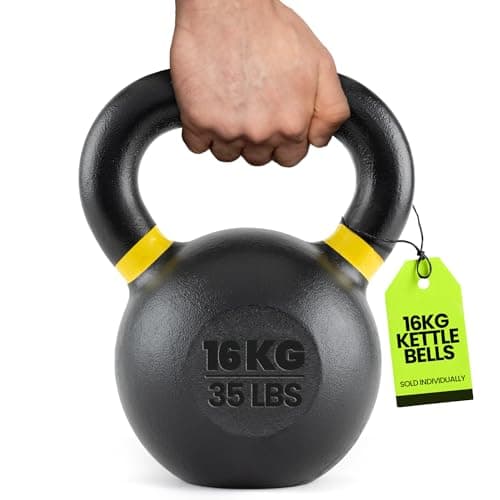
Rage Fitness Powder Coated Kettlebell (16 kg / 35.2 lb). Licensed stock photograph of the category — not the specific product.
How to perform a two-handed kettlebell swing · 5 steps
1
Set the bell and your stance
Put the bell about a foot in front of your toes. Stand with feet roughly shoulder-width, toes forward or slightly out. Tip the bell back towards you onto its front edge so the handle angles up at you.
2
Hinge and grip
Push your hips back and let your knees bend only as much as that requires. Reach forward, take the handle with both hands, pull your shoulders down and back, and set a flat back with your chest proud. Your shins stay close to vertical.
3
Hike the bell back
Hike the bell back between your legs like a rugby pass, high and tight to your groin, not down near your feet. Your forearms should contact your inner thighs. This back-swing is the loading phase - there is no swing without it.
4
Snap the hips and let the bell float
Drive your hips forward hard and stand tall: glutes clenched, quads tight, abs braced as if about to be punched. The bell floats up to somewhere between your navel and your chin on its own momentum. Your arms stay long and relaxed - they do not lift.
5
Let it fall, and catch it with a hinge
Keep your arms passive and let the bell drop. As it reaches your hips, hinge again to absorb it and hike it back. Breathe out sharply at the top, in on the backswing. Stop the set the moment the hinge turns into a squat.
What the swing actually is
A kettlebell swing is a ballistic hip hinge. You load the hamstrings and glutes by sending your hips backwards, then extend the hips violently and the bell goes where the force sends it. The arms are connective tissue in this movement, not prime movers, and the bell's height is a read-out of how much power your hips produced rather than a target to chase.
That one sentence explains almost every coaching cue you will ever hear about the swing. "Hike the bell back" - load the hinge. "Snap your hips" - extend it fast. "Arms are ropes" - do not add a shoulder raise on top. "Stand tall at the top" - finish the extension rather than leaning back. If you understand the movement as a hinge that throws, you can self-coach the rest.
It also explains why the swing is the single best exercise available in a small space. It trains the posterior chain explosively, it is a serious conditioning stimulus, and it needs about four square feet of floor and one object. Nothing else on this site gives you that combination, which is why the swing is the first thing we would teach anybody who has just bought a bell.
The five faults, and how to fix each one
| Fault | What you feel | What is happening | The fix |
|---|---|---|---|
| Squatting it | Quads and knees, bell feels heavy at the bottom | Knees travelling forward instead of hips travelling back | Face a wall a foot away and hinge until your hips touch it behind you; your knees cannot come forward |
| Lifting with the arms | Shoulders and biceps, shoulders burning | Hips too slow, or the bell too light | Go heavier, and consciously relax the arms. The bell rises because you stood up, not because you pulled |
| Swinging too high | Lower back pinching at the top | Overhead or above-chest swings done with a hardstyle hinge | Cap it at chest height. If you want overhead, that is an American swing and a different technique argument |
| Hiking too low | Rounding in the low back, bell near the floor | The bell going down rather than back | Think rugby pass: high, tight, forearms brushing the inner thighs |
| Leaning back at the top | Lower back compression, ribs flared | Hyperextending to finish instead of clenching glutes | Brace the abs and clench the glutes at the top. Stand tall, not arched |
What muscles the kettlebell swing works
Primary: glutes and hamstrings, which produce the hip extension, and the spinal erectors and deep abdominal wall, which hold the spine rigid while that happens. The swing is one of the better posterior chain exercises available without a barbell, and it is close to the only one you can do in an apartment.
Secondary: lats and upper back, which keep the bell close and the shoulders packed; forearms and hands, which fail first on long sets; quads and calves, which contribute to the stand-up. The shoulders work isometrically to control the bell rather than to raise it.
And the heart. Ten sets of ten swings with short rests is as hard as most interval work and considerably harder than it looks. The swing is simultaneously a strength-endurance exercise and a conditioning exercise, which is unusual and part of why it has survived.
What weight to start with, and the reps that work
Counter-intuitively, too light is the more common error. A bell you can easily lift with your arms will get lifted with your arms, and the hinge never gets learned. For two-handed swings, most women should start at 12 to 16 kg and most men at 16 to 24 kg - and if that sounds heavy relative to what you can curl, that is because the swing is a hip exercise and your hips are strong.
The rep scheme that teaches the movement is sets of ten. Ten swings, set the bell down, rest thirty to sixty seconds, repeat ten times. Ten sets of ten at a sensible weight is a complete session and it is still the standard prescription decades after it became one. Longer sets are a conditioning choice, not a technique choice, and the first thing that degrades in a set of twenty-five is the hinge.
The kettlebell size guide has the full sizing table by sex and experience, and the one-kettlebell workout puts swings into a session alongside the other four movements worth learning first.
Russian or American? The honest answer
The chest-height swing described on this page is the hardstyle or "Russian" swing. The overhead or "American" swing finishes with the bell above the head. Both are real; they are not the same exercise and the technique is not interchangeable.
For almost everybody training at home, the chest-height version is the right one. It keeps the movement a hip hinge, it does not demand the shoulder mobility an overhead finish requires, and the extra range buys you very little power output. Overhead swings exist in competitive fitness for scoring reasons, and they are the version most likely to be performed with a flared ribcage and an arched lower back. If you want the overhead position loaded, do a press or a snatch, which are designed for it.
Where the swing fits in a week, and the floor question
Two or three sessions a week, ten to twenty minutes each, is plenty - and it will do more for your conditioning than most of what people do for an hour. Swings pair well with pulling work, because the swing trains hip extension and a pull-up bar trains the opposite end of the body. They pair badly with a heavy deadlift session on the same day, for the obvious reason.
If you are swinging indoors, two practical points. The bell gets set down between sets, not dropped - a 24 kg bell landing on a floating floor is both a noise event and a damage event, and a vinyl-coated bell is a real improvement here. And you need headroom and clear space behind you: four square feet of floor and nothing breakable within arm's reach plus the length of the bell. The kettlebells in an apartment guide covers flooring, noise and what the neighbours actually hear.
Picks
Bells that swing well
A wide-handled 16 kg single bell for two-handed swings, the cast iron range if you want a specific weight, and the vinyl-coated version if the bell is coming down on an apartment floor.
Key specs
- Weight
- 16 kg / 35.2 lb
- Build
- Single-cast iron, no welded joints
- Handle
- Wide ergonomic handle, powder-coated
Scores · editorial, out of 10
- Handle & finish
- 10
- Weight increments / adjustability
- 7
- Footprint & floor safety
- 7
- Build (casting, seams)
- 10
- Value
- 6
Pick 1 · Kettlebells
Rage Fitness Powder Coated Kettlebell (16 kg / 35.2 lb)
Rage Fitness
A single-cast iron bell with no welded joints, a powder-coated finish that takes chalk, a deliberately wide ergonomic handle, and the weight debossed in both lb and kg so you never grab the wrong one.
Best for
A grown-up single bell for two-handed swings, where handle width decides everything
Pros
- Powder coat holds chalk and does not peel the way enamel does on a dropped bell
- Single-cast with no seam at the handle join — the place cheap bells raise a blister
- Colour-coded, debossed lb and kg markings, so a shared rack never gets confusing
Cons
- Priced above a plain enamel bell of the same weight
- A wide handle is right for two hands and slightly loose for single-arm snatches
Key specs
- Weights
- 5–80 lb in 5 lb steps
- Handle
- ~1.25 in. (35 mm), textured
- Base
- Flat
Scores · editorial, out of 10
- Handle & finish
- 7
- Weight increments / adjustability
- 9
- Footprint & floor safety
- 7
- Build (casting, seams)
- 8
- Value
- 10
Pick 2 · Kettlebells
Yes4All Solid Cast Iron Kettlebell
Yes4All
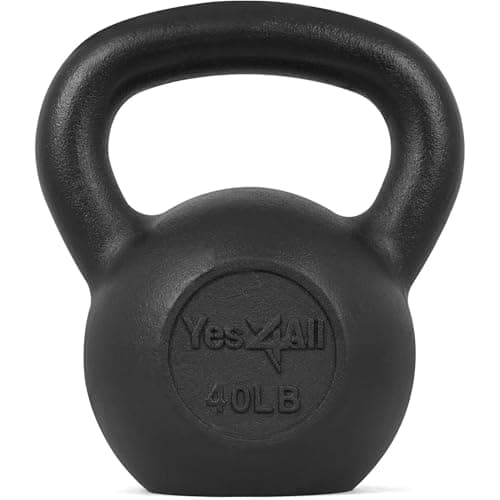
The one-piece cast iron bell sold in 5 lb steps from 5 to 80 lb with a 1.25 in. handle and a flat base — the default first kettlebell because you can buy exactly the size you need.
Best for
A first bell in the exact weight you need without paying for a coating you don't
Pros
- 5 lb increments across the whole range — 15, 20, 25, 30, 35 lb are all there for a beginner's first two bells
- One-piece casting, no welded handle to fail
- Flat base sits still for rows, push-ups and storage
Cons
- Painted (not powder-coated) finish on the basic version chips and can leave marks on a wood floor — use a mat
- 35 mm handle is a bit thick for smaller hands on high-rep snatches
Specs from Yes4All — Solid Cast Iron Kettlebell listing (weights, handle, base).
Key specs
- Weights
- 5–100 lb across the range
- Coating
- Vinyl over cast iron
- Handle
- Solid steel, 8.86 in. wide
Scores · editorial, out of 10
- Handle & finish
- 8
- Weight increments / adjustability
- 8
- Footprint & floor safety
- 10
- Build (casting, seams)
- 7
- Value
- 9
Pick 3 · Kettlebells
Yes4All Vinyl Coated Kettlebell
Yes4All
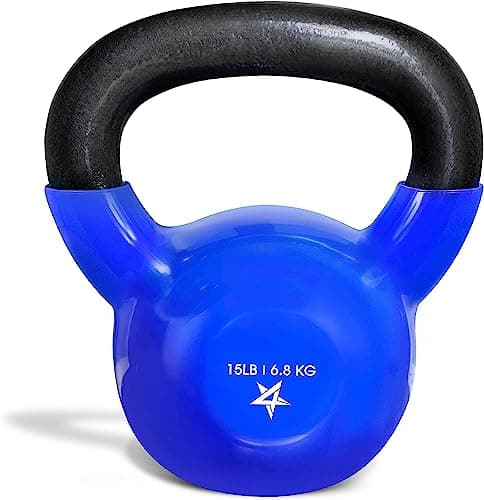
The same cast iron bell in a vinyl jacket, 5–100 lb across the range — the apartment kettlebell: quieter to set down and kinder to a floor you don't own.
Best for
Kettlebell training on an apartment floor with neighbors below
Pros
- Vinyl coating dampens the clank on a hard floor and won't scratch it
- PVC-coated shell takes a knock on a hard floor without chipping the way enamel does
- Color-coded — the fastest way to grab the right weight
Cons
- Vinyl adds a little bulk to the bell and can crack if dropped on concrete
- Colour varies by weight, so a matched-looking pair means buying one weight twice
Specs from Yes4All — Vinyl Coated Kettlebell listing (weights, coating, handle).
FAQ
Questions readers ask
What muscles does the kettlebell swing work?
Primarily the glutes and hamstrings, which drive the hip extension, plus the spinal erectors and the deep abdominal wall holding the spine rigid. Secondarily the lats and upper back, the forearms and grip - which usually fail first - and the quads and calves in the stand-up. The shoulders work to control the bell, not to raise it.
How high should a kettlebell swing go?
Between navel and chin height for a hardstyle swing, with chest height as the practical ceiling. The height is a read-out of how much power your hips produced, not a target. If you are pulling the bell above chest height with your shoulders, you have turned a hip exercise into a shoulder exercise and your lower back is taking the difference.
Why does my lower back hurt after kettlebell swings?
Nearly always one of three things: the bell is travelling down between your feet instead of back towards your groin, you are rounding your back in the hinge, or you are leaning back at the top instead of clenching your glutes. Fix the hike first - rugby pass, high and tight, forearms brushing the inner thighs - and brace your abs hard at the top.
What weight kettlebell should I start swinging with?
For two-handed swings, 12 to 16 kg for most women and 16 to 24 kg for most men. Too light is the more common mistake: a bell you can lift with your arms will be lifted with your arms, and the hip hinge never gets learned. The swing is a hip exercise, and hips are stronger than people expect.
Is a kettlebell swing a squat or a deadlift?
Neither, but it is far closer to a deadlift. It is a hip hinge: the hips travel backwards to load and forwards to drive, and the knees bend only as much as that requires. If your knees are travelling forward over your toes and you feel it in your quads, you are squatting the bell - stand a foot from a wall and hinge until your hips touch it to feel the difference.
How many kettlebell swings should I do?
Sets of ten, ten sets, with thirty to sixty seconds of rest - that is the standard prescription and it still works. Two or three sessions a week. Longer sets are a conditioning choice rather than a technique one, and the hinge is usually the first thing to break down past about fifteen reps while you are learning.
Should I do Russian or American kettlebell swings?
Russian - the chest-height version - for almost everyone training at home. It keeps the exercise a hip hinge, it does not require the shoulder mobility an overhead finish needs, and the extra range adds little. Overhead swings exist largely for competition scoring and are the version most often done with a flared ribcage and an arched lower back.
Related
Keep reading
- One kettlebell workout for beginners
The session the swing belongs in, plus the four other movements worth learning.
- What size kettlebell should a beginner buy
The full sizing table, and why too light is the common error.
- Kettlebells in an apartment
Flooring, noise and setting a bell down rather than dropping it.
- Best kettlebells
The ranked roundup, where handle width decides most of the score.
Sources
- —Rage Fitness — Powder Coated Kettlebell 16 kg listing (single-cast iron with no welded joints, wide ergonomic powder-coated handle) · amazon.com
- —Yes4All — Solid Cast Iron Kettlebell listing (5-80 lb in 5 lb steps, textured handle of about 1.25 in., flat base) · amazon.com
- —Yes4All — Vinyl Coated Kettlebell listing (5-100 lb range, vinyl over cast iron, solid steel handle 8.86 in. wide) · amazon.com