Comparison · Kettlebells
Adjustable vs standard kettlebells: one object or three, and what the dial costs
An adjustable bell solves a real problem - three bells cost three times as much and take three times the floor. It also changes the shape of the thing, and shape is most of what a kettlebell is.
Rope & Rep is reader-supported. Product links go through our affiliate resolver and we may earn a commission from qualifying purchases at no cost to you. Prices are the retailer's and change — every button opens the live price on Amazon rather than showing a stale number.
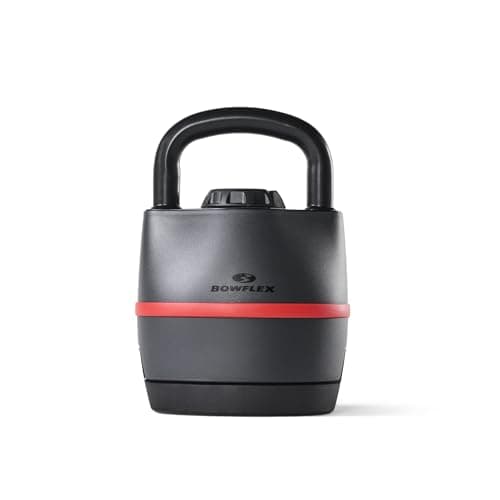
BowFlex SelectTech 840 Adjustable Kettlebell. Licensed stock photograph of the category — not the specific product.
The thing nobody mentions: a kettlebell is a shape
A dumbbell is a handle with weight at both ends and an adjustable dumbbell is the same object with more hardware. A kettlebell is different: the whole point is that the mass sits in a ball offset below and behind the handle, which is what makes it swing, what makes it rest on the back of your forearm in the rack position, and what makes a clean feel like a clean.
Adjustability has to come from somewhere, and in practice it comes from the shell. A dial-type adjustable uses a plastic housing around a stack of weight plates, so the shell is boxier and wider than a cast iron bell and the corner of it is what lands on your forearm. A steel competition-shell adjustable keeps the geometry by loading plates inside a uniform shell - which is why those cost considerably more and weigh their full loaded weight even when set light.
That is the real trade in this comparison, and it is almost never the one that gets discussed. For two-handed swings it barely matters: the bell hangs below your hands and the shell shape is irrelevant. For cleans, for the rack position, for presses and for snatches, it matters a lot - a wide plastic shell will bang the outside of your forearm until you learn to turn the bell differently.
Side by side
| Adjustable kettlebell | Standard fixed kettlebell | |
|---|---|---|
| Weights covered | One object, 6 settings (8-40 lb dial) or 41 settings (12-32 kg competition shell) | One weight each. Ranges run 5-80 lb or 5-100 lb |
| Footprint | One bell, roughly 9 x 7 x 12.5 in. | One bell per weight, each needing its own floor |
| Cost for 3 beginner weights | One purchase, usually less than three bells | Three purchases, but each is cheap |
| Cost per pound at one weight | Poor | The best available |
| Shell shape | Boxier plastic housing, or a uniform steel competition shell at a price | Classic cast iron bell, grows with weight |
| Handle | Fixed width and diameter at every setting | Varies by model - about 32 to 38 mm, wider on heavier bells |
| Dropping it | Do not. Mechanisms and plastic housings are not drop-rated | Cast iron tolerates being set down hard; vinyl protects the floor too |
| Changing weight mid-session | Seconds, which enables ladders and drop sets | Only if you own the next bell |
| Double-bell work | Needs two adjustables - expensive | Needs two matched bells - cheap at light weights |
Where the adjustable genuinely wins
The beginner progression problem. Nobody's correct first kettlebell weight stays correct. A woman starting two-handed swings at 12 kg will want 16 kg within a few months and 20 kg within a year; a man starting at 16 kg will be at 24 kg. Buying a bell you will outgrow is annoying; buying three at once is expensive and most of them sit unused. An adjustable is the clean answer to a problem that is otherwise solved by either waste or patience.
Floor space, which for renters is decisive. Three cast iron bells is three objects you have to look at and walk around. One adjustable is a box under a desk. Readers of this site training in a flat or a single garage bay should weight this heavily.
Weight changes inside a session. Being able to drop from 24 kg to 16 kg in ten seconds unlocks descending ladders and drop sets that are otherwise impossible without owning both bells. This is a genuine training capability rather than a convenience, and it is the reason some people who own a rack of fixed bells still own one adjustable.
Fine increments, on the competition-shell version. A steel adjustable with 0.5 kg steps across 12 to 32 kg gives you something no fixed collection does without owning forty bells - including the exact 16, 24 and 32 kg weights that matter if you are training for HYROX.
Where fixed bells genuinely win
Cost per pound at the weight you actually use. If you train at 24 kg and intend to for the next three years, a single cast iron 24 is a fraction of the price of any adjustable and will outlive you. The adjustable is paying for optionality you are not using.
Durability and drops. Cast iron is one piece of metal. There is nothing in it to loosen, rattle or crack, and setting it down hard is a non-event. Every adjustable has a mechanism, and every mechanism is a thing that can wear, rattle at the top of a swing, or fail - and no adjustable is sold as drop-safe. If your training involves putting a bell down quickly at the end of a hard set, that is a real consideration.
Consistency of shape and handle. With fixed bells, the 16 feels like the 16 every time. With a dial bell, a setting change can subtly change where the mass sits, and with a competition-shell adjustable the shell stays the same but the bell always weighs its loaded total to carry around.
Double-bell work. Two matched bells are how you do double swings, double cleans, double front squats and most of what makes kettlebell training interesting past the first year. Two 20 lb vinyl bells costs very little. Two adjustables costs a lot. Our kettlebell sets roundup covers the matched-pair route.
So what should most people buy?
If you are buying your first kettlebell and you have never swung one: one fixed cast iron bell at 12 to 16 kg for women or 16 to 24 kg for men. It is cheap, it is indestructible, it teaches you the swing, and if kettlebell training turns out not to be for you, you are out very little.
If you already know you like it and you are getting stronger: an adjustable, because the next eighteen months will take you through three weights and you do not want three bells. Accept the shell shape, learn to turn the bell in the clean, and check the lock.
If you know your weight and intend to stay there, or you want to do double-bell work: fixed, every time, and buy the handle width you want rather than the cheapest. The best kettlebells roundup ranks the fixed options and best adjustable kettlebells ranks the other side.
And if the deciding factor is the floor rather than the training - a flat, a shared room, a corner you have to clear every evening - the adjustable wins on that basis alone, and that is a perfectly good reason. The kettlebells in an apartment guide covers the rest of that problem.
Picks
Both sides of this comparison
Two adjustables - the plastic-shelled dial bell and the steel competition-shell version - against two fixed ranges where you buy the exact weight you need.
Key specs
- Weights
- 8 / 12 / 20 / 25 / 35 / 40 lb
- Size
- 8.8 × 7 × 12.5 in.
- Adjust
- Dial
Scores · editorial, out of 10
- Handle & finish
- 6
- Weight increments / adjustability
- 9
- Footprint & floor safety
- 9
- Build (casting, seams)
- 6
- Value
- 7
Pick 1 · Kettlebells
BowFlex SelectTech 840 Adjustable Kettlebell
BowFlex
Six bells in one: 8, 12, 20, 25, 35 and 40 lb by turning a dial, in an 8.8 × 7 × 12.5 in. footprint — the adjustable bell for an apartment corner that can't hold a rack.
Best for
Replacing a beginner's first three bells with one object that fits under a desk
Pros
- Six weights in the footprint of one 40 lb bell — the space argument is decisive in a studio
- Dial change takes a second between sets
- Flat base; the 8–40 lb range is exactly the beginner-to-intermediate window
Cons
- Plastic shell and a flat, wide handle — it's not a bell you should drop or use for hard snatches
- Tops out at 40 lb; the jumps (20→25→35) aren't even
Specs from BowFlex — SelectTech 840 Adjustable Kettlebell (weights, dimensions).
Key specs
- Weights
- 12–32 kg (26.5–70.5 lb), 41 settings in 0.5 kg steps
- Handle
- 35 mm, competition-shape steel shell
- Size
- 8.25 in. wide × 11 in. tall, 70.6 lb loaded
Scores · editorial, out of 10
- Handle & finish
- 10
- Weight increments / adjustability
- 10
- Footprint & floor safety
- 7
- Build (casting, seams)
- 9
- Value
- 6
Pick 2 · Kettlebells
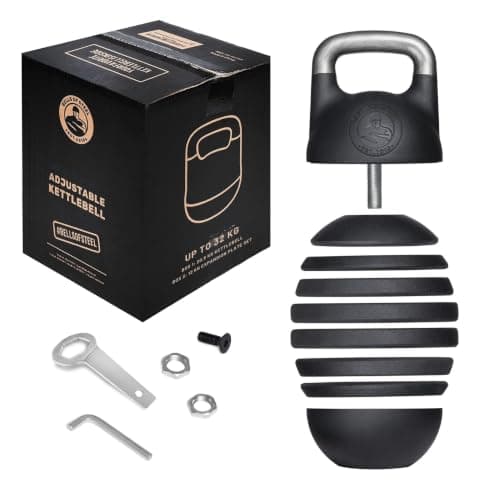
Bells of Steel Adjustable Competition Kettlebell (12–32 kg)
Bells of Steel
A 12 kg competition-shape steel shell with a full set of iron plates that sets any weight from 12 to 32 kg in 0.5 kg steps — 41 settings on a 35 mm handle, in the footprint of one bell.
Best for
Someone who wants one bell from 26 to 70 lb with competition geometry, not a plastic shell
Pros
- 0.5 kg micro-loading — 41 weights, with no gap to jump between presses
- Competition shape and a 35 mm handle at every setting, so cleans, snatches and get-ups feel the same light or loaded
- Steel shell and iron plates locked by a screw — no plastic dial to wear out, and a limited lifetime warranty on the shell
Cons
- Changing weight means the supplied Allen key and hex wrench — under a minute, not a second
- The most expensive adjustable here, and it starts at 12 kg (26 lb)
Specs from Bells of Steel — Adjustable Competition Kettlebell (range, 41 settings, 35 mm handle, dimensions, warranty).
Key specs
- Weights
- 5–80 lb in 5 lb steps
- Handle
- ~1.25 in. (35 mm), textured
- Base
- Flat
Scores · editorial, out of 10
- Handle & finish
- 7
- Weight increments / adjustability
- 9
- Footprint & floor safety
- 7
- Build (casting, seams)
- 8
- Value
- 10
Pick 3 · Kettlebells
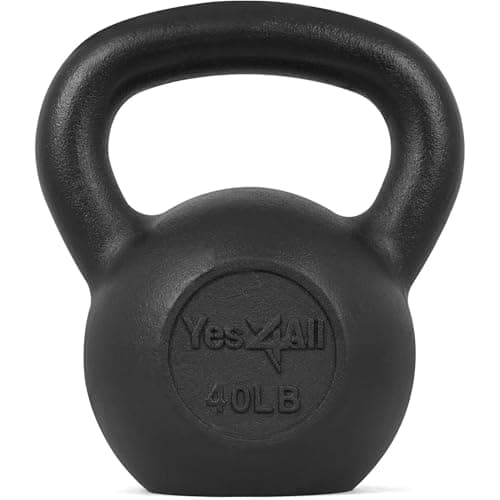
Yes4All Solid Cast Iron Kettlebell
Yes4All
The one-piece cast iron bell sold in 5 lb steps from 5 to 80 lb with a 1.25 in. handle and a flat base — the default first kettlebell because you can buy exactly the size you need.
Best for
A first bell in the exact weight you need without paying for a coating you don't
Pros
- 5 lb increments across the whole range — 15, 20, 25, 30, 35 lb are all there for a beginner's first two bells
- One-piece casting, no welded handle to fail
- Flat base sits still for rows, push-ups and storage
Cons
- Painted (not powder-coated) finish on the basic version chips and can leave marks on a wood floor — use a mat
- 35 mm handle is a bit thick for smaller hands on high-rep snatches
Specs from Yes4All — Solid Cast Iron Kettlebell listing (weights, handle, base).
Key specs
- Weights
- 5–80 lb (13 sizes)
- Finish
- Powder coat, no seams
- Accuracy
- Within 1% of stated
Scores · editorial, out of 10
- Handle & finish
- 9
- Weight increments / adjustability
- 9
- Footprint & floor safety
- 7
- Build (casting, seams)
- 9
- Value
- 8
Pick 4 · Kettlebells
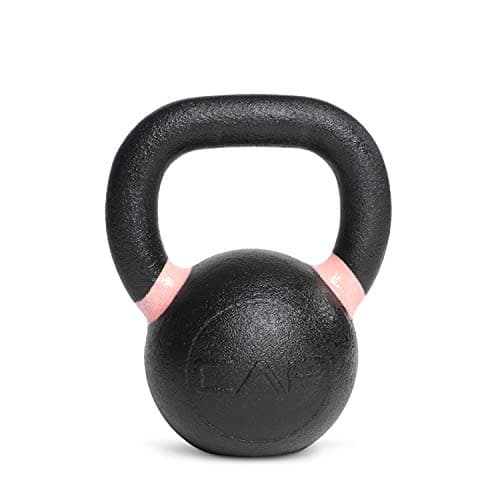
CAP Barbell Cast Iron Competition Kettlebell
CAP Barbell
Seam-free, powder-coated cast iron in 5–80 lb, weight accurate to 1%, with a wide opening handle and a flat base — a step up in finish from painted bells at a small premium.
Best for
A powder-coat bell with an honest weight in the widest range of sizes
Pros
- Powder coat holds chalk and doesn't chip like paint or enamel
- Machined seam-free casting — no ridge under the handle
- Color-coded band and lb/kg markings
Cons
- Bell dimensions scale with weight (it's cast iron, not a true competition bell despite the name)
- Costs more than the painted Yes4All at the same weight
Specs from CAP Barbell — Competition Weight Cast Iron Kettlebell (weights, finish, accuracy).
FAQ
Questions readers ask
Is an adjustable kettlebell as good as a regular one?
For swings, deadlifts and goblet squats, effectively yes. For cleans, presses and snatches it is not quite the same, because the shell shape is what rests on your forearm in the rack position and adjustables are boxier - unless you pay for a steel competition-shell version. The other difference is drops: fixed cast iron tolerates being set down hard, adjustables do not.
Are adjustable kettlebells worth it?
They are worth it if you expect your training weight to change - which is true of most people in their first couple of years - or if floor space is tight. They are poor value if you already know you train at one weight, because a single fixed cast iron bell at that weight costs a fraction as much and lasts forever.
Can you swing an adjustable kettlebell?
Yes, and swings are the movement where the shape difference matters least, since the bell hangs below your hands. The one discipline it requires is checking the locking mechanism before every set - plates working loose at the top of a ballistic swing is the failure that matters, and a five-second check prevents it.
How many kettlebells do I actually need?
One, to start. Two matched bells once you want double swings, double cleans and front squats - usually after a year. Three fixed weights covers most people indefinitely: a light bell for presses and get-ups, a working bell for swings, and a heavier one to grow into. That three-bell span is exactly what an adjustable replaces.
Do adjustable kettlebells feel different in the rack position?
Dial-type ones do. The plastic housing is wider and boxier than a cast iron bell, so the corner contacts the outside of your forearm and you have to turn the bell slightly differently in the clean. Steel competition-shell adjustables keep the normal geometry, which is most of why they cost more.
Which is cheaper, one adjustable or three fixed kettlebells?
Usually the adjustable, for a beginner's three weights. The arithmetic flips at a single weight: one fixed cast iron bell is by far the cheapest way to own one kettlebell, and it is cheaper still second-hand because cast iron does not wear out.
Related
Keep reading
- Best adjustable kettlebells
The ranked roundup of the adjustable side, mechanism by mechanism.
- Best kettlebells
The fixed side, where handle width decides most of the score.
- Cast iron vs competition kettlebells
The other shape argument - uniform shell against a bell that grows.
- What size kettlebell should a beginner buy
What weight you would be buying, before you decide how many.
Sources
- —BowFlex — SelectTech 840 Adjustable Kettlebell product page (8 / 12 / 20 / 25 / 35 / 40 lb settings, 8.8 x 7 x 12.5 in., dial adjustment) · bowflex.com
- —Bells of Steel — Adjustable Competition Kettlebell (12-32 kg, 41 settings in 0.5 kg steps, 35 mm competition-shape steel shell, 8.25 x 11 in., 70.6 lb loaded) · bellsofsteel.us
- —Yes4All — Solid Cast Iron Kettlebell listing (5-80 lb in 5 lb steps, textured handle of about 1.25 in., flat base) · amazon.com
- —CAP Barbell — Cast Iron Competition Kettlebell (5-80 lb across 13 sizes, seamless powder coat, weight within 1% of stated) · capbarbell.com