Best Competition Kettlebell · Kettlebells
The best competition kettlebells, ranked by what the maker will put in writing
A competition bell is a promise about dimensions: the same 35 mm handle and the same shell at every weight, so nothing about your technique changes when the number does. Which means the only way to rank them is by who publishes the geometry and who just prints the word on the box.
Rope & Rep is reader-supported. Product links go through our affiliate resolver and we may earn a commission from qualifying purchases at no cost to you. Prices are the retailer's and change — every button opens the live price on Amazon rather than showing a stale number.
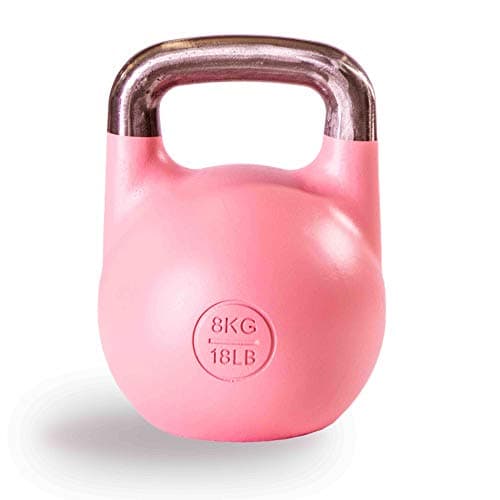
Bells of Steel Pro Grade Competition Kettlebell (8 kg). Licensed stock photograph of the category — not the specific product.
Quick picks
| # | Product | Best for | Score | Price |
|---|---|---|---|---|
| 1 | Bells of Steel Pro Grade Competition Kettlebell (8 kg) A gravity-cast, single-piece competition bell built to Girevoy Sport Union, IKFF and IUKL specification: the shell is the same size at every weight, so your technique does not change as you move up. | Girevoy-style long sets, and anyone who wants one grip and one shell size forever | 8.0 | |
| 2 | 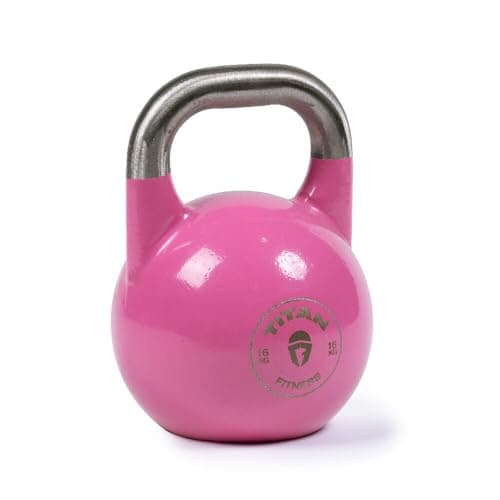 Titan Fitness Competition Kettlebell (16 kg) A true competition shell at a cast-iron price: 35 mm handle, 210 mm across and 290 mm tall at every weight in the range, single-piece hollow-core casting with the kilos laser-etched on. | A first competition bell, and anyone who wants the standard dimensions without the standard price | 8.0 | |
| 3 | 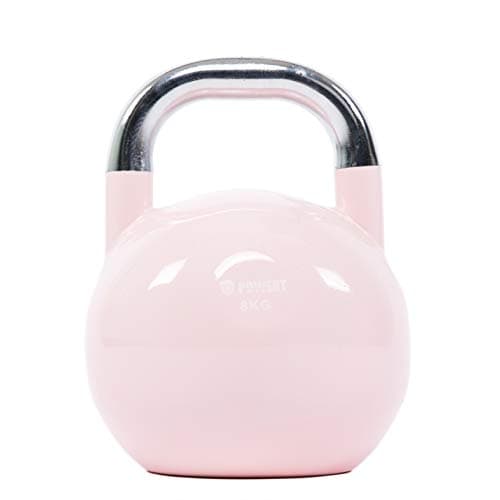 POWERT Competition Kettlebell (8 kg) Coated steel in the competition shape and the competition colors, in the 6 to 12 kg sizes the specialist brands price out of reach - and with nothing published about it beyond that. | A light competition-shape bell for technique work, where the alternative is a cast iron bell twice the size | 6.0 | |
| 4 | 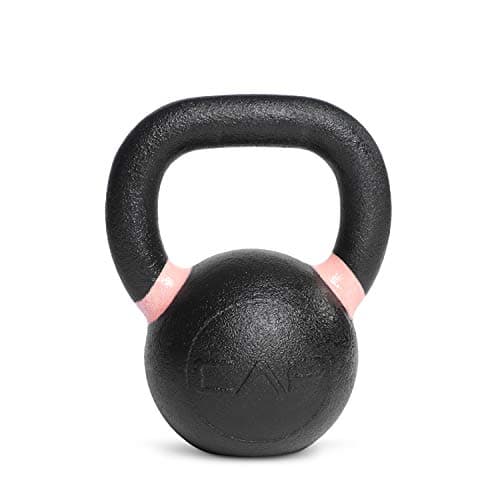 CAP Barbell Cast Iron Competition Kettlebell Seam-free, powder-coated cast iron in 5–80 lb, weight accurate to 1%, with a wide opening handle and a flat base — a step up in finish from painted bells at a small premium. | A powder-coat bell with an honest weight in the widest range of sizes | 8.5 |
Scores are our editorial judgment from each maker's published specs and mounting instructions, weighted for a renter or small-space trainer.
What “competition kettlebell” actually means
It is a specification, borrowed from Girevoy Sport, and it has nothing to do with being better made. A competition bell is built to a fixed external geometry: a 35 mm handle on the adult sizes, a handle window around 60 mm deep and 190 mm wide, and a shell roughly 210 mm across and 280 to 290 mm tall. Crucially, those numbers do not move. A 12 kg competition bell and a 32 kg competition bell are the same size object; the difference is wall thickness inside a hollow core.
That is the entire value proposition, and it is a real one. On a cast iron bell, weight and size go up together, so every time you progress you are learning a slightly different lift - the bell sits differently in the rack, the clean path changes, the handle gets thicker and the ball bumps your forearm in a new place. On competition bells, going from 16 to 20 kg is a number change. Nothing about your technique has to adapt. For anyone doing long sets of single-arm snatches, cleans or jerks, that consistency is worth paying for.
What it is not is a mark of build quality. A cast iron bell from a good maker can be better finished than a cheap competition bell. And the uniform shell has a real cost: at 8 kg you are holding a full-size 210 mm shell that weighs almost nothing, which feels absurd and takes up as much floor as the 32. Our cast iron vs competition comparison argues the category question properly; this page assumes you want a competition bell and sorts which one.
The criteria, in the order they matter
1. Published geometry. The product is a dimensional promise, so a maker who will not publish the dimensions has not made the promise. The figures that matter are handle diameter, handle window, shell diameter and height, and whether those are stated as constant across the range. Two of the four bells here publish all of that. One publishes the word “competition” and a color.
2. Handle and finish. 35 mm is the adult standard and 34 mm on the 4 to 6 kg bells, which exists because a 35 mm handle on a 4 kg bell is too big for the hands it is for. Finish is the second half: competition bells are powder coated or painted rather than bare, and a smooth coat takes chalk less willingly than the textured powder coat on a good cast iron bell. That is a genuine trade against the geometry.
3. Weight accuracy, published in grams. The specialist brands state a tolerance - plus or minus 200 g on the heavier bells, 100 g on the light ones. It sounds pedantic and it is exactly the kind of thing a dimensional standard should include. Mostly it is a proxy: a maker who publishes tolerance is a maker who measured.
4. Footprint and floor safety. Scored, and scored low for every bell on this page, because the uniform shell is the whole problem for a small space. A 210 mm shell is a 210 mm shell at 8 kg, so a ladder of five competition bells takes up far more floor than a ladder of five cast iron bells of the same weights. If floor space is your binding constraint, read kettlebells in an apartment before you commit.
5. Value. Last, and the spread here is close to three to one at the same weight. The expensive end buys a published tolerance and a lifetime warranty rather than a different lift.
How the four compare
| Bell | Handle | Shell at every weight | Published tolerance | Range |
|---|---|---|---|---|
| Bells of Steel Pro Grade | 35 mm (34 mm on 4-6 kg) | 210 mm across x 210 mm tall, 4-48 kg | ±200 g (8-48 kg), ±100 g (4-6 kg) | 16 weights, 4-48 kg |
| Titan Fitness Competition | 35 mm, 190 mm window | 210 mm across x 290 mm tall, whole range | Not published | 8-34 kg |
| POWERT Competition | Not published | Not published | Not published | 6, 8, 12 kg live |
| CAP Barbell “Competition” cast iron | Wide cast iron handle | No - shell grows with weight | Within 1% of stated | 13 sizes, 5-80 lb |
Who should actually buy one
Buy competition bells if you do long single-arm sets - snatches, cleans, jerks, anything for time or for high reps - because that is where a changing shell actively costs you. Buy them if you intend to own a ladder of three or more weights and want the progression to be seamless. Buy them if you train anywhere that uses them, because the transition back and forth is otherwise a small tax every session.
Buy cast iron instead if you mostly swing two-handed, which is most people - a wide handle is kinder to two hands than a 35 mm one, and our main kettlebell roundup ranks those. Buy cast iron if you are buying your first bell and still finding out whether you like kettlebells, because the price difference is large and the benefit is invisible until you are doing long sets - our beginners page and sizing guide cover that properly. Buy cast iron if floor space is tight, because the uniform shell is a real footprint penalty at the light end.
There is a third route worth knowing about: an adjustable bell. An adjustable competition-shell bell gives you a fixed external geometry across a range of weights from one object, which solves both the progression problem and the footprint problem at once. What it costs you is the time to change the weight and a mechanism that can fail - adjustable vs standard works that through.
On the colors, since everybody asks
The color coding is a genuine convention rather than branding, which is why bells from different makers often match: it comes from Girevoy Sport competition, where the referee needs to see the weight from across a platform. Blue is 12 kg, yellow 16, purple 20, green 24, orange 28, red 32. Lighter bells and the gaps between those numbers vary more by maker, and nobody is obliged to follow it. The practical value at home is a shared rack where nobody has to read a number before picking up a bell, which matters more than it sounds if two people train in the same garage.
The picks in detail
Every pick, reviewed
Key specs
- Weight
- 8 kg / 17.6 lb
- Handle
- 34 mm on the 4–8 kg bells; 35 mm from 10 kg up
- Build
- Gravity-cast single piece, no welding; color-coded
Scores · editorial, out of 10
- Handle & finish
- 10
- Weight increments / adjustability
- 8
- Footprint & floor safety
- 5
- Build (casting, seams)
- 10
- Value
- 6
Pick 1 · Kettlebells
Bells of Steel Pro Grade Competition Kettlebell (8 kg)
Bells of Steel
A gravity-cast, single-piece competition bell built to Girevoy Sport Union, IKFF and IUKL specification: the shell is the same size at every weight, so your technique does not change as you move up.
Best for
Girevoy-style long sets, and anyone who wants one grip and one shell size forever
It wins because it is the only bell here with the whole specification in writing. Bells of Steel publishes the handle diameter at both breakpoints - 35 mm from 8 kg up, 34 mm on the 4 and 6 kg bells where a full 35 mm handle would be too much for the hands buying them - the handle window at 60 mm, a shell of 210 mm across and 210 mm tall held constant from 4 kg all the way to 48 kg, and a weight tolerance in grams. That is what a dimensional standard looks like when a maker takes it seriously.
The range is the second reason: sixteen weights from 4 to 48 kg, gravity cast as a single piece with a hollow core so there is no weld seam under the handle to catch a forearm, powder coated with the weight embossed on the face in both kg and lb, and a limited lifetime warranty. If you intend to build a ladder over several years, this is the line that will still be there and still be the same size.
Two things to know. Competition bells cost two to three times a cast iron bell of the same weight and this is the expensive end of the four - $57.99 at 4 kg rising to $545.99 at 48 kg on the maker's own price list. More practically: every weight read Unavailable on bellsofsteel.us when we checked on 28 October 2026, while the individual bells remained live and purchasable on Amazon. The buy link here goes to the live listing, but if you want a specific weight it is worth checking both. The listing copy also quotes 33 mm in one place and 34 mm in the detail for the light bells; the maker's spec page says 34 mm, and that is the figure to trust.
Pros
- Uniform shell size across the range — the rack position and the clean path never change
- Built to GSU / IKFF / IUKL competition specification rather than approximating it
- Gravity-cast as one piece, so there is no weld seam to catch a forearm
Cons
- Competition bells cost two to three times a cast-iron bell of the same weight
- The listing's own copy quotes 33 mm in the title and 34 mm for this size in the detail — assume 34 mm
Key specs
- Handle
- 35 mm, 190 mm window
- Shell
- 210 mm across x 290 mm tall at every weight
- Build
- Single-piece hollow core, laser-etched kg
Scores · editorial, out of 10
- Handle & finish
- 9
- Weight increments / adjustability
- 8
- Footprint & floor safety
- 5
- Build (casting, seams)
- 9
- Value
- 9
Pick 2 · Kettlebells
Titan Fitness Competition Kettlebell (16 kg)
Titan Fitness
A true competition shell at a cast-iron price: 35 mm handle, 210 mm across and 290 mm tall at every weight in the range, single-piece hollow-core casting with the kilos laser-etched on.
Best for
A first competition bell, and anyone who wants the standard dimensions without the standard price
Second, and the one most people reading this should actually buy. Titan publishes the full competition geometry - 35 mm handle, 190 mm handle window, 210 mm shell diameter, 290 mm height - and states plainly that those dimensions hold across the range, which is the promise that matters. Single-piece hollow-core casting, laser-etched kg markings, a color per weight. At roughly half what the specialist brands charge at the same weight.
For a first competition bell, or for filling a gap in a ladder, that combination is hard to argue with. The geometry is the product, Titan publishes the geometry, and the price difference against the pick above buys you most of a second bell.
Why it is not first. Titan publishes no weight tolerance on its own product page, where Bells of Steel publishes a figure in grams at two breakpoints - and on a product sold as a standard, a missing tolerance is a missing part of the standard. Availability is the other wrinkle: Titan's own store showed the 14 kg on backorder to 6 December 2026 when we checked, so the specific weight you want may only be buyable through a marketplace listing for now. And the smooth powder coat takes chalk less willingly than the textured finish on a good cast iron bell, which you notice in the back half of a long set.
Pros
- Full competition geometry - 35 mm handle, 190 mm window, 210 x 290 mm shell - held constant from the lightest bell to the heaviest
- Roughly half what the established competition brands charge at the same weight
- Single-piece hollow-core casting, so there is no weld seam under the handle to catch a forearm
- Laser-etched kg markings and a color per weight, which keeps a shared rack honest
Cons
- Titan publishes no weight tolerance on its own product page, where the specialist brands publish a figure in grams
- Titan's own store showed the 14 kg on backorder to 6 December 2026 when we checked, so the weight you want may only be available through a marketplace listing
- Smooth powder-coat finish rather than a textured competition paint - it takes chalk less willingly than a powder-coated cast iron bell
Key specs
- Weights
- 6, 8 and 12 kg on live listings
- Shell
- Coated steel, color-coded
- Handle / tolerance
- Not published
Scores · editorial, out of 10
- Handle & finish
- 6
- Weight increments / adjustability
- 6
- Footprint & floor safety
- 6
- Build (casting, seams)
- 5
- Value
- 7
Pick 3 · Kettlebells
POWERT Competition Kettlebell (8 kg)
POWERT
Coated steel in the competition shape and the competition colors, in the 6 to 12 kg sizes the specialist brands price out of reach - and with nothing published about it beyond that.
Best for
A light competition-shape bell for technique work, where the alternative is a cast iron bell twice the size
Third, and it is here for one honest reason: it fills the light end of the range, where a competition shell arguably matters most and where the specialist brands are at their worst value. An 8 kg cast iron bell is a small ball on a wide handle - a genuinely awkward object to clean or snatch. An 8 kg bell in a full competition shell handles exactly like the 16 will, which is the whole point for someone learning the lifts or coming back from a layoff. POWERT covers 6, 8 and 12 kg on live listings, color-coded to the sport convention, cheaper than a specialist bell at the same weight.
That is the case for it, and it is a real case.
Here is the case against, which is why it is third and not second. POWERT publishes no spec sheet anywhere we could read: no handle diameter, no shell dimensions, no weight tolerance, and no statement of which competition standard the shape follows. On a product whose entire selling point is standardized geometry, that is not a minor omission - it is the omission. We have scored it as unverified rather than as compliant, and if a verified 35 mm handle matters to you, buy the Titan instead. The 12 kg listing is also priced close to the Titan 16 kg, which is poor value per kilo at the top of its range.
Pros
- Fills the light end of the range, where a competition shell matters most - an 8 kg cast iron bell is a tiny ball on a wide handle
- Color-coded to the sport convention, so it racks alongside the bells above without confusion
- Cheaper than a specialist competition bell at the same weight
Cons
- POWERT publishes no spec sheet anywhere we could read: no handle diameter, no shell dimensions, no weight tolerance, no statement of which competition standard the shape follows
- That is a real gap on a bell whose entire selling point is standardized geometry - scored as unverified, not as compliant
- The 12 kg listing is priced close to the Titan 16 kg, which is poor value per kilo at the top of its range
Key specs
- Weights
- 5–80 lb (13 sizes)
- Finish
- Powder coat, no seams
- Accuracy
- Within 1% of stated
Scores · editorial, out of 10
- Handle & finish
- 9
- Weight increments / adjustability
- 9
- Footprint & floor safety
- 7
- Build (casting, seams)
- 9
- Value
- 8
Pick 4 · Kettlebells
CAP Barbell Cast Iron Competition Kettlebell
CAP Barbell
Seam-free, powder-coated cast iron in 5–80 lb, weight accurate to 1%, with a wide opening handle and a flat base — a step up in finish from painted bells at a small premium.
Best for
A powder-coat bell with an honest weight in the widest range of sizes
Fourth, and the most useful entry on the page, because it is the thing you will mistake for a competition bell. CAP calls this a “Competition Weight” kettlebell and it is a good product: seam-free machined cast iron, powder coated rather than painted, weight accurate to within 1 percent, color-coded with lb and kg markings, in thirteen sizes from 5 to 80 lb. The powder coat holds chalk better than any smooth competition finish here.
What it is not is a competition bell. CAP's dimensions scale with weight, like every cast iron bell - so you get the color coding and the accurate weight without the one property that defines the category. If you came to this page because you wanted a well-finished, honestly-weighted, color-coded bell, this is probably your answer and it will cost you a third of the pick at the top. If you came because you want the same shell at every weight, it is not.
We have ranked it deliberately rather than leaving it out, because “competition” on a listing title is unregulated and this is the clearest example of what that looks like from a brand that is otherwise straight with you. The honest summary: a good cast iron bell wearing a word it has not earned, and our main roundup is where it belongs.
Pros
- Powder coat holds chalk and doesn't chip like paint or enamel
- Machined seam-free casting — no ridge under the handle
- Color-coded band and lb/kg markings
Cons
- Bell dimensions scale with weight (it's cast iron, not a true competition bell despite the name)
- Costs more than the painted Yes4All at the same weight
Specs from CAP Barbell — Competition Weight Cast Iron Kettlebell (weights, finish, accuracy).
Buying guide
Which weight to start with
The competition standard is built around 16 kg for men and 8 to 12 kg for women as the entry sizes, and those are reasonable for the lifts these bells are for - long sets of cleans, snatches and jerks, where you will be doing far more reps than a cast iron swing session. If you are buying a single bell to learn the lifts, 12 kg for most women and 16 kg for most men is the defensible choice, and it is one step lighter than what people usually buy. Our sizing guide has the full table, and the logic there holds for competition bells with one adjustment: go lighter than you would in cast iron, because the lifts are longer.
Building a ladder without buying four full-size shells
This is the real planning problem, and it is a floor-space problem rather than a money problem. Four competition bells is four 210 mm shells, which is noticeably more floor than four cast iron bells of the same weights because the light ones do not shrink. Two approaches work. Buy two bells four kilos apart and use the heavier one two-handed until the lighter one is easy, which covers a year of progress for most people. Or buy an adjustable competition-shell bell, which gives you the fixed geometry across a range from one footprint - adjustable vs standard covers what that mechanism costs you.
Chalk, coatings and long sets
Worth knowing before you spend: competition bells are finished smooth, and a smooth coat plus sweat is the single most common complaint about them. The fix is chalk, which these bells assume you have - competition is chalked. If you train somewhere chalk is not an option, a textured powder-coated cast iron bell is genuinely the better grip, and that is a real argument against the whole category for a home gym in a carpeted room. It is also why the CAP bell at number four scores well on finish despite not being a competition bell.
Floor protection matters more with these
A competition shell has a flat steel base and sits with all its weight on a small area, which is harder on a floor than a cast iron bell of the same weight spread across a wider foot. On a slab it does not matter. On anything you do not own, put something under them - kettlebells in an apartment covers what works, and a plyo box is not it.
What we did not rank, and why
Kettlebell Kings competition bells. The best-known name in the category and a brand this site has wanted to score properly for a while; we could not reach a readable product page with current price and stock on an automated read on 28 October 2026, so it is not scored. Action for a future run: re-check kettlebellkings.com. Pro Kettlebell's Apollo Line (IKO Official Vasilev line, 12 kg at $182 and 16 kg at $197, both live) - the only bell found with an explicit competition-body endorsement in the title, which is exactly the credential this page cares about, but prokettlebell.com would not return a readable product page, so the geometry behind the endorsement could not be verified. Worth a manual look. Rogue Fitness. roguefitness.com still returns 403 to automated reads, unchanged all year. Titan's adjustable competition-style bell is already in this registry and covered in the adjustable roundup - it is a different product class and ranking it against fixed bells would flatter it on footprint and penalize it unfairly on everything else. Competition bell sets and multi-bell packages are covered in the sets roundup, which is the page to read if you are buying three at once.
How this list was built
Each bell's ASIN was confirmed live on 28 October 2026 with a title-verified lookup - brand, model and weight tokens present in the listing title, with a purchasable offer. Handle diameters, shell dimensions, casting, finishes and tolerances come from the page named under each product; where a maker publishes none of it, the entry says so and scores the absence rather than assuming the shape is compliant. Where a maker's own store showed a weight unavailable or on backorder while the marketplace listing stayed live, the entry says that too. Scores are editorial judgments from those published specs against the kettlebell rubric, weighted for someone training in a small space. Nothing here was hands-on or lab tested; the methodology page sets out exactly what the scores are and are not.
FAQ
Questions readers ask
What is the difference between a competition kettlebell and a regular one?
Dimensions. A competition bell is built to a fixed external geometry - 35 mm handle, roughly 210 mm shell diameter, 280 to 290 mm tall - and those numbers stay the same at every weight, with the difference hidden in the wall thickness of a hollow core. A cast iron bell grows as it gets heavier, so every weight is slightly a different lift. It is a standard, not a quality grade: a good cast iron bell can be better finished than a cheap competition bell. Our full comparison covers the trade.
Are competition kettlebells worth it for a home gym?
If you do long single-arm sets - snatches, cleans, jerks for reps or for time - yes, because that is where a changing shell actively interferes. If you mostly swing two-handed and press occasionally, which is most people, a wide-handled cast iron bell is cheaper, grips better with chalk-free hands and is kinder to two hands on the same handle. The uniform shell is also a real footprint penalty: a light competition bell takes up as much floor as a heavy one.
Why is the handle on a competition kettlebell 35 mm?
Because the Girevoy Sport standard fixed it there, and because a constant handle diameter is half the point of the standard - a thicker handle on a heavier bell would change your grip as you progress. Most makers drop to 34 mm on the 4 and 6 kg bells, since a full 35 mm handle is too big for the smaller hands those weights are usually bought for. For comparison, a cast iron bell handle is typically thicker and wider and rarely published as a number at all.
What do the colors on competition kettlebells mean?
They encode the weight, so a referee can read it across a platform, and that is why bells from different makers often match. The common convention is blue 12 kg, yellow 16, purple 20, green 24, orange 28, red 32; the lighter bells and the in-between weights vary more by maker and nobody is required to follow it. At home the value is a shared rack where nobody has to squint at a number.
Is a 'competition weight' cast iron kettlebell the same thing?
No, and this is the most common confusion in the category. “Competition weight” and “competition style” usually mean a cast iron bell that is color-coded, accurately weighed and flat-based - all good things, none of them the defining one. The test: does the maker publish one shell dimension for the whole range, and a handle diameter in millimeters? If the dimensions increase with weight, it is cast iron. We rank one such bell fourth on this page, labeled, for exactly this reason.
What weight competition kettlebell should a beginner buy?
12 kg for most women and 16 kg for most men, which is one step lighter than people usually buy - because the lifts competition bells are for involve far more reps than a cast iron swing session. If you are new to kettlebells generally rather than to competition bells specifically, start with cast iron and the sizing in our beginner sizing guide; the competition geometry only starts paying off once your sets get long.
Do competition kettlebells need chalk?
They effectively assume it. The smooth powder-coat or painted finish that comes with the standard grips noticeably worse than a textured cast iron powder coat once your hands are wet, and competition itself is chalked. If chalk is not practical where you train - a carpeted spare room, a shared space - that is a real argument for a textured cast iron bell instead, and one of the few places where the cheaper category simply wins.
Can you buy competition kettlebells individually or only in sets?
Individually, and for a home gym that is usually the better route - every bell on this page is sold as a single weight. Sets look economical and tend to include weights you will not use for a year, plus four full-size shells is a lot of floor. Two bells four kilos apart covers most of a year of progress. If you do want several at once, the kettlebell sets roundup covers what is actually in stock as a package.
Related
Keep reading
- Cast iron vs competition kettlebells
The category question, decided before you pick a bell.
- Best kettlebells
Where a well-made cast iron bell belongs.
- Best adjustable kettlebells
Fixed geometry across a range, from one footprint.
- What size kettlebell should a beginner buy
The sizing table, and why to go lighter for long sets.
- Kettlebells in an apartment
What a flat steel base does to a floor you do not own.
Sources
- —Bells of Steel — Competition Kettlebells product page, read 28 October 2026 (35 mm handle on 8-48 kg and 34 mm on 4-6 kg, 60 mm handle window on 8-48 kg and 64 mm on 4-6 kg, gravity cast as one piece with a hollow core, 210 mm tall and 210 mm across at every weight from 4 to 48 kg, 16 weights, weight accuracy ±200 g on 8-48 kg and ±100 g on 4-6 kg, powder coat with kg and lb embossed, limited lifetime warranty, $57.99-$545.99; every weight read Unavailable on the maker's own store that day) · bellsofsteel.us
- —Titan Fitness — Competition Kettlebell product page, read 28 October 2026 (35 mm handle, 190 mm / 7.48 in. handle width, 210 mm / 8.3 in. diameter, 290 mm / 11.4 in. height held constant across the range, hollow-core single-piece construction, laser-etched kg markings, smooth finish, color per weight; no weight tolerance published; the 14 kg read backorder to 12/06/2026) · titan.fitness
- —POWERT — Competition Kettlebell 8 kg listing, verified live 28 October 2026 (coated steel, ergonomic competition design, color coded; the 6 kg and 12 kg listings were live the same day). POWERT publishes no spec sheet, so handle diameter, shell dimensions and tolerance are not claimed · amazon.com
- —CAP Barbell — Competition Weight Cast Iron Kettlebell product page (5-80 lb in thirteen sizes, seam-free machined casting, powder coat, weight within 1% of stated, color-coded band with lb and kg markings; dimensions scale with weight) · capbarbell.com
- —Bells of Steel — Pro Grade Competition Kettlebell 8 kg listing (weight, handle diameters, casting, standards) · amazon.com