Best for Running · Conditioning
Best weighted vests for running: bounce is the only spec that matters
A running vest has one job — hold weight flat against your ribs while both feet leave the ground, twice a second, for half an hour. Almost no vest does it. Here are the ones that do, and the load to actually run with.
Rope & Rep is reader-supported. Product links go through our affiliate resolver and we may earn a commission from qualifying purchases at no cost to you. Prices are the retailer's and change — every button opens the live price on Amazon rather than showing a stale number.
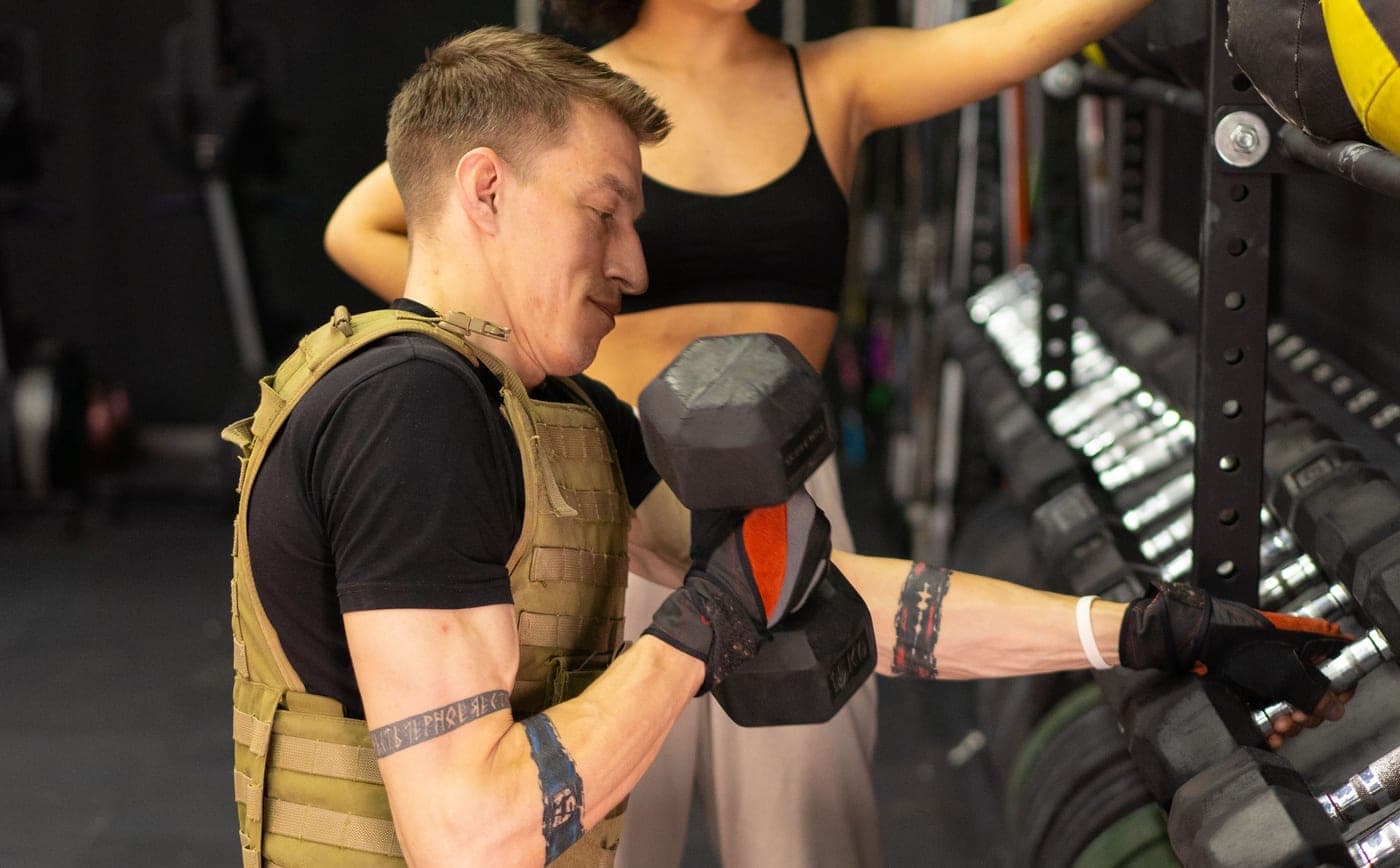
A man working out in a weighted vest in a gym. Licensed stock photograph of the category — not the specific product.
Quick picks
| # | Product | Best for | Score | Price |
|---|---|---|---|---|
| 1 | Hyperwear Hyper Vest PRO (10 lb) A slim, zip-front vest loaded with 0.25 in. steel micro-weights (10 lb, expandable) in sized fits — the vest that doesn't bounce on runs and doesn't shift on a pull-up. | A vest for the run and the pull-up bar both — PFT prep in one garment | 8.0 | |
| 2 | Hyperwear Hyper Vest ELITE (10 lb, expandable to 42 lb) Hyperwear's heavy one: ships at 10 lb, takes weights to 42 lb total, two-way-stretch CORDURA with a front zip and side lacing — slim enough to walk in, heavy enough to load a pull-up. | One vest for the walk and the bar, when you don't want to own two | 8.5 | |
| 3 | Hyperwear Hyper Vest FIT (10 lb, women's fit) The only vest here built on a women's contoured pattern: a zip-front CORDURA shell holding twenty half-pound weights to 10 lb — a walking and bone-loading vest, not a pull-up vest. | Loaded walking, hills and daily wear on a torso a unisex pocket vest doesn't fit | 8.1 | |
| 4 | CAP Barbell 20 lb Adjustable Weighted Vest A one-size mesh vest with removable 0.75 lb steel-shot packets to 20 lb, adjustable chest and waist belts and padded shoulders — the cheap entry into weighted pull-ups and walks. | A first light vest to add 5–20 lb to pull-ups, dips and walks | 8.1 |
Scores are our editorial judgment from published specs and mounting instructions, weighted for a renter or small-space trainer — not lab measurements. We have not tested these units.
Why almost no vest can be run in
Running is a series of controlled falls. Each stride you leave the ground and come back to it, and anything attached to you that is not rigidly held goes up and comes down slightly late. In a pocket vest, the thing coming down late is a sealed bag of iron shot sitting in a pouch that is bigger than it is. It thumps. Over thirty minutes and three thousand strides, that thumping travels into your traps and the back of your neck, and you stop running before you stop being able to run.
A plate vest solves it with two things at once. The weights are flat — Hyperwear's are quarter-inch steel plates of about 2.25 oz each — so they spread across the whole panel instead of concentrating in eight pouches. And the shell is cut as compression wear and sized by chest measurement, so the panel is already flush before you tighten anything. Flat weight plus a flush panel means there is nowhere for the load to travel.
This is why the running answer and the weighted-pull-up answer are different vests, and why our pull-up roundup ranks a cheap pocket vest first while this page does not rank it at all.
The four, on bounce
| Vest | Weight type | Sizing | Load | Run verdict |
|---|---|---|---|---|
| Hyper Vest PRO | 0.25 in. steel micro-weights | Sized + side lacing | 10 lb; S max 20, M max 25 lb | Yes — the purpose-built answer |
| Hyper Vest ELITE | Micro-weights, stretch shell | Sized + side lacing | 10 lb shipped, 42 lb max | Yes at 10-15 lb; not at 42 |
| Hyper Vest FIT | 20 x 0.5 lb weights | Sized, women's contoured | To 10 lb | Yes — the lightest, flushest option |
| CAP Barbell 20 lb | ~0.75 lb shot packets | One size, two belts | To 20 lb | Short, easy runs only |
The pick: Hyper Vest PRO
The PRO is the vest Hyperwear built for exactly this. Quarter-inch steel micro-weights, a breathable washable shell, sizing by chest — small covers 31 to 34 in., medium 35 to 38 in. — and side lacing to take the panel in further. It ships at 10 lb and caps at 20 lb in a small or 25 lb in a medium. From $239.95 on Hyperwear's own store, checked 29 September 2026.
That 20 to 25 lb ceiling is not a weakness for running; it is roughly where you should stop anyway. What you are paying for is the absence of movement, and it is the one thing you cannot get cheaply. There is no budget version of a compression-fit plate vest, and we are not going to invent one.
When to take the ELITE instead
The ELITE is the same micro-weight system in a two-way stretch CORDURA shell with a front zip and side lacing, and it takes weights to a 42 lb total. From $259.95, checked the same day. If you want one vest for running and for loading pull-ups, this is it — run it at 10 to 15 lb and load it up for the bar.
Do not run it at 42 lb. Not because the vest fails, but because you will. A plate vest removes bounce; it does not remove the cost of carrying a third of your body weight through every landing.
The lightest, flushest option
The Hyper Vest FIT is built on a women's contoured pattern, zips at the front, and holds twenty half-pound weights to a 10 lb maximum. From $84.99, checked 29 September 2026 — roughly a third of the PRO. For running that 10 lb ceiling is not much of a limit: 10 lb is already above 5% of body weight for anyone under 200 lb.
The half-pound weights are the quiet advantage here. You can run at 3 lb for two weeks and then at 4 lb, which is the right way to introduce load to a running gait and is impossible in a vest whose smallest unit is a 3 lb packet. Fit and sizing detail sits on the women's vest page.
And the honest budget answer
The CAP Barbell 20 lb is the only pocket vest we will put on this page, with a caveat rather than a recommendation. Its packets are small — roughly three-quarters of a pound — and its mesh shell is light, so loaded to 5 or 8 lb with the packets distributed evenly it is tolerable on a short, easy run. It is a one-size straight cut on two belts, so the panel will never be truly flush, and past about ten minutes you will feel it.
If your budget is the constraint and running is the goal, the better purchase is no vest at all for now: run unloaded, and spend the money on a vest when you are running enough that load is the limiting factor.
How much weight to run with
Lighter than you think, and lighter than you would walk with. Walking under load tolerates around 10% of body weight; running does not, because every stride multiplies the load through the landing. About 5% of body weight is a sensible running ceiling — 9 lb at 180 lb, 7 lb at 140 lb — and starting at half that for the first two weeks is not timid, it is how you find out whether your knees and hips agree with the idea.
Add load or distance, never both in the same week. And run your first loaded sessions on a surface you know, not on a trail where you also have to think about your feet.
What we will not tell you
How many extra calories a weighted run burns. It depends on your mass, the load, the gradient, your pace and your efficiency, and every figure published about it is a general activity estimate applied to a situation nobody measured. Loaded running costs more than unloaded running. That is as precise as the honest answer gets.
How this list was built
Weight type, plate thickness, sizing method, load range, shell material, current price and stock came from Hyperwear's own weighted-vest collection and CAP Barbell's own product page, all read on 29 September 2026. Scoring used the site's weighted vest rubric — fit that stays put 30%, adjustability of load 25%, durability 25%, value 20% — with "stays put" read as stays put at running cadence rather than on a dead hang. No vest here was tested in a lab; we own no lab and say so on our methodology page.
The picks in detail
Every pick, reviewed
Key specs
- Weights
- 10 lb, expandable (S max 20, M max 25 lb)
- Fit
- Sized (S 31–34 in. chest, M 35–38 in.)
- Weights
- 0.25 in. steel micro-weights
Scores · editorial, out of 10
- Fit for pull-ups (stays put)
- 10
- Adjustability of load
- 7
- Durability
- 9
- Value
- 5
Pick 1 · Weighted vests
Hyperwear Hyper Vest PRO (10 lb)
Hyperwear
A slim, zip-front vest loaded with 0.25 in. steel micro-weights (10 lb, expandable) in sized fits — the vest that doesn't bounce on runs and doesn't shift on a pull-up.
Best for
A vest for the run and the pull-up bar both — PFT prep in one garment
Why it is #1. The vest built for this job: quarter-inch steel micro-weights, sized by chest with side lacing, and nothing inside it that can travel. From $239.95 on 29 September 2026. The 20 to 25 lb ceiling by size is about where running load should stop anyway.
Pros
- Thin steel plates and a compression fit — no bounce running, no swing hanging from a bar
- Sized by chest, with side lacing to dial the fit
- Breathable, washable fabric
Cons
- Max 20–25 lb depending on size — not a heavy pull-up vest
- The most expensive per pound here
Specs from Hyperwear — Hyper Vest PRO (weights, sizing, capacity).
Key specs
- Weights
- 10 lb shipped, 42 lb total capacity
- Fit
- Sized, front zip plus side lacing
- Shell
- Two-way stretch CORDURA (PFAS-free)
Scores · editorial, out of 10
- Fit for pull-ups (stays put)
- 10
- Adjustability of load
- 9
- Durability
- 9
- Value
- 5
Pick 2 · Weighted vests
Hyperwear Hyper Vest ELITE (10 lb, expandable to 42 lb)
Hyperwear
Hyperwear's heavy one: ships at 10 lb, takes weights to 42 lb total, two-way-stretch CORDURA with a front zip and side lacing — slim enough to walk in, heavy enough to load a pull-up.
Best for
One vest for the walk and the bar, when you don't want to own two
If you want one vest for everything. The same micro-weight system in a stretch CORDURA shell, with the ceiling lifted to 42 lb. From $259.95. Run it at 10 to 15 lb and load it for the bar — just do not try to run it heavy.
Pros
- 42 lb ceiling in a thin-plate vest — the usual trade between slim and heavy mostly disappears
- Side lacing tightens the whole panel, so the load doesn't swing on a hang
- Same micro-weight system as the PRO, so weights carry across
Cons
- The most expensive vest on this site by a wide margin
- Extra weights are a separate purchase to get past the 10 lb it ships with
Specs from Hyperwear — Hyper Vest ELITE (10 lb shipped, 42 lb capacity, CORDURA shell, side lacing).
Key specs
- Weights
- 20 x 0.5 lb, to 10 lb
- Fit
- Women's contoured pattern, sized
- Shell
- CORDURA (PFAS-free), front zip
Scores · editorial, out of 10
- Fit for pull-ups (stays put)
- 8
- Adjustability of load
- 8
- Durability
- 9
- Value
- 7
Pick 3 · Weighted vests
Hyperwear Hyper Vest FIT (10 lb, women's fit)
Hyperwear
The only vest here built on a women's contoured pattern: a zip-front CORDURA shell holding twenty half-pound weights to 10 lb — a walking and bone-loading vest, not a pull-up vest.
Best for
Loaded walking, hills and daily wear on a torso a unisex pocket vest doesn't fit
The lightest and the finest steps. Twenty half-pound weights to a 10 lb ceiling on a contoured, front-zip pattern, from $84.99. Half-pound increments are the right way to introduce load to a running stride, and 10 lb is already above 5% of body weight for most runners.
Pros
- Cut for a woman's torso and chest rather than cinched down from a men's pattern
- Half-pound weights mean you can start at 3 lb and add a pound at a time
- Front zip and a close fit, so it doesn't ride up on a walk or shift on a hill
Cons
- 10 lb ceiling; it is not a weighted-pull-up vest and isn't sold as one
- Costs more than a 20 lb one-size pocket vest that holds twice the weight
Specs from Hyperwear — Hyper Vest FIT (women's contoured fit, twenty half-pound weights, CORDURA shell).
Key specs
- Weights
- To 20 lb, ~0.75 lb packets
- Fit
- One size, chest + waist belts
- Shell
- Reinforced nylon/polyester mesh
Scores · editorial, out of 10
- Fit for pull-ups (stays put)
- 7
- Adjustability of load
- 9
- Durability
- 7
- Value
- 10
Pick 4 · Weighted vests
CAP Barbell 20 lb Adjustable Weighted Vest
CAP Barbell
A one-size mesh vest with removable 0.75 lb steel-shot packets to 20 lb, adjustable chest and waist belts and padded shoulders — the cheap entry into weighted pull-ups and walks.
Best for
A first light vest to add 5–20 lb to pull-ups, dips and walks
The caveat, not the recommendation. Small shot packets and a light mesh shell make it tolerable on a short easy run at 5 to 8 lb. It is a one-size straight cut on two belts, so the panel is never truly flush and you will feel that past ten minutes.
Pros
- 0.75 lb packets allow almost any load from 5 to 20 lb
- Breathable mesh; machine-washable with packets removed
- Reflective strips for evening walks
Cons
- 20 lb ceiling — you'll outgrow it if weighted pull-ups become a focus
- Two-belt fit is less secure inverted or on kipping movements
Specs from CAP Barbell — 20 lb Adjustable Weighted Vest (packets, fit, materials).
Buying guide
Which one to buy
- Running is the main use: Hyper Vest PRO.
- Running and weighted pull-ups from one vest: Hyper Vest ELITE.
- Lightest load, finest steps, lowest price of the plate vests: Hyper Vest FIT.
- Short easy runs on a tight budget: CAP Barbell 20 lb, loaded light.
Check before you order
Chest at the fullest point — sized vests are ordered on this number. Then collarbone to waist: a panel longer than your torso rides up over the hips at pace no matter how tight the waist is.
The load rule
About 5% of body weight as a running ceiling, half that to start. Add weight or distance, never both in the same week.
FAQ
Questions readers ask
What is the best weighted vest for running?
The Hyperwear Hyper Vest PRO. Quarter-inch steel micro-weights spread across a compression shell that is sized by chest and laced at the sides, so there is nowhere for the load to bounce. From $239.95 on Hyperwear's own store, checked 29 September 2026.
Can you run in a regular weighted vest?
Not comfortably. A standard pocket vest holds sealed iron bags in pouches larger than the bags, so every stride the weight lifts and lands late. Over half an hour that travels into your traps and neck. Running needs flat plates in a fitted shell.
How much weight should I run with?
About 5% of body weight as a ceiling, and half of that for the first couple of weeks. That is roughly 9 lb at 180 lb. Running multiplies load through every landing, so the sensible running load is well under the 10% that works for walking.
Is running in a weighted vest bad for your knees?
It increases the load your knees absorb on every landing, which is the point and also the risk. The way to manage it is a base of comfortable unloaded running first, a light load, and adding weight or distance but never both at once. If a knee starts talking to you, take the weight off rather than pushing through, and see a clinician if it persists.
Weighted vest or ankle weights for running?
A vest, without much argument. Ankle weights hang load at the end of a swinging lever and change your stride mechanics, which is a poor trade during running. A vest keeps the load over your center of mass. We compare the two properly on our vest versus ankle weights page.
Does a weighted vest make running harder or just heavier?
Both, and the distinction matters. The extra mass raises the effort at any given pace, so a loaded run at your usual pace is a harder session than the same route unloaded. Expect to run slower at the same effort rather than the same speed at more effort.
Related
Keep reading
- Best weighted vests for men
Pocket vest or plate vest, decided.
- Best weighted vests for walking
Where a heavier load is fine.
- Weighted vest vs ankle weights
Why ankle load is the wrong load for a run.
- Jump rope vs running
The low-impact conditioning alternative.
- Marine PFT prep plan
Where a runnable vest earns its price.
Sources