Comparison · Conditioning
Battle ropes vs kettlebells: one builds conditioning, one builds everything else
A rope is a pure conditioning tool with no technique barrier and no strength ceiling to chase. A bell is a strength tool that happens to do conditioning. If you can only buy one, the deciding factor is usually the floor you train on.
Rope & Rep is reader-supported. Product links go through our affiliate resolver and we may earn a commission from qualifying purchases at no cost to you. Prices are the retailer's and change — every button opens the live price on Amazon rather than showing a stale number.
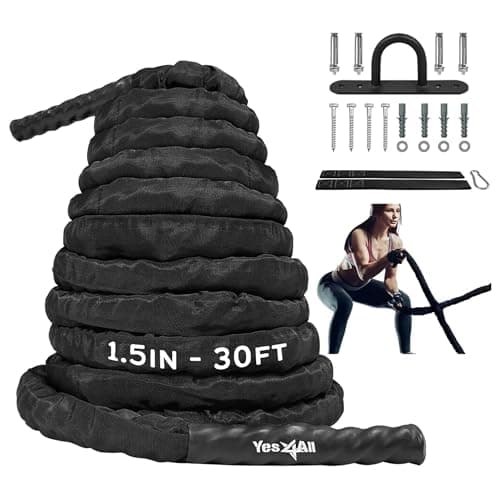
Yes4All Battle Rope 1.5 in. × 30 ft (with cover, anchor and strap). Licensed stock photograph of the category — not the specific product.
What each one actually trains
A battle rope is a conditioning device and nothing else. The load is fixed — it is the weight of the rope, and you cannot add to it — so the only variables are duration, wave size and rest. That makes it excellent at raising a heart rate and building local endurance in the shoulders, arms and trunk, and completely incapable of making you stronger in any meaningful sense. Nobody has ever got a bigger deadlift from a rope.
A kettlebell is a strength tool with a conditioning mode. A single bell will do swings, goblet squats, presses, rows, carries, Turkish get-ups, cleans and snatches, which between them cover hip hinge, squat, vertical press, horizontal pull and loaded carry — most of a strength programme. Done in a circuit, the same bell gives you conditioning too. The ceiling is the weight you own, and you raise it by buying another bell.
That asymmetry is the whole comparison. The rope does one job very well. The bell does five jobs adequately-to-well, including the rope's job.
Side by side
| Battle rope | Kettlebell | |
|---|---|---|
| Trains | Conditioning, shoulder and trunk endurance | Strength, power, conditioning, carries |
| Floor space | ~17 x 8 ft for a folded 30 ft rope | ~6 x 6 ft for swings |
| Needs an anchor | Yes, unless you buy an anchor-free rope | No |
| Noise | Almost none - no impact, nothing dropped | The loudest object in an apartment if set down hard |
| Technique barrier | Essentially none | Real - the swing takes weeks to learn |
| Progression | Longer sets, bigger waves, heavier rope | Heavier bell, more reps, harder variations |
| Injury risk | Low; shoulder overuse if volume spikes | Low with good form; lower back if the swing is a squat |
| Cost to start | One rope | One bell, then a second when you outgrow it |
| Storage | A coil the size of a car tyre | A dense object that lives on the floor |
The space question, which decides more than it should
People assume the kettlebell needs more room because it is the heavier object. The opposite is true. A bell needs enough floor to swing without hitting anything: roughly 6 ft of clearance in front and a ceiling above about 7 ft if you ever press overhead. That is a bedroom.
A rope folded around an anchor needs 15 ft between you and the anchor, a couple of feet behind, and about 4 ft of clearance either side so the waves do not strike a wall. Plus the anchor itself. For a lot of people reading this on a site about small-space training, the rope is simply not an option, and that settles the comparison before any of the training arguments get a hearing.
The exception is the short anchor-free rope, which works held at both ends with the middle under your feet and needs about 10 ft of floor and nothing to tie to. It costs several times what a standard poly rope costs, and for apartment training that is usually money well spent. Our battle rope length and anchor guide has the measurements in full.
Learning curve
You can have a productive battle rope session on the day the rope arrives. Alternating waves, double waves and slams are the whole vocabulary, none of them are technical, and the rope self-regulates — when you are tired the waves get smaller and the session gets easier automatically. The only genuine error is doing too much too early and irritating a shoulder.
A kettlebell swing is a different proposition. Most people spend their first few weeks squatting the weight up and lifting it with their arms instead of hinging at the hip and letting the bell float, and a badly executed swing done for high reps is one of the few genuine ways to annoy a lower back with a light weight. It is learnable from a good explanation in a couple of sessions, but it has to be learnt. The kettlebell swing form guide is the place to start, and the one-kettlebell workout is the programme to run once it clicks.
Which one if you can only buy one
Garage or spare room, no noise constraint: the kettlebell. It does more, it costs less to start, and it will still be useful when your training goals change. Buy one bell in the right weight — 35 lb for most men, 18 to 26 lb for most women, per our size guide — and add a second later.
Apartment, neighbours below: the rope. Even accounting for the cost of the anchor-free version, the rope is the tool you will actually use at 7 am on a Tuesday without thinking about who is underneath you.
You already lift and want conditioning only: the rope. If a barbell or dumbbells already cover your strength work, a bell is partly redundant and a rope is not.
You want to be stronger: the kettlebell, obviously. There is no version of this where a rope gets you there.
What owning both looks like
They pair well, and the reason is that they fatigue different things. A common and effective structure is kettlebell strength work first — swings, goblet squats, presses, carries — followed by three to six rounds on the rope as a finisher. The bell work is limited by force production and the rope work is limited by lungs and grip, so one does not eat into the other.
If you are building toward owning both, buy the bell first and add the rope when you have somewhere to anchor it. Our home conditioning workouts page has sessions that use each on its own and both together.
Picks
One of each, if you want to see the two options
Two ropes - the standard anchored one and the anchor-free one - and two bells in the finishes that suit a garage and an apartment respectively.
Key specs
- Rope
- 1.5 in. × 30 ft, 16 lb
- Handles
- 10 in. heat-shrink
- Anchor
- Steel anchor + strap included
Scores · editorial, out of 10
- Length vs space needed
- 8
- Material & sleeve
- 9
- Anchor solution for renters
- 9
- Value
- 9
Pick 1 · Battle ropes
Yes4All Battle Rope 1.5 in. × 30 ft (with cover, anchor and strap)
Yes4All
A 16 lb, 1.5 in. × 30 ft poly-dacron rope in a nylon sleeve with 10 in. handles, a steel anchor and a strap — the rope with a published weight and every part you need in one box.
Best for
A 30 ft rope for a garage or driveway with a stated 16 lb weight
Pros
- 16 lb published weight — the honest way to compare ropes
- Steel anchor for a permanent wall/floor mount and a strap for a temporary one
- Nylon sleeve keeps fibers off the floor
Cons
- The steel anchor needs a drilled mount — renters use the strap only
- Longer 40/50 ft versions sold separately
Specs from Yes4All — Battle Rope with Protective Cover listing (length, weight, handles, anchor).
Key specs
- Rope
- 20 ft, 15 lb (Elite 25 ft, 19 lb)
- Core
- Flexible metal, triple-braided poly
- Anchor
- Optional — works unanchored
Scores · editorial, out of 10
- Length vs space needed
- 10
- Material & sleeve
- 9
- Anchor solution for renters
- 10
- Value
- 6
Pick 2 · Battle ropes
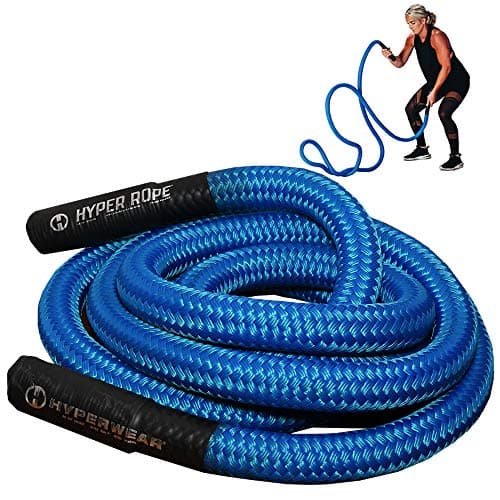
Hyperwear Hyper Rope (20 ft / 15 lb)
Hyperwear
A 20 ft, 15 lb braided rope with a flexible metal core that works with NO anchor — the battle rope for an apartment or a balcony where there's nothing to tie to. A 25 ft / 19 lb Elite version exists.
Best for
Battle-rope conditioning with no anchor point and 10 ft of floor
Pros
- Unanchored use — hold both ends, stand on the middle, and it works
- Short and dense: 20 ft of rope in the floor space of a 10 ft swing
- Anchors normally if you do have a post
Cons
- Costs more than a 50 ft poly rope
- The metal core makes it stiffer; it doesn't wave like a soft rope
Specs from Hyperwear — Hyper Rope Anchor-Optional Weighted Battle Rope (lengths, weights, core).
Key specs
- Weights
- 5–80 lb in 5 lb steps
- Handle
- ~1.25 in. (35 mm), textured
- Base
- Flat
Scores · editorial, out of 10
- Handle & finish
- 7
- Weight increments / adjustability
- 9
- Footprint & floor safety
- 7
- Build (casting, seams)
- 8
- Value
- 10
Pick 3 · Kettlebells
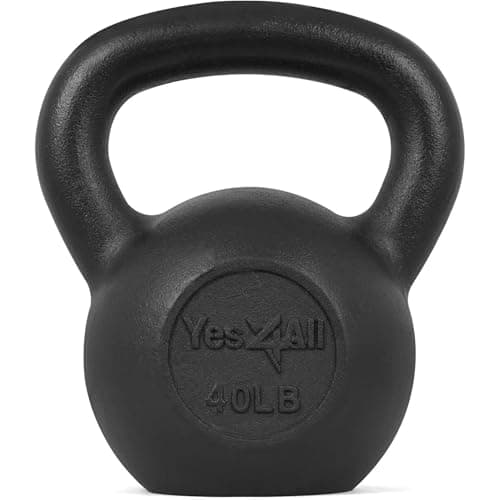
Yes4All Solid Cast Iron Kettlebell
Yes4All
The one-piece cast iron bell sold in 5 lb steps from 5 to 80 lb with a 1.25 in. handle and a flat base — the default first kettlebell because you can buy exactly the size you need.
Best for
A first bell in the exact weight you need without paying for a coating you don't
Pros
- 5 lb increments across the whole range — 15, 20, 25, 30, 35 lb are all there for a beginner's first two bells
- One-piece casting, no welded handle to fail
- Flat base sits still for rows, push-ups and storage
Cons
- Painted (not powder-coated) finish on the basic version chips and can leave marks on a wood floor — use a mat
- 35 mm handle is a bit thick for smaller hands on high-rep snatches
Specs from Yes4All — Solid Cast Iron Kettlebell listing (weights, handle, base).
Key specs
- Weights
- 5–100 lb across the range
- Coating
- Vinyl over cast iron
- Handle
- Solid steel, 8.86 in. wide
Scores · editorial, out of 10
- Handle & finish
- 8
- Weight increments / adjustability
- 8
- Footprint & floor safety
- 10
- Build (casting, seams)
- 7
- Value
- 9
Pick 4 · Kettlebells
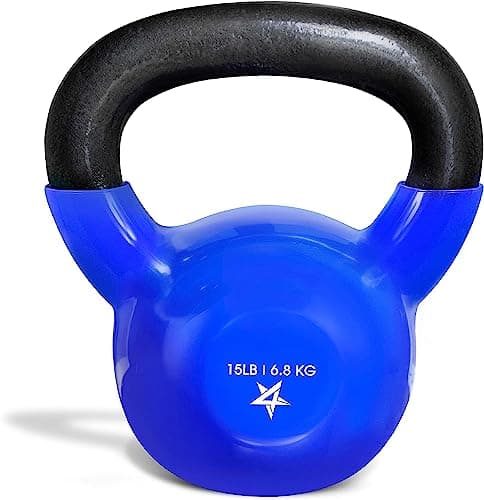
Yes4All Vinyl Coated Kettlebell
Yes4All
The same cast iron bell in a vinyl jacket, 5–100 lb across the range — the apartment kettlebell: quieter to set down and kinder to a floor you don't own.
Best for
Kettlebell training on an apartment floor with neighbors below
Pros
- Vinyl coating dampens the clank on a hard floor and won't scratch it
- PVC-coated shell takes a knock on a hard floor without chipping the way enamel does
- Color-coded — the fastest way to grab the right weight
Cons
- Vinyl adds a little bulk to the bell and can crack if dropped on concrete
- Color varies by weight, so a matched-looking pair means buying one weight twice
Specs from Yes4All — Vinyl Coated Kettlebell listing (weights, coating, handle).
FAQ
Questions readers ask
Are battle ropes or kettlebells better for fat loss?
Neither tool burns fat on its own; the diet and the total weekly work do that. Of the two, a kettlebell circuit usually produces more total work per session because it moves the whole body against a load, while a rope produces a very high heart rate for short bursts. The one you will actually use several times a week is the better one.
Can battle ropes build muscle?
Not meaningfully. The load is fixed at the weight of the rope and cannot be increased, so there is no progressive overload to drive growth. You will build local endurance and some conditioning-related density in the shoulders and arms. For actual muscle, you need something you can make heavier — a kettlebell, a dip belt, a vest.
Which needs less space, a battle rope or a kettlebell?
A kettlebell, clearly. Swings need about 6 by 6 ft of floor and a 7 ft ceiling for overhead work. A folded 30 ft battle rope needs roughly 17 by 8 ft plus something immovable to anchor to. A short anchor-free rope narrows the gap to about 10 ft of floor, at several times the price.
Which is quieter for an apartment?
The rope, by a wide margin. There is no impact and nothing is ever dropped. A kettlebell can be made apartment-friendly with a vinyl coating and a thick mat, but it starts from being the loudest object in the room and gets quieter, where a rope starts quiet.
Should a beginner buy a kettlebell or a battle rope first?
A kettlebell, unless noise or the lack of an anchor point rules it out. One bell covers hinge, squat, press, row and carry, which is most of a strength programme, and it does conditioning as well. A rope only does conditioning, and it needs considerably more floor and something to tie to.
Related
Keep reading
- Battle ropes vs jump rope
The same question against the other small-space conditioning tool.
- Best battle ropes for beginners
If the rope won: diameter, length and the anchor problem.
- Best kettlebells for beginners
If the bell won: which weight and which finish to start with.
- Conditioning workouts at home
Sessions that use each tool alone and both together.
Sources
- —Yes4All — Battle Rope with Protective Cover listing (1.5 in. x 30 ft, 16 lb, anchor and strap) · amazon.com
- —Hyperwear — Hyper Rope Anchor-Optional Weighted Battle Rope (20 ft, 15 lb, unanchored use) · hyperwear.com
- —Yes4All — Solid Cast Iron Kettlebell listing (5-80 lb in 5 lb steps, ~1.25 in. handle, flat base) · amazon.com
- —Yes4All — Vinyl Coated Kettlebell listing (5-100 lb, vinyl over cast iron, solid steel handle) · amazon.com