Guide · Conditioning
Battle rope length and anchor: half the rope in floor, and something to loop it around
A 30 ft rope needs 15 ft of floor; a 50 ft rope needs 25. Here is the length by room, every way to anchor one without a drill, the bolted anchor for people who can, and the rope that needs no anchor at all.
Rope & Rep is reader-supported. Product links go through our affiliate resolver and we may earn a commission from qualifying purchases at no cost to you. Prices are the retailer's and change — every button opens the live price on Amazon rather than showing a stale number.
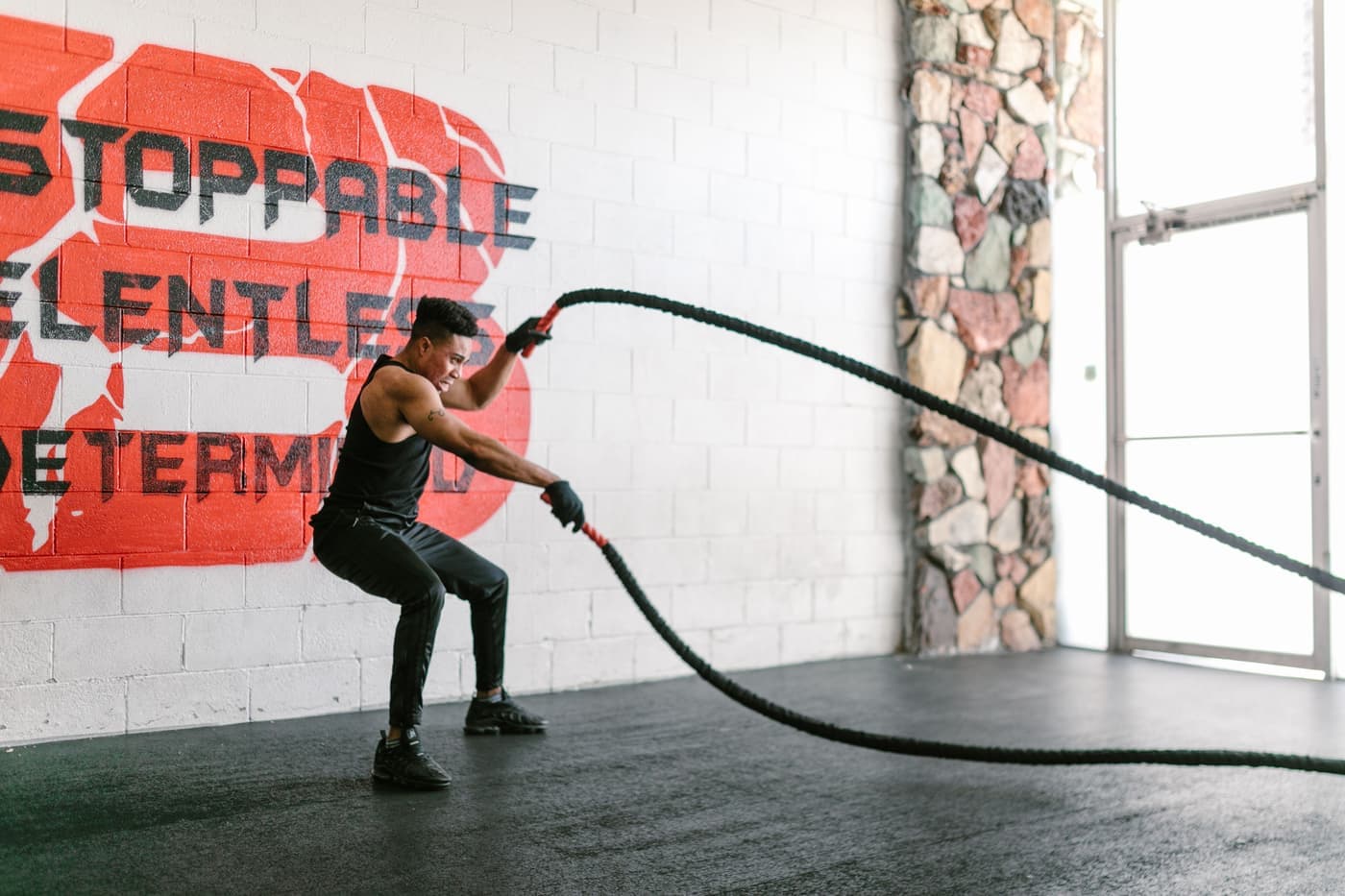
A man training with battle ropes in a gym. Licensed stock photograph of the category — not the specific product.
Anchoring a battle rope with a strap (no drilling) · 5 steps
1
Pick the anchor
A post, a column, a tree trunk thicker than your thigh, a rack foot, or the leg of a heavy piece of furniture. It must outweigh a hard tug — test with a slow pull.
2
Wrap the strap
Pass the anchor strap around the post at about knee to hip height and clip or loop it so it cinches on itself.
3
Thread the rope
Feed the rope through the strap's loop or ring to its midpoint so both halves are equal. Equal halves are what make the waves match.
4
Walk back to full extension, then step in
Take the ends to where the rope is nearly straight, then step in one or two paces — a little slack is what lets the rope wave.
5
Test with slow waves
Make three slow alternating waves and watch the anchor. Any shift, and it's the wrong anchor.
Length by space
| Rope | Floor from anchor | Fits | Feel |
|---|---|---|---|
| 20 ft unanchored (Hyper Rope) | ~10 ft | Apartment, balcony, hallway | Dense, short waves |
| 30 ft | ~15 ft | One-car garage, patio, small yard | The standard — fast waves |
| 40 ft | ~20 ft | Two-car garage, driveway | Longer, heavier waves |
| 50 ft | ~25 ft | Yard, park | Slow, heavy; the gym feel |
Measure from where the anchor will be to where you can stand with the rope nearly straight, then subtract a pace. If that is 13–16 ft, a 30 ft rope; if you have 20 ft, a 40. Buying long for a short room means coiling the excess at the anchor, which works but changes the feel. The rope roundup lists lengths for each rope.
Anchors without a drill
- Strap around a post, column or tree. The standard renter anchor; most ropes ship with a strap. Knee to hip height.
- A heavy kettlebell. Rope through the handle of a 50 lb+ bell on a mat. Fine for waves; it will creep on slams.
- A rack foot or a power tower base. Strap around the lowest crossmember. Check the tower maker allows lateral load.
- A fence post or a car's tow hook (outdoors). Strap, not rope, around anything with an edge.
- An unanchored rope. The Hyper Rope's metal core lets you stand on the middle and hold both ends. Nothing to tie to, 10 ft of floor.
The bolted anchor
A steel anchor plate lag-bolted into a wall stud, a floor joist or concrete is the gym solution and the quietest, most consistent one. It needs a drill and permission. Mount at knee to hip height into framing (a stud finder and a pilot hole, the same rules as a ceiling pull-up bar), never into drywall. The Yes4All rope ships with a steel anchor and a strap so you can start with the strap and bolt later.
Diameter
1.5 in. fits most hands and moves fast; 2 in. is heavier, harder to grip, and for large hands and heavy conditioning. For a first rope, 1.5 in.
A first four weeks
| Week | Session |
|---|---|
| 1 | Alternating waves 20 s on / 40 s off × 8 |
| 2 | Alternating waves 20/40 × 6, double waves 20/40 × 4 |
| 3 | Alternating 30/30 × 6, slams 15/45 × 4 |
| 4 | Alternating 30/30 × 6, double 20/40 × 4, slams 15/45 × 4 |
The rope is a shoulder-and-core tool; the legs hold a half squat throughout. Where it fits with the jump rope and the sled is in conditioning workouts at home.
Picks
Ropes for each anchor situation
A rope with a strap anchor in the box, the unanchored rope, and the rope with a steel anchor for owners.
Key specs
- Rope
- 1.5 in. poly dacron, 30 / 40 / 50 ft
- Handles
- 8.66 in. heat-shrink, non-slip
- Anchor
- Strap kit included
Scores · editorial, out of 10
- Length vs space needed
- 8
- Material & sleeve
- 8
- Anchor solution for renters
- 9
- Value
- 9
Pick 1 · Battle ropes
Perantlb Poly Dacron Battle Rope 1.5 in. (30 / 40 / 50 ft)
Perantlb
A 1.5 in. poly-dacron rope in 30, 40 or 50 ft with a protective sleeve, 8.66 in. heat-shrink handles and an anchor kit in the box — the complete starter rope; buy the 30 ft for a small space.
Best for
A first battle rope with the anchor included, sized to a garage or yard
Pros
- Anchor strap kit included — loop it round a post, a tree or a rack foot without drilling
- Sleeved version resists the fraying that kills battle ropes on concrete
- 30 ft (15 ft of working room) is the right length for a one-car garage
Cons
- Poly dacron sheds fibers over time; keep it sleeved
- Rope weight isn't published by the maker — assume 15–25 lb by length
Specs from Perantlb — Poly Dacron Battle Rope with sleeve listing (lengths, handles, anchor kit).
Key specs
- Rope
- 20 ft, 15 lb (Elite 25 ft, 19 lb)
- Core
- Flexible metal, triple-braided poly
- Anchor
- Optional — works unanchored
Scores · editorial, out of 10
- Length vs space needed
- 10
- Material & sleeve
- 9
- Anchor solution for renters
- 10
- Value
- 6
Pick 2 · Battle ropes
Hyperwear Hyper Rope (20 ft / 15 lb)
Hyperwear
A 20 ft, 15 lb braided rope with a flexible metal core that works with NO anchor — the battle rope for an apartment or a balcony where there's nothing to tie to. A 25 ft / 19 lb Elite version exists.
Best for
Battle-rope conditioning with no anchor point and 10 ft of floor
Pros
- Unanchored use — hold both ends, stand on the middle, and it works
- Short and dense: 20 ft of rope in the floor space of a 10 ft swing
- Anchors normally if you do have a post
Cons
- Costs more than a 50 ft poly rope
- The metal core makes it stiffer; it doesn't wave like a soft rope
Specs from Hyperwear — Hyper Rope Anchor-Optional Weighted Battle Rope (lengths, weights, core).
Key specs
- Rope
- 1.5 in. × 30 ft, 16 lb
- Handles
- 10 in. heat-shrink
- Anchor
- Steel anchor + strap included
Scores · editorial, out of 10
- Length vs space needed
- 8
- Material & sleeve
- 9
- Anchor solution for renters
- 9
- Value
- 9
Pick 3 · Battle ropes
Yes4All Battle Rope 1.5 in. × 30 ft (with cover, anchor and strap)
Yes4All
A 16 lb, 1.5 in. × 30 ft poly-dacron rope in a nylon sleeve with 10 in. handles, a steel anchor and a strap — the rope with a published weight and every part you need in one box.
Best for
A 30 ft rope for a garage or driveway with a stated 16 lb weight
Pros
- 16 lb published weight — the honest way to compare ropes
- Steel anchor for a permanent wall/floor mount and a strap for a temporary one
- Nylon sleeve keeps fibers off the floor
Cons
- The steel anchor needs a drilled mount — renters use the strap only
- Longer 40/50 ft versions sold separately
Specs from Yes4All — Battle Rope with Protective Cover listing (length, weight, handles, anchor).
FAQ
Questions readers ask
How long should a battle rope be for home use?
30 ft for most garages and yards (needs about 15 ft of floor from the anchor). 40–50 ft only with 20–25 ft of runway; 20 ft unanchored for an apartment.
How do you anchor a battle rope without drilling?
A strap around a post, column or tree; the rope through a 50 lb+ kettlebell handle; a strap around a rack foot; or an unanchored rope with a metal core.
How high should a battle rope anchor be?
Knee to hip height. Higher anchors flatten the waves; floor-level anchors make slams awkward.
1.5 or 2 inch battle rope?
1.5 in. for most people — it fits the hand and moves fast. 2 in. is for large hands and heavy conditioning.
Related
Keep reading
- Best battle ropes
Four ropes ranked, lengths listed.
- Battle ropes vs jump rope
Which rope for which room.
- Garage gym essentials
The rope in the garage plan.
- Conditioning workouts at home
Rope rounds in a week.
Sources