Guide · Conditioning
Agility ladder drills, in the order you should actually learn them
Every ladder ships with a leaflet of twenty drills and no sense of sequence. Here are ten that matter, ordered so each one teaches the footwork the next one needs - plus the fault that ruins each drill and how to spot it on yourself.
Rope & Rep is reader-supported. Product links go through our affiliate resolver and we may earn a commission from qualifying purchases at no cost to you. Prices are the retailer's and change — every button opens the live price on Amazon rather than showing a stale number.
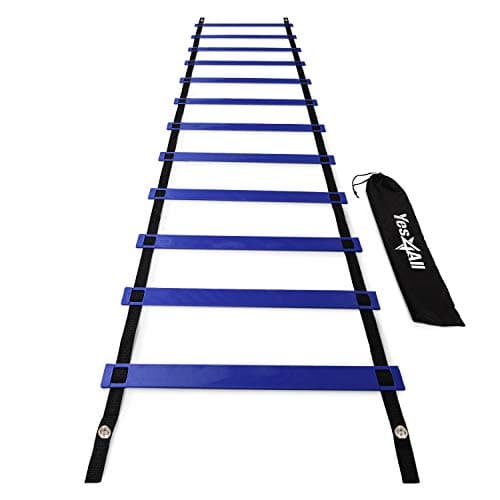
Yes4All Agility Ladder (12 rungs, 15 ft). Licensed stock photograph of the category — not the specific product.
What ladder drills are actually training
An agility ladder does not make you faster in a straight line and it does not build your engine. What it trains is foot speed and foot placement - the ability to put a foot exactly where you intended, quickly, repeatedly, without looking - and the stiffness in the ankle and calf that lets you do it off the ground rather than through it. That is a coordination skill, which has two consequences for how you train it.
The first is that fatigue destroys it. A coordination drill done when you are gassed trains sloppiness, which is why the rep scheme below looks easy on paper - five to eight seconds of work with thirty to forty-five seconds of rest - and why doing ladder drills as a twenty-minute conditioning block is a waste of a ladder. If conditioning is what you want, a jump rope or a battle rope does it better in less space.
The second is that it rewards patience in a very specific way: the gains come from the pattern becoming automatic, and that takes repetitions spread over weeks rather than a hard session. Ten minutes three times a week beats forty minutes on a Sunday, every time.
The ten drills, in learning order
| # | Drill | What it is | Reps | The fault to watch |
|---|---|---|---|---|
| 1 | Two feet in | Both feet land in every square, moving forward | 4-6 passes | Heel contact. Stay on the balls of the feet |
| 2 | One foot in (high knees) | One foot per square, knee driving up | 4-6 passes | Leaning back. Chest stays over the hips |
| 3 | Lateral two feet in | Facing sideways, both feet in each square | 3-4 each direction | Crossing the feet. They stay parallel |
| 4 | In-in-out | Two feet in a square, then both out wide, then forward | 4-6 passes | Pausing on the 'out'. It is one rhythm, not two moves |
| 5 | Icky Shuffle | In-in-out in a 3-step lateral rhythm down the ladder | 4-6 passes | Looking down. This is the drill eyes-up matters most |
| 6 | Lateral in-in-out | Side-on version of #4, hips square to the ladder | 3-4 each direction | Hips rotating to face the direction of travel |
| 7 | Ali shuffle | Feet split front and back, swapping each square | 4 passes | Standing tall. Keep a soft athletic bend |
| 8 | Single-leg hops | One foot only, square to square | 2-3 passes per leg | Landing flat. Land and leave on the ball of the foot |
| 9 | Scissors / crossover | One foot crosses behind as you travel sideways | 3 each direction | Over-rotating the trailing hip |
| 10 | Ladder to sprint | Any drill above, exiting into a 5-10 yard sprint | 6-8 reps | Decelerating at the last rung instead of accelerating out |
Work down that list rather than across it. Drills one to four are the alphabet: nothing above them makes sense until two feet in is clean at speed and in-in-out has one rhythm rather than two. Five to seven are the real content - the Icky Shuffle in particular is the drill most people recognise and most people do badly, because it demands a three-count rhythm while you are travelling sideways. Eight and nine are load and asymmetry. Ten is the one that makes the whole thing transfer.
The drill everyone skips, and why it is the important one
Number ten. A ladder drill that ends at the last rung teaches your feet to be quick inside a box and then stop. Nothing in any sport does that. Put two cones five and ten yards past the end of the ladder, and finish every third set by accelerating out of the last square to the far cone.
That single change converts footwork into speed. It also exposes whether your ladder pattern was ever athletic: people who have been bouncing through the rungs with their weight back cannot accelerate out of the last one, and you feel it immediately. Twenty flat cones costs less than a takeaway and is the cheapest upgrade available to a ladder session.
A 12-minute session you can run on a driveway
Minutes 0-2 - warm up. Ankle circles, calf raises, twenty easy single bounces with a rope if you have one, then two slow passes of two-feet-in at walking pace.
Minutes 2-7 - the pattern block. Pick two drills, one forward and one lateral - say in-in-out and the Icky Shuffle. Alternate them: one pass of each, then thirty to forty-five seconds rest. Six to eight rounds. Every pass should look like the one before it; the moment it does not, the block is over.
Minutes 7-10 - the sprint block. Four to six reps of a ladder pass into a ten-yard sprint to a cone, walking back as the rest.
Minutes 10-12 - finish. Calf and shin stretch, ankle mobility. Skipping this is how a week of new ladder work turns into shin splints.
Run that two or three times a week, at the start of a session, before anything heavy. It pairs naturally with box jumps - the ladder trains putting the foot down, the box trains getting off the floor - and badly with a hard sled session on the same legs an hour earlier.
Sport-specific variations, briefly
Soccer. Weight the lateral drills - three and six - and finish every set into a change of direction rather than a straight sprint. The game is played sideways more than people train it.
Basketball. Defensive slide footwork means the Ali shuffle and scissors matter most, plus single-leg hops for the deceleration demand on one leg.
Boxing. In-in-out and the Ali shuffle, both done at a lower stance than feels natural, and paired with rope work - the boxing rope session covers the other half of the same quality.
General conditioning and older athletes. Stay on drills one to five, keep both feet involved, and do not chase speed. The value here is ankle stiffness and foot placement, which is the same quality that makes a kerb or a loose paving slab a non-event.
What ladder you need for these drills
Less than the marketing suggests. Twelve rungs over 15 ft is enough for everything above and fits on a normal driveway with room for the sprint exit; 20 ft is better if you have the run-off and want longer passes. Rung spacing adjustable to about 15 in. is the spec that matters, because the tighter spacings are what make the quick drills quick.
What you should not buy is the longest ladder you can find and then lay it out in a space with no room to exit. Our agility ladder roundup ranks the current sets on rung type, rail length and whether they tangle in a bag, and the honest answer in that category is that a cheap flat ladder plus twenty cones beats an expensive ladder on its own.
Picks
Ladders these drills are written for
A 15 ft twelve-rung ladder for a driveway, a 20 ft version for anyone with the run-off, and twenty flat cones for the drills that leave the ladder.
Key specs
- Length
- 15 ft, 12 rungs (8- and 20-rung versions also sold)
- Rung spacing
- Adjustable to 15 in.
- Included
- Carry bag
Scores · editorial, out of 10
- Fit for purpose
- 8
- Adjustability
- 10
- Durability
- 7
- Value
- 10
Pick 1 · Agility gear
Yes4All Agility Ladder (12 rungs, 15 ft)
Yes4All
A 12-rung, 15 ft nylon-strap ladder with plastic rungs you can slide up to 15 in. apart, carry bag included — the standard ladder, sized for a driveway.
Best for
A first ladder for footwork drills in a driveway or hallway
Pros
- Adjustable rung spacing — tighten for quick feet, widen for bounding
- 15 ft fits a two-car driveway or a long hallway
- Sold in combo sets with cones, hurdles and stakes
Cons
- Loose rungs slide out of position if you catch one
- Nylon straps tangle in the bag — roll it, don't stuff it
Specs from Yes4All — Agility Ladder listing (length, rungs, spacing, bag).
Key specs
- Length
- 20 ft, 12 rungs
- Rungs
- 16.5 in. wide, spacing to 15 in.
- Bundle
- Bag; 10-cone version available
Scores · editorial, out of 10
- Fit for purpose
- 8
- Adjustability
- 9
- Durability
- 7
- Value
- 9
Pick 2 · Agility gear
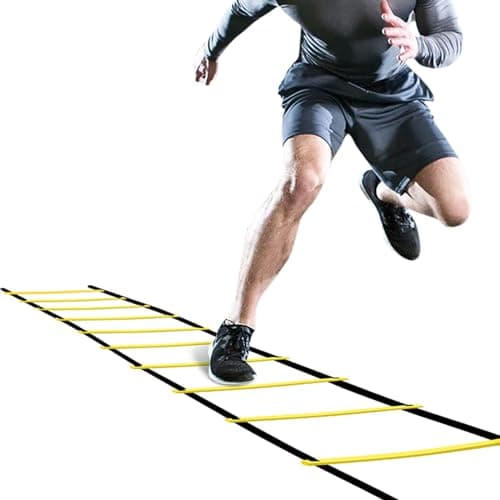
GHB Pro Agility Ladder (12 rungs, 20 ft)
GHB
A 20 ft, 12-rung nylon ladder with 16.5 in. rungs adjustable to 15 in. apart, with a carry bag and a version bundled with 10 cones — the longer ladder for a yard.
Best for
Longer drill runs on grass or a long driveway; a bundle with cones
Pros
- 20 ft with 12 rungs gives wider default spacing — better for bounding and lateral drills
- Cone bundle covers shuttle and slalom drills too
- Indoor/outdoor nylon
Cons
- 20 ft needs a real runway — too long for most hallways
- Same loose-rung caveat as any strap ladder
Specs from GHB — Pro Agility Ladder 12 Rung 20 ft listing (length, rungs, bundle).
Key specs
- Count
- 20 — five each of yellow, black, white and orange
- Height
- 2 in.
- Included
- Carry rack; 100% polyethylene
Scores · editorial, out of 10
- What happens when an athlete stands on it
- 10
- Height & visibility for the drill it is for
- 7
- Durability on pavement and in the weather
- 9
- Count, storage & value
- 7
Pick 3 · Agility cones & markers
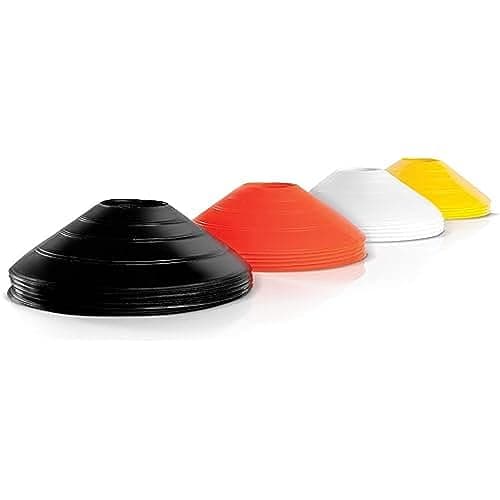
SKLZ Agility Cones (2 in., set of 20)
SKLZ
Twenty 2 in. polyethylene cones in four colors with a carry rack — the low-profile marker you can sprint over, cut around and stand on without a trip hazard or a broken cone.
Best for
Footwork, shuttle and change-of-direction work where you will step on a cone sooner or later
Pros
- Two inches tall, so catching one with a foot at speed costs you nothing
- Four colors in one set — enough to run a called-color reaction drill without buying twice
- The maker's own trade listing states the cones will not break when stepped on
- Carry rack keeps twenty cones stacked in a shape that fits a gym bag
Cons
- Two inches is invisible from across a field — these mark footwork, not boundaries
- Rigid polyethylene cones skitter on a polished gym floor if you clip one hard
- Costs roughly twice a generic 20-pack of the same count
Specs from SKLZ (Implus) — Agility Cones trade listing (count, colors, 2 in. height, polyethylene, carry rack).
FAQ
Questions readers ask
What are the best agility ladder drills for beginners?
Two feet in, one foot in, lateral two feet in, and in-in-out - in that order. Those four are the alphabet of every other drill, and until two-feet-in is clean and quiet at speed, nothing above it will look right. Four to six passes of each with real rest between them is a complete first session.
How long should an agility ladder session be?
Ten to fifteen minutes, done fresh. The work intervals are five to eight seconds with thirty to forty-five seconds of rest, because this is a coordination stimulus and fatigue degrades it. Two or three short sessions a week produce far more than one long one.
Do agility ladder drills actually make you faster?
They improve foot speed, foot placement and ankle stiffness, which show up as quicker changes of direction and cleaner first steps. They do not meaningfully improve straight-line top speed - that comes from sprinting and strength work. The drill that bridges the gap is exiting the ladder into a five to ten yard sprint.
What is the Icky Shuffle?
A three-count lateral drill: two feet into a square, then one foot out to the side, then travel on - in, in, out - repeating down the ladder while facing forward. It is the best-known ladder drill and the most commonly done badly, almost always because people look down at their feet instead of keeping their eyes up.
Can you do agility ladder drills indoors?
Yes, on low-pile carpet or a clean hard floor with grip, as long as you have the length - 15 ft of ladder plus a couple of feet at each end. Avoid polished floors and socks: the failure mode in this category is a foot sliding off a rail. A garage slab is the ideal indoor surface.
Do I need cones as well as a ladder?
Not strictly, but twenty flat markers cost very little and they add the thing a ladder cannot do on its own: an exit. Putting cones at five and ten yards past the last rung turns a footwork drill into an acceleration drill, which is where the transfer to sport actually happens.
How often should I do ladder drills?
Two to three times a week, at the start of a session, with at least a day between. The adaptation is neurological and comes from frequent short exposures rather than long hard ones - and the calves and shins need the recovery day, particularly in the first fortnight.
Related
Keep reading
- Best agility ladders
Which ladder to run these drills on, ranked on rungs, rails and tangle.
- Best agility cones
The twenty flat markers that give a ladder session an exit.
- Conditioning workouts at home
Where a 12-minute footwork block sits in a week.
- What size plyo box should I get
The other half of the same quality - getting off the floor rather than onto it.
Sources
- —Yes4All — Agility Ladder listing (15 ft, 12 rungs, spacing adjustable to 15 in., carry bag; 8- and 20-rung versions also sold) · amazon.com
- —GHB Pro — Agility Ladder listing (20 ft, 12 rungs, 16.5 in. wide rungs, spacing to 15 in., bag; 10-cone bundle version) · amazon.com
- —SKLZ (Implus) — Agility Cones trade listing (20 cones, 2 in. tall, 100% polyethylene, carry rack, will not break when stepped on) · b2b.implus.com