Guide · Jump Ropes
A jump rope workout for boxing, built in rounds instead of minutes
Boxers skip in three-minute rounds with sixty seconds off because that is the shape of the sport, not because it is a nice interval. Here is the session, the five drills inside it, and the six weeks that take you from one honest round to five.
Rope & Rep is reader-supported. Product links go through our affiliate resolver and we may earn a commission from qualifying purchases at no cost to you. Prices are the retailer's and change — every button opens the live price on Amazon rather than showing a stale number.
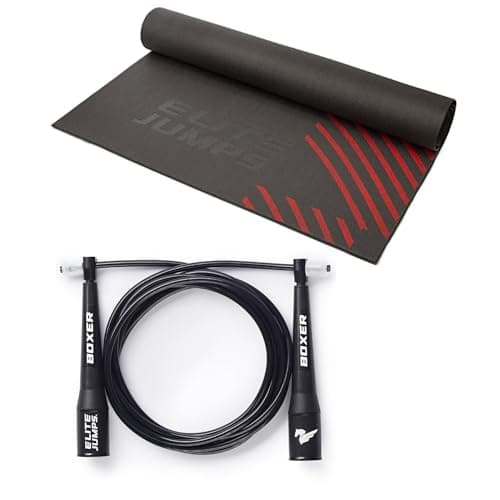
Elite Jumps Boxer Jump Rope 3.0. Licensed stock photograph of the category — not the specific product.
A three-round boxing jump rope session · 5 steps
1
Set the rope and the clock
Size the rope so the handle tops reach the sternum when you stand on the middle, and set a round timer to three minutes work, one minute rest. Stand on the balls of your feet, hands at hip height and a hand's width from the body, elbows tucked.
2
Round one - basic bounce and rhythm
Three minutes of relaxed single bounces, one jump per turn, barely clearing the floor. Count to a four-beat rhythm. The job of this round is to stop the rope and your feet arguing, not to raise your heart rate.
3
Round two - boxer skip and footwork
Three minutes alternating feet in the boxer step, then half the round moving: forward and back two steps, then side to side, keeping the turn unbroken. This is the round that transfers to the ring.
4
Round three - speed and double-unders
Three minutes of thirty seconds fast single bounces, thirty seconds easy. In the last minute, trade the fast blocks for sets of three to five double-unders with easy bounces between.
5
Finish on the floor, not on the rope
Two minutes of calf raises and ankle circles, then stretch the calves and the front of the shin. Skipping loads the lower leg hard; this is the part people skip and then regret.
Why boxers skip, and what it is actually training
Skipping survived in boxing gyms for a century for reasons that have very little to do with burning calories. It builds three things the sport needs and almost nothing else trains at once: the ability to stay on the balls of the feet for a full round without the calves failing, a rhythm your body keeps while the hands do something else, and the coordination to change direction without a stutter step. A heavy bag teaches you to hit; the rope teaches you to stand and move while you do.
That is why the structure of this session is rounds and the content is footwork. Running three minutes of flat, high, hard bounces at full speed is a conditioning workout that happens to use a rope. A boxing jump rope workout keeps the clearance tiny, the contact quiet, the shoulders still and the feet busy - and it ends up being harder, because precision at low amplitude is more demanding than thrashing.
If you have not yet bought the rope, the boxing rope roundup is the page to read first: a string-core PVC rope at about 5 mm is the one this session is written for, because it turns at a speed a human can keep time with and it tells you where it is.
The session, round by round
| Round | What you do | Target | What it is for |
|---|---|---|---|
| Warm-up (2 min) | Ankle circles, calf raises, 60 seconds of rope on the ground - step over it, no turning | No clock | Waking the ankle and the Achilles before you load them |
| Round 1 (3 min) | Basic bounce, one jump per turn, barely clearing the floor | Unbroken | Rhythm, relaxation, shoulder stillness |
| Round 2 (3 min) | Boxer skip, then the same step moving forward/back and side to side | Max 3 breaks | Footwork that transfers to the ring |
| Round 3 (3 min) | 30 sec fast / 30 sec easy; last minute in sets of 3-5 double-unders | Max 5 breaks | Speed, calf power, composure under fatigue |
| Cool-down (2 min) | Calf raises, ankle circles, calf and shin stretch | No clock | The part that stops shin splints |
That is thirteen minutes of actual work and it is enough. Boxers who skip for twenty minutes are usually using it as a warm-up, not as training - and when it is training, it is this: short, specific and sharp. Run it three times a week on days you are not doing your hardest conditioning work, and never two days in a row when you are starting out.
The five drills, and the fault each one fixes
Basic bounce. Two feet, one jump per turn, one inch of air. This is the baseline and the diagnostic: if you cannot do three unbroken minutes of it, nothing further in this list will go well. The fault it fixes is jumping high, which is what everyone does on day one.
Boxer skip. Weight shifts from one foot to the other with each turn, like a slow jog in place, and it is the single most boxing-specific thing you can do with a rope. It keeps you on the balls of both feet with the weight moving, which is exactly the stance problem the rope is solving. It also halves the impact per foot, so it is the drill you extend when the calves are complaining.
Travelling skip. The boxer step, moving - two steps forward, two back, then left and right - without breaking the turn. This is the drill that makes the transfer explicit: you are now changing direction with a rhythm to keep, which is the ring. Most people break the rope the first ten attempts; that is the drill working.
High knees / sprint step. Fast alternating feet with the knee lifting to about hip height, in ten to fifteen second bursts. Not a finesse drill - this is calf power and heart rate, and it belongs in the last round only.
Double-unders. Two rope passes per jump. In boxing they are a power and composure drill rather than a skill you need, which is why they live at the end of round three in sets of three to five rather than as a target of fifty. If they are not there yet, the double-under page covers the rope and the technique.
The six-week build, from three rounds to five
| Weeks | Rounds | What changes | Sessions per week |
|---|---|---|---|
| 1-2 | 3 | Nothing. Round 1 and 2 only on the first week if the basic bounce still breaks | 3, never on consecutive days |
| 3-4 | 4 | Add a second footwork round; keep the speed round last | 3 |
| 5-6 | 5 | Add a second speed round. Double-unders now appear in two rounds | 3-4 |
Five three-minute rounds with a minute between them is a real boxing skipping workout and it is where most people should stop adding volume. After that, the gains come from quality: fewer breaks, lower clearance, quieter feet, more of the round spent moving rather than bouncing in place. A boxer who can do five clean rounds of travelling boxer skip has the footwork base the sport wants.
Where this fits in a boxing week
Skipping is a warm-up on bag days and training on its own days - that is the simplest honest split. Six minutes of easy rounds before bag work raises the temperature and switches the feet on. The full session above is a standalone piece of work and should be treated like one: not before a hard sparring session, and not the day after one, because tired calves are how ankles get rolled.
For the rest of the week, the rope pairs best with the two things it does not train. Pulling strength, from a pull-up bar - boxing is a pulling-weak sport and the rope does nothing for it. And rotational and whole-body power, from kettlebell swings or slam balls, where the rope has nothing to offer. If you are building the whole corner out, garage gym essentials puts the pieces in order.
One last thing worth saying: the comparison people always want is skipping against running. For a boxer they are not substitutes - the rope is footwork and the run is an engine - and the jump rope vs running page works through what each one actually delivers.
Picks
Three ropes for three jobs in this session
The string-core PVC rope the rounds are written for, the bearing cable for the speed round, and the 1 lb set for the conditioning finisher.
Key specs
- Rope
- 5 mm PVC, string core, 10 ft
- Handles
- 5.5 in. polymer, dowel action
- Sizing
- Snap-lock cord ends
Scores · editorial, out of 10
- Rope type fit for the buyer
- 9
- Adjustability & sizing
- 9
- Bearings & handles
- 8
- Apartment-friendliness (floors, noise)
- 8
- Value
- 9
Pick 1 · Jump ropes
Elite Jumps Boxer Jump Rope 3.0
Elite Jumps
The classic boxer's rope done well: a 5 mm PVC cord with a string core, 10 ft to trim, 5.5 in. polymer handles with a smooth dowel, snap-lock ends for resizing — the rope that teaches rhythm.
Best for
Learning footwork and rhythm; a rope you can size yourself and use outdoors
Pros
- String-core PVC gives a steady, audible turn — the best feedback of any non-weighted rope here
- 10 ft cord fits anyone up to about 6 ft 3 in. before trimming
- The Amazon listing bundles an Elite Jumps rope mat, which is most of a mat's price for free
Cons
- A dowel turns slower than a bearing; double-unders are possible but not its strength
- PVC on bare concrete wears — jump on a mat
Specs from Elite Jumps — Boxer Jump Rope 3.0 listing (cord, handles, sizing).
Key specs
- Cables
- 2 × 9 ft 3 in., 4.0 + 4.5 mm PVC-coated
- Handles
- 6.2 in. polished aluminum, silicone grips
- Bearing
- Swivel bearing, all directions
Scores · editorial, out of 10
- Rope type fit for the buyer
- 8
- Adjustability & sizing
- 10
- Bearings & handles
- 10
- Apartment-friendliness (floors, noise)
- 6
- Value
- 6
Pick 2 · Jump ropes
Buddy Lee Aero Speed 2.0
Buddy Lee
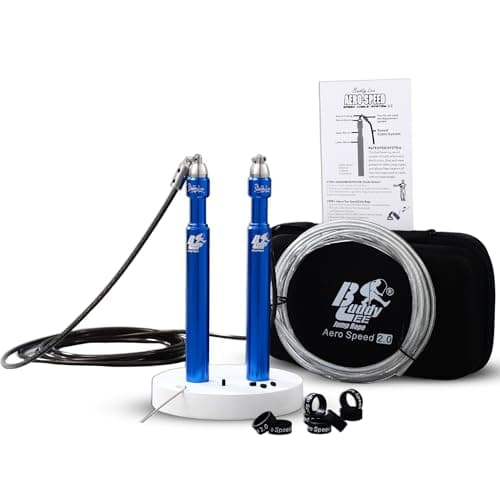
The speed rope with a real swivel bearing: two 9 ft 3 in. PVC-coated cables (4.0 and 4.5 mm), 6.2 in. polished aluminum handles, cutters and a wrench in the box — the rope you buy once.
Best for
A serious jumper who wants a speed rope that will still be right in five years
Pros
- Two cable thicknesses in the box — the 4.5 mm gives a little more feel, the 4.0 mm more speed
- Patented swivel bearing rotates in every direction, not just around the handle axis
- Cable cutters and L-wrench included, so sizing is precise and repeatable
Cons
- The most expensive speed rope here
- Steel cables on concrete fray and sting on a miss — mat, always
Specs from Buddy Lee — Aero Speed 2.0 (cables, handles, bearing, included tools).
Key specs
- Ropes
- 1 lb + 2 lb, coated
- Handles
- Power handles, fast-clip
- Sizing
- By height (S/M/L/XL)
Scores · editorial, out of 10
- Rope type fit for the buyer
- 9
- Adjustability & sizing
- 7
- Bearings & handles
- 8
- Apartment-friendliness (floors, noise)
- 7
- Value
- 6
Pick 3 · Jump ropes
Crossrope Get Strong Set (1 lb + 2 lb)
Crossrope
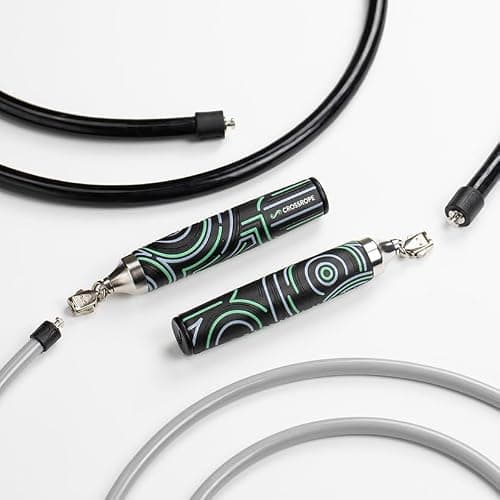
The heavy weighted set — 1 lb and 2 lb ropes on Power handles — that turns jumping into a strength-conditioning session in a space the size of a doormat.
Best for
Conditioning in an apartment where a 2 lb rope replaces a run
Pros
- A 2 lb rope loads shoulders, grip and core — a 10-minute session is genuinely hard
- Slow rotation makes it the most forgiving rope for timing; almost impossible to trip on
- Rated for concrete; lifetime handle warranty
Cons
- Heavy ropes are loud on a bare floor and hard on the mat — apartment users need a thick mat
- The most expensive rope on this site
Specs from Crossrope — Get Strong Weighted Jump Rope Set (contents, rope weights).
FAQ
Questions readers ask
How long should a boxer jump rope for?
Three to five three-minute rounds with a minute of rest between them, three times a week - thirteen to twenty-three minutes including rests. Start at three rounds and add one every two weeks. Longer unbroken sessions are a warm-up, not boxing training, because the sport is fought in rounds and the rope should be trained the same way.
What is the boxer skip?
Shifting your weight from one foot to the other on each pass of the rope, like a slow jog in place, instead of landing on both feet together. It keeps you on the balls of both feet with the weight moving - which is the boxing stance - and it halves the impact through each leg, so it is also the version to use when the calves are sore.
Is jumping rope better than running for boxing?
They do different jobs. The rope trains footwork, ankle stiffness and the ability to stay light for a full round; a run builds the aerobic base that lets you recover between them. Most boxing programmes use both, with the rope near-daily and the running two or three times a week.
What jump rope do boxers use?
Traditionally a light PVC or leather rope with a plain dowel handle - fast enough for speed work, slow enough to keep time with, and with enough mass to feel. The modern equivalent is a 5 mm string-core PVC cord, which is what this session is written for. Bearing speed cables are for double-unders; weighted ropes are for conditioning rounds, not footwork.
How many skips should a boxer do per round?
At a relaxed boxing rhythm, a three-minute round is roughly 220 to 300 turns at 75 to 100 per minute, and closer to 400 if the round includes fast blocks. Counting turns is less useful than counting breaks: the goal is a round with no more than two or three, at whatever speed lets you keep the feet quiet.
Should I jump rope before or after a boxing workout?
Before, if it is a short easy warm-up of a round or two. After or on its own day, if it is the session above - three to five rounds of real work on tired legs before bag or sparring work is how technique falls apart and ankles get rolled.
Related
Keep reading
- Best jump rope for boxing
Which rope to run this session with, and why the dowel handle survives rounds.
- Best jump rope for double unders
The rope and the technique for the last minute of round three.
- Jump rope vs running
Why a boxer does both rather than choosing.
- Conditioning workouts at home
Where three rounds of rope sits in a full training week.
Sources
- —Elite Jumps — Boxer Jump Rope 3.0 listing (5 mm string-core PVC cord, 10 ft, 5.5 in. polymer dowel handles, snap-lock sizing) · amazon.com
- —Buddy Lee — Aero Speed 2.0 listing (bearing speed rope specifications used for the speed round) · amazon.com
- —Crossrope — Get Strong Set listing (1 lb and 2 lb interchangeable ropes used for the conditioning finisher) · amazon.com
- —Buddy Lee — Aero Speed 2.0 (cables, handles, bearing, included tools) · buddyleejumpropes.com
- —Crossrope — Get Strong Weighted Jump Rope Set (contents, rope weights) · crossrope.com