Best Agility Cones · Conditioning
The best agility cones, ranked on what happens when you step on one
Every cone on this page costs less than a takeaway. The thing that separates them is height — two inches is a marker you can sprint over, nine inches is a gate you have to go around, and getting that backwards is how a footwork session ends an ankle.
Rope & Rep is reader-supported. Product links go through our affiliate resolver and we may earn a commission from qualifying purchases at no cost to you. Prices are the retailer's and change — every button opens the live price on Amazon rather than showing a stale number.
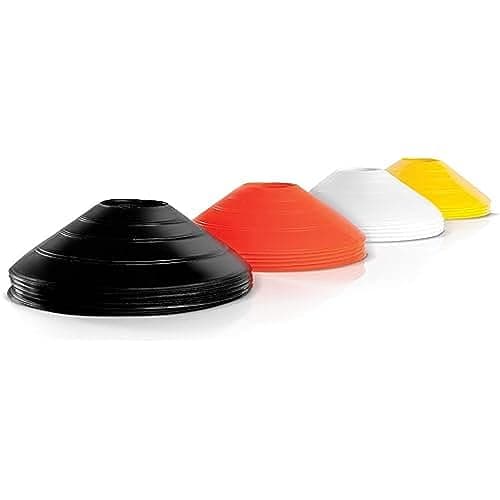
SKLZ Agility Cones (2 in., set of 20). Licensed stock photograph of the category — not the specific product.
Quick picks
| # | Product | Best for | Score | Price |
|---|---|---|---|---|
| 1 | SKLZ Agility Cones (2 in., set of 20) Twenty 2 in. polyethylene cones in four colors with a carry rack — the low-profile marker you can sprint over, cut around and stand on without a trip hazard or a broken cone. | Footwork, shuttle and change-of-direction work where you will step on a cone sooner or later | 8.4 | |
| 2 | 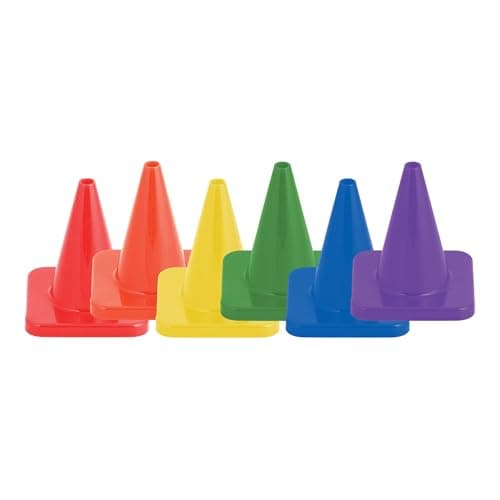 Champion Sports 6 in. Flexible Vinyl Cone (set of 6) Six 6 in. flexible vinyl cones in assorted colors — tall enough to make a gate you have to go around, soft enough to fold flat when you clip one at a sprint. | Slalom gates, start and finish markers, and drills where you want the cone to be an obstacle | 7.7 | |
| 3 | 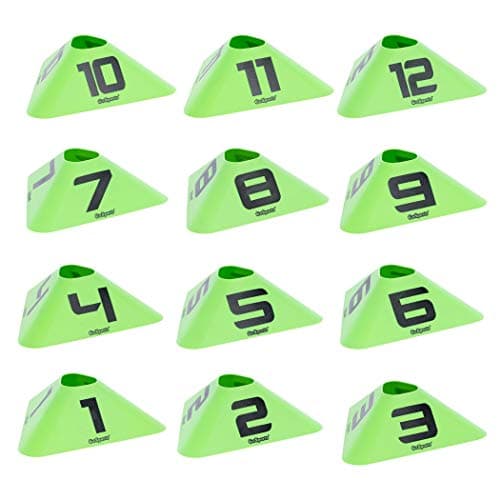 GoSports Modern Sports Cones (12, numbered 1-12) Twelve hard-plastic cones printed 1 through 12 in high-visibility green — the set that turns a grid into a reaction drill, because a called number is a decision and a called direction is not. | Reaction and decision drills you can run alone, and coaching kids without shouting directions | 7.2 | |
| 4 | 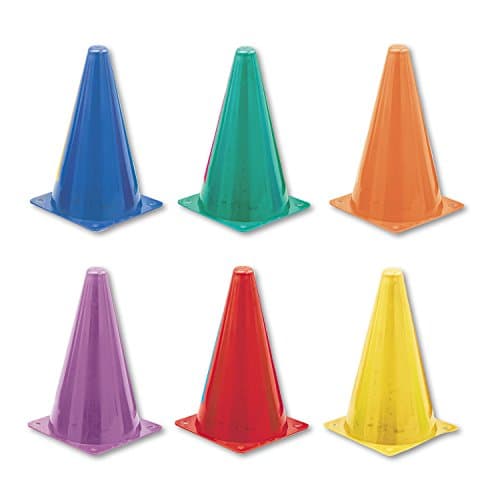 Champion Sports Field Marker Cones (9 in., set of 6) Six 9 in. cones in six different colors — the boundary and target markers, visible from the other end of a field, in the only set here where every cone is a different color. | Marking a course, a boundary or a turnaround point you need to see while sprinting at it | 7.6 | |
| 5 | 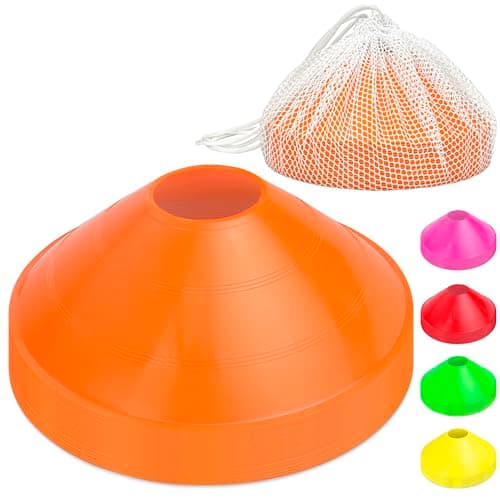 GoSports Agility Training Sport Cones (20 pack with tote) Twenty low-profile field markers and a tote for about the price of two coffees — the cheapest honest way to put a grid on a driveway, and the set to buy if cones are a thing you will lose. | A first set of markers, or replacing the ones that vanished into a hedge | 7.5 |
Scores are our editorial judgment from each maker's published specs and mounting instructions, weighted for a renter or small-space trainer.
Start with the drill, not the cone
Agility cones look like the most interchangeable product in home training, and in one sense they are: they are molded plastic, they cost a few dollars each, and no brand has a secret. But they are not interchangeable in use, because the cone is not the point of the drill — the cone is the thing that tells your feet where to be. A marker you sprint over does a completely different job from an obstacle you run around, and the two are physically incompatible. A 9 in. cone in the middle of a tight footwork grid is a trip hazard that will eventually catch a toe at full speed, and a 2 in. disc marking the far turn of a shuttle is invisible by the time you are looking for it.
So the question is not which cone is best. It is which of the three heights you need, and the honest answer for most people is two of them. That is why the lead pick on this page is a twenty-pack of low-profile markers rather than the most impressive cone: footwork is where most of the work happens, and twenty cheap flat markers lay out more drills than six tall ones.
If you came here because you already own an agility ladder and the cone bundle that came with it turned out to be four cones, you are in the right place — cones are the part of an agility setup that gets bought second, and the part that decides how many drills you can actually run.
The four criteria, in the order they matter
What happens when an athlete stands on it. Thirty percent of the score, and the only criterion that can hurt you. A cone inside a working grid gets stood on — not occasionally, routinely. There are three safe answers: be flat enough that a foot rolls over it (2 in. markers), be flexible enough to fold and spring back (vinyl cones), or be outside the grid entirely (tall markers). The unsafe answer is a rigid cone four to nine inches tall sitting where feet are moving fast. Rigid plastic also cracks when it is stood on cold, which turns a cone into sharp edges on a surface people are barefoot or in thin trainers on.
Height and visibility for the drill it is for. Twenty-five percent. This is the fit-for-purpose criterion and it cuts both ways: a tall cone scores badly inside a grid and well as a boundary, a flat marker the reverse. What raises a score here is being honest about the job and doing it completely — six distinct colors on a tall-marker set is genuinely more useful than six orange ones, because it lets you call a color instead of a position.
Durability on pavement and in the weather. Twenty-five percent. Cones live outdoors, get driven over, get left in a shed through a winter and get thrown into a bag wet. Polyethylene handles all of that. Flexible vinyl handles being stood on better but stiffens in real cold. Hard thin plastic is the one that cracks, and a printed number is the first thing to wear off.
Count, storage and value. Twenty percent, and the lowest weight on purpose, because almost every set here is cheap enough that price is not really the decision. What does matter is whether the set includes something to carry it in. Twenty loose cones in the bottom of a car boot become eleven cones in about a month, and a rack that holds them in a stack is worth more than the two dollars it adds.
The three heights, and what each one is for
| Height | What it is | The drills it runs | What it must never do |
|---|---|---|---|
| 2 in. markers | Flat discs or mini cones you can stand on | Footwork grids, shuttle lines, ladder substitutes, dot drills, boundary of a tiny space | Mark anything you need to see while sprinting toward it |
| 6 in. flexible cones | Soft vinyl that folds flat under a foot | Slalom gates, weaves, start/finish markers, anything you cut around inside the grid | Nothing — this is the safe compromise height, which is why it costs more |
| 9 in. field markers | Taller rigid or semi-rigid cones | Boundaries, turnaround points, target zones, keeping your head up | Sit inside a footwork grid |
Most home setups want twenty of the first and six of the third, and skip the middle one until a specific drill asks for gates. If you are buying one set and one set only, buy the markers: the drills you can run with twenty flat cones in a driveway outnumber the drills you can run with six tall ones by a wide margin.
How many cones do you actually need?
More than the four that come bundled with a ladder, and fewer than the fifty-packs sold to clubs. The useful counts are these. A 5-10-5 shuttle needs three markers. A T-drill needs four. A box drill needs four. A four-by-four footwork grid needs sixteen, which is why twenty is the standard pack size and not an arbitrary number. A slalom or weave needs six to eight, spaced one to two yards apart. Add a boundary and you want four more.
So: twenty markers runs every grid and shuttle drill you will do at home. Six tall cones adds boundaries and turnarounds. Twelve numbered cones turns the grid into a reaction drill. That is the whole category, for roughly the price of a single pair of training shoes, and it is the cheapest meaningful upgrade available to anyone training in a driveway.
Cones with poles: what the bundles are actually for
A large share of searches for agility cones are really searches for cones with poles — the sets where a cone has a socket in the top and a four-foot slalom pole drops into it. They are a different product with a different job, and they are worth understanding before you buy one by accident.
A pole raises the obstacle to roughly chest height, which stops you cutting through the gate with your upper body and forces a real change of direction rather than a lean. For soccer and basketball footwork that is a genuine training difference. The costs are real too: a pole set runs several times the price of a cone set, the poles need somewhere to live that is four feet long, and a rigid pole socketed into a rigid cone is the single most trip-prone object you can put on a training surface. The sets that are currently buyable are also mostly unbranded, with specs that are hard to verify before purchase.
Our read: buy cones first and add poles only if slalom work is the specific thing you are training. For general conditioning in a small space, the money is better spent on an agility ladder and twenty flat markers, and better still on the rope that gives you the same footwork quality inside a six-foot square.
Where cones fit in a week, and where they do not
Cone work is neural, not metabolic. The point is accelerating, decelerating and changing direction with control, and that quality disappears the moment you get tired — which means cone drills belong early in a session, fresh, in short bursts with real rest. Five to eight seconds of work and thirty to forty-five seconds of rest, eight to twelve reps, is a complete agility block. Running cone drills as conditioning, twenty minutes of shuttles until you are wrecked, trains something, but it is not agility and you would get more of it from a battle rope or a sled.
The other honest limit is surface. Cone drills need grip, and grip is what a cold driveway in January does not have. Change of direction on a slick surface is how knees and ankles get hurt, and no cone fixes that. If your only outdoor surface is unreliable for half the year, the indoor equivalent is the ladder on carpet or a rope on a mat, and the conditioning workouts page places both in a week.
The picks in detail
Every pick, reviewed
Key specs
- Count
- 20 — five each of yellow, black, white and orange
- Height
- 2 in.
- Included
- Carry rack; 100% polyethylene
Scores · editorial, out of 10
- What happens when an athlete stands on it
- 10
- Height & visibility for the drill it is for
- 7
- Durability on pavement and in the weather
- 9
- Count, storage & value
- 7
Pick 1 · Agility cones & markers
SKLZ Agility Cones (2 in., set of 20)
SKLZ
Twenty 2 in. polyethylene cones in four colors with a carry rack — the low-profile marker you can sprint over, cut around and stand on without a trip hazard or a broken cone.
Best for
Footwork, shuttle and change-of-direction work where you will step on a cone sooner or later
It wins because of a boring sentence on the maker's own trade listing: the cones will not break when stepped on. That is the whole category in one line. Twenty cones, two inches tall, five each of four colors, in 100% polyethylene with a carry rack — the rack being the part that means you still own twenty cones next year.
Four colors is the quiet advantage over every single-color 20-pack. It lets one person run a called-color reaction drill with a phone and a random number generator, which is the closest thing to a coach that training alone in a driveway offers. The trade-off is price: this costs roughly double a generic twenty-pack of the same count, and it is still only a little more than a takeaway.
Pros
- Two inches tall, so catching one with a foot at speed costs you nothing
- Four colors in one set — enough to run a called-color reaction drill without buying twice
- The maker's own trade listing states the cones will not break when stepped on
- Carry rack keeps twenty cones stacked in a shape that fits a gym bag
Cons
- Two inches is invisible from across a field — these mark footwork, not boundaries
- Rigid polyethylene cones skitter on a polished gym floor if you clip one hard
- Costs roughly twice a generic 20-pack of the same count
Specs from SKLZ (Implus) — Agility Cones trade listing (count, colors, 2 in. height, polyethylene, carry rack).
Key specs
- Height
- 6 in.
- Count
- 6, assorted colors
- Material
- Flexible vinyl
Scores · editorial, out of 10
- What happens when an athlete stands on it
- 9
- Height & visibility for the drill it is for
- 8
- Durability on pavement and in the weather
- 8
- Count, storage & value
- 5
Pick 2 · Agility cones & markers
Champion Sports 6 in. Flexible Vinyl Cone (set of 6)
Champion Sports
Six 6 in. flexible vinyl cones in assorted colors — tall enough to make a gate you have to go around, soft enough to fold flat when you clip one at a sprint.
Best for
Slalom gates, start and finish markers, and drills where you want the cone to be an obstacle
The one to buy for anything you cut around rather than over. Six inches of flexible vinyl is tall enough to be a real gate and soft enough that clipping it at a sprint folds the cone instead of your ankle, and that combination is the only honest way to put an obstacle inside a working grid.
Six cones is the limitation, and it is a real one — a slalom wants six to eight, so one set is exactly enough for one drill and not enough for two. It also costs about the same as twenty low-profile markers, which is the right trade when the drill needs gates and the wrong trade when it does not.
Pros
- Flexible vinyl folds under a foot and springs back instead of cracking
- Six inches is the compromise height — visible at distance, still safe to run over
- Assorted colors in one set, which a single-color 20-pack cannot do
Cons
- Six cones is a small grid; a shuttle course wants two sets
- Costs about the same as twenty low-profile markers
- Vinyl goes stiff in genuine cold and is slower to spring back
Specs from Champion Sports — 6 in. High Visibility Flexible Vinyl Cone, set of 6 listing (height, count, material).
Key specs
- Count
- 12, numbered 1 through 12
- Color
- High-visibility green
- Material
- Hard plastic; gym, turf or grass
Scores · editorial, out of 10
- What happens when an athlete stands on it
- 7
- Height & visibility for the drill it is for
- 8
- Durability on pavement and in the weather
- 6
- Count, storage & value
- 8
Pick 3 · Agility cones & markers
GoSports Modern Sports Cones (12, numbered 1-12)
GoSports
Twelve hard-plastic cones printed 1 through 12 in high-visibility green — the set that turns a grid into a reaction drill, because a called number is a decision and a called direction is not.
Best for
Reaction and decision drills you can run alone, and coaching kids without shouting directions
Numbers are a training feature, not a gimmick. A called direction is a path; a called number is a decision, and decisions are what agility training is supposed to load. Twelve cones printed 1 through 12 in high-visibility green gives one person, alone, a randomized reaction drill that otherwise needs a coach.
Two honest marks against it. GoSports does not publish a cone height for this set, so you are buying the profile on a photograph, and these are hard plastic rather than flexible vinyl — the one set on this page that can crack instead of folding. Keep them out of the path of a heel strike and they will last.
Pros
- Numbers let one person run a random-order drill from a phone timer
- Twelve numbered positions is a far richer grid than four colors
- High-visibility green reads against both grass and a wooden floor
Cons
- GoSports does not publish a cone height for this set either
- Hard plastic, so this is the one set here that can crack rather than fold
- Printed numbers wear off with repeated outdoor use
Specs from GoSports — Modern Sports Cones 12 Pack with Numbered Cones listing (count, numbering, color, surfaces).
Key specs
- Height
- 9 in.
- Count
- 6 — red, orange, yellow, green, blue, purple
- Use
- Boundary, gate and target marking
Scores · editorial, out of 10
- What happens when an athlete stands on it
- 5
- Height & visibility for the drill it is for
- 10
- Durability on pavement and in the weather
- 8
- Count, storage & value
- 8
Pick 4 · Agility cones & markers
Champion Sports Field Marker Cones (9 in., set of 6)
Champion Sports
Six 9 in. cones in six different colors — the boundary and target markers, visible from the other end of a field, in the only set here where every cone is a different color.
Best for
Marking a course, a boundary or a turnaround point you need to see while sprinting at it
Nine inches, six cones, six different colors, and the cheapest route to tall markers here. This is the boundary-and-turnaround set: cones you can read at distance while sprinting at them with your head up, which is exactly what a 2 in. disc cannot do.
It also carries the biggest caveat on the page, and it is the reason it sits at number four rather than number one. A rigid 9 in. cone is the trip hazard in this category. Put these on the outside of the working area — the far turn, the boundary, the target — and never inside a footwork grid.
Pros
- Nine inches is tall enough to read at distance with your head up
- Six distinct colors makes called-color drills possible out of one box
- Cheapest route to tall cones on this page
Cons
- Tall cones are the trip hazard on this page — do not put them inside a footwork grid
- Six cones only, and they nest rather than stack flat
- No carry rack or bag included
Specs from Champion Sports — Field Marker Cones 9 in., set of 6 listing (height, count, colors).
Key specs
- Count
- 20, with tote bag
- Profile
- Low-profile field marker
- Height
- Not published by the maker
Scores · editorial, out of 10
- What happens when an athlete stands on it
- 9
- Height & visibility for the drill it is for
- 5
- Durability on pavement and in the weather
- 6
- Count, storage & value
- 10
Pick 5 · Agility cones & markers
GoSports Agility Training Sport Cones (20 pack with tote)
GoSports
Twenty low-profile field markers and a tote for about the price of two coffees — the cheapest honest way to put a grid on a driveway, and the set to buy if cones are a thing you will lose.
Best for
A first set of markers, or replacing the ones that vanished into a hedge
The value pick, and genuinely the right answer for a specific buyer: someone who needs twenty markers today, trains in a park, and knows from experience that cones get lost. Twenty low-profile markers and a tote bag for a few dollars means replacing the set is not a decision.
It is last because of what is missing rather than what is wrong. GoSports does not publish a height or a material for this set, there is only one color so no reaction drills, and a tote lets cones tangle where a rack holds them in a stack. Everything the SKLZ set tells you about itself, this one does not.
Pros
- Cheapest set here by a wide margin — losing two is not a problem
- Tote bag rather than a rack, which packs flatter in a car
- Low profile, so the trip risk is as low as the SKLZ set
Cons
- GoSports does not publish a cone height or a material for this set, so you are buying on the picture
- One color only — no color-coded reaction drills
- A tote does not hold cones in a stack the way a rack does; they tangle
Specs from GoSports — Agility Training Sport Cone 20 Pack with Tote Bag listing (count, low-profile markers, tote).
Buying guide
What to buy, in one paragraph
Buy twenty low-profile markers and six tall cones. That is the answer for almost everyone, it costs less than forty dollars together, and it runs every drill in this article. Add flexible 6 in. cones only when a drill specifically asks for gates you cut through, and add numbered cones only if you train alone and want reaction work. Skip pole bundles until slalom work is the thing you are actually training.
How this list was built
Every set here was confirmed as a live, purchasable listing on 7 October 2026 before it was scored. Heights, counts, colors and materials come from the page named under each product; where a maker does not publish a figure — GoSports does not publish cone height on either of its sets — the entry says so instead of estimating it. Scores are editorial judgments built from those published specs against the rubric at the top of the page, weighted for someone training on a driveway or a patch of grass rather than a club buying for a full field. They are not measurements, and nothing here was lab tested. The methodology page sets out how the scoring works in full.
What wears out, in order
Printed numbers go first, then color fades on anything left in direct sun for a season, then hard plastic cracks — usually at the base, usually in cold weather, usually under a heel. Polyethylene markers and flexible vinyl essentially do not wear out; they get lost. That is why a carry rack or a tote is a real part of the purchase and not packaging.
Three mistakes that cost nothing to avoid
Buying one tall set and using it for everything. It is the single most common cone purchase and it puts rigid obstacles inside the footwork grid. Buying four cones. Almost every bundled cone set is four, almost every grid wants sixteen, and the gap is two coffees wide. Buying poles before cones. Poles make a good drill better and a missing drill no closer to existing.
FAQ
Questions readers ask
How many agility cones do I need?
Twenty flat markers covers every drill most people run at home: a shuttle needs three, a T-drill or box drill needs four, a four-by-four footwork grid needs sixteen, and a slalom needs six to eight. Add six tall cones for boundaries and turnaround points. The four cones bundled with an agility ladder are not enough for a grid.
What is the difference between disc cones and tall cones?
Height, and therefore job. Flat markers of about two inches are things you run over, so they go inside the working grid where feet are moving fast. Tall cones of about nine inches are things you see at distance, so they go on the outside as boundaries, turnarounds and targets. Putting a tall rigid cone inside a footwork grid is the one genuine mistake in this category.
What height agility cone should I buy?
Two inches for footwork and shuttles, six inches of flexible vinyl for gates you cut around, nine inches for boundaries and turnarounds. If you buy one height, buy two inches — flat markers run far more drills in a driveway than tall cones do.
Are agility cones worth it?
For change-of-direction work, yes, and they are the cheapest useful equipment in home training — twenty markers costs less than a month of a gym membership. What they will not do is replace conditioning. Cone drills are short, fast and neural; run them fresh, early in a session, and get your conditioning from a rope, a ladder or a sled.
Do I need agility cones with poles?
Only if slalom and weave work is specifically what you are training. A pole raises the obstacle to chest height, which stops you leaning through a gate and forces a real cut — a genuine training difference for soccer and basketball footwork. It also costs several times as much, needs four feet of storage, and is the most trip-prone object you can put on a training surface. Cones first.
Can you use agility cones indoors?
Flat markers, yes — on a hard floor or low carpet they sit still and give you dot drills and short shuttles in a hallway. Rigid cones skitter on polished floors when clipped, and tall cones indoors run into the same trip problem with less room to decelerate. For indoor footwork in a genuinely small space, a ladder on carpet or a jump rope on a mat gives you more per square foot.
What are agility cones made of?
Three materials. Polyethylene for low-profile markers, which is the one that survives being stood on and left outside. Flexible vinyl for mid-height cones, which folds under a foot and springs back but stiffens in real cold. Hard plastic for some numbered and tall sets, which is the one that cracks. Makers do not always publish the material — where they do not, this page says so.
Related
Keep reading
- Best agility ladders
The other half of a footwork setup, and the one that needs 15 to 20 feet.
- Conditioning workouts at home
Where short, fast cone work sits in a week.
- Best jump ropes
Footwork quality inside a six-foot square, for when the driveway is wet.
- Best plyo boxes for beginners
The other way to train deceleration without a field.
- Garage gym essentials
What else earns a place on the same slab.
Sources
- —SKLZ (Implus) — Agility Cones trade listing: 20 cones, five each yellow/black/white/orange, 2 in. tall, 100% polyethylene, carry rack, will not break when stepped on · b2b.implus.com
- —Champion Sports — 6 in. High Visibility Flexible Vinyl Cone, set of 6, assorted colors · amazon.com
- —Champion Sports — Field Marker Cones, 9 in. high, set of 6 in red, orange, yellow, green, blue and purple · amazon.com
- —GoSports — Modern Sports Cones, 12 pack numbered 1-12, high-visibility green hard plastic for gym, turf or grass · amazon.com
- —GoSports — Agility Training Sport Cone 20 Pack with Tote Bag, low-profile field markers · amazon.com