Guide · Conditioning
Sled push weight: how much to load, by what you want from it
Speed work is light and fast; conditioning is moderate and repeated; strength is heavy and short. Loads as a share of body weight for each, the surface correction that makes or breaks the number, and a first month.
Rope & Rep is reader-supported. Product links go through our affiliate resolver and we may earn a commission from qualifying purchases at no cost to you. Prices are the retailer's and change — every button opens the live price on Amazon rather than showing a stale number.
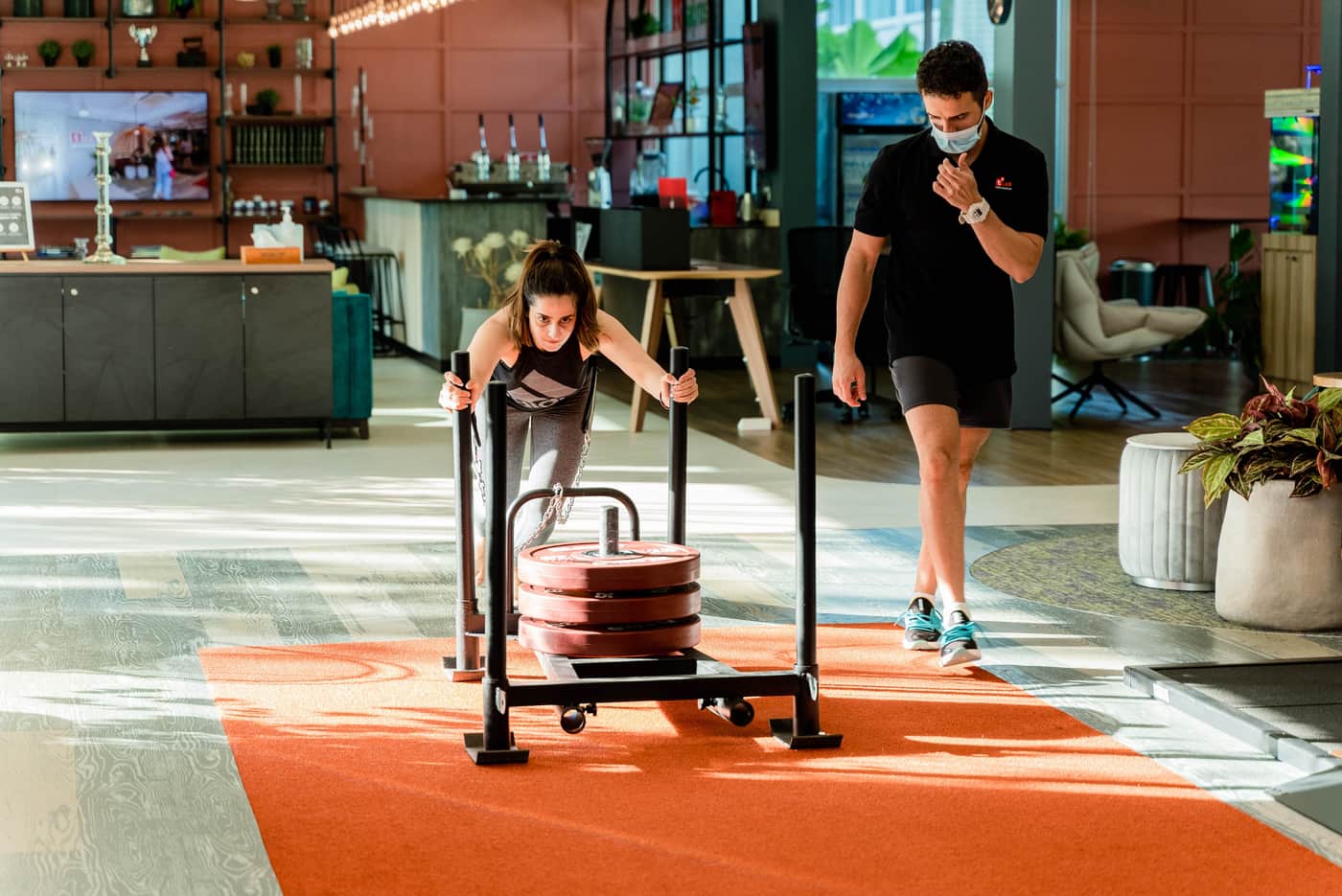
A woman pushing a weighted sled in a gym. Licensed stock photograph of the category — not the specific product.
The number depends on the surface
A sled's resistance is the load times the friction of the surface, so “how much weight” has no answer without “on what”. The percentages below are the ones sled coaches use on artificial turf, which is also roughly dry short grass. On rubber flooring or rough concrete, expect the same sled to feel close to twice as heavy; on wet grass, closer to half. Adjust by feel on the first push, not by the chart. Which surfaces work at all is in weight sled for concrete vs grass.
Load by goal
| Goal | Load | Distance | Rest | Rounds | Feel |
|---|---|---|---|---|---|
| Speed / acceleration | 10–20% BW | 10–20 yd | Full (2–3 min) | 6–8 | Fast — sprint form intact |
| Conditioning | 50–100% BW | 20–40 yd | 60–90 s | 6–10 | Hard, continuous drive |
| Strength | 150–300% BW | 10–20 yd | 2–4 min | 4–6 | A grind; steps, not strides |
| Recovery / warm-up | 25–50% BW | 20 yd | Walk back | 4 | Easy |
A 180 lb person on turf: speed pushes at about 20–35 lb total (the 29 lb Titan low-bar sled alone is a speed load); conditioning at 90–180 lb; strength at 270–540 lb. On rough concrete, halve every plate number.
Push, pull or drag
Low-bar push (hands on a bar near the ground) is the quad grinder — the heaviest loads. High-pole push (upright) is for sprint drives — moderate loads, fast. Harness drag (facing away, walking or sprinting) is speed and posterior chain — light loads. Backward drag (facing the sled, rope in hands) is knees and quads — light to moderate. The Titan low-bar sled does all four; the Yes4All is a drag sled only.
The magnetic-brake sled
The TANK has no plate post; its three brake levels make the resistance, and the resistance rises with speed. There is no weight to choose — pick the level, push as hard as you want, and the brake matches you. That is why it makes a 10-yard driveway work: the harder you push, the harder it pushes back.
A first month with a plate sled
| Week | Session | Load |
|---|---|---|
| 1 | 6 × 20 yd low-bar push, walk back | Sled + 25 lb |
| 2 | 8 × 20 yd low-bar push, walk back | Sled + 45 lb |
| 3 | 6 × 20 yd push + 6 × 20 yd backward drag | Push sled + 70 lb; drag sled + 25 lb |
| 4 | 4 × 15 yd heavy push (2 min rest) + 6 × 20 yd speed drag | Heavy: ~100% BW total; speed: sled + 10–25 lb |
Form on a heavy push
- Arms straight or locked at a fixed bend — the arms transmit, the legs push.
- Body at about 45°, hips low, spine long. Head neutral.
- Short, driving steps with the whole foot; don't bound.
- If the sled stops, reset your feet — don't shove with a rounded back.
Picks
Sleds this guide is written for
A plate sled for grass and turf, a drag sled for speed, and the magnetic sled where plates don't apply.
Key specs
- Size
- 36 × 24.5 × 11.25 in., 29 lb
- Loading
- Olympic/standard plates, 8 in. post
- Rated load
- 500 lb
Scores · editorial, out of 10
- Surface compatibility
- 6
- Footprint & storage
- 9
- Loading & handles
- 8
- Value
- 9
Pick 1 · Sleds
Titan Fitness Low Bar Push Pull Drag Sled (with harness)
Titan Fitness
A 29 lb steel sled, 36 × 24.5 in., with a 20.5 × 18 in. plate platform, a low push bar and a drag harness, rated 500 lb — the compact sled for a driveway or a strip of grass.
Best for
A first sled that pushes, pulls and drags and stores against a garage wall
Pros
- Low bar puts you in a drive position that hammers the quads; harness included for drags
- 29 lb — one person carries it to the driveway
- Takes Olympic or standard plates you may already own
Cons
- Bare steel runners chew up asphalt and scuff concrete; use it on grass, turf or a plywood strip
- Single low bar only — no upright handles for sprint pushes
Specs from Titan Fitness — Low Bar Push Pull Drag Sled (dimensions, weight, capacity, harness).
Key specs
- Loading
- 1 in. / 2 in. plates, up to 100 lb
- Harness
- Padded vest, 37–52 cm adjustable
- Surfaces
- Grass, carpet, concrete
Scores · editorial, out of 10
- Surface compatibility
- 8
- Footprint & storage
- 10
- Loading & handles
- 5
- Value
- 10
Pick 2 · Sleds
Yes4All Weighted Training Pull Sled with Vest
Yes4All
A speed-training drag sled: takes 1 in. or 2 in. plates to 100 lb, comes with a padded vest and steel buckle, and works on grass, carpet or concrete — the cheapest way to add a drag to a run.
Best for
Sprint drags and PFT run prep on grass with the plates you already have
Pros
- Vest and leash included — nothing else to buy for drags
- Small, light and cheap; stores on a hook
- 100 lb is plenty for speed work, which uses 10–20% of body weight
Cons
- Drag only — no push bar
- 100 lb cap rules out heavy strength pushes
Specs from Yes4All — Weighted Training Pull Sled with Vest listing (capacity, vest, surfaces).
Key specs
- Size
- 45.1 × 31.9 × 37.5 in., 67 lb
- Resistance
- Magnetic brake, 3 levels, speed-dependent
- Storage
- Wall-mountable
Scores · editorial, out of 10
- Surface compatibility
- 10
- Footprint & storage
- 8
- Loading & handles
- 8
- Value
- 4
Pick 3 · Sleds
Torque Fitness TANK M1 Push Sled
Torque Fitness
A wheeled sled with a three-level magnetic brake that resists more the faster you push, 45 × 32 × 37.5 in., 67 lb, nearly silent, and it won't mark a floor — the sled for a garage with no yard.
Best for
Sled work on a finished garage floor, a driveway or an apartment hallway
Pros
- Wheels, not skids — usable on concrete, rubber, asphalt and hard floors without damage
- Magnetic resistance rises with speed, so a short 10-yard push is still hard
- Bi-directional: push then pull without turning it around; wall-mount to store
Cons
- Several times the price of a plate sled
- No plate loading on the base model — resistance comes from the brake, not from weight
Specs from Torque Fitness — TANK M1 Push Sled (dimensions, weight, resistance system).
FAQ
Questions readers ask
What is a good sled push weight?
On turf: 10–20% of body weight for speed, 50–100% for conditioning, 150–300% for strength — sled included. On rough concrete, about half those plate loads.
How heavy should a sled be for beginners?
The sled plus 25–45 lb for 20-yard conditioning pushes on grass or turf, twice a week. Add 20–25 lb a week as it feels easy.
How far should you push a sled?
10–20 yards for speed and strength, 20–40 yards for conditioning. A driveway of 20 ft works for heavy pushes and for a magnetic-brake sled.
Does sled pushing build muscle?
Heavy pushes load the quads, glutes and calves hard with no eccentric — a strength and conditioning tool that leaves less soreness than squats. Light pushes are conditioning.
Related
Keep reading
- Best weight sleds
Plate, drag and magnetic sleds ranked.
- Weight sled for concrete vs grass
The surface correction.
- Conditioning workouts at home
Sled days in a weekly plan.
- Marine PFT prep plan
Sled drags for the three-mile run.
Sources