Best Medicine Ball · Conditioning
The best medicine balls, ranked by what you are allowed to throw them at
Medicine ball is a category name covering three different objects: a soft ball you catch, a firm ball that bounces, and a dead ball you slam. Buy the wrong one and you either split a shell or take a rebound in the face. Here is the sorting, then the picks.
Rope & Rep is reader-supported. Product links go through our affiliate resolver and we may earn a commission from qualifying purchases at no cost to you. Prices are the retailer's and change — every button opens the live price on Amazon rather than showing a stale number.
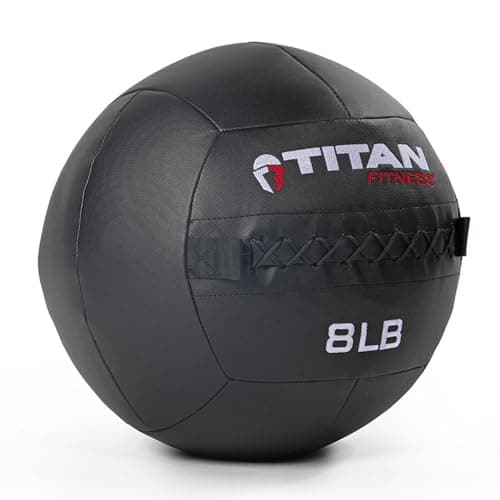
Titan Fitness Composite Wall Ball (6-30 lb, 13 in.). Licensed stock photograph of the category — not the specific product.
Quick picks
| # | Product | Best for | Score | Price |
|---|---|---|---|---|
| 1 | Titan Fitness Composite Wall Ball (6-30 lb, 13 in.) A 13 in. poly-composite wall ball with a non-slip laminate shell, PP fiberfill, double-stitched seams and two side grip loops - the soft ball that costs sensible money and is the easiest here to hold with wet hands. | Wall shots and throws in a garage, bought without paying competition-ball money | 9.0 | |
| 2 | 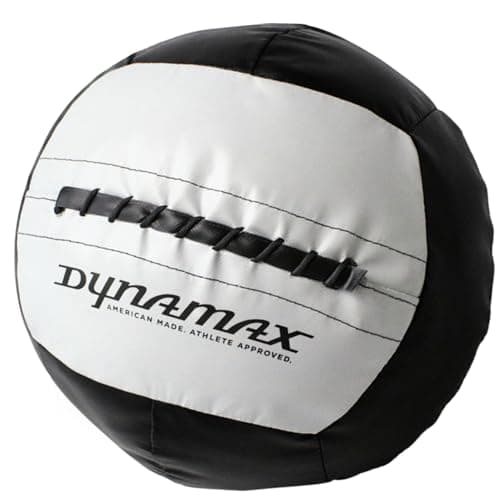 Dynamax Standard 14 in. Medicine Ball (4-30 lb) The original soft-shell med ball: 14 in. at all eleven weights from 4 to 30 lb, handmade in Austin from 70 percent post-consumer material, built to absorb rather than bounce. | Anyone who wants the ball the wall-shot movement was built around and will pay for it | 8.9 | |
| 3 | 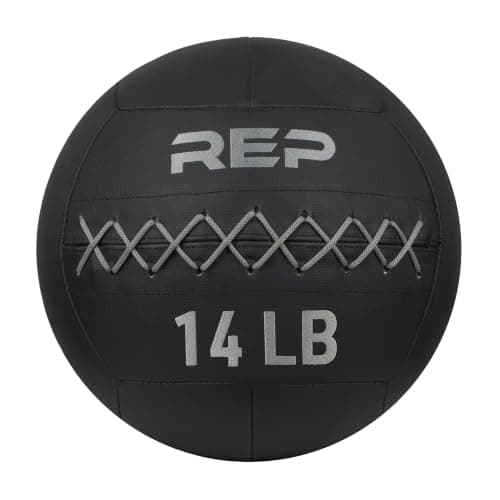 REP Fitness Medicine Ball (4-30 lb, 14 in.) A soft-shell 14 in. wall ball in ten weights from 4 to 30 lb, the same diameter at every weight — the ball for throws, wall shots and partner work, which REP says plainly is not for repeated floor slams. | Wall shots, overhead throws and partner work in a garage with a wall you can hit | 8.8 | |
| 4 | 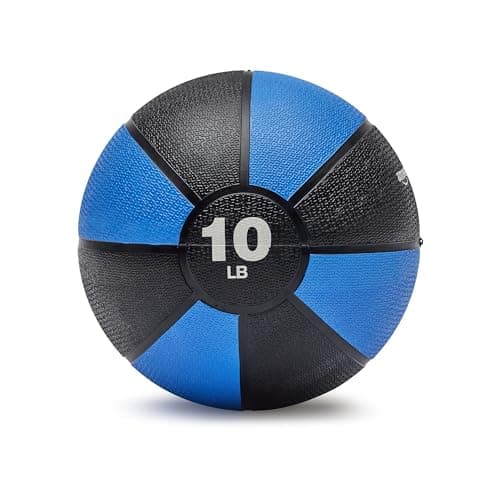 Amazon Basics Weighted Medicine Ball (10 lb, 9.3 in.) A firm rubber 9.3 in. ball with a lightly textured surface and the weight printed on both sides — the cheap bouncing medicine ball for throws against a hard surface, rebounds and twists. | Rebound throws, Russian twists and core work where you want the ball to come back | 7.2 |
Scores are our editorial judgment from each maker's published specs and mounting instructions, weighted for a renter or small-space trainer.
The three objects sold as “medicine balls”
This category is confusing because one name covers three products with different engineering goals, and marketplace listings mix the words freely. Sorting them is most of the buying decision.
The soft wall ball. A large, soft-shelled ball — typically 13 or 14 in. across — with a fiberfill or cotton interior designed to absorb impact and not rebound. Its job is the wall shot: squat, throw the ball up at a target, catch it on your chest, repeat. The size is the point, because you receive it with two hands and a forearm, and the softness is the point, because you receive it at all.
The firm rubber medicine ball. Smaller, usually 9 to 10 in., with a dense rubber shell and a lightly textured surface. It bounces off hard surfaces, which makes it the tool for rebound throws, chest passes, Russian twists and weighted core work. It is the cheapest thing in the category and the one you should not try to catch on your sternum.
The slam ball. Sand or iron-sand inside a thick rotomolded shell, dead bounce, built to be driven into concrete at full effort. It is a different product and it has its own roundup on this site. If what you want is to throw weight at the floor as hard as you can, you want that page, not this one. Our slam ball vs medicine ball comparison settles the two against each other if you are not sure which problem you have.
Everything ranked below is one of the first two. The reason the rankings look the way they do is that this page scores bounce behavior at 30 percent and grip with wet hands at 25 percent, ahead of weight range, shell durability and value — because those two decide whether the ball does the movement you bought it for.
The criteria, in the order they matter
1. Bounce behavior. What can you throw this at? A soft ball can go at a wall, a target, a partner or the ground, and it stays where it lands. A firm rubber ball can go at a wall or a slab and will come back, which is either the feature or the hazard depending on your ceiling. There is no ball that does both well.
2. Grip with wet hands. Underrated and decisive. Every medicine ball movement ends with the ball leaving your hands at speed, and the surface is all you have — most of these have no handle at all. A non-slip laminate with stitched side loops is meaningfully better than a smooth vinyl shell twenty minutes into a session.
3. Weight range offered. Two things here: whether the line covers the weight you will want in a year, and whether the diameter stays the same when you get there. A line running 4 to 30 lb at a constant 14 in. is a line you can progress inside.
4. Shell and seam durability. Soft balls fail at the seam, not the shell, which is why double stitching is worth looking for and why the published material matters less than the published stitching. Rubber balls fail by going slick rather than by splitting.
5. Value. Last, and genuinely last — the spread between the cheapest and the most expensive ball here is more than three to one for objects that do the same movement, and the expensive end is only worth it for specific reasons we have tried to name rather than imply.
How the four compare
| Ball | Bounce | Diameter | Weights | Grip |
|---|---|---|---|---|
| Titan composite wall ball | None - soft shell | 13 in. | 6-30 lb, plus sets | Non-slip laminate + two stitched loops |
| Dynamax Standard | None - built to absorb | 14 in. at every weight | 4-30 lb (11 sizes) | Smooth soft shell, no loops |
| REP Fitness medicine ball | None - sand filled, non-bounce | 14 in. at every weight | 4-30 lb (10 sizes) | Soft textured shell |
| Amazon Basics medicine ball | Yes - bounces off hard surfaces | 9.3 in. | 10 lb (line lists 4, 6, 12 lb) | Lightly textured firm rubber |
What a medicine ball actually gets you that nothing else does
One thing: a loaded movement you are allowed to accelerate all the way through and then catch. Almost every other loaded exercise in a home gym ends in deceleration — you have to stop the kettlebell, control the bar, land the jump. Throwing is the exception, and catching a 14 lb object on your chest and immediately redirecting it into another throw is a conditioning stimulus that a kettlebell and a rope do not replicate.
The second thing is that it is the cheapest full-body conditioning piece that works against a wall rather than a floor. For anyone who cannot slam — which is anyone with a neighbor underneath — this matters, and it is the main reason this page exists alongside the slam ball roundup. A wall shot into a block wall is loud in the room and almost silent through the structure; a slam into a suspended floor is the opposite.
What it will not do is replace strength work. A 20 lb ball is a 20 lb ball; the throw is the stimulus, not the load. Our conditioning workouts page places ball work alongside the rope and the bells rather than instead of them.
Where you can use one, honestly
A garage with a bare wall: ideal. Pick a spot without a window or a light fitting above your target height, mark the target with tape, and you have the whole wall-shot family.
A garage with a drywall-over-stud wall: be careful. Repeated 20 lb impacts in one spot will eventually dent drywall. Aim at a stud line, or hang a scrap of plywood as a target plate.
Outdoors against a fence post or a block wall: excellent, and it keeps the ball dry only if you take it back inside. Soft shells are moisture resistant, not waterproof.
An apartment: the soft ball, cautiously, and no bouncing ball at all. Floor throws are out; so is anything at a shared wall. What works upstairs is a soft ball used as a held load — squats, carries, rotations, sit-up passes — which is a real use and not the one you paid for. The apartment gym setup page is the honest answer for that space, and it does not start with a ball.
Which to buy
If you want one ball and a wall: buy the 13 in. composite wall ball in 14 or 20 lb. It has the best grip of anything here, it costs about half what the premium option does, and the inch it gives up on diameter is something you notice for a session and then stop noticing.
If you want the best soft ball and the price is acceptable: buy the 14 in. Dynamax. It is the ball the movement was designed around, it holds one diameter across eleven weights, and it is the one that will still be round in five years.
If you want the widest weight choice at a middle price: REP's line runs 4 to 30 lb in ten sizes at a constant 14 in., and REP states plainly on its own page that these are for throws and wall shots rather than repeated floor slams — which is the kind of honesty worth rewarding.
If you want rebound work, twists and passes rather than wall shots: buy the cheap 9.3 in. rubber ball and read the ceiling warning twice.
The picks in detail
Every pick, reviewed
Key specs
- Weights
- Seven from 6 to 30 lb; 6-14, 18-30 and 6-30 lb sets
- Diameter
- 13 in.
- Build
- Poly-composite laminate over PP fiberfill, double stitched, two grip loops
Scores · editorial, out of 10
- Bounce behavior (what you can throw it at)
- 9
- Grip with wet hands
- 10
- Weight range offered
- 9
- Shell & seam durability
- 8
- Value
- 8
Pick 1 · Medicine balls
Titan Fitness Composite Wall Ball (6-30 lb, 13 in.)
Titan Fitness
A 13 in. poly-composite wall ball with a non-slip laminate shell, PP fiberfill, double-stitched seams and two side grip loops - the soft ball that costs sensible money and is the easiest here to hold with wet hands.
Best for
Wall shots and throws in a garage, bought without paying competition-ball money
First because it wins the criterion this page weights second-heaviest and nothing else here even competes on: grip. Titan publishes a non-slip poly-composite laminate shell with two stitched side loops, and twenty minutes into a set of wall shots with sweaty hands, a loop you can hook a finger through is the difference between throwing the ball and dropping it on your own foot.
The rest of the spec sheet is unusually complete for this price: PP fiberfill interior, tight double stitching on the seam that is the normal failure point, seven weights from 6 to 30 lb plus matched sets, and a one-year warranty from a brand that publishes a product page rather than a marketplace listing. The 8 lb is the weight stocked on Amazon when we checked on 20 October 2026; on Titan's own store the 10 lb was on backorder.
Two honest marks against it. It is 13 in., not the 14 in. that the wall-ball standard and every other soft ball here uses — one inch sounds trivial and is noticeable on the catch for the first session or two, and it means the ball is not interchangeable with a gym's. And Titan publishes materials and stitching but no tested load or drop rating, so durability here is an inference from the construction rather than a number.
Pros
- Two stitched side loops - the only ball here with a deliberate grip, which matters on a sweaty overhead throw
- Non-slip laminate rather than smooth vinyl, and tight double stitching on the seam that normally fails first
- Seven weights from 6 to 30 lb plus matched sets, and a one-year warranty from a brand with a spec page
Cons
- 13 in., not the 14 in. the CrossFit-standard wall balls use - a one-inch difference you feel on the catch
- Soft shell means no rebound, so this is useless for the bouncing-ball exercises
- Titan does not publish a tested load or a drop rating, only the materials and the stitching
Key specs
- Weights
- 4-30 lb (11 sizes)
- Diameter
- 14 in. at every weight
- Build
- Soft shell, evenly distributed filler, moisture resistant; 70% post-consumer material
Scores · editorial, out of 10
- Bounce behavior (what you can throw it at)
- 10
- Grip with wet hands
- 8
- Weight range offered
- 10
- Shell & seam durability
- 10
- Value
- 4
Pick 2 · Medicine balls
Dynamax Standard 14 in. Medicine Ball (4-30 lb)
Dynamax
The original soft-shell med ball: 14 in. at all eleven weights from 4 to 30 lb, handmade in Austin from 70 percent post-consumer material, built to absorb rather than bounce.
Best for
Anyone who wants the ball the wall-shot movement was built around and will pay for it
The best ball on the page, second because of what it costs. Dynamax is the original soft-shell medicine ball and still the reference: 14 in. at all eleven weights from 4 to 30 lb, a shell engineered to absorb impact rather than return it, evenly distributed filler so it holds its shape and balance, and handmade in Austin, Texas from 70 percent post-consumer material.
The constant diameter across eleven weights is the feature that justifies the price if anything does. The catch, the throw and the overhead position are identical at 4 lb and at 30 lb, so progressing is a number rather than relearning the movement — and with eleven weights, the progression is actually available.
The case against is straightforward. It is by far the most expensive ball here and the per-pound cost is worst at the light end, which is exactly where a beginner buys. There are no grip loops and the shell is smooth, so it is held by squeezing. And a 14 in. soft ball stores like a basketball you cannot deflate — fine in a garage, awkward in a closet.
Pros
- Eleven weights at one constant 14 in. diameter - progressing is a number, never a new technique
- Designed to absorb impact without bouncing, which is what makes a caught throw safe
- Handmade in the USA with published recycled content, and the reference ball in most gyms that own one
Cons
- By far the most expensive ball here, and the per-pound cost is worse at the light end
- No grip loops and a smooth soft shell - it is held by squeezing, not by a handle
- Soft shell plus 14 in. means it stores like a basketball you cannot deflate
Key specs
- Weights
- 4-30 lb (10 sizes)
- Diameter
- 14 in. at every weight
- Intended use
- Throws, wall shots, partner work — not repeated floor slams
Scores · editorial, out of 10
- Bounce behavior (what you can throw it at)
- 9
- Grip with wet hands
- 9
- Weight range offered
- 10
- Shell & seam durability
- 8
- Value
- 6
Pick 3 · Medicine balls
REP Fitness Medicine Ball (4-30 lb, 14 in.)
REP Fitness
A soft-shell 14 in. wall ball in ten weights from 4 to 30 lb, the same diameter at every weight — the ball for throws, wall shots and partner work, which REP says plainly is not for repeated floor slams.
Best for
Wall shots, overhead throws and partner work in a garage with a wall you can hit
Third, and the one to buy if the weight you want is oddly specific. REP's line runs 4 to 30 lb in ten sizes at a constant 14 in., sand filled and non-bouncing, which means it sits between the composite ball and the Dynamax on both price and range.
What earns it a place is that REP states on its own product page that these balls are for throws, wall shots and partner work and not for repeated floor slams. A maker telling you in writing what its product is not for is rarer than it should be, and it is the single most useful sentence in this category — it is the reason our slam ball vs medicine ball page can be definite rather than hedged.
It is third rather than higher for two reasons. The shell is soft textured but has no grip loops, so it loses to the Titan on the wet-hands criterion. And it costs noticeably more per pound than any slam ball on this site, which is worth saying out loud to anyone who arrived here wanting something to throw at a floor: you are paying for the catch, and if you never catch it, you are paying for nothing.
Pros
- Constant 14 in. diameter means the catch and the throw feel identical as you move up in weight
- Soft shell is the only thing on either side of this comparison you can safely catch on the chest
- Ten weights from 4 lb, so a beginner and a strong adult buy from the same line
Cons
- REP says outright this is not a floor-slam ball — slam it and you are outside its intended use
- Costs more per pound than any slam ball on the site
- 14 in. is a big object to store; it does not tuck under a shelf like a 9 in. ball
Specs from REP Fitness — Medicine Balls collection (weights, 14 in. diameter, stated intended use).
Key specs
- Weight
- 10 lb (the line also lists 4, 6 and 12 lb)
- Diameter
- 9.3 in.
- Shell
- Firm, lightly textured rubber — bounces off hard surfaces
Scores · editorial, out of 10
- Bounce behavior (what you can throw it at)
- 8
- Grip with wet hands
- 6
- Weight range offered
- 6
- Shell & seam durability
- 7
- Value
- 10
Pick 4 · Medicine balls
Amazon Basics Weighted Medicine Ball (10 lb, 9.3 in.)
Amazon Basics
A firm rubber 9.3 in. ball with a lightly textured surface and the weight printed on both sides — the cheap bouncing medicine ball for throws against a hard surface, rebounds and twists.
Best for
Rebound throws, Russian twists and core work where you want the ball to come back
Last on this page and first for a different job. This is a firm 9.3 in. rubber ball with a lightly textured surface that bounces, and that single property makes it the only ball here you can use for rebound throws, chest passes against a hard surface, Russian twists and weighted sit-up passes. The weight is printed on both faces, which stops a shared set getting mixed up.
It is also the cheapest thing in the category by a wide margin, and for core work with a partner it is genuinely all you need.
The reasons it ranks last against this page's criteria are real. A bouncing ball indoors with a low ceiling or a window in range is the one genuine hazard in this roundup — it comes back, and it comes back fast. Lightly textured rubber goes slick with sweat faster than a laminate or a soft shell. And the listed weight is 10 lb with a line that stops around 12 lb, so there is nowhere to progress to. Buy it for rebound and core work, not as your wall ball.
Pros
- It bounces, which is the entire point for rebound throws against a wall or a concrete floor
- 9.3 in. is a one-hand-friendly size for twists and passes
- Weight printed on both faces, so a shared set never gets mixed up
Cons
- A bouncing ball is dangerous indoors with a low ceiling or a window in range
- Lightly textured rubber gets slick with sweat faster than a tread or a soft shell
- Fixed 10 lb, and the line stops well below slam-ball weights
Specs from Amazon Basics — Weighted Medicine Ball 10 lb listing (weight, 9.3 in. diameter, rubber shell, bounce).
Buying guide
What to buy, in one paragraph
One ball, a wall, sensible money: the 13 in. Titan composite wall ball at 14 lb (or 20 lb if you already train). The best version of the same thing, at roughly double: the 14 in. Dynamax. A specific weight in a ten size range at a middle price: REP. Rebound throws, twists and partner core work rather than wall shots: the cheap 9.3 in. rubber ball. Throwing weight at a concrete floor as hard as you can: none of these — read the slam ball roundup instead.
How this list was built
Every ball here was a live, purchasable listing re-verified on 14 October 2026 before it was scored. Diameters, weight ranges, shell and fill materials, stitching and warranties come from the page named under each product; where a maker publishes no tested load or drop rating — which is all four of them — the entry says so rather than implying a figure. Scores are editorial judgments from those published specs against the medicine ball rubric, weighted for a garage with a wall and a buyer who has to store the thing. Nothing on this page was lab tested or hands-on tested; the methodology page sets out exactly what the scores are and are not.
What goes wrong with a first medicine ball
In order of how often it happens. The buyer wanted a slam ball. They bought a soft wall ball, threw it at a concrete floor for a month and split the seam, outside the use the maker publishes. The ball was too heavy. A 20 lb ball turns a continuous conditioning movement into a set of slow singles. There was no wall. A soft wall ball with nothing to throw at becomes a held-load object, which is a $70 answer to a question a sandbag answers better. The bouncing ball was used indoors. That one usually ends with a lamp.
Two things not worth paying for
A four-figure capacity or “pro” grade claim. Nobody in this category publishes a tested drop figure, including the expensive end, so a big number on a cheap listing is marketing rather than data. What you can actually check is the stitching and the shell material. Dual-grip handles on a throwing ball. Handles are useful on a ball you swing and hold; on a ball you release and catch they are something to land on. If grip is your concern, stitched side loops on a soft shell are the version that helps.
Wall ball, medicine ball, slam ball: the one-line version
A wall ball is a big soft medicine ball you throw at a wall and catch. A medicine ball is the whole family, including small firm ones that bounce. A slam ball is a dead-bounce sand-filled ball built to be destroyed on concrete, and it is the only one of the three you should never try to catch.
FAQ
Questions readers ask
What weight medicine ball should I buy?
For a first soft wall ball in a home gym, 14 lb for most men and 10 lb for most women, which is a step below the 20 and 14 lb competition prescriptions. The point of a wall shot is that it is continuous, and a ball heavy enough to break your rhythm on rep eight has stopped being a conditioning movement. For a firm rubber ball used for twists and passes, 8 to 10 lb covers almost everyone.
What is the difference between a wall ball and a medicine ball?
A wall ball is a type of medicine ball: large (13 or 14 in.), soft shelled, and built to absorb impact so you can catch it on your chest after throwing it at a wall. “Medicine ball” is the family name and also covers small firm rubber balls that bounce off hard surfaces. If a listing says 14 in. and soft, it is a wall ball; if it says 9 in. and rubber, it is not.
Can you slam a medicine ball?
Not repeatedly, and at least one maker says so in writing — REP states on its own product page that its medicine balls are for throws, wall shots and partner work rather than repeated floor slams. A soft shell driven into concrete over and over fails at the seam, and that failure is outside the published use, so it is on you rather than on the warranty. For slamming, buy a sand-filled slam ball.
Do medicine balls bounce?
It depends entirely on which one. Soft-shelled wall balls are built specifically not to bounce, so that a thrown ball can be caught and a dropped ball stays put. Firm rubber medicine balls do bounce, which is the feature for rebound throws against a wall or a slab — and the hazard in a low-ceilinged room. Check this spec before anything else.
Is 13 inch or 14 inch better for a wall ball?
14 in. is the standard, so it is the size a gym will have and the size every programmed workout assumes. 13 in. catches very slightly differently and is typically cheaper; after a session or two you stop noticing. Buy 14 in. if you train anywhere else as well, and take the 13 in. if the price gap is meaningful to you.
Can you use a medicine ball in an apartment?
A soft one, carefully, and not for what you bought it for. Throws and floor work are out if somebody lives below you, and so is anything aimed at a shared wall. A soft ball still works as a held load for squats, carries, rotations and sit-up passes. A bouncing rubber ball indoors is a bad idea in any apartment. The apartment gym setup page covers what actually survives a shared floor.
Do I need a medicine ball if I already have a slam ball?
Only if you want the catch. A slam ball does loaded carries, dead-weight squats and rotational slams perfectly well and is terrible at anything you receive. If you have a wall you are allowed to hit, adding a soft ball buys you the whole wall-shot family, which is a continuous full-body movement that slamming does not give you. Our slam ball vs medicine ball comparison works through the overlap.
What should I throw a wall ball at?
A bare block or concrete wall is ideal. Drywall over studs will eventually dent under repeated 20 lb impacts, so aim at a stud line or hang a scrap of plywood as a target plate. Mark the target height with tape — nine to ten feet is the usual prescription — and check there is no window or light fitting above it. Outdoors, a fence post or a block wall works, but take the ball back inside: soft shells are moisture resistant, not waterproof.
Related
Keep reading
- Slam ball vs medicine ball
Dead bounce against a ball built to be caught.
- Best slam balls
The page for throwing weight at a floor.
- Conditioning workouts at home
Where ball work sits in a real week.
- Best sandbags for training
The other cheap, awkward, full-body load.
- Garage gym essentials
What competes for the same slab.
Sources
- —Titan Fitness — Composite Wall Ball product page (6-30 lb and set options, 13 in. diameter, poly-composite laminate shell, PP fiberfill interior, tight double stitching, two grip loops, one-year warranty, in stock 14 October 2026) · titan.fitness
- —Power Systems — Dynamax Standard 14 in. Medicine Ball product page (11 weights from 4 to 30 lb, constant 14 in. diameter, soft shell designed to absorb rather than bounce, 70% post-consumer material, handmade in Austin, Texas) · powersystems.com
- —REP Fitness — Medicine Balls collection page (4-30 lb in ten sizes, 14 in. at every weight, stated as for throws, wall shots and partner work and not for repeated floor slams) · repfitness.com
- —Amazon Basics — Weighted Medicine Ball 10 lb listing (10 lb, 9.3 in. diameter, firm lightly textured rubber shell that bounces off hard surfaces, weight printed on both faces) · amazon.com
- —Titan Fitness - Composite Wall Ball product page (6-30 lb and set options, 13 in. diameter, poly-composite laminate shell, PP fiberfill, double stitching, two grip loops, one-year warranty) · titan.fitness