Comparison · Conditioning
Slam ball vs medicine ball: one is built to be thrown down, the other to be thrown at something
They look like the same object and they are not. A slam ball has a dead bounce and a thick shell so you can drive it into concrete. A medicine ball is sized and surfaced to be caught, thrown and bounced back. Buying one for the other job is how a ball splits or a ceiling gets hit.
Rope & Rep is reader-supported. Product links go through our affiliate resolver and we may earn a commission from qualifying purchases at no cost to you. Prices are the retailer's and change — every button opens the live price on Amazon rather than showing a stale number.
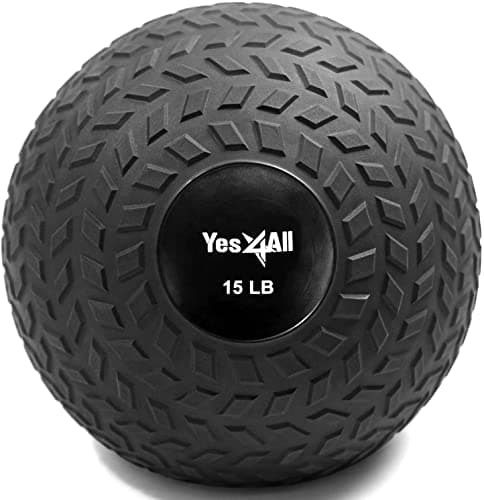
Yes4All Slam Ball (10–40 lb, 9.7 in.). Licensed stock photograph of the category — not the specific product.
The actual difference is bounce, and everything else follows from it
Strip away the marketing and there is one engineering decision separating these two products: whether the ball is designed to return energy or absorb it.
A slam ball is built to absorb. The fill is sand or iron sand, which has almost no elastic rebound, inside a thick rotomolded PVC or rubber shell. Throw it at a concrete floor from overhead and it lands with a dull thud and stops. That dead bounce is the entire reason the product exists: it means you can put maximum effort into every rep without the ball coming back at your face, and without chasing it across a garage between reps. The thick shell is there because the ball's whole life is high-speed impacts with concrete.
A medicine ball is built to be handled. Some return energy and some do not, and that split matters enormously — a soft-shell wall ball absorbs so you can catch it on your chest, a firm rubber medicine ball rebounds so you can throw it at a wall and get it back. What both have in common is that they are designed around the catch. That means a bigger diameter you can wrap two hands and a forearm around, a surface that stays in a sweaty hand, and a shell that does not need to survive repeated concrete impacts because it is not supposed to take them.
This is not a subtle distinction in practice. REP Fitness says so explicitly on its own medicine ball page: the balls are for throws, wall shots and partner work, not for repeated floor slams. That is a maker telling you, in writing, that the two products are not interchangeable.
Side by side
| Slam ball | Medicine ball | |
|---|---|---|
| Bounce | Dead — sand or iron-sand fill, essentially no rebound | Varies by design: soft wall balls absorb, firm rubber balls bounce off hard surfaces |
| Typical diameter | About 9 to 10 in. across the whole weight range | 9.3 in. for a firm rubber ball; 14 in. at every weight for a soft wall ball |
| Shell | Thick rotomolded PVC or rubber, built for concrete impact | Soft shell for wall balls, firm textured rubber for bouncing balls |
| Weight range | 5 to 70 lb on the widest line here; 150 lb exists | 4 to 30 lb on the soft line; small bouncing balls run roughly 4 to 12 lb |
| Primary job | Overhead slams, floor-direction power, loaded carries, rotational slams | Wall shots, overhead and rotational throws, rebound work, partner passing |
| What it needs | A floor you are allowed to destroy | A wall you are allowed to hit, or a partner |
| Apartment-friendly | No, and not with a mat either | A soft wall ball, cautiously; a bouncing ball, no |
| Price | Lowest cost per pound in this comparison | The soft wall balls cost more per pound than any slam ball on the site |
What a slam ball does that a medicine ball cannot
The overhead slam itself, mostly — a full triple extension followed by driving a weight into the floor as hard as you can, with nothing to decelerate. There are very few movements in home training where you are allowed to accelerate all the way through without braking, and almost all of them involve throwing something you are not going to catch. That makes the slam genuinely different from a swing or a jump, both of which end in deceleration.
The second thing is that it is the cheapest way to own something heavy and hand-sized. A 20 or 30 lb ball with a grippy tread doubles as a loaded carry object, a dead-weight squat load, a rotational slam implement and a step-up weight, and it does all of that at a lower cost per pound than anything else in the category. If nobody lives below you, a single slam ball is one of the better value purchases in a garage gym — and it sits alongside a sandbag rather than replacing one, because the sandbag gives you a shifting load and handles while the ball gives you something to destroy.
What a slam ball is bad at is anything requiring a catch. A sub-10-inch dense ball caught on the chest is an unpleasant and slightly risky object, and the thick shell that makes it survive concrete also makes it hard to hold at the top of a throw.
What a medicine ball does that a slam ball cannot
Everything that ends in a catch. A 14 in. soft-shell wall ball is the only thing in this comparison you can throw at a wall, receive on your chest, and immediately throw again — which is the whole wall-shot family, a genuine full-body conditioning movement, and the one that makes a medicine ball worth its higher price if you have a wall. The constant 14 in. diameter across the weight range on the REP line is a real feature here: the catch and the throw feel identical as you move up in weight, so progressing is just a number rather than a new skill.
A firm rubber bouncing ball does a different job again — rebound throws against a hard surface, chest passes, Russian twists, weighted sit-ups with a partner. The 9.3 in. size is the point: small enough for one hand, heavy enough to matter, and it comes back. That is excellent outdoors or in a garage with a blank wall, and actively dangerous in a low-ceilinged room with a window in range.
The honest limitation of the medicine ball side is the surface requirement. A soft wall ball with no wall is a very expensive floor ball, and a bouncing ball with nothing safe to bounce off is a paperweight. Check what you are allowed to throw at before you buy either.
Which to buy first
For most people reading this site — a garage corner, a concrete slab, training alone — the slam ball is the first purchase. It is cheaper, it needs no wall and no partner, and its one real requirement (a floor you can abuse) is the requirement a garage already satisfies. Buy one in the 15 to 25 lb range if you are new to it; that is heavy enough to be a real power movement and light enough that your technique does not fall apart on rep eight.
Buy the medicine ball first instead if you have a wall you are allowed to hit — a bare garage wall, a block wall, a fence post — or a training partner. Wall shots are a better conditioning movement than slams for most people, because they are continuous rather than single-effort, and they load the catch as well as the throw.
If you live above someone, buy neither and read the apartment setup page instead. The power work that actually survives a shared floor is rope skipping on a mat, kettlebell swings set down rather than dropped, and band work — the conditioning workouts page builds a week out of exactly those.
Can you own one ball and do both?
Partly, in one direction only. A slam ball will do loaded carries, dead-weight squats and rotational slams perfectly well, and it will do a bad job of anything you catch. A medicine ball will do throws, catches and rebound work, and if you slam it repeatedly into a floor you are outside the use its maker publishes — REP says so on its own product page, which means a split shell is on you rather than on the warranty.
So if you are buying one object: buy the slam ball and accept that catching work is off the menu. If you want both jobs properly, the two together cost less than a single plyo box and take up the same floor space as one kettlebell. Our slam ball roundup ranks the shells on the one spec that decides a slam ball's life — whether the seam is glued or rotomolded — and garage gym essentials puts both against everything else competing for the same slab.
Picks
The gear on both sides of this comparison
Two slam balls — the cheapest seamless shell and the widest weight range — and two medicine balls: a 14 in. soft wall ball for throws, and a cheap bouncing rubber ball for rebound work.
Key specs
- Weights
- 10 / 15 / 20 / 25 / 30 / 40 lb
- Diameter
- 9.7 in. at 15 lb
- Shell
- Seamless rotomolded PVC, iron-sand fill
Scores · editorial, out of 10
- Shell & seam durability
- 8
- Weight range offered
- 7
- Floor manners (dead bounce, diameter)
- 9
- Grip with wet hands
- 9
- Value
- 10
Pick 1 · Slam balls
Yes4All Slam Ball (10–40 lb, 9.7 in.)
Yes4All
A rotationally molded, seamless PVC shell filled with iron sand, about 9.7 in. across, in weights from 10 to 40 lb — the cheapest ball here with no glued seam to split.
Best for
A first slam ball, and the one most people should buy two of
Pros
- Rotomolded seamless shell — there is no glued seam, which is where cheap balls fail first
- Iron sand rather than ordinary sand, so it neither bounces back nor rolls away after a slam
- Grooved tread and triangle grip patterns hold on with wet hands
Cons
- Stops at 40 lb, so a strong adult will run out of range
- A sub-10 in. shell across the line means the 40 lb ball is dense and awkward to catch
- PVC stiffens in an unheated garage over winter and scuffs quickly on rough concrete
Specs from Yes4All — Sand-Filled Slam Ball listing (weight options, measured diameter, PVC shell, sand fill).
Key specs
- Weights
- 5–70 lb (12 sizes)
- Shell
- Sand-filled rubber, little to no bounce
- Warranty
- 1 year home / 6 months commercial
Scores · editorial, out of 10
- Shell & seam durability
- 9
- Weight range offered
- 10
- Floor manners (dead bounce, diameter)
- 9
- Grip with wet hands
- 9
- Value
- 6
Pick 2 · Slam balls
REP Fitness Slam Ball (5–70 lb)
REP Fitness
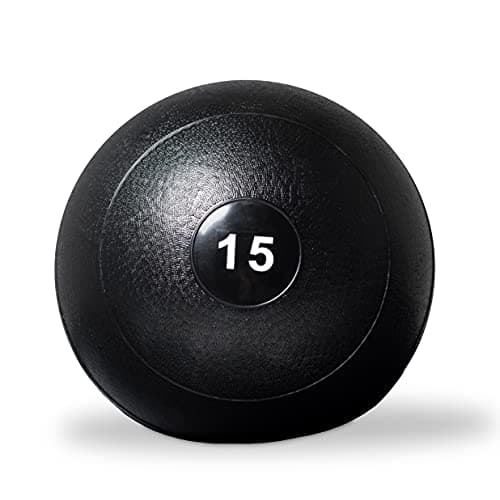
A sand-filled rubber-shelled ball in twelve weights from 5 to 70 lb with a stated 1-year home warranty — the widest range on this page and the shell least likely to give up on a concrete floor.
Best for
Buying one ball you will not outgrow, and slamming it on bare concrete
Pros
- Twelve weights from 5 to 70 lb — the only line here that covers a nervous beginner and a strong adult
- Rubber shell handles concrete and outdoor slabs better than the PVC balls
- A stated home-use warranty, which almost nothing in this category offers
Cons
- Costs more per pound than any PVC ball on this page
- Sold one weight at a time, so a light-and-heavy pair is two full-price purchases
- REP ships from its own warehouse and lists estimated ship dates rather than guaranteed ones, so a heavy size can take a while
Specs from REP Fitness — Slam Balls collection (weight range, sand-filled rubber shell, warranty terms).
Key specs
- Weights
- 4-30 lb (10 sizes)
- Diameter
- 14 in. at every weight
- Intended use
- Throws, wall shots, partner work — not repeated floor slams
Scores · editorial, out of 10
- Bounce behavior (what you can throw it at)
- 9
- Grip with wet hands
- 9
- Weight range offered
- 10
- Shell & seam durability
- 8
- Value
- 6
Pick 3 · Medicine balls
REP Fitness Medicine Ball (4-30 lb, 14 in.)
REP Fitness
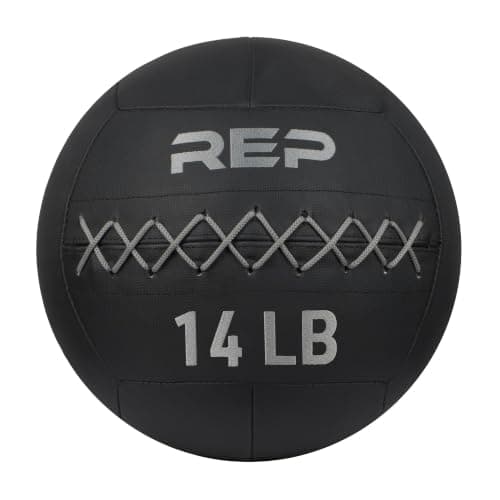
A soft-shell 14 in. wall ball in ten weights from 4 to 30 lb, the same diameter at every weight — the ball for throws, wall shots and partner work, which REP says plainly is not for repeated floor slams.
Best for
Wall shots, overhead throws and partner work in a garage with a wall you can hit
Pros
- Constant 14 in. diameter means the catch and the throw feel identical as you move up in weight
- Soft shell is the only thing on either side of this comparison you can safely catch on the chest
- Ten weights from 4 lb, so a beginner and a strong adult buy from the same line
Cons
- REP says outright this is not a floor-slam ball — slam it and you are outside its intended use
- Costs more per pound than any slam ball on the site
- 14 in. is a big object to store; it does not tuck under a shelf like a 9 in. ball
Specs from REP Fitness — Medicine Balls collection (weights, 14 in. diameter, stated intended use).
Key specs
- Weight
- 10 lb (the line also lists 4, 6 and 12 lb)
- Diameter
- 9.3 in.
- Shell
- Firm, lightly textured rubber — bounces off hard surfaces
Scores · editorial, out of 10
- Bounce behavior (what you can throw it at)
- 8
- Grip with wet hands
- 6
- Weight range offered
- 6
- Shell & seam durability
- 7
- Value
- 10
Pick 4 · Medicine balls
Amazon Basics Weighted Medicine Ball (10 lb, 9.3 in.)
Amazon Basics
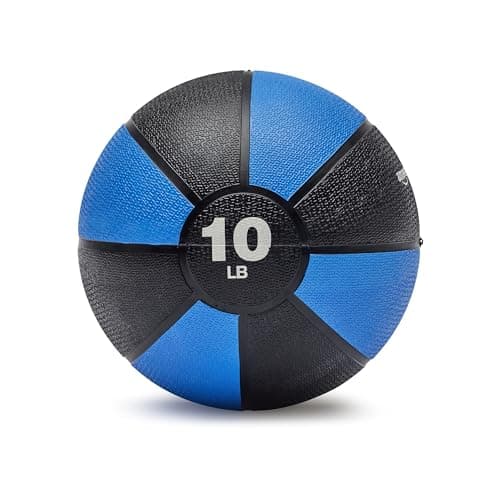
A firm rubber 9.3 in. ball with a lightly textured surface and the weight printed on both sides — the cheap bouncing medicine ball for throws against a hard surface, rebounds and twists.
Best for
Rebound throws, Russian twists and core work where you want the ball to come back
Pros
- It bounces, which is the entire point for rebound throws against a wall or a concrete floor
- 9.3 in. is a one-hand-friendly size for twists and passes
- Weight printed on both faces, so a shared set never gets mixed up
Cons
- A bouncing ball is dangerous indoors with a low ceiling or a window in range
- Lightly textured rubber gets slick with sweat faster than a tread or a soft shell
- Fixed 10 lb, and the line stops well below slam-ball weights
Specs from Amazon Basics — Weighted Medicine Ball 10 lb listing (weight, 9.3 in. diameter, rubber shell, bounce).
FAQ
Questions readers ask
What is the difference between a slam ball and a medicine ball?
Bounce, and everything that follows from it. A slam ball is sand or iron-sand filled inside a thick rotomolded shell, so it lands dead and stays put — built to be thrown into a floor at full effort. A medicine ball is built around the catch: bigger diameter, grippier surface, and either a soft shell you can catch on the chest or a firm rubber one that rebounds off a wall.
Can you slam a medicine ball?
Not repeatedly, and not according to the people who make them. REP Fitness states on its own medicine ball page that the balls are for throws, wall shots and partner work rather than repeated floor slams. A firm rubber medicine ball will also bounce back at you off concrete, which is the specific hazard the dead bounce of a slam ball exists to remove.
Can you use a slam ball as a medicine ball?
For anything that does not involve catching it, yes — loaded carries, dead-weight squats, step-ups, rotational slams. For wall shots and partner throws it is a poor substitute: a dense sub-10-inch ball is unpleasant to receive on the chest and awkward to hold overhead.
Is a slam ball or medicine ball better for weight loss?
Whichever one you will use three times a week, which for most home setups is the slam ball because it needs nothing but a floor. If you have a wall you can hit, wall shots with a medicine ball are the better continuous conditioning movement — they load the catch as well as the throw, so the work rate stays high for longer than a set of single-effort slams.
What weight slam ball should I start with?
15 to 25 lb for most adults new to slams. Heavy enough that the movement is a real power effort, light enough that your position does not collapse by the eighth rep. Go lighter, around 10 lb, if the plan is high repetition conditioning rather than power.
What weight medicine ball should I buy?
For wall shots, 10 to 14 lb is the usual starting range for an adult; for rotational and overhead throws, lighter is often better because the speed of the throw is the point. Soft wall ball lines commonly run from 4 lb, so starting light and moving up inside the same 14 in. diameter is straightforward.
Can you use a slam ball in an apartment?
No. A slam ball puts essentially all of its energy into the structure under it, and a mat protects the floor finish without doing much about the impact your neighbor hears and feels. It is the one piece of equipment on this site we tell apartment readers outright not to buy.
Why are medicine balls bigger than slam balls?
Because you catch them. A 14 in. ball can be received against the chest with two hands and forearms, which a 9 in. dense ball cannot. Slam balls stay small because small is denser, denser is easier to grip at the top of an overhead throw, and nothing about a slam requires you to catch anything.
Related
Keep reading
- Best slam balls
The shells ranked, and the apartment caveat up front.
- Best training sandbags
The other cheap heavy object, and the quiet one.
- Battle ropes vs jump rope
The other conditioning either-or, decided by space.
- Apartment gym setup
What actually survives a shared floor.
- Conditioning workouts at home
Where throws and slams sit in a week.
Sources
- —REP Fitness — Medicine Balls collection: 4-30 lb in ten sizes, 14 in. diameter at every weight, stated as for throws, wall shots and partner work rather than repeated floor slams · repfitness.com
- —REP Fitness — Slam Balls collection: 5-70 lb in twelve sizes, sand-filled rubber shell, 1 year home warranty · repfitness.com
- —Yes4All — Sand-Filled Slam Ball listing: seamless rotomolded PVC, iron-sand fill, 10-40 lb, about 9.7 in. at 15 lb · amazon.com
- —Amazon Basics — Weighted Medicine Ball 10 lb listing: 9.3 in. diameter, firm lightly textured rubber, bounces off hard surfaces · amazon.com