Comparison · Conditioning
Battle ropes vs a rowing machine: one folds into a bucket, one lives in your hallway
Both give you hard, low-impact conditioning without running. The difference is almost entirely physical - what they cost, how much floor they occupy when you are not using them, and whether the people below you can hear it.
Rope & Rep is reader-supported. Product links go through our affiliate resolver and we may earn a commission from qualifying purchases at no cost to you. Prices are the retailer's and change — every button opens the live price on Amazon rather than showing a stale number.
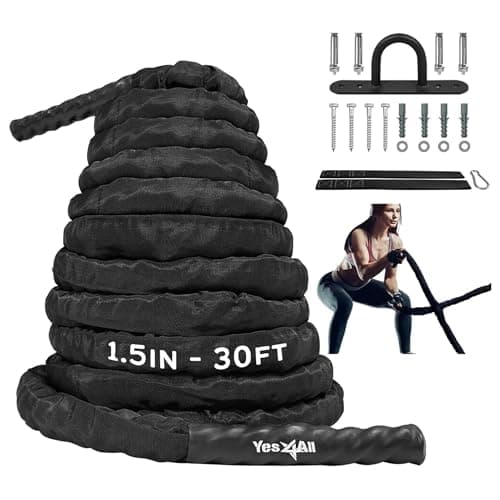
Yes4All Battle Rope 1.5 in. × 30 ft (with cover, anchor and strap). Licensed stock photograph of the category — not the specific product.
The comparison that actually decides it
| Battle ropes | Rowing machine | |
|---|---|---|
| Space while in use | 15-25 ft of clear floor for a 30-50 ft rope, doubled back | About 8 x 2 ft, plus room behind the seat |
| Space when stored | A crate or a hook. Genuinely zero floor | 8 ft, or 2-3 ft if it folds upright |
| Price class | The cost of a few takeaways | Ten to forty times the rope, for anything worth owning |
| Anchor needed | Yes - post, rack leg, loaded sled, tree, or a weighted unanchored rope instead | No |
| Noise through a floor | The rope slapping the ground, and your feet | Chain or flywheel whir plus the seat rail |
| What it trains hardest | Shoulders, arms, grip, trunk; anaerobic repeat efforts | Legs, back, aerobic capacity; measurable output |
| Impact on joints | Near zero | Near zero |
| Measurability | A clock and nothing else | Watts, splits, distance, stroke rate |
| Learning curve | Minutes | Real - bad rowing technique is common and loads the low back |
Where the rope genuinely wins
Storage, which is the whole argument for most people. A 30 ft battle rope is a 16 lb coil. It goes in a crate, on a hook, in a cupboard, under a bed. A rowing machine is a piece of furniture - even a folding one is a 2 to 3 ft object standing in a corner of a room you also live in. If you are renting a one-bedroom flat, that is not a minor consideration, it is the consideration.
Price. You can buy a serviceable 1.5 in. battle rope with an anchor for less than the delivery charge on a decent rower. That buys you the right to find out whether you like rope conditioning at all, which is a much better deal than finding out on a machine you then have to resell.
Upper-body and grip work. This is the one genuine training difference rather than a logistics one. Rowing is a leg-dominant movement; the arms finish the stroke, they do not drive it. Ten minutes of alternating waves loads the shoulders, the arms and the forearms in a way nothing on a rower touches, and grip fatigue is the usual reason a rope set ends. If you also train pull-ups, that carry-over is real.
No technique barrier. You can wave a rope badly and still get a good workout. You cannot row badly and get a good workout - you get a sore lower back and a slow split. That asymmetry matters a lot if nobody is coaching you.
Where the rower genuinely wins
Aerobic capacity, properly. A rower drives a far larger fraction of your muscle mass through a long range of motion, which is why it can take you to a genuine aerobic ceiling and hold you there for twenty or forty minutes. Battle ropes are brilliant at thirty-second intervals and much less good at steady state - your grip gives out long before your heart rate settles into anything you would call a base.
Numbers. Watts, a 500 m split, a 2 km time. Being able to see today's output against last month's is a legitimately powerful motivator and a legitimately useful training tool, and a rope offers you a stopwatch and your own impression of how hard it felt. If you are the kind of person who trains better with a number, that is worth more than any spec in the table.
Leg and posterior chain work. A rower is a hinge and a leg press repeated two thousand times. For someone whose training is otherwise all upper-body pulling and pushing - which describes a lot of home calisthenics setups - that is a real gap being filled.
No anchor problem. A rower needs a floor. A battle rope needs something immovable at one end, and if you do not have a post, a rack leg, a loaded sled or a tree, you have a problem the rope cannot solve on its own. The battle rope length and anchor guide works through the options, including the honest one: a short weighted rope used unanchored.
The noise question, since most of you are renting
Neither of these is quiet, and they are loud in different ways. A battle rope makes an impact noise - the rope striking the floor, several times a second, plus your feet shifting in a half-squat. Through a timber floor that transmits as a thud, which is the kind of sound neighbours notice most. On grass, carpet or a thick mat it softens considerably; on a concrete slab in a garage it does not matter at all.
A rower makes a mechanical noise - flywheel whir, chain or belt, and the seat running on the rail - plus a rhythmic weight shift. Air rowers are the loudest and magnetic ones much quieter. The honest summary is that a magnetic rower in a flat is more neighbour-friendly than a battle rope in a flat, and both are worse than a jump rope on a mat.
What ten minutes on each actually looks like
Ropes. Thirty seconds of alternating waves, thirty seconds off, ten rounds. That is a complete session and it will leave your forearms useless. Variations - double waves, slams, circles, lateral waves - change what gets hit but not the structure. Work is short because grip and shoulders cap it, and that is a feature if your training time is fifteen minutes, not sixty.
Rowing. Ten minutes at a conversational split as a warm-up, or eight rounds of 250 m with ninety seconds rest as the session. It scales both ways, which the rope does not: there is no such thing as easy steady-state battle ropes.
If neither fits, the third option is worth naming. A sled is low-impact, silent, needs no anchor and loads the legs the way a rower does - but needs outdoor space. A kettlebell gives you hard conditioning in two square feet. And the battle ropes vs jump rope page covers the comparison most small-space readers should actually be making.
Picks
The rope side of this comparison
Four ropes: the one with a steel anchor in the box, the one you can buy at three lengths, the short weighted rope that needs no anchor at all, and the cheap one. We do not review rowing machines - see the note below for why.
Key specs
- Rope
- 1.5 in. × 30 ft, 16 lb
- Handles
- 10 in. heat-shrink
- Anchor
- Steel anchor + strap included
Scores · editorial, out of 10
- Length vs space needed
- 8
- Material & sleeve
- 9
- Anchor solution for renters
- 9
- Value
- 9
Pick 1 · Battle ropes
Yes4All Battle Rope 1.5 in. × 30 ft (with cover, anchor and strap)
Yes4All
A 16 lb, 1.5 in. × 30 ft poly-dacron rope in a nylon sleeve with 10 in. handles, a steel anchor and a strap — the rope with a published weight and every part you need in one box.
Best for
A 30 ft rope for a garage or driveway with a stated 16 lb weight
Pros
- 16 lb published weight — the honest way to compare ropes
- Steel anchor for a permanent wall/floor mount and a strap for a temporary one
- Nylon sleeve keeps fibers off the floor
Cons
- The steel anchor needs a drilled mount — renters use the strap only
- Longer 40/50 ft versions sold separately
Specs from Yes4All — Battle Rope with Protective Cover listing (length, weight, handles, anchor).
Key specs
- Rope
- 1.5 in. poly dacron, 30 / 40 / 50 ft
- Handles
- Heat-shrink, non-slip
- Anchor
- Strap kit included
Scores · editorial, out of 10
- Length vs space needed
- 8
- Material & sleeve
- 8
- Anchor solution for renters
- 9
- Value
- 9
Pick 2 · Battle ropes
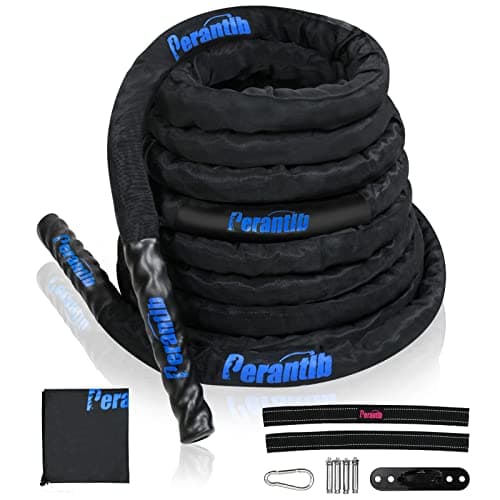
Perantlb Poly Dacron Battle Rope 1.5 in. (30 / 40 / 50 ft)
Perantlb
A 1.5 in. poly-dacron rope in 30, 40 or 50 ft with an upgraded protective sleeve, non-slip heat-shrink handles and an anchor strap kit in the box — the complete starter rope; buy the 30 ft for a small space.
Best for
A first battle rope with the anchor included, sized to a garage or yard
Pros
- Anchor strap kit included — loop it round a post, a tree or a rack foot without drilling
- Sleeved version resists the fraying that kills battle ropes on concrete
- 30 ft (15 ft of working room) is the right length for a one-car garage
Cons
- Poly dacron sheds fibers over time; keep it sleeved
- The 30 ft is 17.5 lb; the maker publishes no weight for the longer cuts
Specs from Perantlb — 100% Poly Dacron Heavy Battle Rope listing (diameter, lengths, sleeve, anchor kit, weight).
Key specs
- Rope
- 20 ft, 15 lb (Elite 25 ft, 19 lb)
- Core
- Flexible metal, triple-braided poly
- Anchor
- Optional — works unanchored
Scores · editorial, out of 10
- Length vs space needed
- 10
- Material & sleeve
- 9
- Anchor solution for renters
- 10
- Value
- 6
Pick 3 · Battle ropes
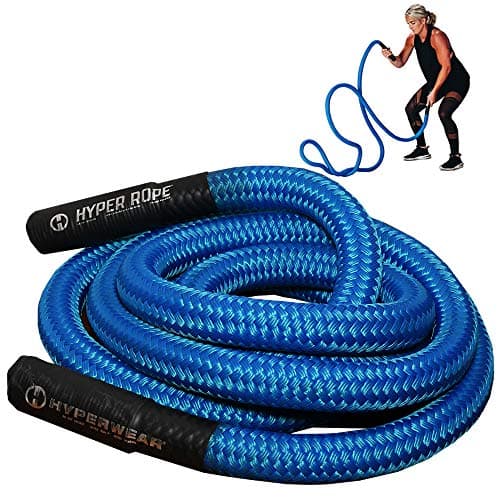
Hyperwear Hyper Rope (20 ft / 15 lb)
Hyperwear
A 20 ft, 15 lb braided rope with a flexible metal core that works with NO anchor — the battle rope for an apartment or a balcony where there's nothing to tie to. A 25 ft / 19 lb Elite version exists.
Best for
Battle-rope conditioning with no anchor point and 10 ft of floor
Pros
- Unanchored use — hold both ends, stand on the middle, and it works
- Short and dense: 20 ft of rope in the floor space of a 10 ft swing
- Anchors normally if you do have a post
Cons
- Costs more than a 50 ft poly rope
- The metal core makes it stiffer; it doesn't wave like a soft rope
Specs from Hyperwear — Hyper Rope Anchor-Optional Weighted Battle Rope (lengths, weights, core).
Key specs
- Rope
- 1.5 in. × 30 ft polyester blend
- Sleeve
- 600D Oxford, waterproof
- Anchor
- Not included
Scores · editorial, out of 10
- Length vs space needed
- 8
- Material & sleeve
- 9
- Anchor solution for renters
- 5
- Value
- 10
Pick 4 · Battle ropes
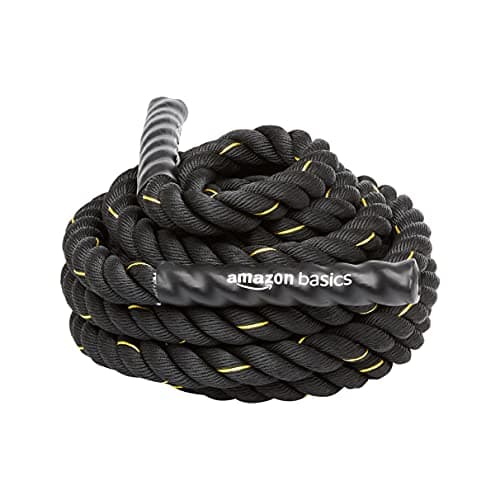
Amazon Basics Battle Rope 1.5 in. × 30 ft
Amazon Basics
A polyester-blend 1.5 in. × 30 ft rope with a 600D Oxford waterproof sleeve, heat-shrink caps and a tracking line — the house-brand rope at the lowest price, without an anchor.
Best for
The cheapest sleeved 30 ft rope if you already have something to loop it around
Pros
- Waterproof sleeve — leave it in a damp garage without worry
- Clockwise twist construction; heat-shrink caps stop fraying
- Also sold in 2 in. and 40/50 ft versions
Cons
- No anchor or strap in the box
- Rope weight not published
Specs from Amazon Basics — Battle Rope 1.5 in. × 30 ft listing (construction, sleeve).
FAQ
Questions readers ask
Are battle ropes as good as a rowing machine for cardio?
For short, hard intervals, yes - thirty seconds of waves gets your heart rate as high as thirty seconds of hard rowing. For sustained aerobic work, no. Grip and shoulder fatigue cap a rope set long before your cardiovascular system is the limit, so a rope is an interval tool and a rower is an engine-building tool.
How much space do battle ropes need compared to a rower?
A 30 ft rope doubled back from an anchor needs roughly 15 ft of clear floor while you use it, and none at all when stored - it coils into a crate. A rowing machine needs about 8 ft by 2 ft in use and either keeps that footprint permanently or folds to a 2 to 3 ft upright. For a renter, that storage difference is usually the deciding factor.
Which is better for losing weight, battle ropes or rowing?
Whichever one you will actually do four times a week. Rowing lets you accumulate more total work per session because it is sustainable for longer, which matters for energy expenditure. Battle ropes fit into ten minutes and need no setup, which matters for consistency. Neither out-performs a sensible diet.
Do battle ropes need an anchor?
A conventional 30 to 50 ft rope does - a post, a rack leg, a loaded sled, a tree or a proper anchor strap. Weighted short ropes of about 20 ft are designed to be used unanchored, which is why one is included in the picks above. If you have nowhere to anchor and no outdoor space, that is the version to buy.
Can you use battle ropes in an apartment?
With difficulty. The rope striking the floor is an impact noise that carries through timber floors, you need 15 ft of clear run, and you need an anchor. A thick mat helps and a ground-floor flat helps more. If you are above someone, a jump rope on a mat or a kettlebell is a far better use of the same ten minutes.
Is rowing or battle ropes better for your shoulders?
Battle ropes train the shoulders much harder - they are the primary driver of every wave and slam. Rowing loads the shoulders lightly and the legs and back heavily. If shoulder and grip endurance is the goal, ropes win outright; if you have a shoulder you are protecting, rowing is the gentler of the two.
Related
Keep reading
- Battle ropes vs jump rope
The comparison most small-space readers should be making instead.
- Best battle ropes
The full ranked roundup, including the unanchored option.
- Battle rope length and anchor guide
What to anchor to when you do not own a rack.
- Conditioning workouts at home
Where ten hard minutes of either sits in a training week.
Sources
- —Yes4All — Battle Rope 1.5 in. x 30 ft listing (16 lb, 10 in. heat-shrink handles, steel anchor and strap included) · amazon.com
- —Perantlb — Poly Dacron Battle Rope 1.5 in. listing (30 / 40 / 50 ft lengths, heat-shrink non-slip handles, anchor strap kit) · amazon.com
- —Hyperwear — Hyper Rope listing (20 ft, 15 lb; Elite 25 ft, 19 lb; flexible metal core, triple-braided poly, designed for unanchored use) · amazon.com
- —Amazon Basics — Battle Rope 1.5 in. x 30 ft listing (polyester blend, 600D Oxford waterproof sleeve, no anchor included) · amazon.com
- —Yes4All — Battle Rope with Protective Cover listing (length, weight, handles, anchor) · amazon.com
- —Hyperwear — Hyper Rope Anchor-Optional Weighted Battle Rope (lengths, weights, core) · hyperwear.com
- —Amazon Basics — Battle Rope 1.5 in. × 30 ft listing (construction, sleeve) · us.amazon.com