Comparison · Pull-Up Bars
Pull-up bar vs lat pulldown: the machine fixes you in place, the bar does not
Both pull a bar towards your torso with your lats. One lets you choose a load lighter than you are, which is genuinely useful; the other makes your trunk hold your body rigid while you do it, which is the part a machine removes.
Rope & Rep is reader-supported. Product links go through our affiliate resolver and we may earn a commission from qualifying purchases at no cost to you. Prices are the retailer's and change — every button opens the live price on Amazon rather than showing a stale number.
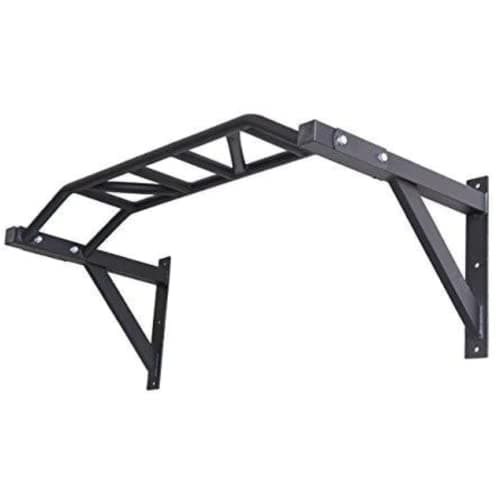
Gronk Fitness Wall Mounted Multi-Grip Pull Up Bar. Licensed stock photograph of the category — not the specific product.
What the two movements actually have in common - and where they split
Both are vertical pulls. The lats, teres major, rhomboids, lower traps and biceps do the work in both, and the shoulder blade travels through roughly the same arc. If your goal is a bigger back, both deliver.
The split is about what is fixed. On a pulldown you are seated with your thighs under a pad, and the bar travels towards you. Your trunk is braced by the machine, so the only thing you have to organise is the arms and the shoulder blades. On a pull-up, the bar is fixed and you travel - which means the abs, the obliques and the glutes have to hold your body in one rigid line against gravity while the lats pull.
That difference cuts both ways and this is the whole argument. The pull-up trains more at once, which is the best thing about it and also why it is harder to overload cleanly: on a bad day your grip goes, or your core gives and you start swinging, and the lats never got the stimulus. The pulldown trains less at once, which is the worst thing about it and also why it is such a reliable way to accumulate lat volume - nothing else fails first.
Side by side
| Pull-up bar | Lat pulldown | |
|---|---|---|
| Load you can use | Bodyweight, minus band assistance or plus a vest or belt | Anything the stack offers, in 2.5-5 kg steps |
| Can a beginner use it? | Not for full reps - needs bands, negatives or a rack-height bar | Yes, from day one, at any fraction of bodyweight |
| Trunk demand | High - abs, obliques and glutes hold the line | Low - the thigh pad does it |
| Grip demand | High, and often the limiter | Moderate; straps remove it entirely |
| Footprint at home | Two studs and a doorway, or a 24 x 20 in. wall bracket | A machine with a stack and a seat |
| Cost | Less than a month of gym membership | Many multiples of that, if buyable at all for home |
| Progression method | Reps, then added weight, then harder variations | Add plates |
| Shoulder friendliness | Depends on grip and range; a dead hang loads the capsule | Easier to keep in a comfortable range |
| Transfer to other skills | Direct - muscle-ups, rings, climbing, carrying yourself | Limited to the pulling pattern |
The case for the bar, which is stronger than it looks
It is the better strength exercise for most people. Moving your own bodyweight through space with a rigid trunk is a more athletic demand than pulling a bar to your chest while a pad holds your legs down, and it is the demand almost every physical task outside a gym actually makes.
It is absurdly cheap per unit of training. A multi-grip wall bar rated to 800 lb costs roughly what two months of a gym membership does and will outlast the building. There is no comparable value anywhere in strength equipment, which is most of why this site exists.
It scales further than people think. Downwards with assistance bands, which take 10 to 125 lb off depending on the band - the functional equivalent of a pulldown's light settings. Upwards with a vest or a dip belt, which is effectively unlimited. And sideways through grip changes, tempo, pauses and rings, which is a whole second category of difficulty a stack cannot offer.
The case for the pulldown, which is more legitimate than bar purists admit
It works before you can do a pull-up. This is the real argument. A pulldown lets someone who cannot do one rep train the exact pulling pattern at 40 percent of their bodyweight, three sets of ten, from their first session - and get measurably stronger at it week by week. Bands do this too, but less precisely: band assistance is largest at the bottom and smallest at the top, which is the opposite of where most beginners need help.
It isolates when you want isolation. If your grip gives out at eight pull-ups but your lats have more in them, a pulldown with straps keeps going. For anyone chasing back size rather than a skill, that is a genuine advantage, and it is why people who can do fifteen pull-ups still do pulldowns.
It is kinder to a problem shoulder. You can choose the range, the grip and the load independently, and you are not loading a dead hang. For someone managing an impingement or coming back from an injury, that control matters.
Progression is trivially measurable. 55 kg last week, 57.5 kg this week. With a pull-up you are counting reps until the day you buy a vest, and rep-based progression is noisier.
How to get the pulldown's advantages without a machine
For scaling below bodyweight: assistance bands. A four-band set covering roughly 10 to 125 lb of assistance turns an impossible pull-up into a set of eight, and you progress by moving down a band. This is the direct substitute and it costs very little. Band assistance is not linear - it helps most at the bottom - so pair it with slow negatives, where you control the descent for three to five seconds and the hardest part of the range gets trained properly.
For lat volume with no grip limit: a band or cable kit with a door anchor. A five-tube band set stacking to 190 lb, or an adjustable cable trainer from 10 to 100 lb, anchored high in a door, gives you a genuine straight-arm and bent-arm pulldown at a chosen resistance. It is not a stack and it does not feel like one, but it is the same movement at a load you pick, which is the thing the machine was for.
For precise progression: a vest with small weight steps. Once you are past bodyweight, a vest with 2 to 3 lb increments gives you something close to a stack's granularity - weighted vest increments covers which vests actually adjust finely.
What we would actually tell someone building a home setup
Buy the bar. Bolt it into studs or joists if you can - a rated wall mount is stronger than any doorway bar and gives you clearance a door frame does not - and the mounting comparison covers which route your home allows. Add a band set in the same order, because that is what makes the bar usable from day one regardless of where you are starting.
If you genuinely cannot do a single pull-up today, start with how to get your first pull-up and work the progression: dead hangs, scapular pulls, band-assisted reps, negatives. Six to twelve weeks is a realistic timeline, and the equipment cost is one bar and one set of bands. A pulldown would be a nicer way to spend those twelve weeks and it would cost more than every other piece of equipment on this site combined.
Picks
What to buy at home for each side
A rated wall-mount bar for the pull-up side, assistance bands for scaling below bodyweight, and two band or cable kits for the closest honest substitute for a pulldown.
Key specs
- Mounting
- Wall studs; assembled 49 × 24 × 20 in.
- Grips
- Multi-grip — wide, neutral and close positions
- Rated load
- 800 lb
Scores · editorial, out of 10
- Fit & clearance (door, ceiling, depth)
- 7
- Reversibility (no drill, no marks, takedown)
- 3
- Rated load & build
- 10
- Grip options
- 10
- Value
- 8
Pick 1 · Pull-up bars
Gronk Fitness Wall Mounted Multi-Grip Pull Up Bar
Gronk Fitness
A commercial-grade stud-mounted station: 37 lb of powder-coated steel, a published 800 lb capacity, multiple grip positions and an assembled 49 × 24 × 20 in. frame — the one wall bar here you can hang rings and bands from without thinking about it.
Best for
A garage wall you are allowed to drill, where the bar has to outlast the house
Pros
- 800 lb rated, which takes a heavy adult plus a weight vest and a band without a second thought
- Powder-coated smooth tube — it does not shred hands or band loops the way a knurled or welded bar does
- A deliberate anchor for rings, ab straps and bands, so one mount becomes the whole wall setup
Cons
- Lag bolts into studs: this is a drilled installation and not a renter's option
- 37 lb of steel at 49 in. wide — a two-person lift to hold it in place while you bolt it
- The most expensive wall bar here by a clear margin
Specs from Gronk Fitness — Wall Mounted Multi Grip Pull Up Bar listing (capacity, coating, assembled size, weight).
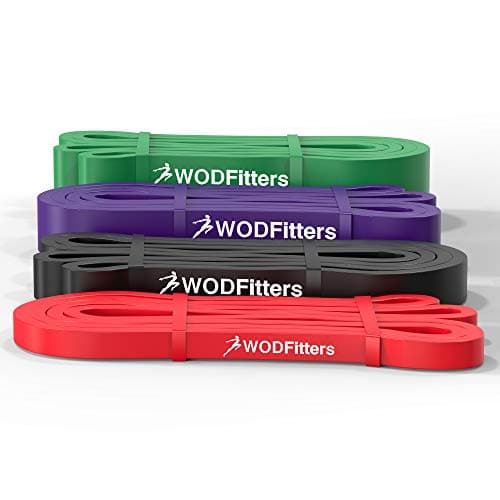
Key specs
- Length
- 41 in. loop
- Assistance
- #1 red 10–35 · #2 black 30–60 · #3 purple 40–80 · #4 green 50–125 lb
- Widths
- 1/2 in. to 1.75 in.
Scores · editorial, out of 10
- Assistance range
- 10
- Material & safety
- 8
- Sizing clarity
- 9
- Bar compatibility
- 10
- Value
- 8
Pick 2 · Assistance bands
WODFitters Pull-Up Assistance Bands (4-band set)
WODFitters
The standard 41 in. loop bands with a clearly published range — red 10–35 lb up to blue 65–175 lb — sold as sets so you can step down assistance as you get stronger.
Best for
Anyone working toward a first pull-up who wants a progression, not one band
Pros
- Published resistance per color, so you can plan the step-down from green to red
- Sets of 4 or 5 cover a 200 lb beginner through to a light-assist finisher
- Natural latex, 41 in. — fits any doorway bar or tower
Cons
- Latex — not for latex allergies, and it degrades in sunlight
- The thickest bands can snap a foot out from under you if you slip; step in carefully
Key specs
- Resistance
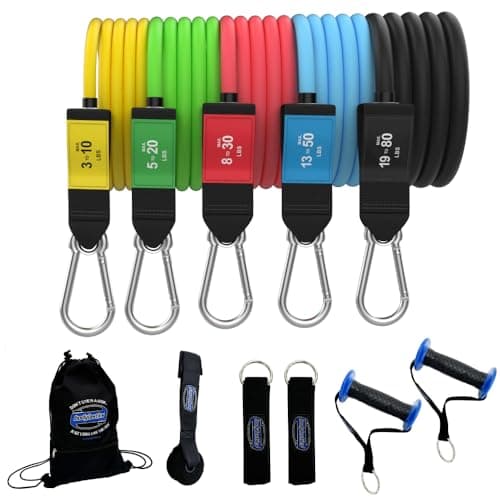
- 5 tubes, 3-80 lb each; 190 lb stacked
- Included
- 2 handles, 2 ankle straps, door anchor, pack
- Safety
- Inner safety cord in each tube (snap-reduction design)
Scores · editorial, out of 10
- Resistance range & stacking
- 10
- Handles & attachments
- 9
- Anchor options for a renter
- 9
- Snap safety & build
- 10
- Value
- 8
Pick 3 · Resistance bands with handles
Bodylastics 5 Band PRO Series Set (190 lb max)
Bodylastics
Five clip-on latex tubes (3-10, 5-20, 8-30, 13-50 and 19-80 lb) that stack to 190 lb, with two handles, two ankle straps, a door anchor and a pack — and an inner safety cord in every tube.
Best for
Replacing a rack of dumbbells in an apartment, at any load from 3 lb to 190 lb
Pros
- Clip any combination of tubes to one handle — the load ladder is effectively continuous
- The inner cord is the reason to buy this over an unbranded set: a tube that fails doesn't whip
- The door anchor means no drilling, no wall plate and nothing for a landlord to notice
Cons
- Five tubes, clips and two straps is more to keep track of than a pair of dumbbells
- Resistance is not constant through a rep — the top of a press is far harder than the bottom
Specs from Bodylastics — 5 Band Pro Series Set (per-tube tensions, contents, price).
Key specs
- Resistance
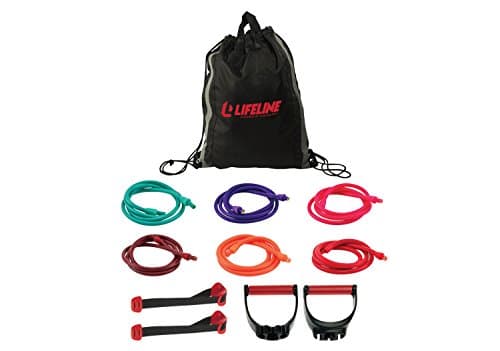
- Adjustable, 10–100 lb
- Handles
- Triple-grip, with a cable pocket for quick swaps
- Included
- 2 handles, door anchor, 5 ft tubes, carry bag
Scores · editorial, out of 10
- Resistance range & stacking
- 6
- Handles & attachments
- 10
- Anchor options for a renter
- 6
- Snap safety & build
- 9
- Value
- 9
Pick 4 · Resistance bands with handles
Lifeline Resistance Trainer Kit (10–100 lb)
Lifeline
A two-handle cable trainer that adjusts from 10 to 100 lb, with triple-grip handles, 5 ft latex tubes, a door anchor and a carry bag — cables pull out of a pocket in the grip so you can swap or double up.
Best for
Pressing and rowing each arm independently, where a rotating handle genuinely matters
Pros
- Triple-grip handles give three hand positions, so the wrist is not locked into one angle through a press
- Cables come out of the handle pocket, so resistance changes without unclipping hardware
- Arrives as a complete kit — tubes, handles, door anchor and bag, nothing else to buy
Cons
- Tops out at 100 lb — well short of a stacked handled-band set
- Latex tubes, so this is the wrong kit if anyone in the house has a latex allergy
Specs from Lifeline — Resistance Trainer Kit listing (10–100 lb adjustable range, handles, door anchor, tubes, bag).
FAQ
Questions readers ask
Is a pull-up better than a lat pulldown?
For strength and athleticism, yes - it demands a rigid trunk while the lats pull, and it transfers to everything that involves carrying your own body. For accumulating lat volume, training below bodyweight, or working around a grip or shoulder limitation, the pulldown is better. They are complements, not substitutes, and most people should do both when both are available.
Can a lat pulldown replace pull-ups?
It can replace most of the lat stimulus, but not the trunk and grip demand, and not the skill. If your goal is back size, pulldowns alone will get you a long way. If your goal is to be able to do pull-ups, you have to do pull-ups - or band-assisted pull-ups and negatives - at some point.
What can I use instead of a lat pulldown at home?
A band or cable kit anchored high in a door frame: a five-tube set stacking to around 190 lb or an adjustable cable trainer from 10 to 100 lb gives you a real pulldown at a chosen resistance. For the other half of what a pulldown is used for - training below bodyweight - use pull-up assistance bands on a bar.
How much of my bodyweight is a pull-up equivalent to on the pulldown?
Roughly your bodyweight minus the weight of your lower legs, which for most people means a pulldown at about 85 to 90 percent of bodyweight is a reasonable comparison. It is only ever approximate: the pulldown has a thigh pad doing the stabilising work, so the same number on the stack is not the same exercise.
I can't do a pull-up. Should I use bands or a pulldown?
Whichever you have. Bands are far cheaper and work on the bar you will eventually use unassisted - their one weakness is that the help is greatest at the bottom and least at the top. Pair bands with slow negatives, which load the top of the range properly, and you have the full picture for the price of a band set.
Is a lat pulldown easier on the shoulders than a pull-up?
Usually, yes. You can pick the grip, the range and the load independently and you are not hanging from a fully extended shoulder under full bodyweight. For someone managing an impingement or returning from injury, that control is a genuine advantage - though a pull-up done with a controlled range and scapular engagement is not inherently harmful.
Related
Keep reading
- Best resistance bands for pull-ups
The direct substitute for a pulldown's light settings.
- How to get your first pull-up
The six-to-twelve-week route from zero, with one bar and one band set.
- Best wall-mounted pull-up bars
The rated mount that gives you clearance a door frame cannot.
- Doorway vs wall mount vs free-standing
Which mounting route your home actually allows.
Sources
- —Gronk Fitness — Wall Mounted Multi-Grip Pull Up Bar listing (wall-stud mounting, assembled 49 x 24 x 20 in., multi-grip positions, 800 lb rating) · amazon.com
- —WODFitters — Pull-Up Assistance Bands 4-band set listing (41 in. loops; #1 red 10-35 lb, #2 black 30-60 lb, #3 purple 40-80 lb, #4 green 50-125 lb) · amazon.com
- —Bodylastics — 5 Band PRO Series Set (five tubes 3-80 lb each, 190 lb stacked, two handles, ankle straps, door anchor, inner safety cord) · bodylastics.com
- —Lifeline — Resistance Trainer Kit listing (adjustable 10-100 lb, triple-grip handles, door anchor, 5 ft tubes) · amazon.com