Best for a Garage · Pull-Up Bars
The best pull-up bar for a garage gym: you can drill, so stop shopping for doorway bars
A garage removes the constraint the rest of this site is built around. Studs, joists and a concrete floor mean you can put a bar where you want it, rated three times higher, for less money than a free-standing frame.
Rope & Rep is reader-supported. Product links go through our affiliate resolver and we may earn a commission from qualifying purchases at no cost to you. Prices are the retailer's and change — every button opens the live price on Amazon rather than showing a stale number.

A weightlifting setup in a garage-style gym with loaded barbell and plates. Licensed stock photograph of the category — not the specific product.
Quick picks
| # | Product | Best for | Score | Price |
|---|---|---|---|---|
| 1 |  REP Fitness Wall-Mounted Multi-Grip Pull-Up Bar The wall bar with the most grips: 46 in. of usable 1.25 in. bar with neutral, close, wide and angled handles, mountable at 14 or 26 in. from the wall, rated 700 lb into studs. | A garage or basement wall where you can hit two studs and want every grip | 7.2 | |
| 2 | Ultimate Body Press Ceiling Mount Pull Up Bar The ceiling bar built for real joists: reversible risers fit 16 or 24 in. on-center joists, it drops 14 in. from the ceiling, and the parallel grips sit a natural 20 in. apart. | A garage or basement with exposed or locatable joists and at least 8 ft of ceiling | 7.0 | |
| 3 | Titan Fitness Adjustable Depth Wall Mounted Pull Up Bar A plain 52 in. straight bar you can set 14 or 22 in. off the wall, 400 lb rating, 11-gauge steel, and brackets that reach stud spacing up to 50 in. — the value wall bar. | A simple, strong straight bar on a garage wall for the least money | 6.4 | |
| 4 | 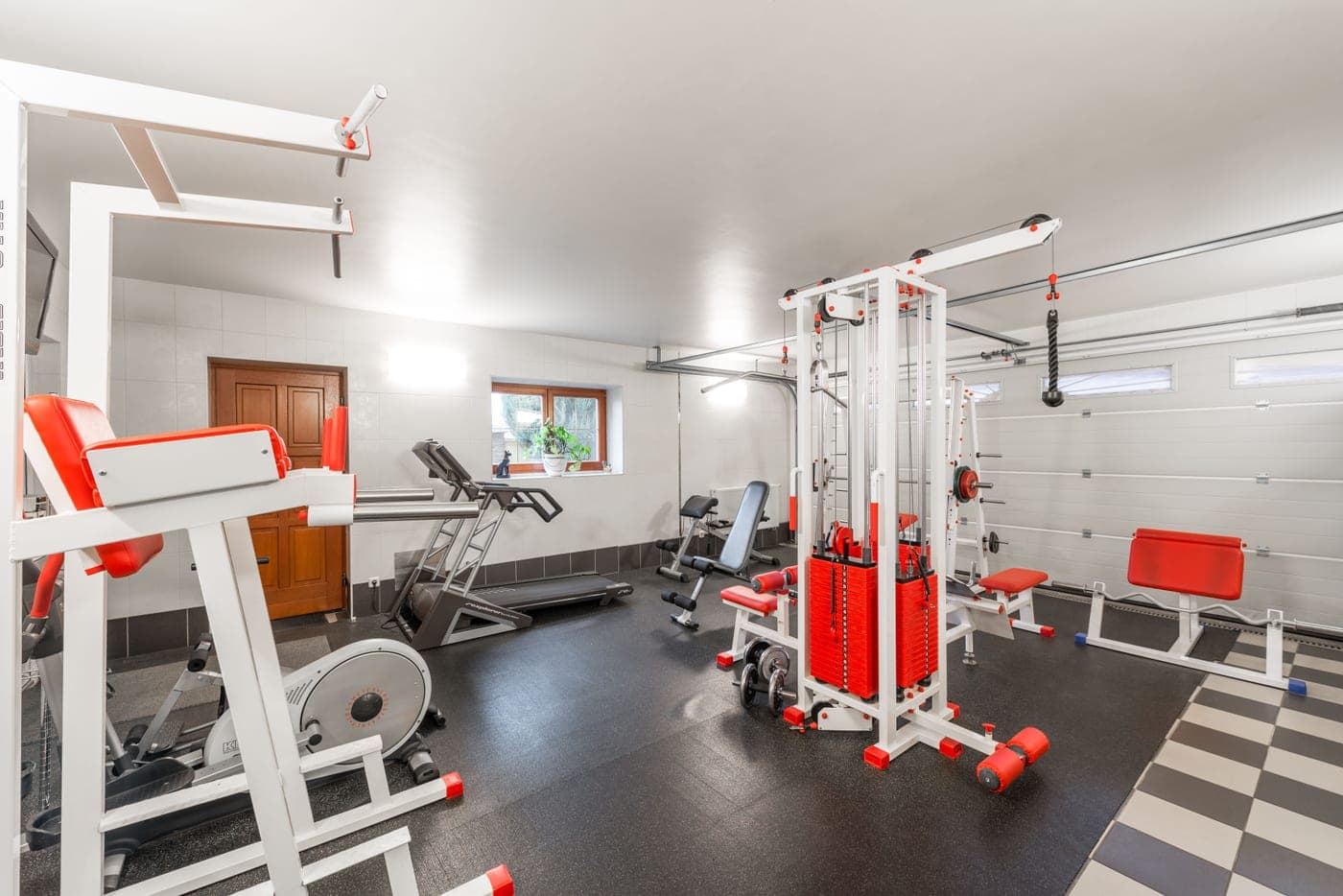 Titan Fitness Heavy-Duty Power Tower The heavy one: 2 x 2.75 in. powder-coated steel, 83.5 in. tall, a multi-grip pull-up station, 2 in. dip bars on a 24 in. spread, a knee-raise pad and a push-up station with seven mounting positions — 135 lb of frame that does not move. | A garage that wants a tower that feels bolted down without bolting anything down | 8.2 |
Scores are our editorial judgment from published specs and mounting instructions, weighted for a renter or small-space trainer — not lab measurements. We have not tested these units.
What changes when the room is a garage
Nearly everything on this site is written for someone who cannot drill. A garage flips that. You have exposed or findable studs, joists or trusses overhead, a floor that does not care, and usually a landlord or spouse who minds a hole in a garage wall far less than one in a hallway.
The consequence is that the whole doorway-bar category becomes irrelevant. A stud-mounted multi-grip bar is rated 700 lb properly installed, sits where you decide, does not need to be taken down, and supports rings, a punch bag or a band anchor as well. That is a different tool from a 300 lb leverage bar wedged in a door casing.
What a garage gives you and an apartment does not, in order of usefulness: clearance (usually 8 to 10 ft, sometimes more), fixings (studs and joists), tolerance (chalk, noise, a dropped bell) and space behind the bar, which is what you need for kipping, rings and anything that swings.
The four, side by side
| Bar | Fixing | Projection / height | Rated | Best for |
|---|---|---|---|---|
| REP Wall-Mounted Multi-Grip | Wall studs | 14 or 26 in. projection | 700 lb installed | The default garage bar |
| Ultimate Body Press Ceiling Mount | Ceiling joists, 16 or 24 in. OC | Hangs below the joist | See maker's spec | Maximum clearance; rings |
| Titan Adjustable Depth Wall Mount | Wall studs | 14 or 22 in. projection | 400 lb | Cheapest solid mounted bar |
| Titan Heavy-Duty Power Tower | Nothing — free-standing | 83.5 in. bar | Not published | A garage you can't drill |
Find out what your garage walls are made of
This is the step that decides everything and the one people skip. Garages come in more constructions than living rooms do.
- Unfinished timber studs. The best case — you can see exactly where they are and how far apart. Lag straight into the center of two studs.
- Drywall over timber studs. Standard, fine. Find the studs with a magnet (it finds the screws) and confirm by drilling a small pilot hole. Do not trust an electronic stud finder alone on a garage wall.
- Single-skin block or brick. Common on older detached garages. Timber lag screws are the wrong fixing — you need resin anchors or sleeve anchors rated for the block, and a single-skin wall may not be suitable at all. This is worth asking a builder about rather than guessing.
- Steel studs. Increasingly common and not suitable for a pull-up bar with ordinary fixings. If your magnet finds studs but the pilot hole goes through thin metal, stop.
And check what is inside the wall before you drill: garage walls carry the circuits for the door opener, outdoor sockets and often the house feed.
Wall or ceiling?
Wall mount if you want the simpler job and the higher rating. Two studs, four lag screws, a level and an hour. The projection number matters: 14 in. keeps you close to the wall (fine for strict pull-ups, tight for anything else), 22 to 26 in. gives room to pull your chest to the bar and to hang rings without brushing the wall behind you. Buy the longer projection if the wall can spare it.
Ceiling mount if you want maximum clearance and a bar you can swing from. It puts the bar out in open air, which is what rings, muscle-up work and kipping all need. The Ultimate Body Press bar spans joists at 16 or 24 in. on center — check which yours are before ordering, because that is not adjustable after the fact.
The ceiling job is less forgiving. You are hanging your bodyweight plus dynamic load from timber overhead, and the failure mode is worse. Our joist mounting guide walks it through, including how to find joist centres and why you never mount to a truss web.
The garage-specific things that catch people out
- The door mechanism. A sectional door's track, springs and opener rail occupy the middle of the ceiling and a strip of both side walls. Map them before choosing a wall.
- Trusses, not joists. Many garages have roof trusses rather than floor joists. You may mount to the bottom chord where a manufacturer permits it; you never mount to a diagonal web. If in doubt, use a wall.
- The slab. Concrete is unforgiving to land on and to drop a bell on. A stall mat under the bar solves both, and it is the cheapest thing in this article.
- Cold and damp. An unheated garage rusts bare steel. Powder-coated bars are fine; keep chalk dry and wipe the bar down in winter.
- Head clearance on the pull, not the hang. You need the bar low enough that your head clears the ceiling at the top of the rep. The clearance page has the numbers.
If you cannot drill, even in the garage
Rented garages, block walls you have been told not to touch, trusses you are not confident about: all real. The answer is a free-standing frame, and in a garage the right one is the heavy one, because you have the floor for it. Titan's Heavy-Duty tower is 135 lb of 2 x 2.75 in. steel on a 30 by 58 in. footprint, and it is the closest a free-standing frame gets to feeling bolted down. The full field is in the power tower roundup and the free-standing bar page.
How this list was built
We read fixing type, projection or height, rated load and mounting requirements off each maker's own listing, then scored on the pull-up bar rubric — fit and clearance 25%, reversibility 25%, rated load and build 20%, grip options 15%, value 15%. This page inverts the reversibility weighting that governs the rest of the site: in a garage, being able to drill is the point, so a permanent mount is rewarded rather than penalized. That is why no doorway bar appears here at all. No bars were tested in a lab; we own no lab and say so on our methodology page.
The picks in detail
Every pick, reviewed
Key specs
- Mounting
- Wall studs; 14 or 26 in. projection
- Bar
- 50 in. wide, 46 in. usable, 1.25 in.
- Rated load
- 700 lb (properly installed)
Scores · editorial, out of 10
- Fit & clearance (door, ceiling, depth)
- 7
- Reversibility (no drill, no marks, takedown)
- 3
- Rated load & build
- 10
- Grip options
- 10
- Value
- 8
Pick 1 · Pull-up bars
REP Fitness Wall-Mounted Multi-Grip Pull-Up Bar
REP Fitness
The wall bar with the most grips: 46 in. of usable 1.25 in. bar with neutral, close, wide and angled handles, mountable at 14 or 26 in. from the wall, rated 700 lb into studs.
Best for
A garage or basement wall where you can hit two studs and want every grip
Why it is #1. Rated 700 lb properly installed into studs, with every grip — wide, neutral, narrow — and a choice of 14 or 26 in. projection. Buy the 26 in. if the wall can spare it: that is the difference between strict pull-ups only and having room for rings and a chest-to-bar pull.
Pros
- Traditional, neutral, close, wide and angled grips on one bar
- Two projection options — 26 in. lets you swing for kipping or muscle-ups, 14 in. saves space
- 700 lb rating with a 2 in. back bar; nonslip powder coat
Cons
- Needs lag bolts into two studs — not a rental-friendly install unless the landlord agrees
- At 50 in. wide it takes real wall space; check the stud spacing matches before ordering
Specs from REP Fitness — Wall-Mounted Multi-Grip Pull-Up Bar (dimensions, projection, rating).
Key specs
- Mounting
- Ceiling joists, 16 or 24 in. OC
- Drop
- 14 in. below ceiling
- Grips
- 4 positions, 20 in. parallel spacing
Scores · editorial, out of 10
- Fit & clearance (door, ceiling, depth)
- 8
- Reversibility (no drill, no marks, takedown)
- 3
- Rated load & build
- 9
- Grip options
- 8
- Value
- 8
Pick 2 · Pull-up bars
Ultimate Body Press Ceiling Mount Pull Up Bar
Ultimate Body Press
The ceiling bar built for real joists: reversible risers fit 16 or 24 in. on-center joists, it drops 14 in. from the ceiling, and the parallel grips sit a natural 20 in. apart.
Best for
A garage or basement with exposed or locatable joists and at least 8 ft of ceiling
Maximum clearance. Spans ceiling joists at 16 or 24 in. on center and puts the bar out in open air, which is what rings, muscle-up work and anything that swings need. Check your joist centres before ordering — that spacing is not adjustable afterwards.
Pros
- Reversible dual-position risers mount to either 16 in. or 24 in. joist spacing without shims
- 14 in. drop keeps headroom under an 8–9 ft ceiling
- 3/16 in. plate-steel mounting plates; template and hardware included
Cons
- You must find and hit the joists — drywall ceilings need a stud finder and care
- Once mounted it is a fixture; four lag holes stay in the ceiling
Specs from Ultimate Body Press — Ceiling Mount Pull Up Bar (joist spacing, drop, grips).
Key specs
- Mounting
- Wall studs; 14 or 22 in. projection
- Bar
- 52 in., 11-gauge steel
- Rated load
- 400 lb
Scores · editorial, out of 10
- Fit & clearance (door, ceiling, depth)
- 7
- Reversibility (no drill, no marks, takedown)
- 3
- Rated load & build
- 9
- Grip options
- 5
- Value
- 9
Pick 3 · Pull-up bars
Titan Fitness Adjustable Depth Wall Mounted Pull Up Bar
Titan Fitness
A plain 52 in. straight bar you can set 14 or 22 in. off the wall, 400 lb rating, 11-gauge steel, and brackets that reach stud spacing up to 50 in. — the value wall bar.
Best for
A simple, strong straight bar on a garage wall for the least money
The cheap solid answer. A straight bar into studs, 400 lb rated, with 14 or 22 in. projection. No multi-grip options, which is the only real difference from the REP. For a garage that just needs a bar, this is the value pick by a wide margin.
Pros
- Adjustable projection: 14 in. for tight spaces, 22 in. for room to swing
- Brackets accommodate stud spacing up to 50 in. — forgiving on odd framing
- 20 lb of 11-gauge steel; 400 lb rating
Cons
- Straight bar only — no neutral or angled grips
- Permanent install; leaves lag-bolt holes when you take it down
Specs from Titan Fitness — Adjustable Depth Wall Mounted Pull Up Bar (projection, gauge, capacity).
Key specs
- Height
- 83.5 in. overall
- Footprint
- 30 in. wide (42 in. with the foot roller) x 58 in. deep
- Frame
- 2 x 2.75 in. steel, 135 lb; rated load not published
Scores · editorial, out of 10
- Fit & clearance (door, ceiling, depth)
- 7
- Reversibility (no drill, no marks, takedown)
- 9
- Rated load & build
- 9
- Grip options
- 9
- Value
- 7
Pick 4 · Pull-up bars
Titan Fitness Heavy-Duty Power Tower
Titan Fitness
The heavy one: 2 x 2.75 in. powder-coated steel, 83.5 in. tall, a multi-grip pull-up station, 2 in. dip bars on a 24 in. spread, a knee-raise pad and a push-up station with seven mounting positions — 135 lb of frame that does not move.
Best for
A garage that wants a tower that feels bolted down without bolting anything down
For a garage you cannot drill. 135 lb of 2 x 2.75 in. steel with a 24 in. dip spread and a knee-raise station — the stiffest free-standing frame on the site, and a garage is the one room with the floor to spare for it. Titan does not publish a rated load.
Pros
- 135 lb of tube is the difference between a tower that sways and one that doesn't
- Dip bars are 2 in. on a 24 in. spread — the width most adults actually want, not a token pair of handles
- Push-up station has seven positions, so a decline push-up has somewhere to go
Cons
- Titan does not publish a rated load for this frame, so we can't score it against a stated number
- 58 in. deep — a genuinely large object, and it does not fold
Specs from Titan Fitness — Heavy-Duty Power Tower (dimensions, frame steel, stations, weight, price).
Buying guide
Which bar for which garage
- Timber studs, want every grip: REP wall mount, 26 in. projection.
- Timber studs, lowest spend: Titan adjustable-depth wall bar.
- Accessible joists, want rings and swing: Ultimate Body Press ceiling mount.
- Block walls, steel studs or a rented garage: Titan Heavy-Duty tower.
Buy the longer projection
The 14 in. option exists for narrow spaces. In a garage you almost always have the depth, and 22 to 26 in. is the difference between a bar you can only do strict reps on and a bar you can actually train under.
Then buy a mat
A stall mat under the bar costs a fraction of the bar and fixes the concrete floor for landing, for a dropped kettlebell and for anything you do on the ground. It is the best value purchase in a garage gym.
FAQ
Questions readers ask
What is the best pull-up bar for a garage gym?
A stud-mounted wall bar. The REP Fitness Wall-Mounted Multi-Grip is rated 700 lb properly installed and offers 14 or 26 in. projection. In a garage you can drill, so there is no reason to accept a 300 lb doorway bar.
Should a garage pull-up bar go on the wall or the ceiling?
Wall for the simpler job and the higher rating; ceiling for maximum clearance and for rings, kipping or muscle-ups. Ceiling mounting is less forgiving of a mistake, so confirm your joist centres and never fix to a truss web.
Can you mount a pull-up bar to a garage block wall?
Sometimes, but not with timber lag screws — you need resin or sleeve anchors rated for the block, and a single-skin wall may not be suitable at all. This is one to ask a builder about rather than guess at. A free-standing tower is the safe default.
How do I find studs in a garage wall?
A magnet finds the screws holding the drywall, which is more reliable than an electronic finder on a garage wall. Confirm with a small pilot hole before you commit. If the pilot hole goes through thin metal, you have steel studs and should stop.
Can I mount a pull-up bar to garage roof trusses?
Only to the bottom chord, and only where the bar's manufacturer allows it. Never to a diagonal web member — those are sized for compression within the truss, not for a hanging body. If you are unsure, use a wall.
What ceiling height do I need in a garage?
Enough that your head clears the ceiling at the top of the rep, not just when hanging. Most garages at 8 ft or more are fine for a wall bar; a ceiling mount needs more, because the bar hangs below the joist. See our clearance guide.
Related
Keep reading
- Best wall-mounted pull-up bars
The mounted bars in full.
- How to mount a pull-up bar to ceiling joists
Doing the ceiling job properly.
- Ceiling height for a pull-up bar
The clearance arithmetic.
- Garage gym essentials
What else earns the floor space.
- Best power towers
If drilling is off the table.
Sources
- —REP Fitness — Wall-Mounted Multi-Grip Pull-Up Bar (dimensions, projection, rating) · repfitness.com
- —Ultimate Body Press — Ceiling Mount Pull Up Bar (joist spacing, drop, grips) · ultimatebodypress.com
- —Titan Fitness — Adjustable Depth Wall Mounted Pull Up Bar (projection, gauge, capacity) · titan.fitness
- —Titan Fitness — Heavy-Duty Power Tower (dimensions, frame steel, stations, weight, price) · titan.fitness