Best Ladder for Kids · Conditioning
The best agility ladder for kids is the one whose rungs do not move
An adult kicks a loose rung and swears. A seven-year-old kicks a loose rung and trips. Everything else about choosing a kids' ladder - length, spacing, surface - follows from that one difference.
Rope & Rep is reader-supported. Product links go through our affiliate resolver and we may earn a commission from qualifying purchases at no cost to you. Prices are the retailer's and change — every button opens the live price on Amazon rather than showing a stale number.
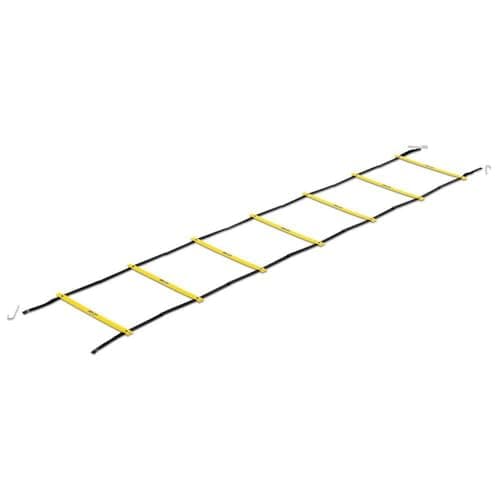
SKLZ Speed and Agility Ladder Pro (10 ft). Licensed stock photograph of the category — not the specific product.
Quick picks
| # | Product | Best for | Score | Price |
|---|---|---|---|---|
| 1 | SKLZ Speed and Agility Ladder Pro (10 ft) A 10 ft, 7-rung ladder with hinged side rails that fold and unfold without tangling, low-profile edges, and extensible ends — the ladder that sets up in ten seconds and stays square. | Quick setup in a small space, and anyone tired of untangling straps | 7.9 | |
| 2 | 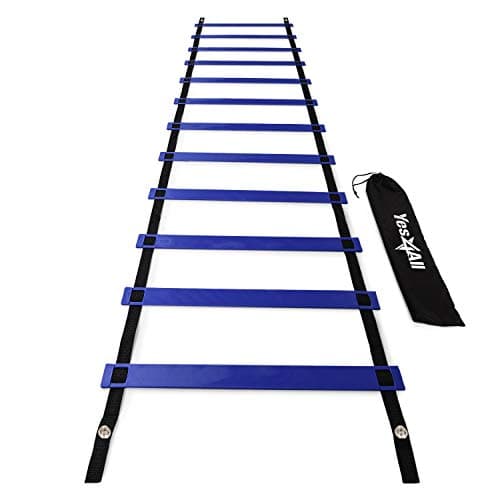 Yes4All Agility Ladder (12 rungs, 15 ft) A 12-rung, 15 ft nylon-strap ladder with plastic rungs you can slide up to 15 in. apart, carry bag included — the standard ladder, sized for a driveway. | A first ladder for footwork drills in a driveway or hallway | 8.7 | |
| 3 | 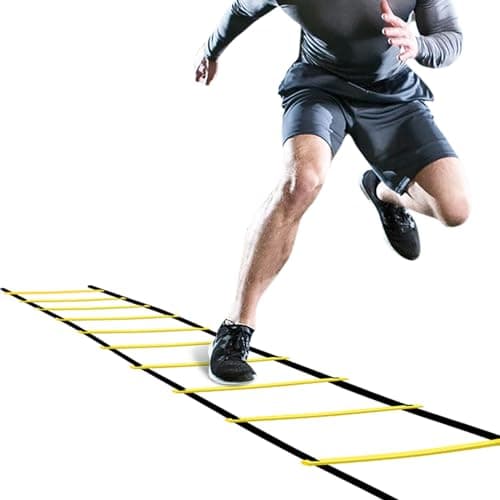 GHB Pro Agility Ladder (12 rungs, 20 ft) A 20 ft, 12-rung nylon ladder with 16.5 in. rungs adjustable to 15 in. apart, with a carry bag and a version bundled with 10 cones — the longer ladder for a yard. | Longer drill runs on grass or a long driveway; a bundle with cones | 8.2 | |
| 4 | 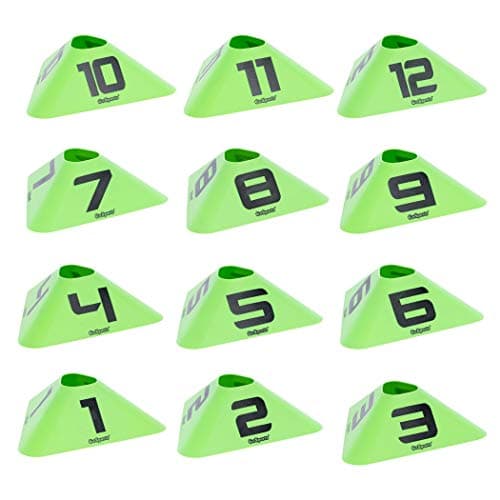 GoSports Modern Sports Cones (12, numbered 1-12) Twelve hard-plastic cones printed 1 through 12 in high-visibility green — the set that turns a grid into a reaction drill, because a called number is a decision and a called direction is not. | Reaction and decision drills you can run alone, and coaching kids without shouting directions | 7.2 |
Scores are our editorial judgment from each maker's published specs and mounting instructions, weighted for a renter or small-space trainer.
Why a kids' ladder is a different purchase
An agility ladder looks like the simplest product in sport, and for an adult it almost is. Choose a length, unroll it, run through it. For children the margin is narrower, and three specifications that barely register for an adult become the whole decision.
The first is whether the rungs hold their position. Most ladders are two nylon straps with flat plastic rungs that slide along them, which lets you change the spacing — a genuinely useful feature, and the reason the rungs also slide when a foot catches one. An adult re-seats it. A child, three steps into a drill at speed, puts the next foot on a rung lying at an angle.
The second is length, and it runs opposite to the instinct to buy the biggest one. Children lose interest in a drill long before they lose fitness, and a 10 ft ladder means a turn every three seconds rather than every six. More turns, more reps, more focus.
The third is rung thickness. A low, tapered rung is one a trainer slides over. A thick rung is one a toe catches. On a surface like a driveway, where a trip is a scraped knee, that is a real distinction.
The four criteria
Do the rungs stay put? Thirty-five percent, and the criterion that sets the whole ranking. Hinged rails score highest; adjustable strap rungs score lowest, regardless of how well made the rest of the ladder is.
Length suited to a child's attention and your space. Twenty-five percent. Ten to fifteen feet wins; twenty feet is for yards and teenagers.
Edge profile and trip risk. Twenty percent. What the maker publishes about the rung height and shape.
Setup time and storage. Twenty percent. A ladder that takes four minutes to untangle gets used half as often as one that unfolds in ten seconds, and with children the difference is the difference between doing it and not.
The four, side by side
| Pick | Length | Rungs | Hold position? | Best for |
|---|---|---|---|---|
| SKLZ Speed and Agility Ladder Pro | 10 ft, 7 rungs | 21 x 17 in., hinged rails | Yes - fixed by the hinge | Children under about 12, and small spaces |
| Yes4All Agility Ladder | 15 ft, 12 rungs | Sliding, spacing to 15 in. | No - adjustable means movable | A driveway, and tightening spacing for small legs |
| GHB Pro Agility Ladder | 20 ft, 12 rungs | 16.5 in. wide, spacing to 15 in. | No | A garden, teenagers, or the cone bundle |
| GoSports Numbered Cones (12) | n/a | 12 cones, numbered 1-12 | n/a | Reaction drills once the ladder gets boring |
Rung spacing for small legs
Standard ladder spacing is about 15 inches, which is set for an adult stride. For a child under about ten that is a stretch, and the result is a drill done in big slow steps rather than quick ones — which trains the opposite of what a ladder is for.
This is the one place where the sliding-rung ladders earn their keep. A strap ladder lets you pull the spacing in to 10 or 12 inches for a younger child and push it back out as they grow. A hinged ladder is fixed at whatever the maker chose. If you are buying for a six-year-old and planning to use the same ladder at twelve, the adjustability is worth the trade-off against rungs that move.
For most buyers, though, the fixed-spacing hinged ladder is the better object, because the spacing it comes at is usable from about eight upward and the shape it holds is worth more than the adjustment.
Drills by age
Five to seven. Two drills, both walking pace to start: one foot in each square, then two feet in each square. The goal is rhythm and looking ahead rather than down. Thirty seconds on, a minute off, four or five rounds, and stop before they are bored rather than after.
Eight to eleven. Add lateral in-and-outs, the icky shuffle, and hopscotch. Introduce racing the clock, which is when most children suddenly start caring. Keep each effort under ten seconds.
Twelve and up. Full speed through all of the above, plus a cone grid at the end of the ladder so the drill finishes with a direction change. This is also the age at which a 20 ft ladder starts making sense. Our agility ladder drills guide has the full progression written out.
Why cones belong in the same purchase
A ladder teaches a fixed pattern at speed. That is a real skill and it is also the limit of what a ladder does — nobody in any sport runs a pre-known pattern. The step that actually transfers is reacting, and a set of numbered cones is the cheapest way to add it: scatter them, call a number, and the child has to find it, choose a path and go.
Twelve numbered cones also solves the coaching problem of running a drill on your own with one child, since a called number is a decision where a pointed finger is not. If you would rather have plain markers, the agility cones roundup covers the full set of options including the low 6 in. discs that are safest underfoot.
The picks in detail
Every pick, reviewed
Key specs
- Length
- 10 ft, 7 rungs (21 × 17 in.)
- Rails
- Hinged, tangle-free fold
- Expand
- Ends link to a second ladder
Scores · editorial, out of 10
- Fit for purpose
- 9
- Adjustability
- 5
- Durability
- 10
- Value
- 7
Pick 1 · Agility gear
SKLZ Speed and Agility Ladder Pro (10 ft)
SKLZ
A 10 ft, 7-rung ladder with hinged side rails that fold and unfold without tangling, low-profile edges, and extensible ends — the ladder that sets up in ten seconds and stays square.
Best for
Quick setup in a small space, and anyone tired of untangling straps
It wins on the criterion that matters most for children: the rungs cannot move. Hinged side rails mean the ladder folds and unfolds without tangling and holds a square shape once it is down, so a foot that clips a rung does not displace it for the next step. SKLZ also specifies low-profile edges, which is the other half of the trip problem, and the ladder sets up in about ten seconds — the single biggest predictor of whether a piece of kit gets used with children.
Ten feet and seven rungs is the right size here, not a compromise: it fits a hallway, a balcony or one parking space, and it means a turn every few seconds rather than a long walk back. The honest trade-offs are the fixed rung spacing, which cannot be tightened for a very small child, and the fact that 10 ft is short if you want a full-speed sprint — though the ends link to a second ladder if you ever do.
Pros
- Hinged rails mean the rungs can't shift — the drill spacing stays where you set it
- 10 ft fits a hallway, a balcony or one parking space
- Low-profile edges don't catch cleats or bare feet
Cons
- Fixed rung spacing — no adjustment
- 10 ft is short for full-speed sprints; link two for length
Specs from SKLZ — Speed and Agility Ladder, Pro 10' (length, hinged rails, extensible ends, low-profile edges).
Key specs
- Length
- 15 ft, 12 rungs (8- and 20-rung versions also sold)
- Rung spacing
- Adjustable to 15 in.
- Included
- Carry bag
Scores · editorial, out of 10
- Fit for purpose
- 8
- Adjustability
- 10
- Durability
- 7
- Value
- 10
Pick 2 · Agility gear
Yes4All Agility Ladder (12 rungs, 15 ft)
Yes4All
A 12-rung, 15 ft nylon-strap ladder with plastic rungs you can slide up to 15 in. apart, carry bag included — the standard ladder, sized for a driveway.
Best for
A first ladder for footwork drills in a driveway or hallway
The one to buy for a child under about eight, and the reason is the spacing. Twelve rungs over 15 ft slide along the nylon straps to anywhere up to 15 in. apart, so you can pull the squares in to a six-year-old stride and push them back out as the legs get longer. Nothing with hinged rails can do that. Fifteen feet is also a good driveway length, and a carry bag is included.
Second rather than first because the same adjustability is the flaw. Rungs that slide to be set also slide when they are kicked, and with young feet they get kicked often. The straps also tangle if the ladder gets stuffed into its bag rather than rolled, which is how most ladders end up living. Buy this one if adjustable spacing is the priority; buy the SKLZ if it is not.
Pros
- Adjustable rung spacing — tighten for quick feet, widen for bounding
- 15 ft fits a two-car driveway or a long hallway
- Sold in combo sets with cones, hurdles and stakes
Cons
- Loose rungs slide out of position if you catch one
- Nylon straps tangle in the bag — roll it, don't stuff it
Specs from Yes4All — Agility Ladder listing (length, rungs, spacing, bag).
Key specs
- Length
- 20 ft, 12 rungs
- Rungs
- 16.5 in. wide, spacing to 15 in.
- Bundle
- Bag; 10-cone version available
Scores · editorial, out of 10
- Fit for purpose
- 8
- Adjustability
- 9
- Durability
- 7
- Value
- 9
Pick 3 · Agility gear
GHB Pro Agility Ladder (12 rungs, 20 ft)
GHB
A 20 ft, 12-rung nylon ladder with 16.5 in. rungs adjustable to 15 in. apart, with a carry bag and a version bundled with 10 cones — the longer ladder for a yard.
Best for
Longer drill runs on grass or a long driveway; a bundle with cones
The ladder for a garden and for older children. Twenty feet with twelve rungs gives wider default spacing, which suits bounding and lateral drills at something like adult stride length, and GHB sells a version bundled with ten cones that covers shuttle and slalom work in one purchase. For a family with a teenager playing a field sport, that bundle is the efficient buy.
Third for younger children for two reasons. Twenty feet needs a real runway and is too long for any indoor space most people have, and it makes each repetition long enough that attention wanders. The sliding rungs carry the same caveat as the Yes4All. Think of this as the ladder a family grows into rather than the one it starts with.
Pros
- 20 ft with 12 rungs gives wider default spacing — better for bounding and lateral drills
- Cone bundle covers shuttle and slalom drills too
- Indoor/outdoor nylon
Cons
- 20 ft needs a real runway — too long for most hallways
- Same loose-rung caveat as any strap ladder
Specs from GHB — Pro Agility Ladder 12 Rung 20 ft listing (length, rungs, bundle).
Key specs
- Count
- 12, numbered 1 through 12
- Color
- High-visibility green
- Material
- Hard plastic; gym, turf or grass
Scores · editorial, out of 10
- What happens when an athlete stands on it
- 7
- Height & visibility for the drill it is for
- 8
- Durability on pavement and in the weather
- 6
- Count, storage & value
- 8
Pick 4 · Agility cones & markers
GoSports Modern Sports Cones (12, numbered 1-12)
GoSports
Twelve hard-plastic cones printed 1 through 12 in high-visibility green — the set that turns a grid into a reaction drill, because a called number is a decision and a called direction is not.
Best for
Reaction and decision drills you can run alone, and coaching kids without shouting directions
Not a ladder, and here deliberately. Twelve hard plastic cones printed 1 to 12 in high-visibility green turn a flat patch of ground into a reaction drill: call a number and the child has to find it, pick a route and move. That is a different and more transferable skill than running a known pattern, and it is the natural second purchase once a ladder has stopped being novel.
The practical appeal is that one adult can run it from a phone timer with one child, which is not true of most drills. Three honest caveats from the listing itself: GoSports does not publish a cone height, the hard plastic can crack rather than fold if it is driven over or stamped on, and the printed numbers wear with heavy outdoor use.
Pros
- Numbers let one person run a random-order drill from a phone timer
- Twelve numbered positions is a far richer grid than four colors
- High-visibility green reads against both grass and a wooden floor
Cons
- GoSports does not publish a cone height for this set either
- Hard plastic, so this is the one set here that can crack rather than fold
- Printed numbers wear off with repeated outdoor use
Specs from GoSports — Modern Sports Cones 12 Pack with Numbered Cones listing (count, numbering, color, surfaces).
Buying guide
What to buy, in one paragraph
For a child between roughly eight and twelve, buy the SKLZ: hinged rails, 10 ft, low-profile edges, ten- second setup. For a younger child who needs tighter squares, buy the Yes4All and accept that the rungs will need re-seating. For a teenager with a garden, buy the GHB, ideally in the cone bundle. Add the numbered cones whenever the ladder starts getting ignored.
How this list was built
Four products confirmed as live, purchasable listings were scored against the agility rubric, re-weighted for children: rung stability and setup time carry far more here than length or price do. Lengths, rung counts, spacing ranges, rail construction and edge profiles all come from the page named under each product; where a maker publishes no figure, the entry says so. Nothing here was tested. The methodology page sets out how the scoring works.
What wears out
On a strap ladder, the straps — they stretch slightly and fray where the rungs slide. On a hinged ladder, the hinges, which loosen over years rather than months. On cones, the print before the plastic. None of these products is expensive enough for durability to be the deciding factor, which is why it is not weighted heavily above.
FAQ
Questions readers ask
What age can a child start using an agility ladder?
Around five, at walking pace, with one or two simple patterns. The aim at that age is rhythm and looking ahead rather than speed. Speed work and timed efforts suit eight and up; full-speed drills with a change of direction at the end suit twelve and up.
What size agility ladder is best for kids?
Ten to fifteen feet. Shorter ladders mean a turn every few seconds, which keeps the reps high and the attention on the drill. Twenty-foot ladders are built for adult sprint runways and need a garden or a long driveway; they are the right buy for teenagers and the wrong one for a seven-year-old.
Do agility ladders actually improve speed?
They improve foot speed, coordination and the rhythm of quick steps, which is worth having. What they do not do on their own is make a child faster over a sprint, because a ladder never asks for a reaction or a change of direction. Pair the ladder with a cone grid or reaction drills to get that part.
Can you use an agility ladder indoors?
On a hard floor with nothing underneath it, yes — a 10 ft ladder fits most hallways. Avoid laying one over a rug, which creates a ridge at the edge, and avoid any floor the ladder can slide on. Indoors is also where the short hinged ladders have a clear advantage over 20 ft strap ladders.
Agility ladder or cones for a young child?
A ladder first, because it gives a clear pattern and an obvious way to improve. Cones second, usually within a few months, because they add the reaction and decision element a ladder cannot. Numbered cones do this best, since one adult can call numbers and run a drill with a single child.
Related
Keep reading
- Agility ladder drills
The full drill progression, from walking pace to full speed.
- Best agility ladders
The general ranked list, scored without the children's weighting.
- Best agility cones
The cone options, including the low discs that are safest underfoot.
- Best jump ropes for kids
The other footwork purchase, and the one that needs no space at all.
Sources
- —SKLZ — Speed and Agility Ladder, Pro 10' (length, 7 rungs at 21 x 17 in., hinged rails, extensible ends, low-profile edges) · sklz.com
- —Yes4All — Agility Ladder listing (15 ft, 12 rungs, spacing adjustable to 15 in., carry bag) · amazon.com
- —GHB — Pro Agility Ladder 12 Rung 20 ft listing (length, 16.5 in. rungs, spacing, cone bundle version) · amazon.com
- —GoSports — Modern Sports Cones 12 Pack with Numbered Cones listing (count, numbering, colour, surfaces) · amazon.com