Guide · Kettlebells
Kettlebell weight for HYROX: the official numbers, and what to buy to train them
The farmers carry is 200 metres with two kettlebells, and the weight depends only on your division: 16 kg for Women, 24 kg for Women Pro and Men, 32 kg for Men Pro. Here are the numbers from the rulebook and the honest answer on training it in a garage.
Rope & Rep is reader-supported. Product links go through our affiliate resolver and we may earn a commission from qualifying purchases at no cost to you. Prices are the retailer's and change — every button opens the live price on Amazon rather than showing a stale number.
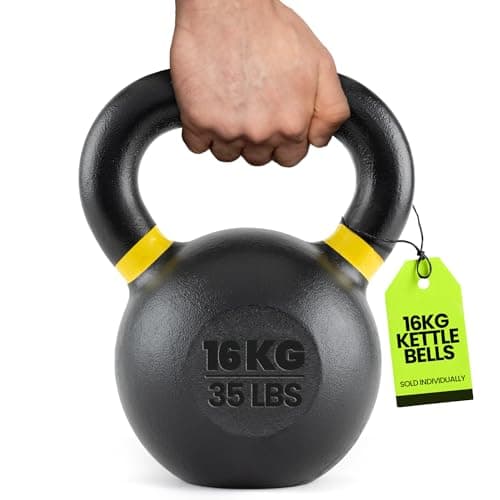
Rage Fitness Powder Coated Kettlebell (16 kg / 35.2 lb). Licensed stock photograph of the category — not the specific product.
The official weights
| Division | Kettlebells | Colour code | Distance |
|---|---|---|---|
| Women | 2 x 16 kg | White | 200 m |
| Women Pro / Men | 2 x 24 kg | Grey | 200 m |
| Men Pro | 2 x 32 kg | Black | 200 m |
| Doubles Women | 2 x 16 kg | White | 200 m |
| Doubles Women Pro / Men / Mixed | 2 x 24 kg | Grey | 200 m |
| Doubles Men Pro | 2 x 32 kg | Black | 200 m |
In pounds, those are roughly 35 lb, 53 lb and 70 lb per hand. One further rule from the same rulebook is worth knowing because it costs people time rather than weight: if you fail to return your kettlebells to the correct area, or leave them lying rather than upright, a 30-second penalty applies - and using the wrong weight for any part of the station means repeating the whole station, with disqualification if you do not.
There is no scaled option inside a division. The only decision you make about kettlebell weight at a HYROX race is which division you enter, so the training question is not "what weight should I use" but "how do I get to 200 metres with that weight".
Why the carry is harder than the number suggests
Two 24 kg bells is 48 kg total, which most men can pick up without ceremony on a fresh day. The farmers carry is the seventh of eight stations, after a sled push, a sled pull, burpee broad jumps and a 1,000 m row, with a kilometre of running between every one of them. Your forearms have already done the sled pull and the rowing. That is the actual difficulty: a moderate load held by a compromised grip while your heart rate is at threshold.
Which means the useful training target is not a heavier bell. It is time under load with a tired grip, and the ability to run - not walk - with the bells for sections of the 200 m. The people who do this station well are not the strongest; they are the ones whose hands do not open.
How to train a 200 m carry at home
Start at race weight for distance you can complete. If 2 x 24 kg gets you 40 metres before the bells slip, that is your starting block - not a reason to drop to 20 kg. Six sets of 40 m with ninety seconds rest, twice a week, and add 10 m a week. Getting to 200 m unbroken takes most people six to ten weeks from a 40 m start.
Train it tired on one of those days. Row 500 m, then carry. That is a far better simulation of the race than a fresh carry, and it is where you discover that your grip, not your legs, is the problem.
Add direct grip work. Dead hangs from a pull-up bar for time, two or three sets to near-failure, twice a week. This is the single highest-return addition for the carry and it needs no extra equipment if you already own a bar.
Do not chase a heavier carry. There is no prize for carrying 2 x 32 kg if you are racing the 24 kg division. Spend the extra sessions on distance and on a tired grip instead.
If you have a short space - a garage or a driveway rather than 50 m of clear run - carry in shuttles of 15 to 20 m with turns. Turns are harder than straight carries, which makes a short space a feature rather than a limitation. The garage gym essentials page covers the rest of a setup that can support this kind of training.
What to buy, honestly
You need a pair. This is the part that catches people out: a farmers carry with one bell is a suitcase carry, which is a useful exercise and not this station. So the real cost of training the carry is two bells at your division weight.
For the Women's division, that is two 16 kg bells, and 16 kg is the single most commonly stocked kettlebell weight there is - it is cheap and easy to buy twice. For Men at 24 kg, a pair is a meaningful purchase but still less than a barbell. For Men Pro at 32 kg, a matched pair of 70 lb bells is a serious buy, and the honest advice is to train at 24 kg for distance and 32 kg for short heavy holds rather than buying two 32s on day one.
An adjustable competition bell changes the arithmetic in one specific case: if you want to hit 16, 24 and 32 kg exactly from one object, and you are willing to train single-arm suitcase carries and swap the setting rather than carry two bells. It is the cheapest route to the exact weights and the wrong route if the carry itself is the thing you need to practise. Our adjustable kettlebell roundup ranks those, and best kettlebell sets covers buying several fixed bells at once.
The other HYROX stations a kettlebell helps with
Nothing else in a HYROX race uses a kettlebell, but a kettlebell trains three of the stations well. The sled push and sled pull are hip extension against resistance, which is what a heavy swing is - and if you have somewhere to use one, a sled is the direct answer. The sandbag lunges want front-loaded lunges, which a single bell in the goblet position replicates closely, and a training sandbag replicates exactly. The wall balls want a front squat and a throw, which a goblet squat partly covers.
If you are building a home setup specifically for this, the ranked priority is: somewhere to run, two bells at your division weight, a pull-up bar for grip, then a sandbag. The conditioning workouts page shows how to put those into a week.
Picks
Bells for training the carry
The single 16 kg bell for the Women's weight, the adjustable that can be set to 16, 24 or 32 kg exactly, and two ranges where you can buy a matched pair cheaply.
Key specs
- Weight
- 16 kg / 35.2 lb
- Build
- Single-cast iron, no welded joints
- Handle
- Wide ergonomic handle, powder-coated
Scores · editorial, out of 10
- Handle & finish
- 10
- Weight increments / adjustability
- 7
- Footprint & floor safety
- 7
- Build (casting, seams)
- 10
- Value
- 6
Pick 1 · Kettlebells
Rage Fitness Powder Coated Kettlebell (16 kg / 35.2 lb)
Rage Fitness
A single-cast iron bell with no welded joints, a powder-coated finish that takes chalk, a deliberately wide ergonomic handle, and the weight debossed in both lb and kg so you never grab the wrong one.
Best for
A grown-up single bell for two-handed swings, where handle width decides everything
Pros
- Powder coat holds chalk and does not peel the way enamel does on a dropped bell
- Single-cast with no seam at the handle join — the place cheap bells raise a blister
- Colour-coded, debossed lb and kg markings, so a shared rack never gets confusing
Cons
- Priced above a plain enamel bell of the same weight
- A wide handle is right for two hands and slightly loose for single-arm snatches
Key specs
- Weights
- 12–32 kg (26.5–70.5 lb), 41 settings in 0.5 kg steps
- Handle
- 35 mm, competition-shape steel shell
- Size
- 8.25 in. wide × 11 in. tall, 70.6 lb loaded
Scores · editorial, out of 10
- Handle & finish
- 10
- Weight increments / adjustability
- 10
- Footprint & floor safety
- 7
- Build (casting, seams)
- 9
- Value
- 6
Pick 2 · Kettlebells
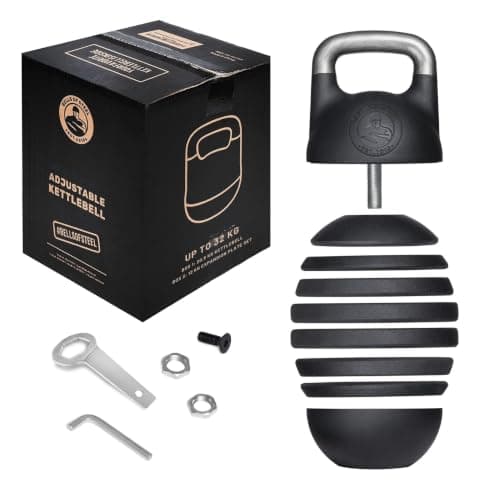
Bells of Steel Adjustable Competition Kettlebell (12–32 kg)
Bells of Steel
A 12 kg competition-shape steel shell with a full set of iron plates that sets any weight from 12 to 32 kg in 0.5 kg steps — 41 settings on a 35 mm handle, in the footprint of one bell.
Best for
Someone who wants one bell from 26 to 70 lb with competition geometry, not a plastic shell
Pros
- 0.5 kg micro-loading — 41 weights, with no gap to jump between presses
- Competition shape and a 35 mm handle at every setting, so cleans, snatches and get-ups feel the same light or loaded
- Steel shell and iron plates locked by a screw — no plastic dial to wear out, and a limited lifetime warranty on the shell
Cons
- Changing weight means the supplied Allen key and hex wrench — under a minute, not a second
- The most expensive adjustable here, and it starts at 12 kg (26 lb)
Specs from Bells of Steel — Adjustable Competition Kettlebell (range, 41 settings, 35 mm handle, dimensions, warranty).
Key specs
- Weights
- 5–80 lb (13 sizes)
- Finish
- Powder coat, no seams
- Accuracy
- Within 1% of stated
Scores · editorial, out of 10
- Handle & finish
- 9
- Weight increments / adjustability
- 9
- Footprint & floor safety
- 7
- Build (casting, seams)
- 9
- Value
- 8
Pick 3 · Kettlebells
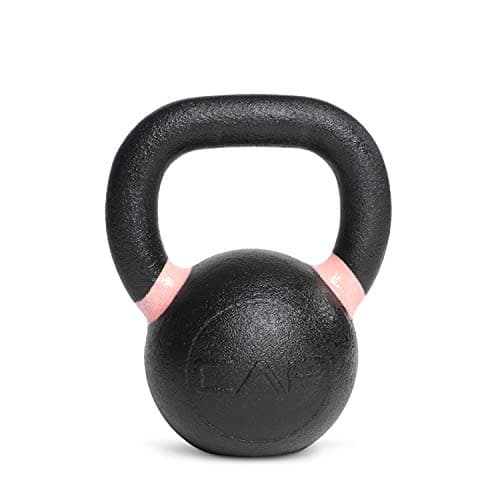
CAP Barbell Cast Iron Competition Kettlebell
CAP Barbell
Seam-free, powder-coated cast iron in 5–80 lb, weight accurate to 1%, with a wide opening handle and a flat base — a step up in finish from painted bells at a small premium.
Best for
A powder-coat bell with an honest weight in the widest range of sizes
Pros
- Powder coat holds chalk and doesn't chip like paint or enamel
- Machined seam-free casting — no ridge under the handle
- Color-coded band and lb/kg markings
Cons
- Bell dimensions scale with weight (it's cast iron, not a true competition bell despite the name)
- Costs more than the painted Yes4All at the same weight
Specs from CAP Barbell — Competition Weight Cast Iron Kettlebell (weights, finish, accuracy).
Key specs
- Weights
- 5–80 lb in 5 lb steps
- Handle
- ~1.25 in. (35 mm), textured
- Base
- Flat
Scores · editorial, out of 10
- Handle & finish
- 7
- Weight increments / adjustability
- 9
- Footprint & floor safety
- 7
- Build (casting, seams)
- 8
- Value
- 10
Pick 4 · Kettlebells
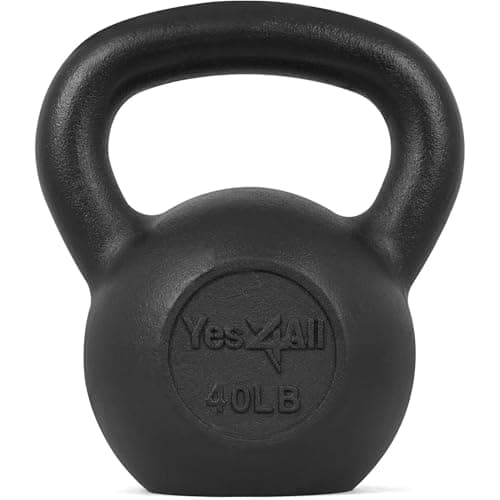
Yes4All Solid Cast Iron Kettlebell
Yes4All
The one-piece cast iron bell sold in 5 lb steps from 5 to 80 lb with a 1.25 in. handle and a flat base — the default first kettlebell because you can buy exactly the size you need.
Best for
A first bell in the exact weight you need without paying for a coating you don't
Pros
- 5 lb increments across the whole range — 15, 20, 25, 30, 35 lb are all there for a beginner's first two bells
- One-piece casting, no welded handle to fail
- Flat base sits still for rows, push-ups and storage
Cons
- Painted (not powder-coated) finish on the basic version chips and can leave marks on a wood floor — use a mat
- 35 mm handle is a bit thick for smaller hands on high-rep snatches
Specs from Yes4All — Solid Cast Iron Kettlebell listing (weights, handle, base).
FAQ
Questions readers ask
What kettlebell weight is used in HYROX?
The kettlebell farmers carry is 200 metres with two bells: 2 x 16 kg for Women, 2 x 24 kg for Women Pro and Men, and 2 x 32 kg for Men Pro. Doubles divisions use the same weights, with Mixed Doubles at 2 x 24 kg. Those figures come from the current HYROX rulebooks, cited below.
How far is the HYROX farmers carry?
200 metres, carried with both kettlebells. It is the seventh workout station, so you reach it after the ski, sled push, sled pull, burpee broad jumps and row, with a kilometre of running before each one. The distance combined with that fatigue is what makes it difficult, not the load itself.
What kettlebell weight should a woman use for HYROX?
16 kg per hand in the Women's division and 24 kg per hand in Women Pro. Train at your race weight for progressively longer carries rather than at a lighter weight for the full 200 m - the specific adaptation you need is holding the race load with a tired grip.
Do I need two kettlebells to train for HYROX?
For the farmers carry itself, yes - it is a two-bell station and a single-bell suitcase carry loads the trunk very differently. You can build a lot of the required grip and leg endurance with one bell plus dead hangs, but the last few weeks before a race should include genuine two-bell carries at race weight.
Can I use cast iron kettlebells to train for HYROX?
Yes, and most people do. The one thing worth matching is handle diameter: race bells are competition-style with a 35 mm handle, and handle thickness is the main determinant of when your grip fails on a long carry. Cast iron handles range from roughly 32 to 38 mm, so pick a pair near 35 mm if you can.
Why do I drop the kettlebells before 200 m?
Almost always grip, not legs. The fix is direct and boring: dead hangs from a bar to near-failure twice a week, carries done after rowing rather than fresh, and shorter carries at race weight rather than long ones at a lighter weight. Keep the bells slightly behind your centre of mass and your shoulders packed down rather than shrugged.
Does the HYROX kettlebell weight change between seasons?
Station standards are set in the rulebook and HYROX does revise them between seasons, so always check the current rulebook for your division and format before a race. The figures on this page were taken from the English Singles and Doubles rulebooks on 11 October 2026.
Related
Keep reading
- Cast iron vs competition kettlebells
Why handle diameter is the spec that decides a 200 m carry.
- Best kettlebell sets
Buying a matched pair at your division weight without paying twice.
- Best adjustable kettlebells
The cheapest route to 16, 24 and 32 kg from one object - and its limits for carries.
- Conditioning workouts at home
Putting carries, grip work and running into one week.
Sources
- —HYROX — Official Rulebook, Singles (EN): kettlebell farmers carry 200 m; Women 2 x 16 kg (white), Women Pro / Men 2 x 24 kg (grey), Men Pro 2 x 32 kg (black); 30-second penalty for kettlebells not returned upright to the correct area · maintain.hyrox.com
- —HYROX — Official Rulebook, Doubles (EN): farmers carry 200 m; Doubles Women 2 x 16 kg, Doubles Women Pro / Men / Mixed 2 x 24 kg, Doubles Men Pro 2 x 32 kg · maintain.hyrox.com
- —Bells of Steel — Adjustable Competition Kettlebell (12-32 kg, 41 settings in 0.5 kg steps, 35 mm competition handle) · bellsofsteel.us
- —CAP Barbell — Cast Iron Competition Kettlebell (5-80 lb across 13 sizes, powder coat, weight within 1% of stated) · capbarbell.com
- —Rage Fitness — Cast Iron Powder Coated Wide Handle Kettlebell listing (weight, casting, finish, handle, markings) · amazon.com
- —Yes4All — Solid Cast Iron Kettlebell listing (weights, handle, base) · amazon.com