Comparison · Jump Ropes
Jump rope mat vs yoga mat: the cable is what decides it
A yoga mat is built for a bare foot pressing down. A jump rope mat is built for a steel cable striking the same strip of surface two hundred times a minute. Use the wrong one and you will know within a fortnight.
Rope & Rep is reader-supported. Product links go through our affiliate resolver and we may earn a commission from qualifying purchases at no cost to you. Prices are the retailer's and change — every button opens the live price on Amazon rather than showing a stale number.
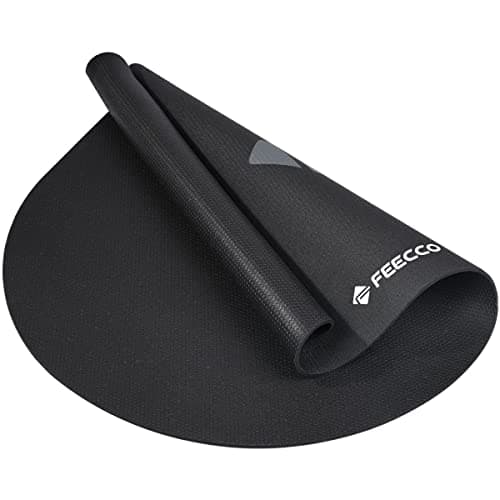
FEECCO Jump Rope Mat 54 × 36 in. (7 mm). Licensed stock photograph of the category — not the specific product.
Three different jobs, and a yoga mat only does one
A mat under a jump rope is doing three things at once, and they are easy to confuse.
The first is protecting the cord. A coated steel cable loses its coating fastest on concrete, and a worn coating is how a speed rope dies. A mat is cheaper than replacing cables.
The second is protecting the floor. Jumping on a hard floor marks it, and jumping on an upstairs floor transmits the impact into the room below. This is the job a yoga mat is closest to doing.
The third is surviving the strikes, and this is where a yoga mat fails. The cord lands on roughly the same narrow strip of surface every single revolution, at speed, for a few hundred revolutions a session. That is an abrasion and cutting load, not a compression load, and a soft foam mat designed for a palm and a bare foot is simply not built for it.
What actually happens to a yoga mat
With a PVC or beaded rope, not much, at least for a while. Those cords are thick, light and blunt, and they slap rather than cut. A decent TPE yoga mat will take months of that.
With a coated steel cable, the sequence is predictable. First the surface scuffs along the strike line. Then the top layer separates, because yoga mats are usually two bonded layers and the cord works into the seam. Then you get a furrow, and after that the mat is shedding material onto the floor and the cable is catching on the lip of the furrow, which is its own problem — a cable catching mid-revolution is how you end up whipping your own ankle.
With a weighted rope, add to that the compression. A 2 lb rope landing repeatedly compresses foam permanently, so the mat develops a visible dent along the strike line even before it tears.
Side by side
| Yoga mat | Jump rope mat | |
|---|---|---|
| Typical size | 68 x 24 in. | 48-54 in. long, 36 in. wide, or larger |
| Typical thickness | 4-6 mm foam or TPE | 5-7 mm PVC, rubber or vinyl foam |
| Built for | Compression from a hand or foot | Repeated cable strikes on one strip |
| Under a steel cable | Scuffs, then separates, then furrows | Designed for it |
| Grip on concrete | Moderate; slides when damp | Non-slip or tire-pattern backing |
| Weight | 2-3 lb | Up to about 6.5 lb |
| Rolls away | Easily | Bulky roll, often no strap |
| Cost | Lower | Higher, but it is a one-off |
Width is the spec nobody checks
This is the quiet reason a yoga mat disappoints even when it survives. A yoga mat is 24 inches wide. The arc your rope traces at the bottom of a revolution is wider than your shoulders by a comfortable margin, and if you drift at all — and everybody drifts — the cord lands on the floor either side of the mat rather than on it.
Purpose-built jump rope mats are 36 inches wide for exactly this reason. The length matters less than you would guess, since you are not travelling; 48 inches is enough for most people and 54 inches is enough for anyone. The ones shaped as ovals or rounded rectangles are tracking the shape of the arc rather than being decorative.
If you are set on using a yoga mat, lay it crossways rather than lengthways. It looks odd and it works better.
Thickness: more is not better
There is a temptation to buy the thickest mat available on the grounds that jumping is high-impact. It is the wrong instinct. A very soft, very thick mat absorbs the bounce you are trying to use — rope jumping is an elastic, ankle-driven movement, and a mat that swallows the rebound makes every jump harder and the rhythm worse.
The useful range is about 5 to 7 mm of a reasonably dense material. That is enough to take the edge off a concrete slab and protect the cord, and firm enough that the ankle still gets its return. Anything softer than a standard exercise mat starts working against you.
If your knees are the concern rather than the floor, the answer is technique and volume rather than padding: lower jumps, quieter landings, shorter sessions more often. The beginner jump rope workout builds that progression properly.
Where you are jumping changes the answer
Concrete garage or driveway. Buy a real mat, and prioritise the backing — a tire-pattern rubber base grips a smooth slab where foam slides. A yoga mat on concrete is the fastest way to destroy both the mat and the cord.
Apartment, upstairs. Buy a real mat, and prioritise size and mass. The mat is doing acoustic work as well as protective work, and a heavier mat transmits less. Our jumping rope in an apartment guide covers the rest of the noise problem, which is mostly about how you land.
Carpet. A yoga mat is genuinely useful here, because the problem is a flat surface rather than protection. Carpet already absorbs the cable strike.
A rubber-floored gym. You do not need a mat at all. The floor is already the mat.
What to buy if the yoga mat is out
Three mats cover the realistic cases. For a daily jumper, especially with a weighted rope, the biggest and heaviest mat is the right answer — 54 by 36 in. of 7 mm PVC at 6.5 lb stays put and gives the cord somewhere to land even when you drift. For an apartment corner, a 48 by 36 in. quarter-inch vinyl foam mat is the smallest footprint that still covers a single-under swing, and vinyl foam is quieter under a PVC rope than hard rubber. For a garage slab on a budget, a 5 mm rubber mat with a tire-pattern base grips smooth concrete better than foam does.
The full ranked comparison, including what each one does to a weighted rope, is on the best jump rope mats page.
Picks
If the yoga mat is not going to survive
Three purpose-built mats across the sizes that matter: the big thick one for daily jumpers, the compact one for an apartment, and the grippy rubber one for a garage slab.
Key specs
- Size
- 54 × 36 in. rounded
- Thickness
- 7 mm (0.28 in.) PVC
- Weight
- 6.5 lb
Scores · editorial, out of 10
- Floor protection & grip
- 9
- Size for a rope
- 10
- Rolls up & stores
- 7
- Durability
- 9
- Value
- 8
Pick 1 · Jump rope mats
FEECCO Jump Rope Mat 54 × 36 in. (7 mm)
FEECCO Fitness
A 54 × 36 in. rounded mat in 7 mm high-density PVC that weighs 6.5 lb — the biggest, thickest and heaviest of the three, which is what keeps the rope on the mat and the mat on the floor.
Best for
Daily jumpers, especially with weighted ropes, on a floor you don't own
Pros
- 54 in. long and 36 in. wide — the longest mat here, so the cord lands on mat instead of floor even when you drift
- 6.5 lb with a non-slip backing: the maker's point is that it stays put when a heavy rope strikes it
- 7 mm of high-density PVC, deliberately softer than the rock-hard PVC mats, and rated for indoor floors, outdoor concrete or grass
Cons
- The rim is a plain cut edge, not tapered — a drifting cable can still catch it
- 6.5 lb of 54 in. PVC is a bulky roll for a small closet, and no carry strap is included
Key specs
- Size
- 48 × 36 in. (Jumbo 86.5 × 43.5 in.)
- Thickness
- 1/4 in. high-density vinyl foam
- Base
- Non-slip
Scores · editorial, out of 10
- Floor protection & grip
- 8
- Size for a rope
- 9
- Rolls up & stores
- 9
- Durability
- 7
- Value
- 8
Pick 2 · Jump rope mats
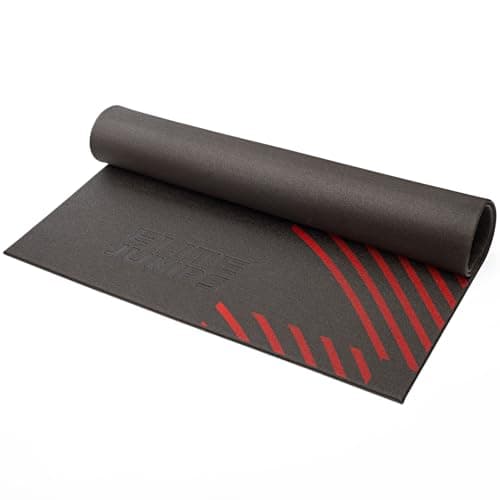
Elite Jumps Jump Rope Mat (Standard)
Elite Jumps
A 48 × 36 in., 1/4 in. high-density vinyl-foam mat with a non-slip base — the right size for an apartment corner, with a Jumbo 86 × 43 in. version for a garage.
Best for
An apartment jumper who needs a mat that fits a small footprint and rolls away
Pros
- The 48 in. standard is the smallest mat here that still covers a single-under swing
- Vinyl foam is quieter under a PVC rope than hard rubber
- Two sizes — buy the Jumbo for a garage or two jumpers
Cons
- Foam compresses under a 2 lb rope over time faster than PVC or rubber
- Square edges can catch a cable if you drift off the mat
Specs from Elite Jumps — Jump Rope Mat (sizes, thickness, material).
Key specs
- Size
- 48 × 36 in. oval
- Thickness
- 5 mm, three-layer rubber
- Base
- Tire-pattern grip
Scores · editorial, out of 10
- Floor protection & grip
- 9
- Size for a rope
- 8
- Rolls up & stores
- 8
- Durability
- 8
- Value
- 10
Pick 3 · Jump rope mats
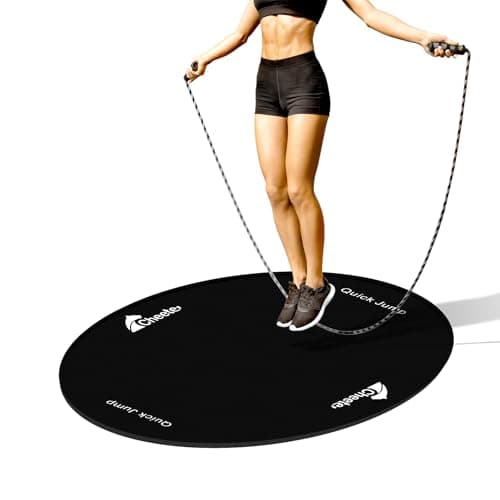
Cheete Jump Rope Mat 48 × 36 in. (5 mm)
Cheete
A 48 × 36 in. oval rubber mat, 5 mm thick, with a fabric top and a tire-pattern base — the budget mat that grips concrete and takes rope strikes without marking.
Best for
Jumping on a garage floor or balcony concrete on a budget
Pros
- Tire-pattern rubber base stays put on smooth concrete better than foam
- Fabric top layer takes cable strikes; rubber middle absorbs landings
- Oval shape matches the rope's arc, so less mat goes unused
Cons
- 5 mm is thinner than the 1/4 in. mats — less cushion for a heavy rope
- Rubber has a smell out of the box; air it out a day
Specs from Cheete — Jump Rope Mat 48×36 (5 mm) listing (size, thickness, layers).
FAQ
Questions readers ask
Can you use a yoga mat for jumping rope?
With a PVC or beaded rope and light use, yes — those cords are blunt and a decent TPE mat takes months of it. With a coated steel speed cable, no. The cord strikes the same narrow strip at speed on every revolution, which scuffs, then separates the mat's bonded layers, then cuts a furrow.
What thickness should a jump rope mat be?
About 5 to 7 mm of a reasonably dense material. That is enough to take the edge off concrete and protect the cord, and firm enough that your ankle still gets its rebound. Very thick, very soft mats absorb the bounce that rope jumping runs on and make the rhythm worse.
What size jump rope mat do I need?
Thirty-six inches wide is the number that matters, because your rope's arc is wider than a 24 in. yoga mat and half the strikes would land on the floor otherwise. Length is less critical since you are not travelling: 48 in. suits most people and 54 in. suits anyone.
Do I need a mat to jump rope on concrete?
For a coated steel cable, effectively yes — concrete strips the coating fast and a worn coating is how a speed rope fails. For a PVC rope you can get away without one, at the cost of the cord wearing through sooner. On concrete, prioritise a mat with a grippy backing; foam slides on a smooth slab.
Will a jump rope mat stop the noise for downstairs neighbours?
It reduces it, and a heavier, denser mat reduces it more, but the mat is only part of the answer. Most of the noise comes from how hard you land, so low jumps and quiet landings do more than any mat. A 6.5 lb mat is meaningfully better than a 2 lb one for this.
Related
Keep reading
- Best jump rope mats
The ranked list, with what each does to a weighted rope.
- Jump rope in an apartment
The rest of the noise problem, which is mostly about how you land.
- Speed rope vs weighted rope
Which cord you own decides how much mat you need.
- Best jump ropes for beginners
Start here if the rope itself is still undecided.
Sources
- —FEECCO Fitness — Jump Rope Mat 54 x 36 listing (size, 7 mm high-density PVC, 6.5 lb weight, non-slip backing, indoor and outdoor use) · amazon.com
- —Elite Jumps — Jump Rope Mat (48 x 36 in. standard and 86.5 x 43.5 in. Jumbo, 1/4 in. high-density vinyl foam, non-slip base) · elitejumps.co
- —Cheete — Jump Rope Mat 48x36 (5 mm) listing (oval size, three-layer rubber, fabric top, tire-pattern grip base) · amazon.com