Comparison · Pull-Up Bars
Pull-up bar vs dip bar: one you cannot use yet, one you can use today
A bar trains the half of your upper body a push-up ignores. A dip station trains the other half, harder. The deciding question is not which is better - it is which one you can currently do a single rep on.
Rope & Rep is reader-supported. Product links go through our affiliate resolver and we may earn a commission from qualifying purchases at no cost to you. Prices are the retailer's and change — every button opens the live price on Amazon rather than showing a stale number.
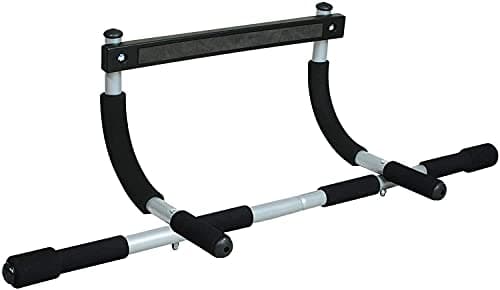
Iron Gym Total Upper Body Workout Bar. Licensed stock photograph of the category — not the specific product.
What each one actually trains
A pull-up bar trains vertical pulling: lats, mid-back, rear shoulder, biceps and grip. That matters more than it sounds because home training is overwhelmingly pushing — push-ups, dips, overhead press, everything you can do with the floor and gravity. Pulling is the half that needs equipment, and a bar is the cheapest equipment that provides it.
A dip station trains vertical pushing at depth: triceps, lower chest, front shoulder and a great deal of trunk. A dip is the heaviest pressing movement most people can do without weights, which makes it genuinely valuable — but it trains the same movement family as a push-up, just much harder.
That asymmetry is the strongest argument in the comparison. Without a bar you have no pulling at all. Without a dip station you have push-ups, which are not as good but are not nothing.
Side by side
| Pull-up bar | Dip bar / station | |
|---|---|---|
| Trains | Vertical pull: lats, mid-back, biceps, grip | Vertical push: triceps, chest, front delt, trunk |
| Substitutes without it | None at home worth having | Push-ups, chair dips, floor presses |
| Usable from day one? | Only if you can do a pull-up | Yes - feet down to scale any amount |
| Other movements | Hangs, knee raises, leg raises, rings and bands hang from it | Inverted rows, L-sits, knee raises, deep push-ups, step-ups |
| Fits a rented flat? | Yes - doorway bars need no screws | Yes, but it is a permanent floor object |
| Footprint | None when stored | About 2 x 3 ft, or stored if the bars nest |
| Typical rated load | 300-500 lb doorway; 800 lb on a bolted wall mount | 400-500 lb |
| Shoulder risk | Low with controlled reps | Real at depth, especially with a forward lean |
| Scaling down | Band assistance or negatives | Feet on the floor, or bent-knee support |
The beginner problem
Here is the case against buying the bar first, and it is a real one. If you cannot currently do a single pull-up — which is true of most people starting out, and of a large majority of women starting out — a pull-up bar is not an exercise. It is a progression tool: dead hangs, scapular pulls, negatives, band- assisted reps. Those are productive and they also take weeks before they turn into a rep.
A dip station, by contrast, scales down infinitely. Leave your feet on the floor and you can do a bench-dip-style rep from the first session, taking as much weight through your legs as you need. There is no barrier to entry.
So the honest answer splits. If you can already do two or three pull-ups, buy the bar, because you can use it immediately and it covers the gap in your training. If you cannot, the bar is still the right purchase — it is the only route to a first pull-up — but go in expecting to work the progression. Our first pull-up guide is the plan, and assistance bands are the accessory that makes it faster.
Which fits a rented flat
This is where a lot of readers of this site actually decide, and the two products behave very differently.
A doorway pull-up bar uses leverage against the frame and needs no screws at all. It goes up in ten seconds, comes down in ten, and leaves nothing behind when the lease ends — assuming your doorway has trim on both sides and falls in the 24 to 32 in. range most bars are built for. Our door frame damage guide covers the real risk, which is pressure marks rather than structural harm.
A dip station needs no fixings either, but it occupies about 2 by 3 ft of floor permanently — unless you buy the independent-bar type, which nests together and slides under a bed. For a small flat, that storage difference is often the whole decision.
What a dip station does beyond dips
This is underrated, and it narrows the gap considerably. A pair of dip bars at 28 to 38 in. gives you:
Inverted rows — lie underneath, grip the bars, pull your chest up. This is horizontal pulling, and it is the one movement that partly substitutes for a pull-up while you are building toward one.
L-sits and knee raises — support yourself on the bars and lift the legs. Excellent trunk work, and more accessible than hanging leg raises.
Deficit push-ups — hands on the bars, chest drops below them, which is a far harder push-up than the floor version.
Step-ups and single-leg work, on the sturdier stations.
With the inverted row in that list, a dip station alone is a more complete gym than the name implies — which is why it is a defensible first purchase for someone who genuinely cannot do a pull-up yet.
The combination argument
Three products on this page solve both problems at once and are worth knowing about before you choose.
A doorway bar that flips. The classic three-grip doorway bars sit on the floor as a push-up and dip frame when you take them down, which is not a real dip station — the handles are only a few inches high — but it is a free extra.
A power tower. One frame with a pull-up bar on top and dip handles below, plus usually a knee-raise station. It is the efficient answer if you have the floor space and a budget, and the power tower roundup covers the options.
Rings on a bar. A set of gymnastic rings hung from a wall-mounted or ceiling-mounted bar gives you ring dips, which are harder than bar dips and scale for years. The rings versus pull-up bar comparison goes into that properly.
The order to buy them in
Bar first, station second, for almost everybody. The bar fills a gap nothing else fills, it costs less, and it stores to nothing. Add the dip station when your push-ups have stopped being hard, which for most people is a few months in.
Reverse it if you genuinely cannot hang. If grip or shoulder issues make a dead hang painful, the dip station gives you inverted rows and deep pressing while you sort that out.
Skip both and buy a tower if you have the space and the money. One object, both jobs, no compromise on either.
Picks
One of each, at both ends of the budget
Two bars - the no-screws doorway bar and the bolted wall mount - and two dip options, the storable independent pair and the fixed station for weighted work.
Key specs
- Door width
- 24–32 in. (trim to 3.5 in.)
- Mounting
- Leverage, no screws
- Rated load
- 300 lb
Scores · editorial, out of 10
- Fit & clearance (door, ceiling, depth)
- 7
- Reversibility (no drill, no marks, takedown)
- 9
- Rated load & build
- 7
- Grip options
- 8
- Value
- 10
Pick 1 · Pull-up bars
Iron Gym Total Upper Body Workout Bar
Iron Gym
The doorway bar everyone copies: three grips, a 300 lb rating, fits a 24–32 in. door with trim up to 3.5 in., and it leaves with you when the lease ends.
Best for
A first bar in a standard apartment doorway
Pros
- Fits the most common US interior door range and trim depth without tools
- Three grip positions (wide, narrow, neutral) on a bar this cheap is rare
- Flips to the floor for push-ups and dips — one piece of gear, four movements
Cons
- The leverage design needs a door with trim on both sides; flat, trimless frames won't hold it
- Grip width is fixed — taller lifters may find the wide grip a touch narrow
Specs from Iron Gym — Total Upper Body Workout Bar listing (door width, trim, load).
Key specs
- Mounting
- Wall studs; assembled 49 × 24 × 20 in.
- Grips
- Multi-grip — wide, neutral and close positions
- Rated load
- 800 lb
Scores · editorial, out of 10
- Fit & clearance (door, ceiling, depth)
- 7
- Reversibility (no drill, no marks, takedown)
- 3
- Rated load & build
- 10
- Grip options
- 10
- Value
- 8
Pick 2 · Pull-up bars
Gronk Fitness Wall Mounted Multi-Grip Pull Up Bar
Gronk Fitness
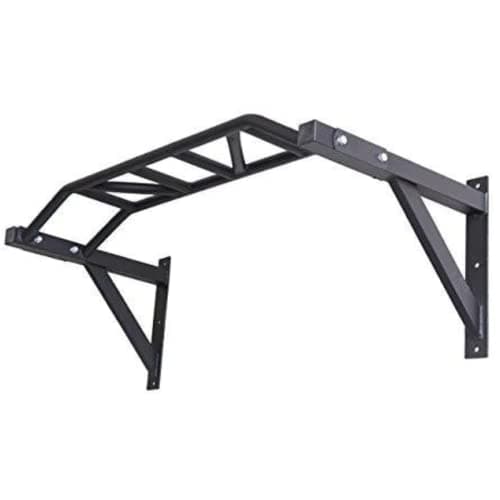
A commercial-grade stud-mounted station: 37 lb of powder-coated steel, a published 800 lb capacity, multiple grip positions and an assembled 49 × 24 × 20 in. frame — the one wall bar here you can hang rings and bands from without thinking about it.
Best for
A garage wall you are allowed to drill, where the bar has to outlast the house
Pros
- 800 lb rated, which takes a heavy adult plus a weight vest and a band without a second thought
- Powder-coated smooth tube — it does not shred hands or band loops the way a knurled or welded bar does
- A deliberate anchor for rings, ab straps and bands, so one mount becomes the whole wall setup
Cons
- Lag bolts into studs: this is a drilled installation and not a renter's option
- 37 lb of steel at 49 in. wide — a two-person lift to hold it in place while you bolt it
- The most expensive wall bar here by a clear margin
Specs from Gronk Fitness — Wall Mounted Multi Grip Pull Up Bar listing (capacity, coating, assembled size, weight).
Key specs
- Size
- 28 in. tall, 21 in. base (XL also sold)
- Weight
- 7.5 lb per bar, 15 lb the pair
- Rated load
- 400 lb
Scores · editorial, out of 10
- Stability & rated load
- 8
- Footprint & storage
- 10
- Height / width adjustment
- 6
- Grip
- 8
- Value
- 8
Pick 3 · Dip bars
Lebert Fitness EQualizer (pair)
Lebert Fitness
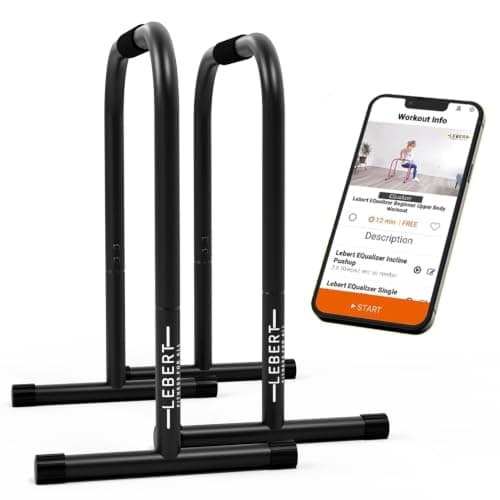
Two independent 28 in. steel bars on a 21 in. base, 7.5 lb each, 400 lb capacity, that nest together for storage — the dip bars that fit under a bed and set up in five seconds. A hip resistance band is in the box.
Best for
Dips, rows and push-ups in an apartment where nothing can stay on the floor
Pros
- Two separate bars — set them at any width, or use one for rows and step-ups
- Nest together and weigh 15 lb for the pair; store under a bed or in a closet
- A hip resistance band and the exercise video library come with it
Cons
- Independent bars can walk apart on a slick floor during dips — use a mat
- No height adjustment within a size; pick the size by your height
Key specs
- Adjustment
- 4 height and 4 width settings
- Base
- Bottom safety connection bar, non-slip foot sleeves
- Rated load
- 400 lb
Scores · editorial, out of 10
- Stability & rated load
- 10
- Footprint & storage
- 6
- Height / width adjustment
- 9
- Grip
- 8
- Value
- 8
Pick 4 · Dip bars
Sportsroyals DP3 Adjustable Dip Bar Station (400 lb)
Sportsroyals
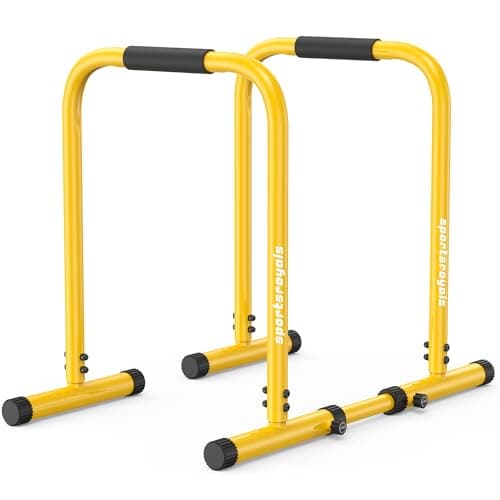
A dip station with four height and four width settings, 2 mm thickened steel tube, a bottom safety connection bar and a 400 lb rating — the stable choice for weighted dips in a garage corner, and it stacks to store.
Best for
Heavy or weighted dips where the bars must not move
Pros
- A bottom connection bar stops the two uprights splaying apart under load
- Four heights and four widths, so the grip width is yours rather than the maker's
- 400 lb rating leaves room for a vest or dip belt
Cons
- Stacks for storage but does not fold flat
- Heavier to move than a pair of EQualizers
Specs from Sportsroyals — DP3 Adjustable Dip Bar listing (height and width adjustment, steel gauge, capacity, base).
FAQ
Questions readers ask
Should I buy a pull-up bar or a dip bar first?
A pull-up bar, for most people. It trains vertical pulling, which nothing else at home provides, and it costs less and stores to nothing. A dip can be partly substituted with push-ups; a pull-up cannot be substituted at all. The exception is if you cannot yet hang comfortably, in which case a dip station gives you inverted rows and deep pressing immediately.
Are dips or pull-ups better for building upper body?
They are complementary rather than competing. Pull-ups build the back, rear shoulder, biceps and grip; dips build triceps, lower chest, front shoulder and trunk. Most home programmes that only do one end up unbalanced — and because home training is already pushing-heavy, the pull side is usually the one that is missing.
Can you do dips on a pull-up bar?
Not on a doorway bar in its mounted position — there is no clearance. Some doorway bars flip to the floor as a low push-up and dip frame, which is a very shallow dip rather than a real one. For proper dips you want a dip station, a power tower, or gymnastic rings hung from a bar.
Which is better for a small apartment?
A doorway pull-up bar, usually. It needs no screws, goes up and down in seconds and stores flat. A dip station occupies about 2 by 3 ft of floor permanently unless you buy the independent-bar type, which nests and fits under a bed — that version is the apartment-friendly dip option.
Is a power tower better than buying both separately?
If you have the floor space and the budget, yes — one frame does both jobs properly, and the dip handles sit higher than a free-standing station because the frame is already tall. The trade is cost and a permanent footprint of around 4 by 4 ft, which rules it out of most flats.
Related
Keep reading
- Pull-up bar vs power tower
The next decision up, if the floor space exists.
- Best dip bars
If the dip station won: which one, and at what height.
- Best pull-up bars
If the bar won: doorway, wall-mount and free-standing ranked.
- How to get your first pull-up
The progression that makes the bar usable if you cannot do one yet.
Sources
- —Iron Gym — Total Upper Body Workout Bar listing (24-32 in. door width, trim to 3.5 in., 300 lb rating, three grips, flips for floor use) · amazon.com
- —Gronk Fitness — Wall Mounted Multi Grip Pull Up Bar listing (800 lb capacity, powder-coated steel, 49 x 24 x 20 in. assembled, 37 lb) · amazon.com
- —Lebert Fitness — EQualizer with Resistance Band listing (28 in. bar height, 21 in. base, 15 lb the pair, 400 lb capacity, nests for storage) · amazon.com
- —Sportsroyals — DP3 Adjustable Dip Bar listing (4 height and 4 width settings, bottom safety connection bar, 400 lb capacity) · amazon.com