Comparison · Kettlebells
BowFlex 840 vs Bells of Steel adjustable kettlebell: a dial you turn against a bell you can swing
These are the two serious adjustable kettlebells, and they are not competing for the same buyer. One changes weight in a second and tops out at 40 lb in a plastic shell. The other is a steel competition bell from 26 to 45 lb — 70 with a separate expansion kit — that needs a hex key and costs more.
Rope & Rep is reader-supported. Product links go through our affiliate resolver and we may earn a commission from qualifying purchases at no cost to you. Prices are the retailer's and change — every button opens the live price on Amazon rather than showing a stale number.
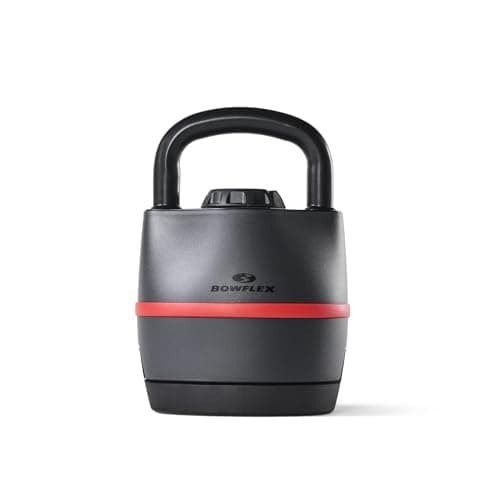
BowFlex SelectTech 840 Adjustable Kettlebell. Licensed stock photograph of the category — not the specific product.
The decision is how often you change the weight
Everything else about these two bells follows from one question that has nothing to do with specs: inside a single training session, how many times do you want a different weight in your hand?
If the answer is four or five times — a press ladder, a complex that drops weight as the reps climb, two people of different strength sharing one bell — then the mechanism matters more than the bell does. The BowFlex changes by turning a dial on the base while the bell sits on the floor. It takes about as long as re-tying a shoe, and it is the only reason to accept a plastic shell.
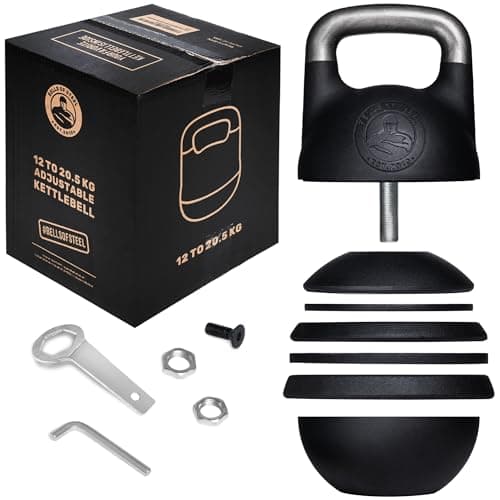
If the answer is once, or once a month, then the mechanism is nearly irrelevant and the shell is the whole purchase. The Bells of Steel bell changes weight by opening a screw with the supplied Allen key and swapping iron plates inside a steel competition-shape shell. Call it under a minute. In exchange you get a 35 mm handle and the same external shape at every setting, which is what makes cleans, snatches and get-ups feel identical whether the bell reads 12 kg or 20.5 kg.
That is the whole comparison in two sentences. The rest of this page is what each trade-off actually costs you.
Side by side
| BowFlex SelectTech 840 | Bells of Steel Adjustable Competition | |
|---|---|---|
| Weight range | 8 / 12 / 20 / 25 / 35 / 40 lb — six settings | 12-20.5 kg (26.5-45.2 lb) — 18 settings in 0.5 and 1 kg jumps; 32 kg and 41 settings with the expansion kit |
| Smallest step | 4 lb at the bottom, 10 lb between 25 and 35 | 0.5 kg (about 1.1 lb), the whole way up |
| How it changes | Dial on the base | Allen key and hex wrench, iron plates inside the shell |
| Time per change | A second or two | Under a minute |
| Shell | Plastic over the weight stack | Steel, competition shape |
| Handle | Flat and wide | 35 mm, identical at every setting |
| Size | 8.8 x 7 x 12.5 in. | 8.25 in. diameter x 11 in. tall, 45.2 lb loaded |
| Warranty | Per BowFlex's own product page | Limited lifetime on the shell |
| Price bracket | The cheaper of the two | The most expensive adjustable on this site; the expansion kit is extra again |
What the plastic shell actually costs you
Not durability in normal use. A dial-adjust bell set down under control on a mat, session after session, is fine, and the BowFlex has been on the market long enough to be a known quantity rather than a gamble.
What it costs you is the two things a kettlebell is uniquely good at. The first is drop tolerance. A cast iron bell can be set down hard, dropped on a rubber mat at the end of a brutal swing set, and knocked against a concrete slab without anyone caring. A plastic shell over a weight stack cannot, and that changes how you finish a set — you have to put it down nicely at the exact moment you least want to.
The second is shape. A kettlebell is a handle over a ball of offset mass, and the offset is the point: it is what makes the swing a hinge and the clean a rotation rather than a curl. A dial-adjust bell is a box with a handle, and it is a wide, flat handle at that. For swings, goblet squats, rows, presses and carries — most of what most people do — this is a non-issue. For snatches and high-rep single-arm cleans, where the bell has to rotate cleanly around the back of your wrist, it is a real difference, and it is why our adjustable vs standard page argues for fixed bells whenever space allows.
What the steel shell actually buys you
Three things, in order of how much they matter.
A constant handle and a constant shape. At 12 kg and at 20.5 kg the handle is 35 mm and the shell is the same size. Nothing about the lift changes as you get stronger — the rack position, the clean path and the insertion on a snatch are identical. On cast iron, the shell grows and the handle thickens with the weight, so every jump is a slightly new skill. That is the same argument our cast iron vs competition page makes, except here you get it without buying five bells.
Half-kilo micro-loading. This sounds like a specification and is actually a training feature. Overhead pressing is the lift where kettlebell progress stalls, because the standard jump between fixed bells is 4 kg — about 9 lb — which is an enormous increment on a one-arm press. Half-kilo steps turn a wall into a ramp.
A ceiling you can raise. Two-handed swings and goblet squats outgrow 40 lb quickly. If you train seriously for a couple of years, a bell that stops at 40 lb becomes a warm-up bell and you buy a heavy bell anyway. As sold, the Bells of Steel bell runs to 45.2 lb — past the BowFlex, though not by much — and a separate expansion kit adds 13 kg of plates to the same shell for a 70.5 lb ceiling. The BowFlex has no such path: 40 lb is where it ends.
The cost is money and a wrench. It is the most expensive adjustable on this site, it starts at 12 kg so it is useless as a beginner's light bell, and changing weight is a deliberate act rather than a reflex.
Which one fits a small space better
Both of them, which is the entire point of an adjustable — but differently.
The BowFlex wins on pure footprint and on how it lives in a room. At 8.8 x 7 x 12.5 in. it goes under a desk or in a closet, it does not look like gym equipment, and it never rings when you set it down. For a studio apartment where the training space is also the living space, that is worth real money.
The Bells of Steel bell is 8.25 in. wide and 11 in. tall, so it is barely larger — but loaded it is 45.2 lb of steel and iron, which is a different object to move and a different thing to set down on a floor you do not own. If you are upstairs from somebody, the honest answer is a mat under the working area and a rule that the bell never leaves your hand above knee height. Kettlebells in an apartment covers the floor and noise question properly.
Neither bell needs a rack, and that is the real small-space win. Three fixed bells covering the same range need somewhere to live, and a corner with three bells in it is a corner you stop walking through.
The case for buying neither
Adjustable kettlebells solve a storage and money problem, and they create a training one: you can only ever hold one bell. Double kettlebell work — double front squats, double cleans, double presses, the farmer carry — needs two bells of the same weight, and no adjustable gives you that at any price.
So if you already own a 16 kg or 20 kg bell and you are thinking about an adjustable to fill in the rest, stop and price a second fixed bell first. A matched pair in your working weight opens a whole category of training that one adjustable cannot touch, and it usually costs less than either bell on this page. The main kettlebell roundup is where to go for that, and the sizing page works out what weight the second one should be.
The other case for neither is simpler: you do not know what weight you need yet. That is an extremely common and entirely reasonable position, and the right response is not to spend serious money on range. It is to buy the cheapest cast iron adjustable that covers the beginner window, train for three months, then buy the bell you have learned you want.
Where the Yes4All adjustable fits
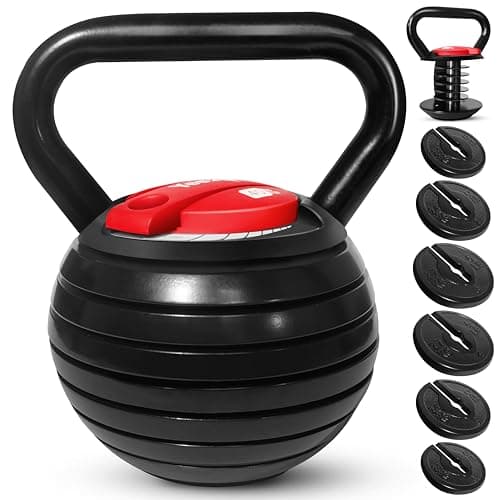
It is on this page because for a lot of readers it is the correct answer to a comparison between two bells they should not buy yet. It is cast iron rather than plastic, powder-coated with no welds, it covers 10 to 40 lb in six settings, and it costs a fraction of either bell above.
What it gives up is everything the other two are being paid for: the plate change is manual and slower than the BowFlex dial, the handle is wider than a competition bell so it is not the one to snatch with, and the 40 lb ceiling is the same one the BowFlex has. It is a good first adjustable and a bad last one. Our adjustable kettlebell roundup ranks all three against the full rubric if you want the scoring rather than the verdict.
The verdict
For most people reading this site — a corner of a rented apartment, one bell, a few sessions a week — the BowFlex 840 is the better buy of the two. The 8 to 40 lb range covers the window where most training actually happens, the footprint is the smallest, and the dial genuinely changes how a session flows when you are working a press ladder alone.
The Bells of Steel bell is the better bell, and it is the right purchase for a narrower buyer: somebody who already knows they hinge, press and clean regularly, who wants competition geometry, and who would otherwise buy four bells over the next two years. Over that horizon the price stops looking unreasonable — but only over that horizon.
And if budget is the live constraint, buy the Yes4All, spend the difference on a mat, and come back to this page in a year when you know what you need.
Picks
The two bells in this comparison, and the budget alternative
The BowFlex SelectTech 840 and the Bells of Steel Adjustable Competition Kettlebell are the head-to-head. The Yes4All adjustable is here because for a large group of readers it is the honest answer to both.
Key specs
- Weights
- 8 / 12 / 20 / 25 / 35 / 40 lb
- Size
- 8.8 × 7 × 12.5 in.
- Adjust
- Dial
Scores · editorial, out of 10
- Handle & finish
- 6
- Weight increments / adjustability
- 9
- Footprint & floor safety
- 9
- Build (casting, seams)
- 6
- Value
- 7
Pick 1 · Kettlebells
BowFlex SelectTech 840 Adjustable Kettlebell
BowFlex
Six bells in one: 8, 12, 20, 25, 35 and 40 lb by turning a dial, in an 8.8 × 7 × 12.5 in. footprint — the adjustable bell for an apartment corner that can't hold a rack.
Best for
Replacing a beginner's first three bells with one object that fits under a desk
Pros
- Six weights in the footprint of one 40 lb bell — the space argument is decisive in a studio
- Dial change takes a second between sets
- Flat base; the 8–40 lb range is exactly the beginner-to-intermediate window
Cons
- Plastic shell and a flat, wide handle — it's not a bell you should drop or use for hard snatches
- Tops out at 40 lb; the jumps (20→25→35) aren't even
Specs from BowFlex — SelectTech 840 Adjustable Kettlebell (weights, dimensions).
Key specs
- Weights
- 12–20.5 kg (26.5–45.2 lb), 18 settings in 0.5 and 1 kg jumps
- Handle
- 35 mm, competition-shape steel shell
- Shell size
- 8.25 in. diameter × 11 in. tall; 45.2 lb fully loaded
Scores · editorial, out of 10
- Handle & finish
- 10
- Weight increments / adjustability
- 9
- Footprint & floor safety
- 7
- Build (casting, seams)
- 9
- Value
- 6
Pick 2 · Kettlebells
Bells of Steel Adjustable Competition Kettlebell (12–20.5 kg)
Bells of Steel
A 12 kg competition-shape steel shell with iron plates that sets any weight from 12 to 20.5 kg in 0.5 and 1 kg jumps — 18 settings on a 35 mm handle, in the footprint of one bell. A separate expansion kit adds 13 kg of plates to reach the full 32 kg and 41 settings.
Best for
Someone who wants one bell from 26 to 45 lb with competition geometry, not a plastic shell
Pros
- 0.5 kg micro-loading — 18 weights, with no gap to jump between presses
- Competition shape and a 35 mm handle at every setting, so cleans, snatches and get-ups feel the same light or loaded
- Steel shell and iron plates locked by a screw — no plastic dial to wear out, and a limited lifetime warranty on the shell
Cons
- Changing weight means the supplied Allen key and hex wrench — under a minute, not a second
- 20.5 kg (45.2 lb) is the ceiling as sold — the 32 kg range needs the separate expansion kit on top
- The most expensive adjustable here, and it starts at 12 kg (26 lb)
Key specs
- Weights
- 10–40 lb, 6 settings
- Build
- Cast iron, powder coat, no welds
- Base
- Flat
Scores · editorial, out of 10
- Handle & finish
- 7
- Weight increments / adjustability
- 9
- Footprint & floor safety
- 8
- Build (casting, seams)
- 7
- Value
- 9
Pick 3 · Kettlebells
Yes4All Adjustable Kettlebell (10–40 lb)
Yes4All
A cast iron, powder-coated adjustable bell with six settings from 10 to 40 lb and a flat base — the cheapest way to own an adjustable kettlebell that's still metal.
Best for
A budget adjustable bell for a beginner who'll outgrow 10 lb but not 40 lb
Pros
- Cast iron with no welds, unlike plastic-shell adjustables
- 10 lb starting weight suits an absolute beginner; 40 lb top is enough for most goblet squats and swings
- Cheapest adjustable here
Cons
- Plate changes are manual — slower than a dial
- Handle is wider than a competition bell; not ideal for snatches
Specs from Yes4All — 10–40 lb Adjustable Kettlebell listing (settings, construction).
FAQ
Questions readers ask
Is the BowFlex 840 a real kettlebell?
It is a real adjustable weight with a kettlebell handle, and it does the kettlebell movements most people actually do — swings, goblet squats, rows, presses, carries — perfectly well. What it is not is a cast kettlebell: the shell is plastic over a weight stack, the handle is flat and wide rather than a 35 mm bar, and it should not be dropped. For snatches and high-rep single-arm cleans, where the bell has to rotate around the back of your wrist, a cast bell is genuinely better.
Can you swing an adjustable kettlebell?
Yes, both of these. The thing to avoid is releasing it. Two-handed swings, single-arm swings and cleans are all fine on either bell; what you cannot do is finish a set by dropping it, which is how plastic shells get broken and how a rented floor gets marked. Set it down under control every time and neither bell minds.
How long does changing the weight take on each one?
A second or two on the BowFlex — you turn a dial on the base while the bell sits on the floor. Under a minute on the Bells of Steel, using the supplied Allen key and hex wrench to open the shell and swap iron plates. If you change weight four times inside a session, that difference is the whole purchase. If you change it once a month, it is noise.
Is an adjustable kettlebell worth it over three fixed bells?
It depends entirely on whether you have somewhere to put three bells. An adjustable wins on floor space and usually on money up to about three bells; past that, fixed bells win on cost per pound and win outright on durability and shape. The one thing no adjustable can do is double kettlebell work, because you only ever have one bell — so if double front squats and double presses are in your plans, buy a matched pair instead.
Which adjustable kettlebell goes heaviest?
Of these, the Bells of Steel Adjustable Competition Kettlebell: 20.5 kg (45.2 lb) as sold, or 32 kg (70.5 lb) once you add its expansion kit. The BowFlex 840 and the Yes4All both stop at 40 lb. For two-handed swings and goblet squats, 40 lb is a weight most people pass within a year or two of consistent training, which is the main argument for paying for the heavier bell up front.
Why does handle diameter matter on an adjustable kettlebell?
Because it decides how much of a set is limited by your grip rather than by the muscles you are trying to train. A 35 mm competition handle that stays 35 mm at every setting means a snatch at 20.5 kg feels like a snatch at 12 kg. A wide, flat dial-adjust handle is comfortable for two hands on a swing and awkward for one hand on anything that rotates. Our rings diameter page makes the same point about grip thickness in a different category — four millimeters changes what a lift is.
Which one should a complete beginner buy?
Neither, probably. A complete beginner is best served by one fixed cast iron bell in the right weight — 8 to 12 kg for most untrained adults — because it costs a quarter as much and teaches the same movements. If you specifically want range because you do not know your weight yet, buy the cheapest cast iron adjustable rather than either bell on this page, and decide properly in three months.
Related
Keep reading
- Best adjustable kettlebells
All three scored against the full rubric.
- Adjustable vs standard kettlebells
One object or three, and what the dial costs.
- Cast iron vs competition kettlebells
Why a constant handle and shell is worth money.
- What size kettlebell should a beginner buy?
The sizing table, movement by movement.
- Kettlebells in an apartment
Floors, noise and nothing dropped.
Sources
- —BowFlex — SelectTech 840 Adjustable Kettlebell product page (six weights from 8 to 40 lb, 8.8 x 7 x 12.5 in., dial adjustment) · bowflex.com
- —Bells of Steel — Adjustable Competition Kettlebell product page (12-20.5 kg and 12-32 kg configurations, 0.5 kg micro-loading, 35 mm handle, shell 8.25 x 11 in., 70.5 lb fully loaded at 32 kg, limited lifetime shell warranty) · bellsofsteel.us
- —Yes4All — 10-40 lb Adjustable Kettlebell listing (six settings, cast iron with powder coat, no welds) · amazon.com