Comparison · Kettlebells
Kettlebell vs sandbag: a fixed load that teaches skill, or a shifting load that does not care
A bell rewards technique and punishes sloppiness. A bag absorbs both, because the weight moves no matter what you do. Which of those is the right first purchase comes down to whether you want to learn something or just carry something heavy.
Rope & Rep is reader-supported. Product links go through our affiliate resolver and we may earn a commission from qualifying purchases at no cost to you. Prices are the retailer's and change — every button opens the live price on Amazon rather than showing a stale number.
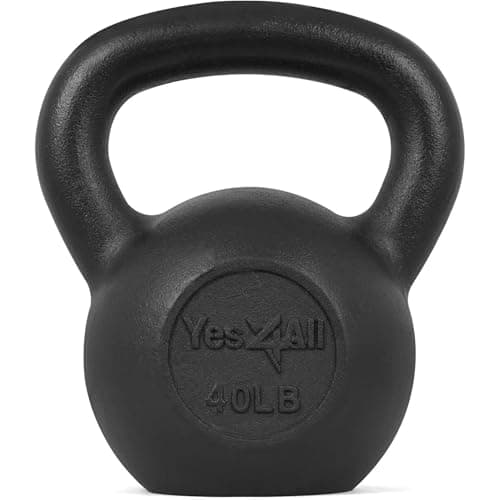
Yes4All Solid Cast Iron Kettlebell. Licensed stock photograph of the category — not the specific product.
The fundamental difference: a fixed load against a live one
A kettlebell is a rigid object with a handle in a known place and a centre of mass a known distance below it. Every rep is the same. That predictability is what makes it a skill tool — you can groove a swing, a clean or a snatch, feel what changed between rep four and rep five, and get better at the movement itself.
A sandbag has no fixed centre of mass at all. The fill shifts on every rep, so a clean that worked last time arrives slightly differently this time and you have to react. That makes it a terrible skill tool and an excellent robustness tool: the trunk, the grip and the stabilising muscles work constantly because nothing is ever quite where it was.
Neither of those is better. They are different training effects, and the choice depends on which one you currently lack.
Side by side
| Kettlebell | Sandbag | |
|---|---|---|
| Load behaviour | Fixed, predictable, same every rep | Shifts constantly; the bag fights back |
| Core movements | Swing, goblet squat, press, row, get-up, clean, snatch | Clean, shoulder, carry, bear hug squat, over-shoulder throw |
| Adjustable? | No - one bell, one weight | Yes - filler bags or inserts across a range |
| Skill to learn | Real; the swing takes a few weeks | Almost none; awkward is the point |
| Grip demand | Moderate, handle-based | High - there is no good handle on a loaded bag |
| Noise | The loudest thing in an apartment if set down hard | Nearly silent; it is a bag |
| Floor risk | Chips wood, marks laminate | None - it is fabric |
| Storage | A dense object in a corner | Folds flat when empty |
| Setup | Open the box and train | Buy sand, fill the inner bags, seal, repeat per weight |
| Cost per pound | Low | Lower if you fill it yourself; high if pre-filled |
What a kettlebell does that a sandbag cannot
Ballistics. A swing, a clean and a snatch all depend on the weight travelling a predictable arc and arriving in a predictable place. You can swing a sandbag, and people do, but the precision that makes a kettlebell swing a hip-power exercise is not available when the load reshapes itself mid-flight.
Pressing overhead with a locked position. A bell racks on the forearm and presses in a straight line. A bag presses as a wobbling mass and the shoulder has to stabilise rather than drive.
The Turkish get-up. Arguably the single most useful movement a one-tool home gym can own, and it needs a fixed weight held directly overhead for ninety seconds. A bag makes it a different and much less useful exercise.
Precision progression. Bells come in defined steps — 5 lb increments on the common cast iron ranges — so you always know exactly what you lifted.
What a sandbag does that a kettlebell cannot
Front-loaded carries. A bag hugged to the chest or sat on one shoulder is the closest gym equivalent to carrying a person, a toolbox or a bag of compost, and it loads the trunk in a way a bell in one hand does not.
Heavy loads cheaply. Getting to 100 lb with kettlebells means buying several expensive bells. Getting to 100 lb with a bag means buying more sand. The adjustable bags here span 5 lb to 200 lb in one purchase.
Falling on you harmlessly. A 60 lb bag dropped on a foot is unpleasant. A 60 lb bell dropped on a foot is a hospital visit. For training alone in a garage, that asymmetry is worth something.
Training the pick-up. The awkward, round-backed, grip-limited lift off the floor is the thing a sandbag trains and nothing else does — and it is the pattern most real-world lifting actually uses.
Noise, floors and apartments
If you train above someone, the sandbag wins outright and it is not close. There is nothing hard about it, nothing to chip a floor, and a dropped bag makes a dull thud rather than a bang. A kettlebell is the loudest object most people own, and it has to be set down forty times a session.
Kettlebells can be made to work upstairs — a vinyl coating and a thick mat get you most of the way, and our kettlebells in an apartment guide covers the rest. But the bag starts quiet, and if your constraint is a neighbour rather than a budget, that matters more than any training argument on this page.
Which to buy first
You are new to training: the kettlebell. One bell gives you hinge, squat, press, row and carry with defined technique you can measure yourself against, and the skill transfers. Our size guide covers which weight to start with, and the one-kettlebell workout is the programme to run.
You already lift and want conditioning and carries: the sandbag. It adds something a barbell and dumbbells genuinely do not have, and it does it cheaply.
You train in an apartment: the sandbag, unless you are willing to buy vinyl bells and a thick mat.
You want one object for the next ten years: the kettlebell. Sand leaks, zips wear and fabric eventually fails. A cast iron bell is a lump of metal that outlives its owner.
The honest answer for most people
Buy one kettlebell, learn to swing it properly, and add a sandbag in six months when you want to carry things. That order works because the bell teaches a hip hinge, and a hip hinge is what makes picking up a heavy awkward bag safe rather than exciting.
If you reverse the order it still works, but the bag will teach you less about how to move and you will probably spend the first month picking it up badly. Either way, the pair of them in a garage covers more ground than most commercial gym floors do. The training sandbag roundup covers that side of the purchase in full.
Picks
One of each, at the weight most people should start at
Two bells - the budget cast iron and the wide-handled powder coat - and two bags, one adjustable across a wide range and one fixed at a weight that will outlast the gym.
Key specs
- Weights
- 5–80 lb in 5 lb steps
- Handle
- ~1.25 in. (35 mm), textured
- Base
- Flat
Scores · editorial, out of 10
- Handle & finish
- 7
- Weight increments / adjustability
- 9
- Footprint & floor safety
- 7
- Build (casting, seams)
- 8
- Value
- 10
Pick 1 · Kettlebells
Yes4All Solid Cast Iron Kettlebell
Yes4All
The one-piece cast iron bell sold in 5 lb steps from 5 to 80 lb with a 1.25 in. handle and a flat base — the default first kettlebell because you can buy exactly the size you need.
Best for
A first bell in the exact weight you need without paying for a coating you don't
Pros
- 5 lb increments across the whole range — 15, 20, 25, 30, 35 lb are all there for a beginner's first two bells
- One-piece casting, no welded handle to fail
- Flat base sits still for rows, push-ups and storage
Cons
- Painted (not powder-coated) finish on the basic version chips and can leave marks on a wood floor — use a mat
- 35 mm handle is a bit thick for smaller hands on high-rep snatches
Specs from Yes4All — Solid Cast Iron Kettlebell listing (weights, handle, base).
Key specs
- Weight
- 16 kg / 35 lb
- Build
- One-piece cast iron, machined flat base
- Handle
- 33 mm bar, 7.75 in wide loop
Scores · editorial, out of 10
- Handle & finish
- 10
- Weight increments / adjustability
- 7
- Footprint & floor safety
- 7
- Build (casting, seams)
- 9
- Value
- 6
Pick 2 · Kettlebells
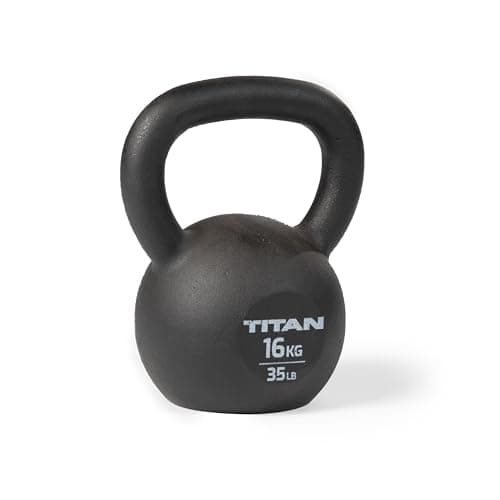
Titan Fitness Cast Iron Kettlebell (16 kg / 35 lb)
Titan Fitness
A one-piece cast iron bell in powder-coated black, machined to a flat base that sits still for push-ups and storage, with a wide 7.75 in handle loop on a 33 mm bar and the weight debossed in both kg and lb.
Best for
A single 16 kg bell for two-handed swings, where the handle window has to fit two hands
Pros
- Powder-coated black and textured, so it holds chalk instead of chipping the way paint does
- Single-piece casting with no seam at the handle join — the place cheap bells raise a blister
- Debossed kg and lb markings on a 10 in bell with a 4 in base, so a shared rack never gets confusing
Cons
- Priced above a painted cast iron bell of the same weight
- Sold individually, so anything needing a matched pair — a farmers carry — means buying two
Key specs
- Sizes
- S 5–25 lb · M 25–75 lb · L 50–125 lb · XL 125–200 lb
- Handles
- 7 rubber handles
- Fill
- Inner filler bags included; sand is not
Scores · editorial, out of 10
- Handles & grip positions (what it lets you lift)
- 9
- Filling & leak control (sourcing sand, inner bags, seal)
- 7
- Weight range & adjustability
- 9
- Shell durability & warranty
- 6
- Value
- 10
Pick 3 · Training sandbags
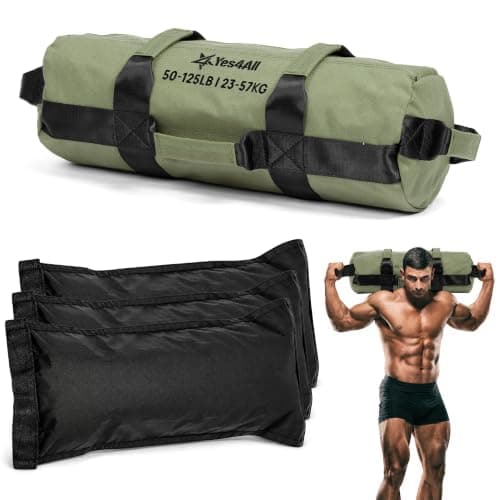
Yes4All Workout Sandbag (S–XL, 5–200 lb)
Yes4All
1000D high-strength nylon, seven rubber handles and four capacities spanning 5 to 200 lb, at a fraction of the GORUCK's price — the sandbag most people should actually buy first.
Best for
A first sandbag, and the widest weight range for the money
Pros
- Four sizes from 5 to 200 lb — the broadest range here, and the only one that starts light enough for a nervous beginner
- Seven rubber handles cover the grips that matter: top, side and end
- 1000D nylon with box stitching, double-fold edges and a double-enclosure hook-and-loop closure, at a budget price
Cons
- No published warranty, which is the clearest single difference between this and the GORUCK
- Sand is not included, and the L and XL sizes need a lot of it
- An Amazon-first brand with no maker's storefront checkout, so price and stock move around more than the others
Specs from Yes4All — Sandbags for Working Out listing (1000D nylon, 7 rubber handles, 5–200 lb sizes, inner bags).
Key specs
- Weight
- 60 lb fixed
- Size
- 28 × 13 in.
- Closure
- Triple locking velcro, double-pass stitched seams
Scores · editorial, out of 10
- Handles & grip positions (what it lets you lift)
- 10
- Filling & leak control (sourcing sand, inner bags, seal)
- 8
- Weight range & adjustability
- 7
- Shell durability & warranty
- 10
- Value
- 7
Pick 4 · Training sandbags
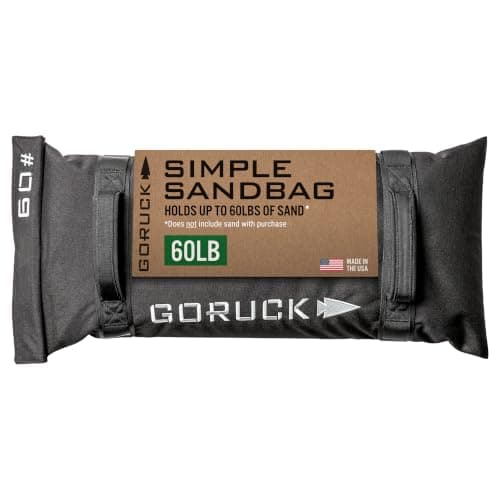
GORUCK Simple Sandbag (60 lb)
GORUCK
A single fixed 60 lb bag, 28 in. long by 13 in. wide, in military-grade fabric with triple-stitched seams, a triple-locking velcro closure and box-stitched padded handles — built for cleans and carries, not for adjusting.
Best for
One heavy bag that will outlast the rest of the gym
Pros
- Padded, reinforced, box-stitched handles — the part that fails first on cheap bags
- Military-grade shell with triple-stitched seams; a manufacturer warranty is listed
- Fixed weight means nothing to fill, measure or re-seal
Cons
- 60 lb only — there is no scaling down for a lighter session
- Costs about the same as an adjustable bag that covers a weight range
Specs from GORUCK — Simple Sandbag 60LB listing (weight, dimensions, closure, handles).
FAQ
Questions readers ask
Is a sandbag as good as a kettlebell?
For carrying strength, grip and trunk stability, it is better. For ballistic work, overhead pressing and anything requiring a predictable load path — swings, cleans, snatches, get-ups — the kettlebell is clearly better, because a shifting centre of mass makes those movements imprecise. They train different things rather than the same thing at different quality.
Can you do kettlebell swings with a sandbag?
You can swing a bag, and it is a reasonable conditioning exercise, but it is not the same movement. The value of a kettlebell swing comes from a predictable arc that lets you drive the hips hard into a known load. A bag that reshapes itself mid-swing turns that into a general effort rather than a precise one.
Which is better for a small apartment, a kettlebell or a sandbag?
A sandbag, mainly because of noise. There is nothing hard to chip a floor and a dropped bag thuds rather than bangs. A kettlebell can be made to work with a vinyl coating and a thick mat, but it starts as the loudest object in the room. The bag also folds flat when empty, which a bell never does.
Do sandbags come with sand?
Usually not. Most training bags ship as a shell with empty inner filler bags, and you buy builder's or play sand separately and fill them yourself. Pre-filled bags with sealed neoprene inserts exist and avoid the mess entirely, at several times the price.
What weight sandbag or kettlebell should a beginner buy?
For a bell, 35 lb (16 kg) suits most men and 18 to 26 lb (8 to 12 kg) suits most women as a first purchase. For a bag, start at 40 to 50 lb filled, because a bag is harder to lift than the same weight with a handle. The advantage of a bag is that you can start light and add sand as you go.
Related
Keep reading
- Kettlebell vs dumbbell
The other first-purchase comparison, and the more common one.
- Best sandbags for training
If the bag won: sizes, handles and which ones ship pre-filled.
- Best kettlebells for beginners
If the bell won: which weight and finish to start with.
- Kettlebells in an apartment
Making bells work upstairs, which is the main case against them.
Sources
- —Yes4All — Solid Cast Iron Kettlebell listing (5-80 lb in 5 lb steps, ~1.25 in. handle, flat base) · amazon.com
- —Titan Fitness — 16 KG Cast Iron Kettlebell listing (16 kg / 35 lb, one-piece casting, powder-coated black, 7.75 in wide handle loop) · amazon.com
- —Yes4All — Sandbags for Working Out listing (1000D nylon, 7 rubber handles, S-XL sizes spanning 5-200 lb, inner filler bags included, sand not included) · amazon.com
- —GORUCK — Simple Sandbag 60LB listing (fixed 60 lb, 28 x 13 in., triple-locking velcro closure, box-stitched padded handles) · amazon.com